


Mr Punter
-
Posts
8581 -
Joined
-
Last visited
-
Days Won
27
Everything posted by Mr Punter
-
Dipping a toe into MVHR
Mr Punter replied to Moonshine's topic in Mechanical Ventilation with Heat Recovery (MVHR)
Here is the one they designed: The top floor had skeilings so the vents could not go in the corners. Timber frame designer unhelpfully put a strongback where it got in the way. This used 125mm rigid duct. I think the flexi stuff with the manifold boxes would be easier to do.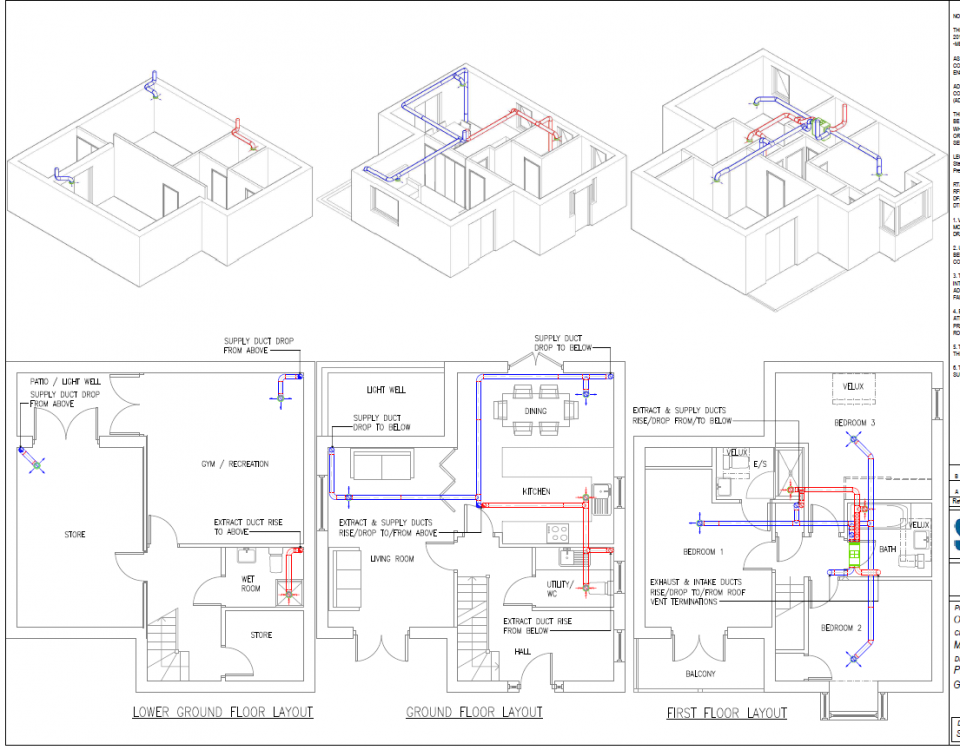
-
Dipping a toe into MVHR
Mr Punter replied to Moonshine's topic in Mechanical Ventilation with Heat Recovery (MVHR)
I once sited a Vent Axia Sentinel Kinetic Plus in a small loft as per the specialist design. You needed to be a contortionist to clean the filters and I doubt the current owners will have ever done so. -
LVT flooring is only a couple of mm thick. Just lay it under the dishwasher, sink, washing machine and leave the other bits as bare ply. I like to mastic round like a dam so if anything leaks it will appear from under the plinth.
-
Like something out of Mad Max. Not sure I would lift a pack of blocks like in the last pic without a change of underwear nearby. Let us know how fast you can drive it!
-
Agree with @PeterW about the shower. We have one that is 1800 x 700 and it is a bit cramped. Can you have the sink and WC on the same wall?
-
Room dims might help. Can you add them to the drawing, or will that spoil it?
-
You would need to do all the ducting and room terminals plus electrics and condense drain but you could leave buying the unit until later.
-
If there is a screen or panel to the shower don't go less than 600mm. Is there a WC in the far corner? If this is an en-suite maybe used in darkness the layout may need a rethink.
-
I've got a backdoor bender : help me mend it please.
Mr Punter replied to ToughButterCup's topic in Doors & Door Frames
Cut a piece of OSB bigger than the infill and screw it to the face. It lasts a surprisingly long time. -
Three on the inner course seems excessive, especially with the cladding. I think you can send the drawings to Visqueen and see what they suggest (normally fairly OTT though).
-
Hi @Alan and welcome. Before your architect does their detail drawings, make 100% sure that your warranty provider and building control are happy with an ICF basement.
-
I have had some fantastic sound test results on timber frame party walls. Even the standard Robust Detail gives fairly good results.
-
Grade II Listed cottage with leaky wall
Mr Punter replied to greyknight's topic in Introduce Yourself
If it is just that wall, would it be out of the question to clad it? Could use oak, clay tiles or natural slate? -
Can you not have a window mounted fan, as the window can be set into the wall a little. If the window is inward opening you could access the fan for servicing or replacement.
-
External electric and gas meter boxes in single skin walls
Mr Punter replied to Moonshine's topic in Electrics - Other
Build the wall in 140mm blocks. They are better if you need to cut deep chases as well. -
If the site is within the settlement boundary and house prices in the area are over £3500 per m2 it may be worth demolishing the existing buildings and gaining consent for, say, four new houses.
-
Bear in mind that plywood is often 1220 x 2440. If you can get it metric sized it will save a trim-up.
-
I have seen this happen a fair bit in France. Much better results than trying to fix something which is inherently defective.
-
It is really difficult to get it to fit as sometimes the studs are a bit thin or the boards are thick. Use 130mm or you will struggle to get the plasterboard on.
-
Making this a u shape means you have a very high external wall to floor ratio so no chance of it being very energy efficient. It also complicates the roof design.
-
Check with your warranty provider and building inspector for the required spec. Flat roofs are a big source of claims. There is no standard covering for flat roof. Can be felt, single ply (lots of types), liquid, fibreglass or GRP. It may be easiest to have thin deck on your joists, then firrings to fall direct to outlets (no box gutter), thin deck and insulation then deck to take the waterproofing.
-
Open plan conundrum! Real life input required
Mr Punter replied to SuperJohnG's topic in New House & Self Build Design
Will smoke from the BBQ not blow into the house? -
Dormers - cost vs benefit
Mr Punter replied to SuperJohnG's topic in Lofts, Dormers & Loft Conversions
Perhaps look at reducing the number of dormers and increase their size. The one that cuts through the floor zone looks a bit odd. Could you add windows to the gable ends? -
If you have a parapet all round you must have 2 outlets. Why not scrap the box gutter and just direct the roof fall to the outlets? What is the proposed roof waterproofing?
-
Can youpost a site plan showing the road and neighbouring properties?



