


Mr Punter
-
Posts
8581 -
Joined
-
Last visited
-
Days Won
27
Everything posted by Mr Punter
-
Crushed concrete is probably the cheapest way to make up the levels. It needs to be spread in layers and very well compacted.. You could put a 100mm layer of type 1 on this an it will wack down nice and flat. EPS is fine as insulation, then concrete on top. Did you consider doing a passive slab, which is a reinforced concrete raft sitting on insulation?
-
What a fantastic project! How do you plan to build it? It looks quite tricky and expensive.
-
The Icon 15 is fine for WCs and for bathrooms where the duct run is short. For longer runs, the mixed flow Icon 30 is better.
-
The pir in the walls was a good call. Any fall on the roof? Could you do a shallow apex? Do you have proper drainage for the WC? Commendable if you do!
-
I have done this using two iCON 30 mixed flow fans. They have an iris to prevent backdrafts so you don't get air from the other bathroom.
-
Aluminium Window Cill (sill) covers : supplier
Mr Punter replied to ToughButterCup's topic in Windows & Glazing
I have used Finish Architectural a few times and found them to be good.- 16 replies
-
- 1
-

-
- aluminium
- window cill
- (and 2 more)
-
If it is the whole width of the house I would say it could not be done without a very large downstand which would restrict headroom indoors. Epic steel and supporting structure needed.
-
Brick cleaning, when it is optimum time post laying?
Mr Punter replied to epsilonGreedy's topic in Brick & Block
The blues are not too bad to clean. I have had some covered in concrete from a floor and they cleaned up OK over a year later. -
They are only rooflights and not installed in the side elevations so should be fine. If you cannot overlook neighbouring gardens from them - they look too far up to do so - you will be OK.
-
As a rule I find a 50:50 split between living areas and bedroom areas works well, so unless there is an integral garage at the front I don't see the point in having the setback 1st floor at the back. The garden room and kitchen will get so hot they will be almost unusable for a fair amount of time. You should design this out now instead of trying to mitigate it after it has been built. As others have mentioned the folding doors can really get in the way.
-
The new roof and dormers look great. I like the bonnet tiles and the verges look neat. It looks like it was designed with the extra floor rather than just lashed on. Another pic when the scaffold is down would be good.
-
Basement floor options and integrated garage access
Mr Punter replied to Moonshine's topic in New House & Self Build Design
I can see your thinking. It is a bit awkward having the door swing over the steps but as long as BC are OK with it, you are the only person needing to use it and it is def the simplest. -
Basement floor options and integrated garage access
Mr Punter replied to Moonshine's topic in New House & Self Build Design
I know it would take space but I would prefer a quarter landing in the hall and 2 steps. For the door use an external front door with all the correct security as other wise it is a weak point.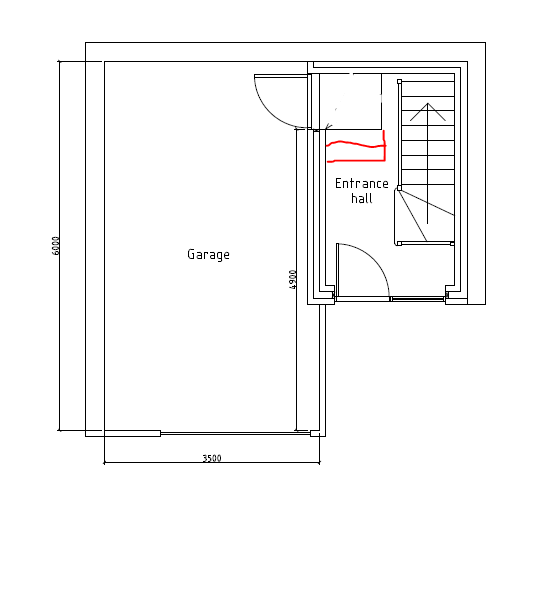
-
Can anyone tell me what are these pipes used for?
Mr Punter replied to BricksP's topic in Building Materials
I googled the rigid stuff and it is mostly used for highways drainage surface and stormwater. -
The connections don't feel too fragile, but I leave a fair bit of slack behind the plasterboard so i could remove and refit a cable if I had to.
-
I have used these patch panels flush mounted into plasterboard wall: https://www.amazon.co.uk/gp/product/B003SSX1Q6/ You need a punch down tool to fit the cables and you need to cut the plasterboard carefully.
-
I think the solid stuff is terminated in the punch down patch panels and face plates. It is for the fixed wiring in the walls. The stranded is more flexible and is for patch leads with crimped connectors.
-
Mine was glued. It has not scratched.
-
We have LVT in bathrooms and shower rooms. Warmer and more comfortable than tiles, easy to clean and looks excellent.
-
Paving unexpected additional cost
Mr Punter replied to ultramods's topic in General Self Build & DIY Discussion
The costs to distribute the hardcore should be similar as he already had the machine and driver, so it is extra material. Do you know the square area? Ask him for invoices for the hardcore. -
WiFi Speakers Not Wired for Sound
Mr Punter replied to Ferdinand's topic in General Self Build & DIY Discussion
I think my stuff is about 6 years old. Sonos are a bunch of crooks and I would never buy their products again. I hope their crappy business fails horribly. -
WiFi Speakers Not Wired for Sound
Mr Punter replied to Ferdinand's topic in General Self Build & DIY Discussion
I just got an email from Sonos to say that from May a couple of my products will be classed as "legacy" and I can either "Trade Up" with a 30% discount or get no further support. Apparently when you trade up they brick the old device. Cheeky American rip-off b*******s! Previous hi-fi lasted 25 years. -
Making our own window cills (sills)
Mr Punter replied to ToughButterCup's topic in Windows & Glazing
CT1 is fine as an adhesive / sealant but it is pretty awful as an exposed finish as it is very difficult to tool. You could have it under the render / plasterboard no probs. -
No the land is not part of the build cost.
-
Making our own window cills (sills)
Mr Punter replied to ToughButterCup's topic in Windows & Glazing
I think they would be good with a splayed reveal internally and externally, covering up at least half the frame.

