

ProDave
-
Posts
30861 -
Joined
-
Last visited
-
Days Won
427
Everything posted by ProDave
-
Go on, you know you really want to buy one to own.....
-
Back of fag packet maths. If a vacant plot is "worth" the same £2K rates valuation, then 26 vacant plots = a rateable value of £52K Split the vacant plots between 4 owners, so 6, 6, 7 and 7 per owner = below the threshold and all owners can claim a 100% rebate. More "money for old rope" grabbing by our lovely Scottish government
-
I can't see the difference. You argued you don't know exactly where it is going, that argument is more true for ducting. Just bury a length of 6mm SWA cable and leave the end coiled up near where you thing it will end up.
-
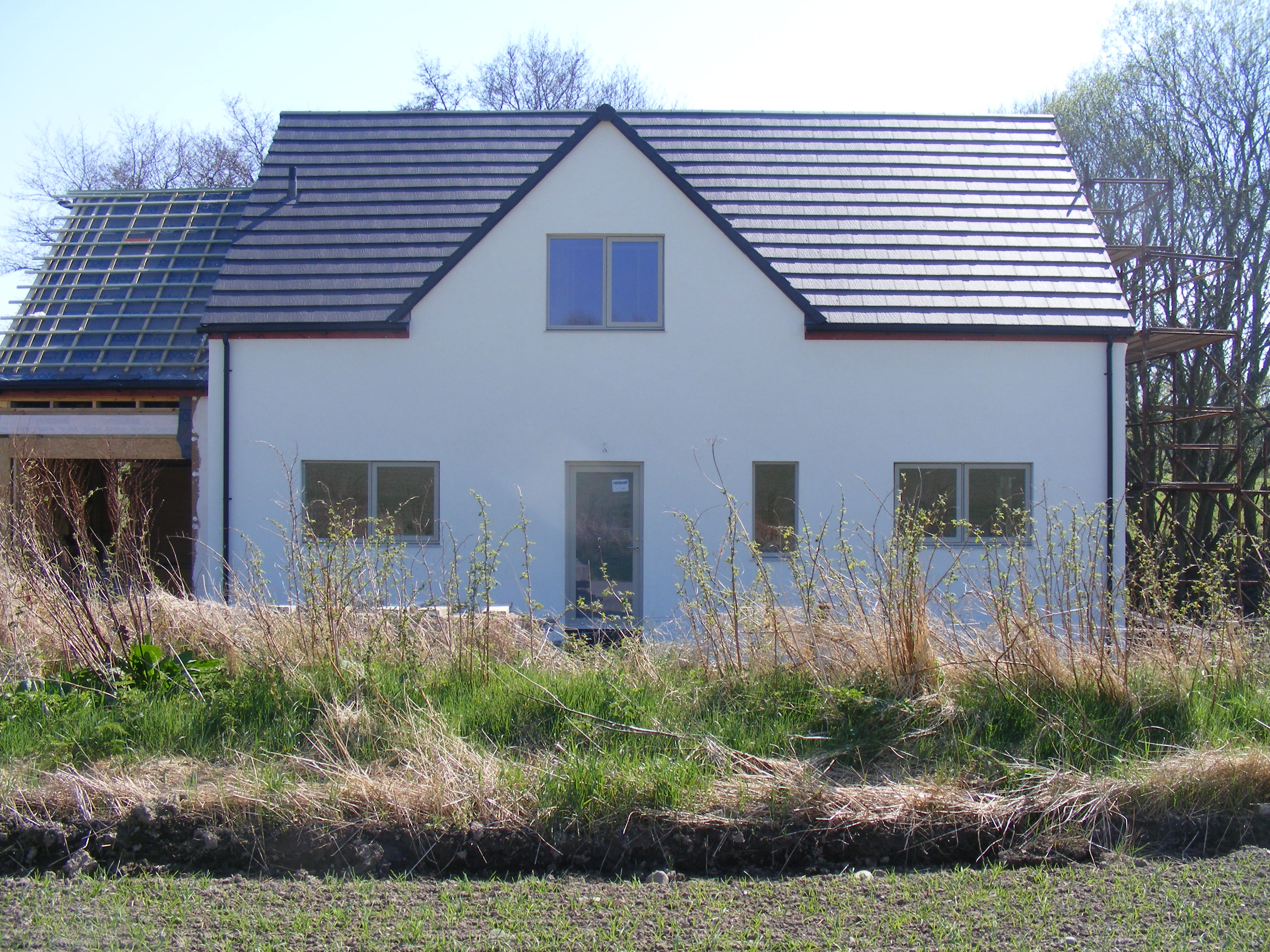
Re ridge tiles. I uses the dry ridge system that comes as a roll of stuff and some plastic brackets. Tile one side, then as you tile the other, roll out a bit more and fit ridge tiles as you go, so you can do that as well without standing n any finished roof.
-
A few tips I used Marley Edgemere which is a flat interlocking concrete tile. I had the one with a "riven" finish being the only one that looked slightly like slate so the planners would allow it. I carried them up in batches with help from swmbo. I reckon by time I had done the roof, I had climbed the equivalent of 2 Munro's up and down the ladder. My knees knew it. Do your roof the "Scottish way" and fit solid sarking board (OSB or ply) before the membrane, then you won't have to worry where you stand. I used Protect VP400 plus non tenting membrane. You need nails at the top, and clips at the bottom for most interlocking tiles. Start bottom right and work up and left and you can do the whole roof without having to stand on any tiles you have already laid. This assumes the gable end is scaffolded so you can work from the scaffold to complete the run. I used a wet diamond tile cutter, intended for cutting ceramic tiles but it did a good job of cutting concrete roof tiles. If there is an area you might want to remove, then don't nail that bit, screw them instead so they are easier to remove some tiles. The purists will say you should load a roof evenly, but I just tiled one side then the other and had no problems.
-
Bend the blade to compensate
-
Is the shaft really bent? Does it run at all? what's the symptoms. A previous mower I had, hit a bit of a stump. What happened was the motor stopped dead, but the inertia kept the flywheel going and it sheered the key that held the flywheel to the top of the shaft. One new key and it ran again and went on for years until the deck rested away. Our own mower packed up a few weeks ago, so SWMBO went into town with the objective to come back with the cheapest petrol mower she could find and came back with a "Challenge" Good points it's got a plastic deck so it won't rust but I suspect it will find some other way to fall apart instead. Bad points it's a bit small at 42cm cut and the grass box is a bit small.
-

Bath Surround / Boxing In, and concealed pipework
ProDave replied to Onoff's topic in Bathrooms, Ensuites & Wetrooms
Thank you. I thought my build was going slow, but I have built my entire house in that time!!!!!1 -
I would stop the decking short of the grass, and put a strip of paving slabs or a soldier course of paving bricks to form the transition from deck to lawn.
-
MVHR unit poorly installed options?
ProDave replied to tomds's topic in Mechanical Ventilation with Heat Recovery (MVHR)
With that set up, I would expect the extract runs from bathrooms to be full of water from condensation by now. -
Low profile concealed shower valve
ProDave replied to Crofter's topic in Bathrooms, Ensuites & Wetrooms
Plan your drain runs in the main to run parallel with and between the joists. You can cut through the web of a JJI but you probably need to add a plywood gusset plate glued and screwed each side. Shower former sits straight on joists, you will need to add some strengthenig webs flush with the top pf the joists to properly support the former. Floor boards on top of joists up to former. This is exactly what I am doing except I have posi joists I can't see the drain issue being any different between a wet room former and a standard shower tray, unless you were planning to put the tray up on legs? -
Low profile concealed shower valve
ProDave replied to Crofter's topic in Bathrooms, Ensuites & Wetrooms
If suspended timber floor is the reason for not having a wet room, then nobody would have one upstairs, including me. -
Low profile concealed shower valve
ProDave replied to Crofter's topic in Bathrooms, Ensuites & Wetrooms
I doubt you will find anything 25mm deep, but something like this http://www.screwfix.com/p/aqualisa-aquavalve-609-built-in-riser-rail-thermostatic-mixer-shower-chrome/32030#product_additional_details_container reqires 60mm from the face of the tiles. Why not batten just this wall in 50mm battens? I doubt you will notice the room shrinking by 25mm? It will make running pipe easier as well (all walls where I need pipes are battened with 50mm) -
Yes the wood fibre board has a waterproof coating. It can be left exposed for a certain length of time, though not permanently. So a very worst case is replace the wood fibre board and re render if anything did happen. Even most timber frames rely on OSB or ply sheeting for the racking strength, so no different to SIPS if that gets wet and rotten. Most timber frames have te racking layer on the outside, but In my case it's mostly 2 layers of OSB on the inside of the frame structure so less likely to get saturated and rot if there was a leak.
-
I don't know about Core Ten, but cor blimey at the price!!!!! £7.5K per square metre.
-
Alternatively don't put any water in the pipes at all. My plumber friend leak tests pipework by pumping it up with air.
-
Fill UFH pipes with inhibitor / antfreeze Assuming it's insulated under the slab and the walls and roof are insulated I can't see it getting cold enough to freeze anyway. Plenty up here leave the slab over winter with UFH pipes then build the house on the slab in the spring, and it never seems to come to harm.
-
I have to respond to this thread as my house is "stucco" onto the timber frame, well sort of. If I am to believe the doomsayers in this thread then in 20 years there will be a soggy rotten mess behind my "stucco" I sincerely hope not. I am not expecting my render to crack, mainly due to part of the application process being to roll a sheet of fibreglass mesh into the wet render and trowel it in to bind the whole lot together. The poor detail in this instance as far as I could tell was no window cills, and the waterproofing membrane around the windows wrongly detailed so instead of water running off in front of the render with a proper cill and drip bead, it ran behind it and even behind the tyvek. Re wood windows Vs ali clad. Our previous house had wood windows. At 15 years old they are still sound and solid. My only objection to wooden windows is the need to re paint or varnish them regularly, which is why this time I have chosen ali clad. If the owner of that house had maintained the windows, they would have spotted the problems sooner and been able to fix them sooner and easier.
-
Okay, that's that idea shelved. Before I posted this I thought I had found something saying mdpe was okay up to 60 degrees so thought 45 might be okay.
-
There is a way round it. Move to the Highlands. I discharged all my planning conditions by email with the planning officer for no fee, and when completed got an email and letter to say all conditions were met. It's a shame some (most?) councils charge a fee, just because they can.
-
I'm in a "use up left over material" phase at the moment. I have some left over 25mm mdpe water pipe. I am thinking it would nicely do the flow and return from the plant room to the Air Source heat pump. Any reason why not? Would it be happy with the "hot water" mode flow temp of 45 degrees? This would only be for the run from the plant room (above the garage) down through the garage, out and along the wall to the ASHP. It would only be at low pressure fed from a small header tank at the highest point of the plant room. Also thinking as it's slightly flexible, I probably won't need to bother with flexible sections of pipe which I would need if using say copper.
-
I discounted a GSHP purely on the cost of the pipe and antifreeze to go in it, and decided on a much cheaper and easier option, an ASHP. And I had my own digger at the time so I could have laid the ground pipes myself.
-
How do I dispose of ... ?
ProDave replied to Ferdinand's topic in General Self Build & DIY Discussion
That reminds me of the argument my BIL had at the tip. The garden waste skip had a sign saying "1 vehicle, 1 bag" So when he dragged the 1 ton builders bag out of the back of his Landy and proceeded to empty it into the skip the guy came storming over but my BIL stood his ground insisting he did only have 1 bag of garden waste in his vehicle. -
About 6 square metres per room, less if you exclude what's under the bath and under a boxed in cupboard. So are we now saying that tanking kit direct on V5? My head is hurting keeping up with the conflicting ideas.
-
If it makes any difference I have wet UFH under the floor deck. My favourite at the moment is 18mm OSB then 6mm ply, but am concerned at how to glue so it's solid.
