

ProDave
-
Posts
30857 -
Joined
-
Last visited
-
Days Won
427
Everything posted by ProDave
-

Plinth/Skirting - How should this get finished ?
ProDave replied to Spinny's topic in Kitchen Units & Worktops
I would take the skirting round the corner with a nice corner joint. You may need to trim the top of the skirt to fit under the unit and would only work if your skirt was no thicker than the end panel of the unit. -
Personally I would not combine the utility and bathroom run, instead I would have a separate run straight out from the utility room and an extra IC along the top as shown in this plan.
-
I don't believe CIL applies anywhere in Scotland. If it did, it would have been written into your planning permission and you should have got the exemption before you put a spade in the ground. I
-
Should I ditch the installers and DIY my ASHP?
ProDave replied to jimseng's topic in Air Source Heat Pumps (ASHP)
I recon from experience 2 days of electricians time and 2 days of plumbers time to install one on a new build. And I am in the camp that does the sums on that plus materials cost and wonder just how most of the companies that quote get figures as high as they do. If you are going for self install, then look at the other option, some companies will supply the kit for £0 using the grant for you to install. MCS sign off for a heat pump is not mandatory, in fact I struggle to see what that expensive bit of paper will actually do for you. -
What you can do for that circuit is separate over current protection and earth leakage protection. That would tell you why it is tripping (though not stop it) which would make solving the issue easier. And a separate circuit for the freezer would also protect it from something else in the garage tripping it.
-
There have been a few developments around here, all small scale, where a number of plots were sold individually for self build. Yes it can take a while before they are all finished, but generally the results are good. If this link works https://maps.app.goo.gl/S3TDGbpQvWBsd7a59 All the houses to the west of that point were sold as individual plots, I wired one of those as a new build, and another when they extended into the loft. These are the detached houses around a green. The houses to the east of that point were all built by a developer. Guess which end of the street I would prefer to live.
-
Availability of sensible priced plots and then the extra cost of a custom build compared to a standard box, is what limits the number of self builds. If only government were to mandate that the mass market house builders who buy up most of the building land in large blocks, must sell a certain percentage of their plots for self build, at the same per house cost as the whole site cost them.
-
Passiv house costs.
ProDave replied to Oz07's topic in Energy Efficient & Sustainable Design Concepts
Re the garage door. I just fitted a standard FD 30, and then added an extra bead around the door frame and extra draught proof seal around that in addition to the intumescent seal (which is not an airtight seal) The garage door was the one removed for the air test blower door so did not figure in the air tight test results. -
Before you get too carried away, I quietened our Conder simply by placing a standard 100mm concrete block in the chamber so the pump sits on that now, not the plastic that it used to sit on. Still not silent but a LOT quieter.
-
Help me identify this pipe and fitting please.
ProDave replied to ProDave's topic in General Plumbing
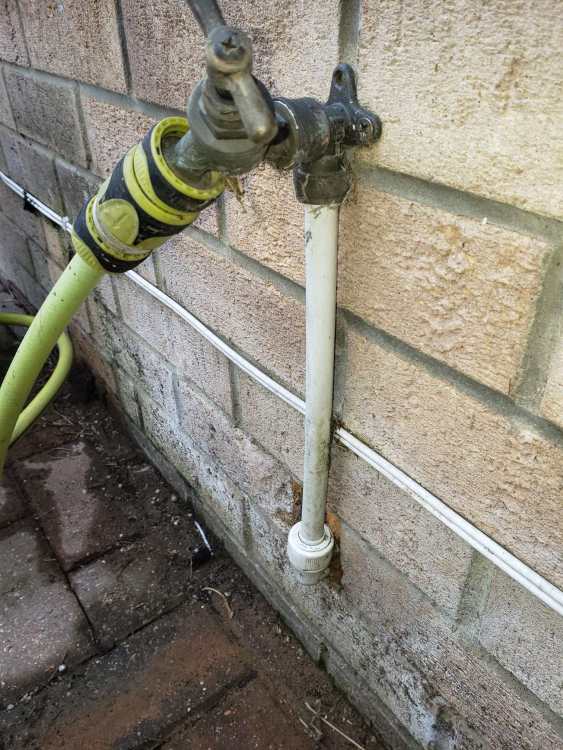
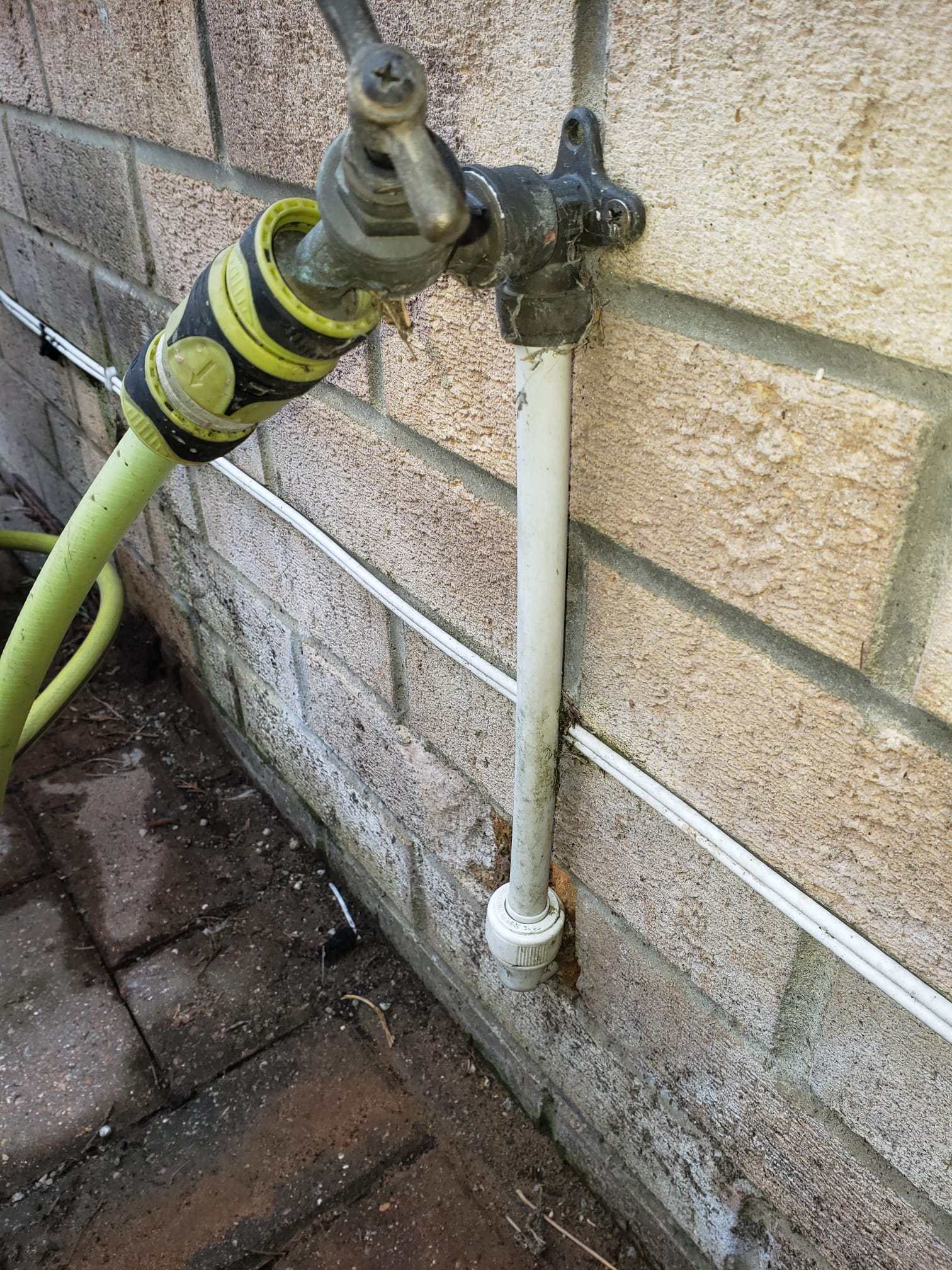
We have delved further into this. Did I mention this extension was build by Bodgit and Scarper (very) Limited. I could not repeat a single word said of them on this forum. As far as I can tell the whole extension is plumbed with this type of pipe and fittings. Delving deeper. That elbow disappears through the wall, half of it foamed in part buried in the wall. Looking inside it gets worse. It comes out in a small boxed in section behind the downstairs wc. Looking into that the whole lot of the boxed in section is filled with expanding foam. If there is an isolator, it would be very hard to reach and would need the expanding foam digging out. Best to assume no isolator for that outside tap. B&S Ltd living up to their reputation. Having discussed all this with the home owner I think we have decided this is a can of worms that is not worth opening. Will get some pipe insulation for that exposed length of pipe. -
I have been tasked by a relative to raise this outside tap to a sensible height (accessible by a wheelchair user) It is connected using some plastic (looking) 15mm pipe. The elbow fitting at the bottom is this The lettering on the top of the fitting reads BS7291/2 2006 Class S PB Q'FIT 15mm The top of the plastic pipe appears to go into a normal 15mm compression fitting with a normal brass nut. I am away from home at the moment, passing through here on my way to other places. My task, on the return trip is to extend this pipe to raise the fitting to a better height. That can either be replace the existing pipe with a new longer length, or leave that alone and couple a new length on with a straight coupler. I am not familliar with these fittings don'd know how to uncouple the pipe from the fitting and if they are even re usable. P.S this is not how I would have done an outside tap and if you mention the builder / plumber that did this the air turns blue with expletives.
.thumb.jpeg.3f0d8aaa9039901eb3ec71717d86a359.jpeg)
-
Starlink loose end on wire.
ProDave replied to saveasteading's topic in Networks, AV, Security & Automation
I guess if you wanted to try it, fit a Cat 5 / 6 plug assuming standard colours. If it doesn't work buy a new cable, deny all knowledge and report a fault (and this thread can be made to vanish) -
How much can you pack standard staircase dimensions?
ProDave replied to Lears's topic in General Self Build & DIY Discussion
Buying a "standard" staircase of fixed rise always struck me as odd. Unless you are VERY lucky it would never work, unless you design your floor levels around the staircase. As above stairbox etc will get what you actually want, made to fit. -
Starlink loose end on wire.
ProDave replied to saveasteading's topic in Networks, AV, Security & Automation
Which is why replace complete cable is best answer. -
Starlink loose end on wire.
ProDave replied to saveasteading's topic in Networks, AV, Security & Automation
Get a new cable fitted and make the offender pay for it. P.S. What is the house being clad with? the aerial bracket seems to have been fitted before the cladding? Are you really going to clad around that? -
I have said before, my preference for wiring a room is a cable all the way round at socket height. That makes it easy to add any extras any time in the future. There must be at least one socket on each wall of the room to create the safe zone.
-
Starlink loose end on wire.
ProDave replied to saveasteading's topic in Networks, AV, Security & Automation
Now it is stripped it does look like standard colours so you should be able to crimp a plug on and try it. -
The beauty of timber frame with a service void. You could make it 4 doubles if you wanted, 2 in each section of wall. Just make sure he know how many before he cuts the holes in the plasterboard.
-
Locks - key only or key & turn cylinder?
ProDave replied to JohnBishop's topic in Doors & Door Frames
That would not be my choice -
Starlink loose end on wire.
ProDave replied to saveasteading's topic in Networks, AV, Security & Automation
True, but I read this as being near the end as he just wanted to fit a Cat 5/6 plug and plug it in? @saveasteading More information needed -
Starlink loose end on wire.
ProDave replied to saveasteading's topic in Networks, AV, Security & Automation
So not a standard cable. So you need to work out what colour goes where. Do you have access to the good end of the cable, you could work it out from there with a bit of testing, or keep searching and see if someone has already worked it out and published it. -
The ironmongery can all be removed and the sash taken out of the frame. My concern is because the window was not intended to be left bare wood, the joinery may not be as good, e,g joints in the wood are fine if painted, but perhaps not if just left bare or varnished? There was a long period (not sure if ongoing?) where Rationel stopped offering natural wood as a finish. IIRC they are painted all round even the bit hidden against the wall when fitted, so perhaps strip one of those edges to see the underlying timber and see if the paint comes off cleanly enough and the joinery revealed is good enough.
-
Starlink loose end on wire.
ProDave replied to saveasteading's topic in Networks, AV, Security & Automation
Can you strip that cable back a bit so we can see the cores properly? From the little I can see that does not look to be the standard colours for a cat 5/6 cable. If it is a non standard termination I hope you still have the plug that was cut off to see how it was terminated. -
Locks - key only or key & turn cylinder?
ProDave replied to JohnBishop's topic in Doors & Door Frames
How did you get in without unlocking a door from the outside all that time? Locking yourself out by mistake surely ended with the demise of the Yale night latch. You can't slam lock a euro cylinder lock by mistake, you have to lock it with a key once shut, from inside or out. All my locks, having been locked from inside can be unlocked by key from outside. The exception is the sliding door on our sun room. It does not have a thumb lock inside. If you lock it from the inside and LEAVE THE KEY IN THE LOCK you can't open it from the outside. So I guess that is your issue if the key is in the lock inside you can't get in. But I still want to know how you get out of the house to be in that situation with all doors? -
I still have 2 or 3 hand drills, not used one for a very long time. Sitting under my bench collecting dust is my dad's old hand cranked bench pillar drill. Choise of 2 gearing rations depending on the size of hole you were drilling, and a mechanism that each rotation of the hand wheel, advances another wheel one notch that slowly winds the drill downwards. I can't imagine ever using it, and don't want to send it for scrap which is probably what will happen to it when I am gone. I also doubt it is worth anything., It's like this one https://www.ebay.co.uk/itm/298358926466?

.jpeg.9a72762ea59af924bac6041dcc724861.jpeg)