
ProDave
-
Posts
30861 -
Joined
-
Last visited
-
Days Won
427
Everything posted by ProDave
-
Safe Zone for wiring on vaulted walls.
ProDave replied to MikeSharp01's topic in Regulations, Training & Qualifications
I have always assumed B if there is no conventional ceiling. -
Another one agreeing this is their problem. They have not supplied what you ordered. I think I am one of many on here that had no problems with Rationel (other than one window cill that got damaged in transit and they replaced promptly) so am happy to recommend them.
-
Are they 240V or 208V (208 is Japan I believe) 60Hz will not be a problem for the heating element, but if it uses the mains frequency as a reference for the clock, then that will run 20% too slow making it useless. If it's 208V that won't work off 240V. I had a water pump with a 208V motor. I managed to rig up an autotransformer to run it okay, but trying it on 240V direct it got very hot and bothered very quickly.
-
Someone interviewed on the news said "too little too late" FFS what did they expect the council to do? anticipate the fire and have a stock of replacement flats ready sitting empty? It was just lucky these are available now to re house some of those affected.
-
A very big autotransformer, and a load of USA Sockets. If you want it to be authentic, some blank & white cored cable. This is how USAF houses used to be wired in the UK (probably still are)
-
Reducing The Potential for Error
ProDave replied to ToughButterCup's topic in Project & Site Management
^^ Rationel supply their doors with a packer under them, which you have to remove if you want it to be Part M (or Scottish equivalent) compliant. -
Air blower treatment plants - power consumption.
ProDave replied to ProDave's topic in Waste & Sewerage
No it's consuming exactly what it should, 2KWh per day, see the above test with nothing else on. the measured current is greater than expected but it must be running at a lousy power factor, and the meter does a good job of measuring KWh not KVA/h I anticipate later on halving that by putting the blower on a timer, but no time for little projects like that just now. I can report the discharge from the plant now it's been in proper use for a few months is an odourless colourless liquid. -
Socket and switch holes in plaster work
ProDave replied to Jimbouk's topic in Plastering & Rendering
Don't forget to allow for finished floor level if final floor has not yet been laid. -
Socket and switch holes in plaster work
ProDave replied to Jimbouk's topic in Plastering & Rendering
Make sure they know the building regs min and max heights. -
Graf waste water treatment plant, any thoughts?
ProDave replied to joe90's topic in General Self Build & DIY Discussion
If you have a high water table you definitely want to concrete all or part as the manufacurer recommends. Otherwise you risk it floating out of the ground when you empty it. -
Cashflow only becomes an issue for me if a job takes a long time, and I have to settle the bill for materials before I have been paid for the job, and that means usually by the end of the month following the one I bought the materials in.
-
My concern is a 70cm wide shower is tiny. If you re going to keep it that side, swap the shower and loo over, so the loo is in the narrow bit by the window, and the shower can be where the loo is shown, with the room from door stepped outwards. We had the same in the last house and that "limited" us to a 1200mm shower. Agree loo in main bathroom adjoining the bedroom will be an annoyance.
-
That en-suite is too squashed. Could it go the other side of the room. where you have "storage" taking in also the cupboard off the landing (which is where I would put the shower. Then the WC can go towards the left with the room stepping in if necessary or not going all the way to the windows so avoiding that constraint. Have your "storage" instead where the en-suite is presently shown.
-
Socket and switch holes in plaster work
ProDave replied to Jimbouk's topic in Plastering & Rendering
I don't see what advantage that gives you over a plasterboard box? (yes I know some hate PB boxes) It seems to have a flaw that the bit that screws to the stud sticks proud of the stud by a few mm. That will create a bump in the plasterboard that some will notice. What fixes the "free" end in their picture? it would appear, nothing. It also ties you to positioning the accessories a certain fixed distance from the studs, no chance to make them line up with other stuff as you may wish. Not for me.- 25 replies
-
- 1
-

-
- swtich hole
- electric
- (and 2 more)
-
When we had our summer (about a month ago, all 3 days of it) the house remained comfortably cool inside. I would love some thermal gain right now.
-
I was aiming for the same sort of overall thickness of wall as a "normal" timber frame. I had already concluded that leaving a 50mm cavity then 100mm blockwork was a very expensive rain screen that adds very little to the insulation as that cavity has to be so well vented so is open to cold air. So my designer came up with the established wood fibre and render cladding system, and a thicker frame to fit more insulation. Overall U values allowing for the cold bridging of the frame 0.14 This document shows how to use wood fibre cladding with either timber or render finish http://www.greenspec.co.uk/downloads/?filename=pavaclad1.pdf I was originally going to use a form of blown in insulation, but changed to using the frametherm when I found it was half the price, gave the same U value, and was a DIY job. Because of the frame make up with the OSB racking layer on the inside (lots of people tried telling me I had put the fame up inside out) the frametherm insulation went in from the outside as I clad the walls in the wood fibre board, doing one wall at a time and getting it rendered before moving on.
-
Its a "timber framed" type of construction but using steel for the wall frames. There are diagonal bracing members so they are not relying on the cladding for racking strength. I doubt it's going to be directly rendered as they are wrapping it in Tyvek.
-
Socket and switch holes in plaster work
ProDave replied to Jimbouk's topic in Plastering & Rendering
My normal protocol is the boarders can cut a rectangular hole for the box, BUT they become responsible if they cut it in the wrong place. Usually the boarders just drill a hole and poke the cables through, at least that way all positions are identified. In spite of telling them the height to drill said hole, it is surprising how many times when I go back to cut the rectangular holes for the boxes, the "temporary" hole is left above or below the proper box position. The boarders never care, their answer is "The taper will sort it" Same when they bruise a board through lack of care. Last time I had an "open ring main" the missing box turned out to be behind a radiator who's position had moved after first fix and nobody thought it would matter. -
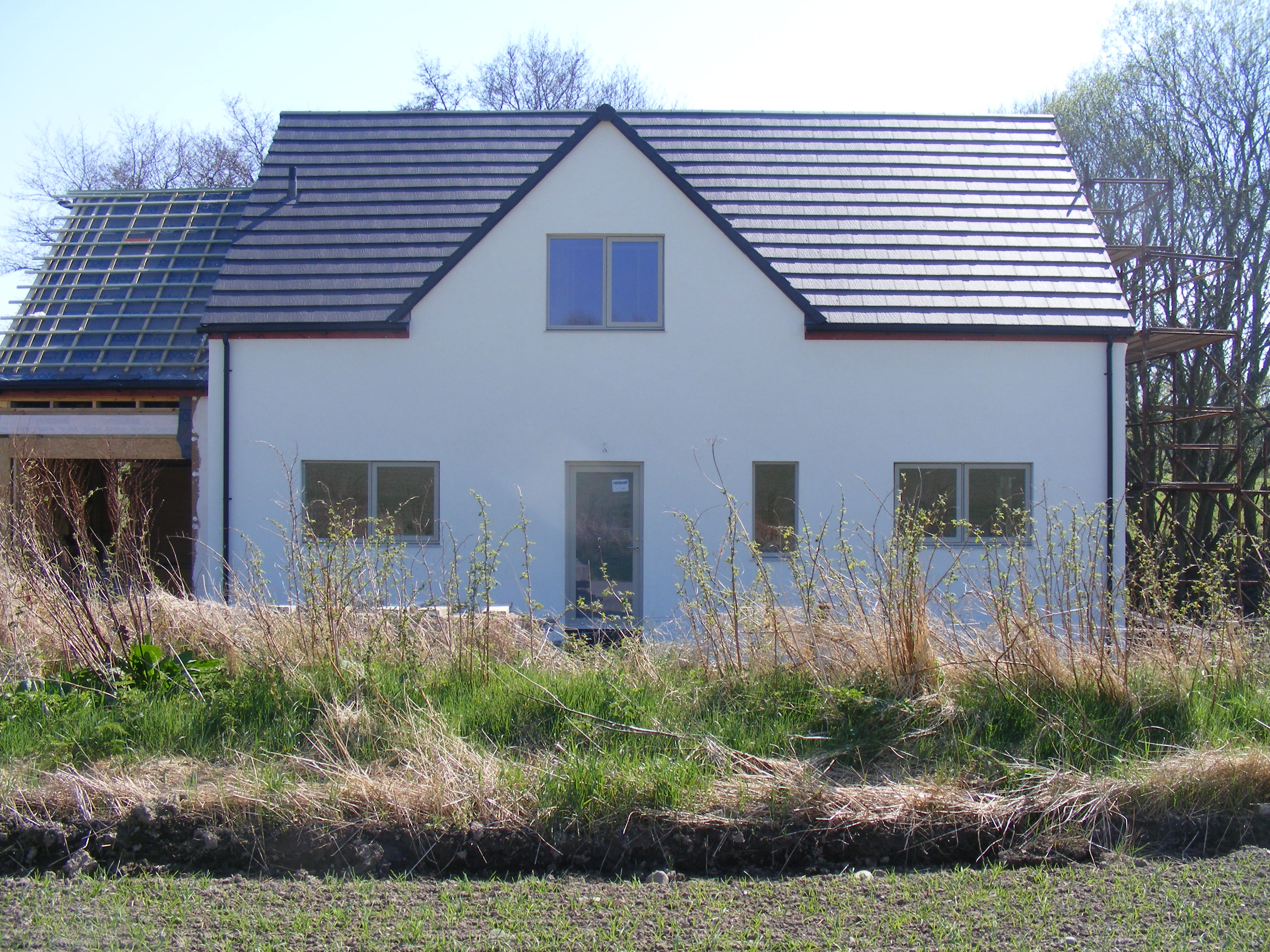
Our build is 195mm studs with 100mm wood fibre board then render on the outside. What external finish are you planning to have? You definitely can build a frame out of I beams, a friend is building just like that near me using JJI I beams. I would have thought any builders merchant could supply them but you will need a structural engineer to sign off the design. For insulation between the frame members I recommend Knauf Frametherm 35. A lot less horrible to handle than most glass wool type insulation and rigid enough to stay put with no slump even when insulating a 45 degree roof.
-
PP for outbuilding - Grade II listed cottage
ProDave replied to Simon's topic in Planning Permission
An appeal needn't cost you anything. I did my planning application for that garage myself, and the appeal myself. The gist of the refusal was the garage was outside the established building line and closer to the road than the house was. There was a very good reason and that was we had an odd shaped plot with only a tiny "back garden" but lots of land to the side. The local planners wanted me to put the garage in the small back garden area (where it might even have been permitted development) but that would leave me little usable garden, so I wanted it to the side to preserve my back garden. The appeal inspector wrote what I thought was a very thorough evaluation of the pro's and con's and concluded that yes it was closer to the road than our house and the neighbours house,. but the other side of the lane was an old cottage fronting directly onto the road without even a footpath. The inspector concluded in light of that, our garage being a bit closer to the road was not out of keeping, and also provided a "beneficial sense of enclosure" to our garden. -
PP for outbuilding - Grade II listed cottage
ProDave replied to Simon's topic in Planning Permission
Some planning officers should not be in the job. When I was in the south I wanted to build a garage, which I described as "built of concrete blocks and rendered" The planning officer said to me "even if it's rendered it will still look like a prefabricated garage" and no amount of discussion could persuade here that it was masonry built of blocks and cement. It was refused, and won on appeal. -
I must call by next time we go south. J33 is where we always pull off for the cheap petrol.
-
The Joy of a Brick Garden Wall
ProDave replied to Ferdinand's topic in Landscaping, Decking & Patios
... And the council need to come and resurface the footpath? -
That sounds like you are considering tench fill? which is where you dig a foundation strip, then fill it all up again with concrete. That is one possible way but as you have found, expensive. A normal strip foundation is dug to the required depth, then 200mm of concrete poured, blockwork built up from that then soil goes back on the outside and hard infill compacted on the inside. The required depth nobody can answer without seeing the land and without a test pit or 2 dug. A previous house we had in Oxfordshire I built a garage with 600mm strip foundations in nice firm ground. Where we are now I had to go more than that just to strip the soft black organic soil before I could then dig the strip foundations which were almost a metre down from that, so 1.5 metres overall.
-
Started in March, Finished in June. No wonder you didn't have time to keep the blog updated. I won't let SWMBO know how quick you built your house...... Looks very smart indeed. Well done.