


Dudda
-
Posts
487 -
Joined
-
Last visited
-
Days Won
1
Everything posted by Dudda
-
You've cellulose though which would help regulate it more. He had Kingspan drylining everywhere. He did have some polished concrete at the entrance and lower level which would help but not up where the heat rises to the living accommodation.
-
It did has a lot of questionable parts in terms of regulations but it was a very nice house. I really did like it and his finishes. It was high spec everywhere. Top range internorm, quadrouple glazed sloped glass, sunamp, top range mist sprinkler, 150mm external insulation and 75mm internal insulation on top of the SIP’s. Would love to know the u-value of the wall. A quick calc by me has it around 0.06 - 0.07 W/m2K. Polished plaster kitchen splashback, polished plaster to both WC’s, Polished concrete floor, the external cladding looked lovely and I really liked how he did the joints and every stainless steel nail was measured and marked before hammering home. What was it? 650w heating demand in winter? It must really suffer from over heating in summer. It would have to in a house that small? I’d love to have the time and money he had. Able to quit my job and go 60% over budjet and still technically not owe the bank a penny as it was from friends and family.
-
If money wasn’t an issue (which is never the case) I’d probably go with the cellulose. To be fair in you’re first option where you’ve Frametherm between the timbers, this is a mineral wool which will be tightly fitted between the joints. It’s also good at sound absorption (not as good as 300mm of cellulose but that’s a lot thicker and more expensive). The PIR that’s put over the wall hasn’t many joints as it’s placed over the whole wall and not cut between all the timbers. The second option of the 0.11 u-value where the PIR is cut between the timbers I’d be more worried about as that’s a lot of cutting with a lot of potential gaps. PIR is getting expensive and has crept up in price a huge amount over the last 12-18 months. A lot of the additional cost in the cellulose option is the additional timber. A compromise could be option one but with 70mm PIR insulation internally instead of 50mm which would reduce you’re u-value slightly while still having a low cost and the advantage of the sound reduction of the mineral wool. PIR doesn’t really do sound reduction like the cellulose or mineral wool. Of course you could always look at using the blue acoustic plasterboard internally on the external walls instead of the standard grey. This would really help with the sound if this is a concern and might be a more cost effective option. Sorry as I’ve kinda increased the options rather than reducing them.
-
I’ve did my first AutoCAD course 23 years ago and used it religiously since and even thought it for a while. Over the last 2-3 years I’ve slowly switched to Revit (made by the came company as AutoCAD). You draw walls, window and door components instead of lines and arcs. When you draw a wall the plan, elevation, section and 3D views all update. It has built in clash detection and is slowly replacing CAD. If your getting drawings done ask can they provide a BIM model rather than line drawings. You can take an unlimited number of view or sheets (drawings) off this model. Believe it or not almost every public funded job in Ireland must be produced in BIM format instead of line. Our office has fully transferred and don’t use CAD now but smaller practices wouldn’t have yet made the full transition. It’s worth doing a quick Google on BIM and Revit before hiring someone to produce drawings.
-
Use the twistfix/helical fixing as that's what they're designed for. It's by far the best job. I've used helical screws on a few different projects going through pir insulation. The first time they were on a very steep roof holding up the huge weight of very thick blue Bangor slates on a church refurbishment. I was a bit worried as it was a 150 year old timber structure but the helical company did calculations and gave me the length and spacing to be used. It all worked out great and I've used them several times since on other projects. Talk to the company and get them to work out the calculations of how many are needed and what length. This will hopefully put you at ease. It's more that strong enough. Remember timber cladding with hold it all together unlike the blue Bangor I used.
-
OK hold on. It’s a 1950’s house with what will be most likely a 50mm cavity on average (it might go up to 70mm in areas like mine does due to wobbly blockwork) and dense concrete blocks so no lightweight or ACC blocks. You’re not going to have the house up at 90% humidity for long in an old draughty house unless you fit a sauna or steam room in your bedroom. Any humidity from cooking or a long shower(s) will quickly dissipate. I don’t think you’ve anything to worry about here BUT as it’s a 1950’s house you could consider putting in an airtight membrane internally and create a service cavity with 25mm battens and fix plasterboard to this. This is what I did to my 1970’s detached house along with 150mm external EPS insulation but I did it to improve my airtightness and reach the Enerphit Passive House standard. The airtight layer also acts as a vapour check reducing any interstitial condensation risks.
-
I know what interstitial condensation is. Nowhere is it stated thermal blocks are used on the inner leaf and I presumed it was regular as thermal blocks are relatively new compared to the existing housing stock. These are what's causing the problem as these are a form of internal insulation. So is this an existing house with an inner leaf of thermal blocks? It mustn't be that old a house? Why not just use a breathable external insulation?
-
I don’t understand how you can have interstitial condensation if you’ve 100mm of external insulation. Interstitial condensation is a risk when you use INTERNAL insulation not usually external. What’s the full proposed wall buildup including thickness of the cavity and other layers? Personally I’d consider 150mm external insulation. The cost of external insulation is mostly labour for fitting the insulation and then rendering. The difference in cost between 100mm and 150mm is very small. No way you’d have an interstitial condensation risk with 150mm external insulation although I doubt it’s possible with 100mm either. I'd also pump fill the cavity to stop thermal looping.
-
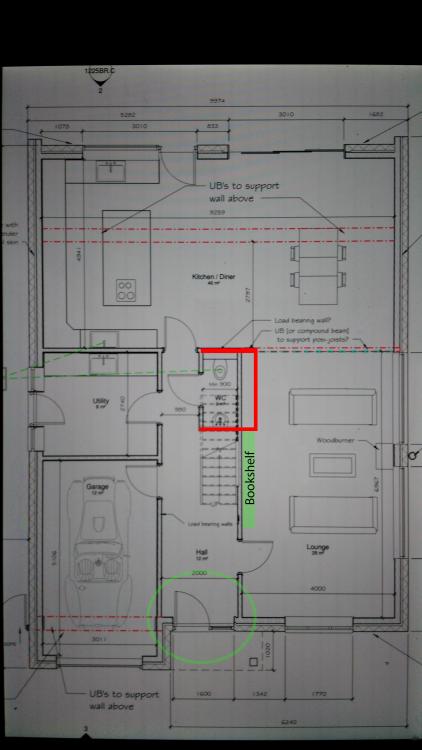
That downstairs WC is tiny for a 5 bed house. You need to make that bigger. If it's staying where it is then stretch it say 300mm into the sitting room and have the area below as bookshelves or something similar to hide the step in the wall. I'd also flip the front door as suggested above. I'd build the garage so it can be converted to a snug or office easily later.
-
You can always order two or three types online to see what it's like before you go buying 30-40 more. If you can't return the ones you don't like you can end up using it in the shed, plant room, attic or behind a fridge, etc.
-
Personally I'd lower the doors as it's probably the cheapest and easiest and I like to have higher ceilings even if it's only an extra 20mm you're gaining. Just checking your floor to ceiling height. If you're building to minimum regulations which a lot of the mass built housing estates are then raising the floor by 20+mm might mean you don't comply with minimum ceiling height and building regulations. Probably unlikely anyone will pick up on it but it can happen.
-
I find some of my tools get legs and go missing when I'm working on my own in the house.
-

Alarm Cable First Fix - Yes or No
Dudda replied to Barney12's topic in Networks, AV, Security & Automation
Thanks guys. Spent 20 minutes looking at the Texecom website recommended a few times above. My brain is not in the right state of mind to start deciphering all the options and combinations right now so I'll park that decision and just pull the cables as you've suggested for now. Sorry Barney for hijacking the thread but I'm in the same position. -
Alarm Cable First Fix - Yes or No
Dudda replied to Barney12's topic in Networks, AV, Security & Automation
Interesting, thanks. That's great as it's cheaper. It's not often on this job I get a saving. So an 8 to be safe or 6 core stranded alarm cable? -
Alarm Cable First Fix - Yes or No
Dudda replied to Barney12's topic in Networks, AV, Security & Automation
Just curious with the 8 core alarm cable Barney mentioned. I've just started fitting electrical back boxes and will start pulling cables soon and going to wire for a future alarm. I was going to use Cat 6 cable as I can then use PoE CCTV cameras with motion detect which trigger an alarm rather than a alarm PIR. Was also going to run a Cat6 to the alarm control panel keypad location. Is this right to future proof myself or should I be using an alarm cable. What's the best to put in now? -
They can have a large splash area particularly when it's windy and it's usually windy in a storm when it's raining...stating the obivous. The advantage of Triple07's sisters house is the metal shoe so it won't be sitting in water. Also the chain is further away as the beam is further back from the fascia line. I'm not worrying about the beam rotting it's staining which will become unsightly beside the front door. In your case Frogeye I'd expect some staining over time on your oak beam as it's not as recessed from the fascia edge.
-
In Ireland the airtight test cert states if vents are open or not and therefore incorporated into the result. You actually have to state if they're sealed at the incoming and outgoing grills to the unit or each individual vent in each room. Not sure about the UK regs but this tester sounds like someone you should avoid if doing another test.
-
Fitting of new windows in EWI layer using EWI brackets
Dudda commented on oranjeboom's blog entry in Kentish RenoExtension
The Compacfoam is the best option and can easily support the weight but is very expensive. I've also seen fibreglass angles used. I like the idea of the brackets but was afraid they wouldn't be strong enough to support the weight. I personally used galvanised steel angles at the bottom and restrained the window back to the existing blockwork with steel brackets as I didn't know better at the time. Live and learn. If I was doing it again I'd use the Compacfoam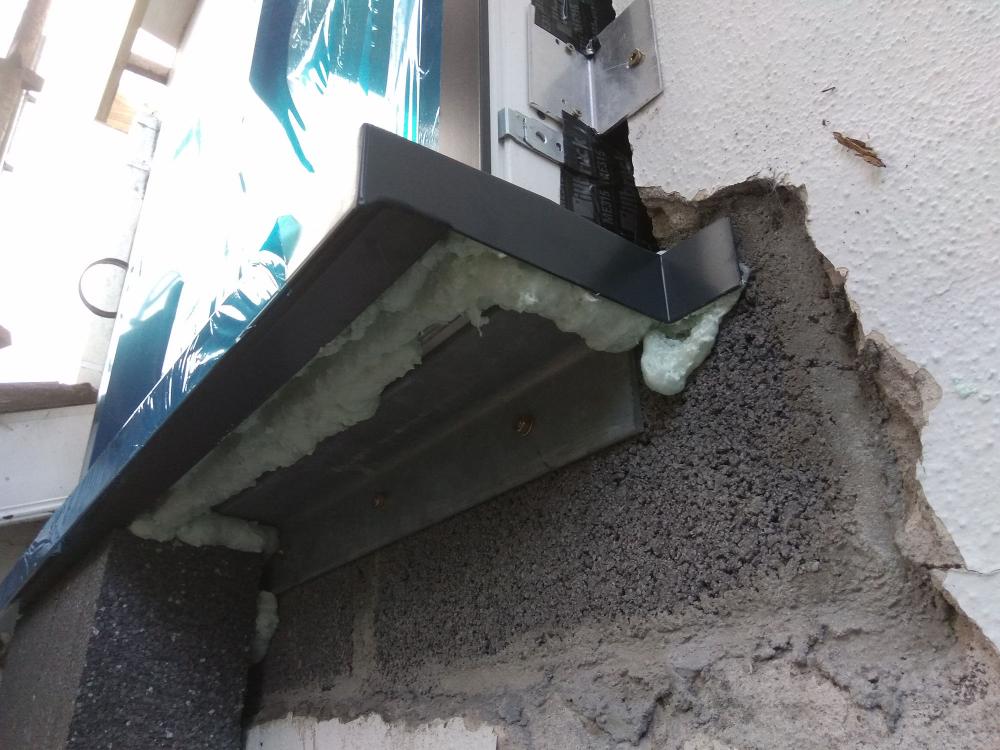
-
Starting to think about MVHR
Dudda replied to MikeGrahamT21's topic in Mechanical Ventilation with Heat Recovery (MVHR)
Varies due to occupancy, size and volume of house, what extractor fans you have and how much they're on, how often front doors or windows are opened etc but in the region of below 3-5 ACH you'd want to start considering mechanical ventilation or additional wall or window vents. -
Starting to think about MVHR
Dudda replied to MikeGrahamT21's topic in Mechanical Ventilation with Heat Recovery (MVHR)
You need to do an airtight test before you go any further. Really you'd want to be looking at 3 ACH or lower for a MVHR system to work right. What I'd suggest first is doing a temporary one yourself with a household fan taped in an open window. Someone did it on this forum and has photos etc. Go around with a smoke pen or similar and seal as much as you can. You're not going to be able to work out an accurate ACH reading or find all the small gaps but you should be able to find the main ones and improve it a good bit. Then I'd get a proper pressurised airtight test done and again go around and seal as much as you can. You should hopefully be looking for smaller leaks at this stage. My biggest worry is the ceiling in your bungalow. You'll have lots of air escaping through all the ceiling lights particularly if you've a lot of recessed spots. You'll also have air escape through electrical sockets and light switches which are difficult to rectify. If after the airtight test you're still up around 7 or 8 ACH with tape and airtight mastic everywhere I think it's time to say you gave it you're best but going any further is a waste of time and money. The house will be slightly better as you've reduced the air leakage. However if you're now down in the 3-4 ACH (which will be very hard to achieve) you can consider progressing and looking further at units and duct runs. -
As I only have a Screwfix account is there much of a saving in the Electricfix or Plumbfix sub sites which are only open to qualified trades?
-
In the masterbedroom flip the ensuite and walk in wardrobe so you can put in a window on the east gable wall for the ensite. It's nicer to be able to open a window in a ensuite and a lot easier than trying to open a rooflight when you get older. I'd also consider flipping the upstairs shower room and hotpress so the shower room is more central and closer to bedrooms 2 and 3.
-
Help! Floor being poured tomorrow. Lots of air in UFH loops
Dudda replied to oranjeboom's topic in Underfloor Heating
Hard to tell from the photos but it looks commercial. Would it be an old matwell they infilled? That means it's a localised issue and not the whole floor. -
Joists: to treat or not to treat that is the question
Dudda replied to ToughButterCup's topic in General Structural Issues
I presume it’s 100 extra for them all as the difference between treated and untreated timber is about 2-4% extra I’ve found. Probably £2-5 a joist depending on how many you have? If they're looking for 100+ a joist he's having a laugh. It’s not just wet rot you need to worry about which is why you treat the wall plate and end of joists and rafters. Treated timber also helps prevent dry rot. I’ve a 1970’s house I’m refurbishing and found a bit of beetle infestation around a first floor ensuite which is also above a utility. The heat and steam from showers and the dryer, washing machine, damp clothes and hot water cylinder all helped create the perfect environment. Its in the joists and studs in this area which wasn't visible when purchasing so all my new timber going in is treated and existing is getting treatment in situ where it's not getting replaced. While not that expensive the painting of the treatment is time consuming and dry timber soaks up a lot so you end up using far more than you think. Additionally when you paint on the preservative it’s only penetrating circa 5mm which is fine but makes you worried when you drill a hole for a pipe or cable later. When you purchase treated timber it’s usually pressure treated so the preservative goes deep into the timber. You’ll notice this when you go cutting and drilling. For only 100 extra and peace of mind I’d go for it. -
Insulation, Heating, time constants etc. Am I expecting too much?
Dudda replied to ProDave's topic in Boffin's Corner
Along with all above which I agree with another thing is you've only a fraction of your internal heat gains currently which all add up to a huge amount. No cooking, no hot water or hot water pipes giving out heat, no showers and steam, nobody living in the house full time giving out heat, no fridge or freezer giving out heat, no TV or computer even in standby, no hairdryer in the mornings, no lights late into the night until bedtime, no washing machine or dryer. This and loads more will probably add up to about half your overall heating requirements so until these are all in you need to input additional heat.



