Dudda
-
Posts
487 -
Joined
-
Last visited
-
Days Won
1
Everything posted by Dudda
-
Have you bought the Kingspan Thermabate? They're a bit expensive and messy for what they do. Most people just make their own cavity closers from ply and insulation, etc.
-
All the top hung Fakro rooflights have a u-value of 1.4 W/m2K and it's only the centre pivot where you can get different glazing options to reduce the u-value. Velux allow you to chose the glazing on the top hung windows and therefore the u-values vary depending on the glazing but in general all are all better performing: Velux with Glazing 70 - 1.3 W/m2K Velux with Glazing 60 - 1.2 W/m2K Velux with Glazing 66 - 1.0 W/m2K Velux with Glazing 62 - 0.81 W/m2K Personally I think a u-value of 1.4 W/m2K is poor and you should be looking for better particularly if you've a number of them.
-

Automatic curtain opener recommendations?
Dudda replied to readiescards's topic in General Self Build & DIY Discussion
That's more affordable and this is an idea I hadn't considered. I might pull a cable to the two large main downstairs windows before we start plasterboarding encase I want one in future. The cable will end up hidden behind a curtain so no harm in having it. At the moment the only need I see for automated curtains is security as having lights and curtains which operate while we're away will make it look like someone is home. When I get to the stage where I can't manually close a curtain I'm sure I'll have bigger things to worry about and hopefully technology will have moved on by then. EDIT: Was thinking more about this. While you're out during the summer you could have blinds or curtains close automatically if the solar gain get's to high and reduce the amount the house would over heat. It's fairly easy to incorporate into a home automation system. http://y2shop.com/eshop/FAQ_electric_curtain_tracks/faq_home_automation_integration -
That's more expensive than I thought. How often do you need to replace or top up that on average?
-
They look pretty good and amazing for the price. I use various 3D drawing packages and Photoshop every day as an architect but couldn't compete with that price. Even if you get some poor student in college learning the program you won't beat that price. Great value.
-
You can get really nice looking plywood window reveal that create a picture frame type effect around the window and I intend on doing something similar but with one layer of ply instead of three as shown in the example photos below. It will be more difficult than plasterboard and probably more expensive to achieve but I think it looks sharp.
-
Does it matter if the expansion vessel and fill loop is on the flow or return (like you have) or does it make a difference? Any advantage to either or is it whatever is easiest?
-
Controlling underfloor heating in passive house
Dudda replied to dogman's topic in Underfloor Heating
Thanks. I should have also stated I'll be running it as all one zone too so will always be around 100 litres. If I was splitting it up into separate zones I would consider a buffer as you have. -
Controlling underfloor heating in passive house
Dudda replied to dogman's topic in Underfloor Heating
Would it also depend on how many loops you have in the manifold? Due to the floor area I'll have 9 loops all 90-100 meters long from the manifold. Allowing 0.12 litres per meter I'll have about 100 litres of water (~900 meters x 0.12) in the pipes in my underfloor heating slab. Looking at @TerryE's picture in the other thread he has three loops so max 36 litres of water. Should I have enough water in the slab and system then to avoid the need for a buffer tank? -
Unless it's to get milk for the tea they don't leave the office. They leave the dispute to solicitors who get engineers out to check.
-
Spray foam under room in roof floorboards - expensive option?
Dudda replied to readiescards's topic in Heat Insulation
Useful info and update on the last 8 replies. Like the plastic tube idea and I suppose having taped felt would aid the issue of the foam coming out between the overlaps but is a lot of effort to prevent it. Do they cut it back in preparation for the OSB or do you and who disposes of all the offcut waste? In short would you recommend it? -
I first fitted a 3G Keylight window in my house which has a motor last summer and a u-value of 1.0. Think it's 960x1600mm or similar. The foam perimeter is more of a marketing thing than anything useful I found. Same for the quick 'flick' install. I had to get another 2 in November and wanted the same size so went with velux but didn't go automated and instead spent the money on the higher spec glass which gives a u-value of 0.8. Its the GGL PK10 - 62. Didn't bother with the insulated collar and instead made my own from left over insulation. I did look at the 4G fakro ones but they're huge money and for curiosity I got a quote for the velux 5G passive certified rooflight. Whatever you're thinking sit down and then double it! Edit: Fakro do a U6 which is comparable to the velux I got and a U8 thermo which is the even more expensive 4G. This is my research from the time but presume it's still current as it's not long ago. Didn't want to post price column. Company Rooflight Uw (W/m²K) Ug (W/m²K) Size Fakro FTT U8 Thermo 0.58 0.3 940 x 1400 Fakro FTT U6 - 09 0.81 0.5 940 x 1400 Velux Passive Rooflight 0.51 Velux GGL PK08 - 62 0.83 0.5 940 x 1400 Velux GGL PK10 - 62 0.83 0.5 940 x 1600 Velux GGU PK08 - 62 0.81 0.5 940 x 1400 Velux GGU PK10 - 62 0.81 0.5 940 x 1600 Keylight Triple Glazed 1.00 0.6 940 x 1600
-
Spray foam under room in roof floorboards - expensive option?
Dudda replied to readiescards's topic in Heat Insulation
What's the minimum thickness of that foam or as I can still see the rafters what thickness are they? I'd be worried about foam expanding upwards and the felt held tight against the tile battens. Really you should have counter battens outside or good spray foam companies put in trays first which maintains a ventilation gap between the felt and the foam. -
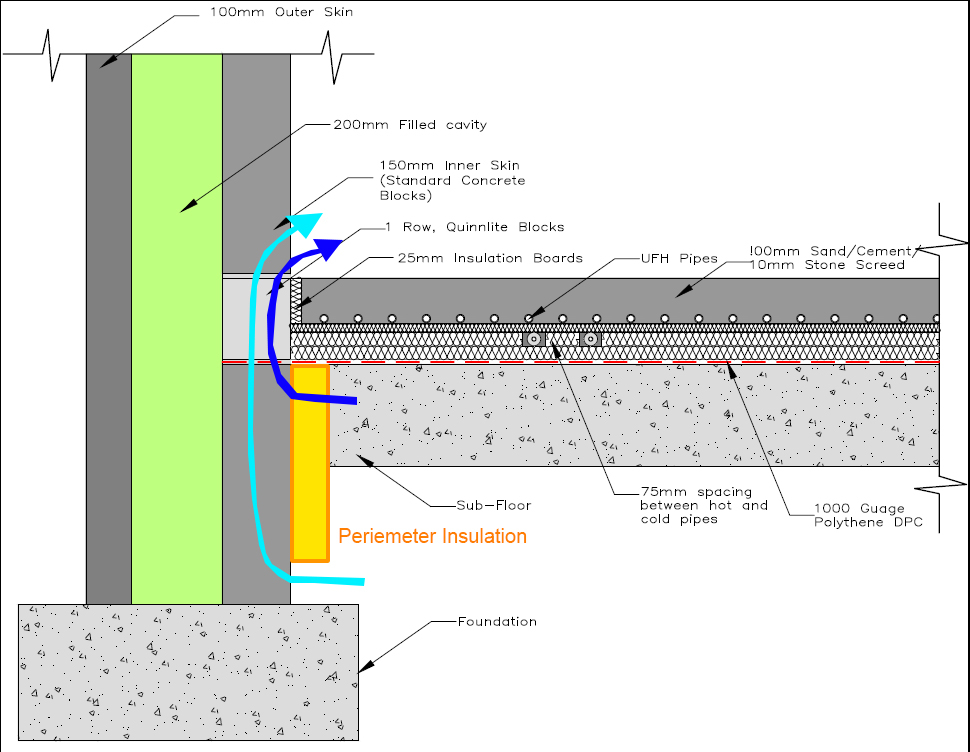
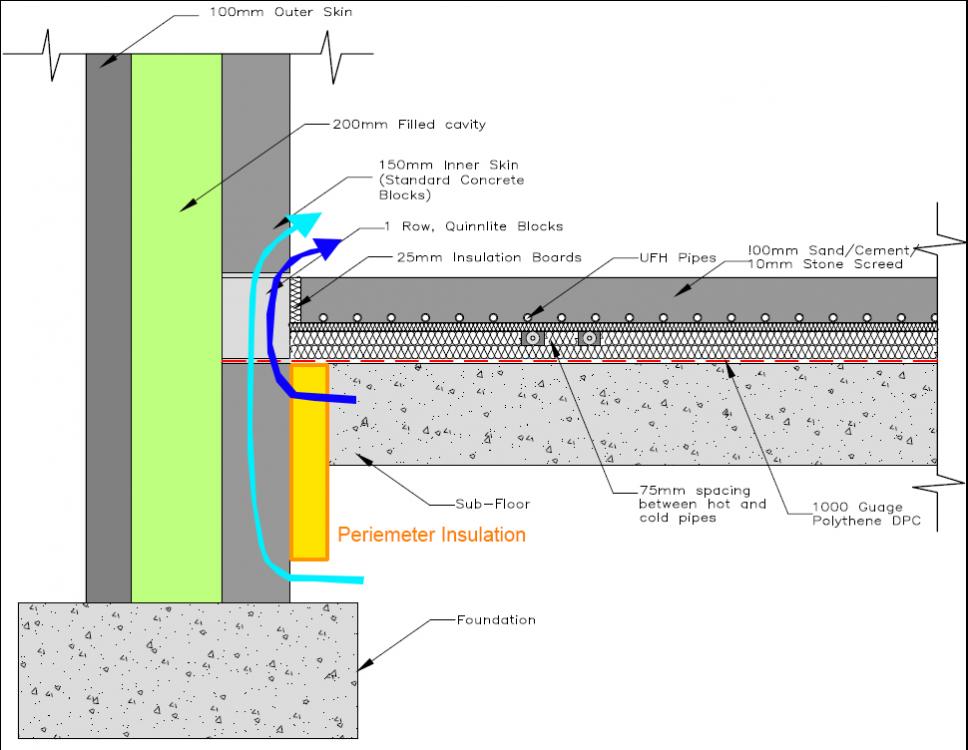
PIR can be as low as 0.018W/m.K eg Kingspan K103 floor insulation. I've had to use it in our refurb where I'm keeping the sub floor in areas and still want to retain the existing sub floor and not increase floor levels. In addition if you're renovating you obviously can't install aerated or Quinnlite blocks in a wall so another trick to reduce the thermal bridge is to put vertical perimeter insulation where you're removing the sub floor and hardcore. It increases the distance for the cold to transfer thus reducing the thermal bridge.
-
It all depends where it is and what's it for. At the top of a fire escape stairs it's one square meter in a public building. That's the most common use which is why I used that as an example. I've never heard of one used in a domestic stairwell. I'm used of Irish regulations so it might be more common in UK regulations.
-
What's the required free open area? Do you need one sq meter of open area or less?
-
In a high sought after area in Dublin the Dún Laoghaire Rathdown local authority is making it mandatory for all new houses to be Passive House. Generally house prices are expensive here so it's not a huge additional burden in the overall price. Will be interesting to watch as it could be rolled out more if it's a success. The wording from the development plan is as follows: All new buildings will be required to meet the passive house standard or equivalent, where reasonably practicable. By equivalent we mean approaches supported by robust evidence (such as monitoring studies) to demonstrate their efficacy, with particular regard to indoor air quality, energy performance, comfort, and the prevention of surface/interstitial condensation. Buildings specifically exempted from BER* ratings as set out in S.I. No. 666 of 2006 are also exempted from the requirements of Policy CC7. These requirements are in addition to the statutory requirement to comply fully with Parts A-M of Building Regulations *BER is Building Energy Rating and UK equivalent is EPC I think.
-
I agree with Mike. A tipping point will happen when energy gets expensive enough to make people react. When no one knows. Until that tipping point happens it's business as usual.
-
What's your final floor finish? Are you polishing the concrete or putting something else over it like carpet, tile, timber, etc? I'd consider trying to get more insulation say 150mm in the floor unless someone has worked out the u-values in detail and can justify 125mm. You can get 150mm thick boards so no need for multiple layers with staggered joints. Quicker to put in. Also it's advisable to put a slip layer or an additional layer of polythene on top of the insulation to stop the concrete seeping between the joints. You could also tape the joints instead of the additional layer of polythene.
-
Part K is minimum requirements. If I was you I'd design a stairs to part M building regulations for a public building. They're designed for people of all capabilities and as a result are a lot more comfortable and therefore a lot larger than what's required for private houses. I'm only up to speed on Irish regulations but presume UK are the same as we usually just copy all the UK regs rather than make our own. Things I'd look at are the following regulations with my comments in red: Section 1.3 (a) the minimum clear width (between enclosing walls, strings or upstands) should 1200 mm; This allows people to pass each other safely (b) a landing should be provided at the top and bottom of each flight; (c) the landings should be level and have an unobstructed length (clear of any door swing) of at least 1200 mm or the width of the flight whichever is greater; When coming down a stairs fast it's hard to stop and if someone opens a door you'll crash straight into it. (d) there should be no single steps; People with low visibility trip easily with only one step as they don't see it. (e) the rise of a flight between landings should not exceed 1800 mm; Allows people to rest (f) all step nosings should incorporate a permanently contrasting continuous material on the tread. The material should be between 50 mm and 65 mm wide on the tread and should visually contrast with the remainder of the tread (refer to 1.6.4). Rationale: This will help people with vision impairment to appreciate the extent of the stair and identify the individual treads; (I'd ignore this one for a private house as it won't make the stairs look great) (g) projecting or overhanging step nosings should be avoided. Rationale: Nosings can cause people to trip or catch their feet. Refer to Diagram 5 for acceptable tread and riser profiles; (h) the rise and going of each step should be consistent throughout a flight; Obvious (i) the rise of each step should be between 150 mm and 180 mm and have a going of at least 300 mm. Rationale: A larger going helps avoid accidents on a stair particularly on descent, as it allows a person to place more of their foot on the step; (j) tapered treads and open risers should not be used as they create a sense of insecurity for people with vision impairment; (k) there should be a continuous handrail on each side of flights and landings in accordance with 1.1.3.6. The minimum unobstructed width between handrails should be not less than 1000 mm; Like point (a) above it allows people to pass (i) isn't relevant as it's for very wide stairs (m) deals with slip resistance (n) the illuminance at tread level should be at least 100 lux; Consider very low level night lights on a PIR so you don't fall down the stairs if you've to get up in the middle of the night or wobble home late drunk! (o) not really relevant (p) ensure good head height.
-
Sealing around ducts
Dudda replied to CC45's topic in Mechanical Ventilation with Heat Recovery (MVHR)
100 euro to Ireland which is only 5 rolls and you'd need at least that for a small house. You can get the airtight mastic and intello membranes from them too and are cheaper so spending enough for free delivery isn't hard. I presume it's similar price range for the UK if not cheaper as it's closer. Delivery took 4 days. I've used them twice. -
Sealing around ducts
Dudda replied to CC45's topic in Mechanical Ventilation with Heat Recovery (MVHR)
All these airtight tapes are expensive. The cheapest I found was getting them in Germany. Got the Pro Climate Tescon Vanna and the profil 12/48. You'll need Google Translate turned on for some of it. Free shipping if you buy a few rolls. http://www.baunativ.de/ I did look at other cheaper and some unbranded stuff but was worried if they failed or lost the stickiness after 5 or 10 years I'd never get access to repair or replace them. -
Building the Dream s6e4 - Are they exaggerating the profits?
Dudda replied to AliG's topic in Property TV Programmes
Completely agree with above comments and the crazy estimate. It's not like they had a high spec finish which would justify the increase valuation. What I can't understand is what happens the car when they get 18 inches of a flood. They didn't have a ramp or anything for the car to drive up on and had three cars parked in front of the house on day of final filming which would get destroyed. Anything you store in a shed like a lawnmower would also need to be constantly raised. -
Importing materials
Dudda replied to Russell griffiths's topic in General Self Build & DIY Discussion
Renovating an old house in the West or Ireland and so far have bought my windows, all first fix plumbing, all airtight membranes and tapes from abroad. I expect I'll buy a lot more as I get closer to second fix. -
Cast Aluminium or Iron Guttering for a Listed Building
Dudda replied to LeanTwo's topic in Building Materials
Don't go with the GRP. Not only are you not allowed to in your case as they stated cast iron or metal and GRP isn't a metal but from a conservation point of view it's terrible practice and looks crap. You want to be faithful to the original building and materials. I've used both the aluminium and cast iron on different historic buildings. I've found the aluminium cheaper but if they're the same price I'd personally get the cast iron but get it pre painted in the factory as it will be much more durable long term rather than buying the non painted version.