


Crofter
-
Posts
3484 -
Joined
-
Last visited
-
Days Won
11
Everything posted by Crofter
-
I fitted 50mm over my studs, and used screws. Big advantage over nails is that you can feel it bite into the stud. I initially fitted a few screws per board, using insulation washers (£12/100 from Amazon), which held the boards securely until I could put the battens on.
-
Oh I can beat that, £24/t for type 1. Only two options for concrete- a readymix lorry and a volumetric. The latter is cheaper per cube right up until you need a full load.
-
Oh well can I suggest simply bamboo then! They seem to be the cheapest that I could find, and the samples I got looked fine.
-
Mine's an Elektra Beckum (now Metabo) very powerful but more of a site saw than a carpentry tool. The fence is only fixed at one end and will wobble a mm if pushed, so tolerances are a bit rough. Rips through wood up to 85mm thick. Not sure about new price, mine was £150 second hand.
-
Ah yes Skyeskyns slippers! What @JSHarris says about T&G vs click fitting seems to make sense. Brings back memories of when I did a hallway with click laminate in my last house, the boards had been stored a bit too long and some had begun to warp (it was a damp house), and getting them to lock down uniformly was an absolute pita- the boards are simply too long. With a few extra hands it would have been much easier. I've still to make the final decision on what to use to bond down the bamboo. Most people will be laying this on a flat slab or chipboard floor, but I'm thinking of having electric UFH mats on top of my chipboard, so I'll need a deep enough bed of adhesive to accommodate that. Also it's a suspended floor with a 16ft span so despite deep engineered joists there is inevitably some deflection. Hence any bonding agent has to have a good degree of flexibility.
-
Welcome aboard, I think there are a few Norn Irelanders here. What's your build route, method, etc?
-
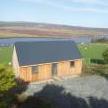 Looks like the excuse you've been waiting for to buy a low slung sports car... As Dave said, all quiet up here. When we do get big storms they don't tend to do that much damage, as everything that can blow has already blown away...
 -
Thanks! Really pleased with the look of the roofing and cladding. Originally I was going to use black box profile roofing, but the 'slate blue' corrugated is a much better look for a small house, I think. Every time I take a pic I realise what a mess the site is though... need to have a bit of a tidy up...
-
Oh and I forgot the best bit: I was packing up for the day and couldn't find my wee radio... I could hear it though... no prizes for guessing where it was So hopefully that's the only time I will have to pry off a piece of cladding...
-
So the roof is now totally finished- was a beast of a job and having finished the ridge I felt as though I had been riding a particularly fat horse all week. Physically tough doing it without help and using just a ladder, but I'm impressed with the corrugated steel and would happily use it in future. I would seriously consider it for wall cladding as well, as it was much quicker and not any more expensive compared to my larch. I had made a start on the larch wall cladding a few months back, fixing the first layer of boards on the gables. I'm now comfortably past the half way point with the cladding, with only the seaward walk not yet started. It's been a process of trial and error to find ways of getting each board in place ensuring that it more or less plumb and with equal gaps either side. Part of this learning process has been judging what kind of tolerance to work to. The boards are highly variable, from less than 95mm width to over 100mm, sometimes tapering at one or both ends, and often with a bit of a curve to them. So my first idea of using a long spirit level and a wooden block as a spacer wasn't going to work. The first layer was done quite carefully with markings on the battens; temporary nails on these marks located each board whilst I used the coil nailer to fix it in place. For the top layer, I didn't want to use that method as it would leave nail holes in visible parts of the cladding. So the best method for fixing the long boards of the gables seems to be to put small marker nails on the reverse side of each board, spaced to match the gap that is being covered. It's obviously a lot of prep time, but I can do that inside the house during bad weather (it is February in Skye after all), and then when the weather allows I can literally just shove the boards up against the wall and they will be in the right place. Unfortunately my progress is now going to be rapidly curtailed as I become the stay at home Dad- SWMBO has gone back to work, so my day now revolves around the couple of hours nap time that let me sprint down to the house site, baby monitor in my pocket, and feverishly nail some boards on. Next project: self build baby pen...
-
@Russell griffiths Do you know the location of the current soakaway/leachfield? In an older system this might just be a pit filled with stones. In newer systems (last 20yrs or so) more likely to be a herringbone pattern of pipes set in stone filled trenches. And in the latest incarnation, pipes arranged in a circuit to prevent dead ends. I don't know what Building Control and/or EA will want you to do in treating this as a new system or simply maintenance/repair or an existing one. I briefly considered building a new system for my new house which would also take over the existing system for my current house, and serve both properties. The EA (well, SEPA in my case) told me that from their point of view it would count as an upgrade to an existing system and be viewed favourably. However it was obviously still a new system and would have needed BCO approval. In the end I realised it was going to be much cheaper and simpler to make the new system smaller, and keep the existing system as is, it just meant slightly shifting the driveway position.
-
My requirements are somewhat different to most people's, given that I may never cook a meal in my new kitchen! So what I need is - idiot proof - easy to clean - looks nice And that is it. I've used induction hobs before but had to be shown how they worked. Is this a common thing? I cannot be bothered explaining to a different set of guests every week how to boil an egg. MiL has a swanky Neff one with a removable puck thingy, that is definitely a no-no! At the moment I'm leaning towards an unbranded £100 ceramic touch control hob, and if it gets scratched then it's not a disaster to replace it. Btw on gas running costs- we used to run our range cooker's hob on 47kg propane bottles. Got nearly two years out of a bottle, costing around £50, so I don't think running costs need be a big concern.
-
Space helps, but if your ground conditions are unsuitable, there's absolutely nothing you can do about it. I still don't think many people are willingly choosing more expensive or complex solutions. The variation in people's choices just reflects their site conditions.
-
Welcome aboard- I'm on Skye so you're not far from me.
-
Are people opting to choose sewerage systems that are more complex and higher cost than the bare minimum that they can get away with? I've sunk nearly £7k of my £40k total budget into mine, and it wasn't through choice. Ground conditions, usage pattern, and lack of a mains option led me to this expensive solution. I would much rather have spent that money on something else!!
-
I wasn't even asked for a pressure test. Posted off my completion form, got my cert back. For all I know they never even visited the site.
-
Is there a limit on ridge height?
-
Sounds like a nightmare to keep clean... I'm a bit paranoid about that aspect of things, how bad is it in real life?
-
Clarification from Everbuild: "I can also confirm that Heatflex is suitable for wooden flooring on top. Please read the instructions for the Lumberjack 650 for moisture content requirements as well as the requirements of the wood floor supplier. "
-
I did think about a wee cover piece, but I had visions of it splitting and falling off and generally being a bit of a pain to maintain. But you have given me an idea... I have a friend who does wood carving, might see if he's up for doing something. But then it wouldn't be all my work... hmmm...
-
Fitted the barge boards today. Here's what I ended up doing at the apex- a single board cut and bent in the middle to provide amore weathertight cap. I scored and then folded the cut edge so as to preserve the PVC coating, and gave any bare metal a quick going over with a can of zinc spray. Maybe a bit OTT but it worked out quite well. Pic shows the barge board from the inside, prior to bending it to match the ridge angle.

-
I've now feel delighted that my 43m2 new build will be positively palatial compared to some of these concepts. Maybe I should split it into three bijou apartments?
-
I had more or less the same problem- I'm building a one bedroom house, designed for only two people, as a holiday let that might only be occupied half the time. Most of the package treatment systems are designed for a minimum of 50% usage rate, and the smallest you can buy is a 4 person. Some of the systems have a 'holiday mode' where part of the tank is shut off, allowing a small population of bugs to thrive in a smaller area. This may well suit you if you have some idea of when you are going to be there, and how long for. I opted for a system called a 'Puraflo' instead. This uses a conventional septic tank and in place of a large leach field, the Puraflo module(s) perform secondary treatment on the effluent. The modules are large plastic boxes filled with peat fibre and piping for distribution of effluent. A pumping module 'doses' the puraflo at intervals, activated by a float switch. The peat fibre is an aerated environment and the final outflow from the system meets or exceeds the same standards as a standalone treatment package. You would stll need some sort of final disposal option for this, e.g. a small soakaway or a watercourse, depending on what you are allowed in your area. The Puraflo people were quite happy with my intended usage pattern, and the system has been around for at least twenty years, with several houses near me using it, so I felt confident that it would be a fairly robust and simple choice. It wasn't the cheapest though, at around £3,500 for a single module and pump installation. Plus the conventional septic tank on top of that.
-
Why not just dowse for the UFH pipes

