


Crofter
-
Posts
3484 -
Joined
-
Last visited
-
Days Won
11
Everything posted by Crofter
-
Yes I've given some thought to whether the washing machine is really needed. I think in practise it will be used by us more than by guests. It might not be essential but is a useful thing to have if you have the space, and I do think that I can afford to give 20% of my storage footprint over to it. And I can supplement the storage with freestanding furniture. Accessing the washing machine from the bathroom would alleviate the noise problem. So yet another layout would see the big cupboard split into two, accessed from kitchen and bathroom, and the bathroom side becomes the airing cupboard, with the UVC sitting beside the washing machine, and shelving above. This would leave the bedroom needing a freestanding wardrobe but I think that's acceptable. The baseline plan puts the UVC up in the (warm) loft. Unfortunately I have already purchased the kitchen, and it's sitting in a Wickes warehouse. I didn't buy an end panel either, because originally it was going to but up against walls at either end. Pondering making a small end wall that creates an upstand, essentially to stop things from falling off the end of the worktop, or being brushed off by people coming in the door. And it saves me buying an end panel and putting an end strip on the worktop.
-
Furniture layout is up for debate, for sure. And as pointed out, it's hard not to end up blocking the door or the sightline from the bed to the stove. My thinking at the moment is to have the sofa facing the big patio door, but far enough back from it to give a line of sight from bed to stove. The small two seater table would go on the wall between the stove the kitchen units (this was always the plan in the original layout). The remaining space could house an armchair by the patio door, and some sort of furniture in the corner (dresser, bookcase, or whatever- basically somewhere to put some secondhand paperbacks, board games, and a vase of flowers). I think people like looking at a stove, even if it's not on. But picture the scene. Throw some last logs on it, drain your glass of red, retire to bed and watch the flames dance as you drift off to the sound of the curlews on the shore outside, as the last glimmer of daylight turns deeper red and then imperceptibly fades to black. (Anyone want a holiday on Skye??) The more conventional solution would be to have a normal sized door offset towards one corner of the bedroom, and that then gives the greatest flexibility for furniture. But, meh, something's missing from that version. IMHO.
-
Thanks @Ferdinand, a pull out unit could help. It's funny how much thought can go into a cupboard! I've yet to sketch out the option of accessing the WM from the bathroom, which would mean dividing it three ways. Any comments on the bedroom-lounge divide? I've notionally put 1200 wide double doors on the centreline. This gives enough space either side for an 800 wide piece of furniture, e.g. chest of drawers plus a freestanding wardrobe. Aesthetically, it very much makes a feature of the woodburning stove and its flue which would be framed in these doors as viewed from the bed. Extra incentive to the flue bang on vertical Edit to add: I shouldn't need a whisky stash as I have one in my own house less than fifty metres away. Hopefully I can survive long enough without a dram to walk that far!
-
It's worth considering, but would not be straightforward. I have a width restriction on the building (another 600mm takes me beyond portable building limit), although a flimsy enough structure would probably be OK- roof overhangs, guttering etc are not counted in the width. So a simple roof, like a car port, might be allowable. Possibly more problematic is that the ground around the house is very uneven and sloping, so making a reasonable sized flat space at the back door is going to be tricky.
-
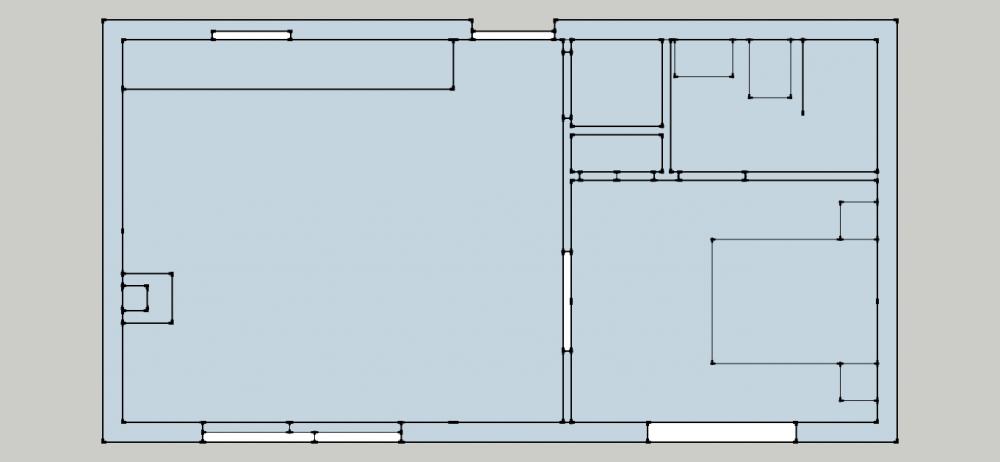
OK here's a version with the cupboard split, creating a shallow wardrobe from the bedroom. The wardrobe is 450 deep, and 1100 wide; the cupboard is now 1050x1100. Because of the need to put a washing machine in there, the narrower cupboard will be a bit hard to utilise fully- it's quite deep for its size, and there's only so much stuff you can put in front of the washing machine. But then again I don't need oodles of space (I keep forgetting this!). Somewhere for the fuse box, some spare linen, a shelf of cleaning products, and the hoover. The depth of the cupboard will also give ample space for things hung on the back of the door. I could move the main partition back a little, but that starts to make the wardrobe look a bit tight... I think? Again, not a huge amount of space is needed here, as when people are on holiday I think they tend to live out of their suitcases rather than fill a wardrobe with clothes. Or maybe that's just me. @MikeSharp01 Interesting that you think I could shrink the bathroom a bit. I sized it based on my interpretation of the building regs for activity areas around a WC and basin, and added a more generous 900 wide shower. I have the luxury of ignoring the regs if I want (portable building exemption) but I have used them as guidance for planning the layout.
-
Yes that's quite a neat idea. Only thing is I'm planning on having the washing machine housed in that cupboard, so making it smaller might make space a bit tight for that.
-
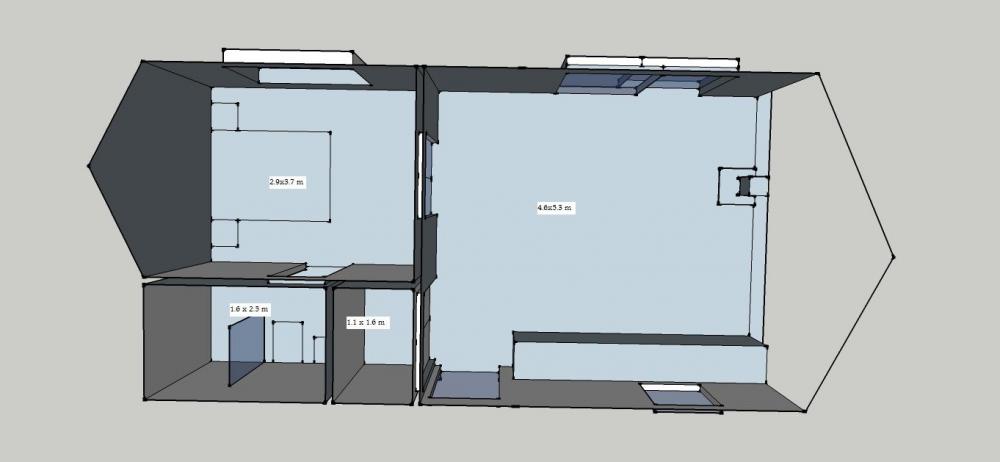
Having spent some time in the shell of the new house, .I've grown rather fond of the space and have become reluctant to start splitting it up with partitions as per my original design. Fortunately everything I have done so far is compatible with a more open plan layout. It's a fairly big change but actually means less building work. It takes the house further away from being somewhere that I would call a home, and makes it more of a holiday house- I am trading storage space for bigger rooms, and losing the practicality of having an entrance vestibule. I've attached a sketch of the revised layout that I'm proposing- any feedback very gratefully received.
-
(Slight off topic) Can you saw the back off a fridge?
Crofter replied to Crofter's topic in Kitchen & Household Appliances
Buying ice isn't much of an option up here- we tend to go for the best part of a week living on the anchor and visiting uninhabited islands or sea lochs in remote places. No houses, certainly no Aldi! It's probably not much of a problem further south. I get the impression yachties tend to eat out much of the time, which again is a rare treat for us. Nearest we get is when a passing fishing boat gives us a few prawns! -
(Slight off topic) Can you saw the back off a fridge?
Crofter replied to Crofter's topic in Kitchen & Household Appliances
Thanks as always Jeremy. The way we have generally been accustomed to cruising is to load up the cool box with packs of frozen meat, and work our way through these over three or four days, eating the higher risk chicken first, then red meat, and finally things like sausages which I think pose less of a risk. For milk, we just use UHT. By day five we are generally down to store cupboard meals or, hopefully, able to restock from a shop somewhere. My first thought had been to buy a little tabletop ice cube maker, and in times of power surplus make bags of ice cubes- but whilst this might work, my gut feeling is that I would need to give over a disproportionate volume of the cool box to ice, and not enough to the food itself. Whereas if I have a proper freezer, I can store that energy in the packs of food that I am carrying anyway, and/or the more efficient cool blocks. It's not exactly top of my priorities list, but cruising with a toddler makes you aware of the need for slightly better hygiene, so we are looking to add a few mod cons this year. A mini freezer takes double the power when running (150w) which maybe means a startup surge of 750w, but that remains doable with a low cost inverter. When running it as a fridge, it would obviously perform fewer cycles. Maybe that would actually be good for efficiency?? -
(Slight off topic) Can you saw the back off a fridge?
Crofter replied to Crofter's topic in Kitchen & Household Appliances
Thanks for thse thoughts. I've looked into gas powered and peltier units and thry do have drawbacks- a compressor is definitely the way to go for best efficiency. Potentially dafter follow up question: There are time when I think it could be advantageous to have a freezer rather than a fridge. E.g. if I have a power surplus from a sunny day or access to shore power, I could store that energy by freezing ice blocks and then get several days use out of that using the unit as a cool box. So the question is- what is actually different between a fridge and a freezer? Am I being overly optimistic thinking that by simply changing the duty cycle I could turn a freezer into a fridge? -
A cunning plan? What do you think?
Crofter replied to ToughButterCup's topic in Central Heating (Radiators)
@Onoff Reminds me of when SWMBO was pregnant last year and the nesting instinct had kicked in, I had to give up a weekend to redecorate the 'nursery'- a room which I intend to convert into the front entrance hallway and stairwell when we do the loft conversion. Lots of stripping woodchip off walls that aren't going to exist in a couple of years time. To cap it all off, we painted the whole place a lurid pink colour following the first ultrasound, and then a few months later a baby boy popped out. I was even less enthusiastic the weekend that we repainted the place blue... -
Not a house question, so hopefully I won't get reported to a moderator I'd like to fit a small fridge to my boat but, as with most things marine, the markup on dedicated 12v equipment is crazy. To get a compressor driven fridge, or a kit of parts to build my own using slabs of insulation, costs over £400. By contrast, I can buy a mini countertop domestic 220v fridge plus an inverter to power it and still have change from £100. The main downside I see to this is that the fridge, whilst very small, is quite hard to find space for. It's surprisingly hard to fit a cube that's half a metre a side into your boat. So... other than voiding my warranty, what would happen if I tried taking one of these little fridges apart? I'm hoping that they are constructed such that the back panel contains all the clever stuff (radiator, compressor, and cooling plate for the inside), and the other five sides of the fridge are simply insulation in the shape of a box. Could I simply cut the back of the fridge off completely, and then build a new insulated box to mount this in? This could allow to me fully utilise the rather awkward shape of a locker. A related question- is a domestic fridge affected by being heeled over? Either for brief periods, or by dint of having been installed at an angle as part of a daft scheme to make it fit into a funny space? Thanks for any ideas
-
A cunning plan? What do you think?
Crofter replied to ToughButterCup's topic in Central Heating (Radiators)
Maybe it's different down your neck of the woods, but up here LPG is generally taken to be the most expensive option, a hangover from the 70s and only an option used by those who want gas for some other purpose anyway (e.g. hotels with kitchens) or those tempted by slightly lower installation costs. As I understand it, the tank remains the property of Calor and you rent it from them, so that is another part of the running cost to consider. I think that if you are spending money on making the house more sellable, you need to put your own preferences to one side. My parents are currently considering some upgrades to their house with a view to renting or selling, and my Dad wants to put in a multifuel stove- I keep telling him to just get an oil boiler as that is what is the standard on the market and most likely to attract interest. -
Why are my LED flood lights semi-illuminated when off?
Crofter replied to readiescards's topic in Lighting
I have a similar issue with some gu10 lamps in my kitchen and it was suggested to me that it might be induced current, and that there wasn't anything to worry about. But it was probably Jeremy who suggested it so it'd be interesting to see why it's more likely in one installation that another.- 29 replies
-
- 1
-

-
- led
- floodlight
- (and 5 more)
-
OK thanks everyone I have a bit of a clearer idea of what to do now. So only one CU needed for an E7 or E10 tarriff. Circuits are now looking like: - 32A ring main covering the living room and bedroom - 6A lighting ring covering all rooms - 16A supply to the sewage treatment system - 32A for the hob and oven - 32A for other kitchen appliances and sockets (dishwasher, fridge, cooker hood) - 16A for the UVC immersion - ? for MVHR- or power off another circuit - ? for heating, need to know total load but assume one circuit will be fine The uncertainty over the heating is largely because I have yet to decide on UFH vs panel heaters. I might also consider a plinth fan heater in the kitchen, as I'd like a way to rapidly get the house up to temperature following a period of non occupancy. At 100w/m2 I would be looking at about 3kw total for UFH, but for panel and plinth heaters it might be more than this. Does the MVHR need a circuit? Seems like overkill for something with less power than a single GLS bulb! Does the size of the kitchen appliances circuit look right, or is it a bit big? Cheers
-
I fretted too much over my design, and it wa only when I realised that all I was doing was farting about with partitions etc that I finally submitted planning drawings. I'm still fretting occasionally now, even though the shell is up and I am about to start plasterboarding! I keep having this sudden urge to make the place open plan. It's probably what an architect would want me to do. But then you try to work out how the space would work as a home and it doesn't make so much sense. I might start a thread on it, actually...
-
Thanks. My current house has a weird and obsolete tarrif called Total Control, where I have two CUs and all heating appliances are wired to both. Glad the E7/E10 systems are a bit simpler.
-
Still need to pin one down. Have a few leads to go on. I'm assuming there's no physical difference between E7 and E10? Still not really sure how the two rates work when you want to have the choice of how to power something. E.g. if you have a panel heater and you want to be able to power it off cheap rate, but still be able to use it during peak times. How does that all work?
-
So the time has come to chase the local sparkies and get cracking with wiring out the little house. Hoping to get a few suggestions on what to spec so that I am reasonably well prepared and can shop around for appropriate kit. Always like going into things with eyes open The house is 43m2 total net floor area, divided into a living/kitchen space, a bedroom, a small vestibule/hallway, and a shower room. There is a 25mm service void throughout, which is not insulated. DHW will be by UVC with E7. Direct electric space heating. My thinking so far on the circuits I will need: - 32A ring main covering the living room and bedroom - 5A lighting ring covering all rooms - 16A supply to the sewage treatment system (supplier recommended this due to the starting current on the pump) - 40A (?) for the hob and oven - 32A for other kitchen appliances and sockets (dishwasher, fridge, cooker hood) - 16A (?) for the UVC immersion - 5A (?) for MVHR (it draws something like 60w max so I imagine I want the smallest possible- or can I just spur it off something else?) - heating I'm not sure about, see questions below Questions: - there is a washing machine in the hall, should that go on the main ring or on the kitchen circuit? - with the UVC on E7, does it need two separate supplies for two elements- or does it not work like that? Come to think of it, does an E7 setup need a second CU? That's certainly how it works on my 'Total Control' system in the current house. - I'm yet to make a final decision on heating, but it will be three separate zones. The baseline plan is a panel heater in the bedroom, another in the kitchen, and a towel rail in the shower room. However I am costing up electric UFH mats instead. Either way, looking at a total load of maybe 3 to 4 kw. And of course I'd be looking to use E7 here as well. Thanks, and sorry for the noob questions!
-
Need decent quality ply for that... normal stuff is full of voids which would detract from the look somewhat!
-
SWMBO is already making noises about us moving into the new house and renting out the old one instead... steady on boys I don't want to end up making it look *too* good!
-
Ah that looks very handy. All I'd seen previously was the expanded mesh stuff that's probably too bulky to hide behind a wee bit of filler. It should give a neater, crisper finish than using wooden trim. I'm not totally against getting a skim coat, btw, just haven't budgeted for it, so it will probably depend on the quotes and also how the walls look by the time I've finished with them- I might need to get a pro in to hide my dodgy handiwork!
-
Don't think anyone was talking about filling ply etc, maybe we're at cross purposes there. Standard detailing on every house I've lived in has been ply reveals, with an architrave surround to protect the external corner and make the transition to the PB wall. All wood surfaces varnished or painted, no attempt to pretend they are not wood. Nail heads visible but they are small lost head types. So, knowing no better, I had just assumed I would do the same on the new house- although maybe swap the ply for PB. Still assumed I would need the architrave. I guess the other option is to put a piece of external corner reinforcement in place but presumably that only works if there is going to be a skim coat?
-
Yes, but I wasn't going to. Maybe this comes down to the difference in practise up here- it's not usual to do a skim coat, you just tape and fill the plasterboard. So if that's good enough for the walls it's probably good enough for thr window reveals too. I wonder if this difference has anything to do with us using TF by default up here? Greater chance of movement so a skim coat might not like that??
-
No... I consider it akin to Voodoo... but why would I need to? I don't see how it makes any difference what sheet material I use for the window reveal, other than PB is cheaper and easier to fill the screw heads. Or am I missing something?

