


Crofter
-
Posts
3484 -
Joined
-
Last visited
-
Days Won
11
Everything posted by Crofter
-
I think a TS and a UVC do fundamentally different jobs. In a UVC, you draw off the water from inside, but in a TS you draw cold water through a coil within the TS, so it acts a bit like a boiler, i.e. it supplies heat but not water.
-
One of the advantages of a volumetric mixer is that you only pay for what you need.
-
With my house being so small, the furniture layout in the bedroom is pretty much set in stone, i.e. there is only one place that it is remotely sensible to put the bed. So... can or should I not bother putting UFH under the bed?
-
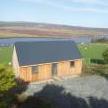
If you like it then you should have put a roof on it
Crofter commented on Crofter's blog entry in Wee Hoose on the Croft
Well for starters you need a nice calm day. The wind got up too much today so I still have the final piece to do. On the side that I have finished, I used a hook made from an offcut of metal strapping, tied to a length of rope which looped around a batten. This could- with some padding to protect the sheet- be hooked onto the bottom edge of the sheet and take its weight, allowing me to draw out the trolley underneath. Then a long stick to prop up the bottom edge of the sheet so I could duck in underneath and remove the two wooden rails. This was the dodgiest bit of all since the sheet is only supported by a hook and a stick, and resting on the ridge. One gust of wind would bring the whole thing down Then a case of putting in all the fixings I could reach, by standing on a ladder at the eaves or one propped against the gable. The final out of reach fixings I had to do by slinging a rope over the ridge and climbing down it. Do I deserve a beer tonight?? -
My UVC will need to go either in the linen cupboard (need to talk to SWMBO about how much space we can lose there) or in the loft space (warm roof so not a complete waste of heat). Either way, I think the discharge pipe will have to go down through the floor. It could just run onto the stones that I laid over the ground under the house, or could perhaps tee into the drains that will take the gutters.
-
Electric shower vs. instant water heater
Crofter replied to Crofter's topic in Bathrooms, Ensuites & Wetrooms
Seeing as this is no longer about electric showers or instant water heaters, I've started a new thread on UVCs... -
Seeing as my original question (instant heater or electric shower http://forum.buildhub.org.uk/ipb/topic/1873-electric-shower-vs-instant-water-heater/) ended up being answered with 'neither- fit a UVC', I decided it would be better to start a new thread. I know that these units are not a DIY install and that you need a plumber with a G3 certificate. They are also to be checked annually. Just how much of the install needs to be done by a plumber? Need to know so that I can plan to be at the right stage. I like to do as much work myself as possible so what is the minimum that a G3 plumber would do and be happy to leave me to finish off? I presume he will need the electrics in place, but what if I haven't finished building the actual bathroom and there are no taps or shower in place yet? Will he be happy connecting to pipes that I have already boxed in behind plasterboard? I've also seen reference to 28mm copper pipes... I've only got a 25mm service void and my plan is to run everything through that- tight but doable in 15mm especially if I have no fittings boxed away anywhere. I guess this will be a sort of Q&A with @Nickfromwales so will buy him a virtual pint...
-
So had an email back from Everbuild this morning. They recommend using 'Febflor Heatflex' instead of the Lumberjack product. Comes in powder form, around £20 for a 20kg bag which will do 2.4m2 at 5mm thickness.
-
A lot of boaty people swear by those pump action weedkiller sprayers, apparently they make quite good showers.
-
Wood Burning Stoves in the popular science press
Crofter replied to SteamyTea's topic in Environmental Building Politics
It's not really fair to compare biofuels with PV solely on the basis of which one is a more efficient use of land area. What would a cradle to grave assessment of cost and environmental impact look like? Considering factors such as the sourcing of the raw materials for PV, the lifespan of the arrays, storage of energy, biodiversity, and of course cost to establish and maintain. I know my situation is atypical for the UK, but I am gradually planting more of my croft with willow cuttings at no cost (except my time). In theory I could cover four acres in this way. What would the same area of PV cost?? Eventually, this will produce wood that I can burn in the winter. Whereas if I went down the PV route, I could look forward to shivering under a blanket all winter muttering about how much excess I produced all summer... -
If you like it then you should have put a roof on it
Crofter commented on Crofter's blog entry in Wee Hoose on the Croft
Ok so I am no Ed Graves but here's a wee clip... now I just have to work out how to work at this speed without the aid of a timelapse app! -
Everbuild website suggests minimum of 0.5kg/m2, I'll drop them a line and see what they suggest when UFH is involved.
-
Blimey this could get expensive. My backup plan is to not bother with UFH in the kitchen/living room and maybe fit a plinth fan heater, plus there is of course the woodburner in that room, and waste heat from cooking, TV, etc. That would halve the area of UFH needed.
-
I'm going to presume that a caravan water heater is not going to have a tremendous output so you'll probably want to limit the flow rate in order to keep the temperature up. Does it have a kW rating? I know from personal experience that you can just about shower in five litres (one of those solar bag thingies) but it's not the best experience ever! As an absolute minimum a shower at home would be using 5l/min so say 20-30l per shower as an absolute lowest figure. So you're looking at about a 100l container to give a couple of showers and a bit left over.
-
I know Sikaflex well, being a boat owner. Hopefully the builders' stuff is a bit less eyewatering than the marine version From what you've said before, it's best to bond down the bamboo rather than having it floating. So whilst this is pretty much a done deal, I'm yet to cost up UFH vs simple panel heaters (or, rather, cost up just how much more UFH will be). Will the use of UFH mean I need more Sika? And will I need those insulation boards that are sold for the electric mats? The floor makeup, by the way, is 22mm chipboard over 300mm rockwool between engineered joists.
-
Yes it's a bit bewildering! As Ed says, are you putting sarking on? And are you doing full fill insulation and therefore need a breather membrane? I did more research on this than was healthy, making a big list of the different types and noting down the vital specs off their BBA certificates (nail tear strength etc). I knew mine was going to be exposed for a lot longer than normal so I didn't want to skimp. Ended up using Cromar Pro Vent 3, for what it's worth.
-
You were lucky then- I had to get the neighbour to offload my windows using his telehandler, and the insulation (from Seconds and Co) we had to strip from its pallets and chuck off the lorry piece by piece.
-
Yep, 1 bar = 33ft in old money. I wonder if you could organise a pumped feed instead? If the one bar is simply a minimum, and the heater doesn't require a very narrow pressure range, then a pump might be the easier option. If you are only allowed occasional connection to the stand pipe then a header tank sounds useful anyway though.
-
Normally if the delivery vehicle is capable of offloading, then they don't charge for doing that- in my experience anyway. It can be handy to have a digger on site for offloading. Failing that, is there anybody with machinery nearby, e.g. a farmer with a telehandler?
-
Wood Burning Stoves in the popular science press
Crofter replied to SteamyTea's topic in Environmental Building Politics
A dummy chimney will be cheaper and give fewer problems with leaks etc, and of course allows you to keep the thermal integrity of the building intact. If you install a flue for a gas appliance, I understand that you cannot use it for other appliances- solid fuel flues must be to a higher standard, and may be larger diameter much of the time as well. -
Oh and can I ask a related question... I gather it's necessary to bond down UFH mats. I'll be using bamboo flooring over a suspended chipboard floor, so any sort of adhesive will need to deal with the slight flexing of the floor. I'm wondering if this is a job for some sort of Sikaflex product, or whether flexible tile adhesive would be suitable? If the former, that could add considerably to the cost.
-
The problem is that a material like tile, when it is at room temperature, will still feel a little cold on bare feet because it conducts heat away. It would have to be closer to skin temperature to prevent this, and in a PH such a large heated surface would massively overheat the whole building. So you can heat it using an efficient wet system, but if all you want is five minutes of warmth whilst someone is using the shower, it may well use less energy to just use direct electric heating, rather than cycling on a full CH system- which would have to run for longer due to a slower response time.
- 33 replies
-
- 1
-

-
- under floor heating
- under tile heating
- (and 5 more)
-
Got my pension in obsidian futures...
-
Wood Burning Stoves in the popular science press
Crofter replied to SteamyTea's topic in Environmental Building Politics
Ethanol fuelled stoves are supposedly quite nice, and avoid the considerable expense of a flue. -
Wood Burning Stoves in the popular science press
Crofter replied to SteamyTea's topic in Environmental Building Politics
Wood burners are like fish... if it smells, something's not right.
