ProDave
-
Posts
30862 -
Joined
-
Last visited
-
Days Won
427
Everything posted by ProDave
-
Small scale domestic hydro power generation project
ProDave replied to ProDave's topic in General Alternative Energy Issues
Care to explain what that is? I don't want to do any engineering work as such. the burn as you see it now is it's docile summer flow. It can get quite excited in winter spate and don't want any obstructions. Any water wheel or other generator will have a means to retract it out of the way when in spate. -
Small scale domestic hydro power generation project
ProDave replied to ProDave's topic in General Alternative Energy Issues
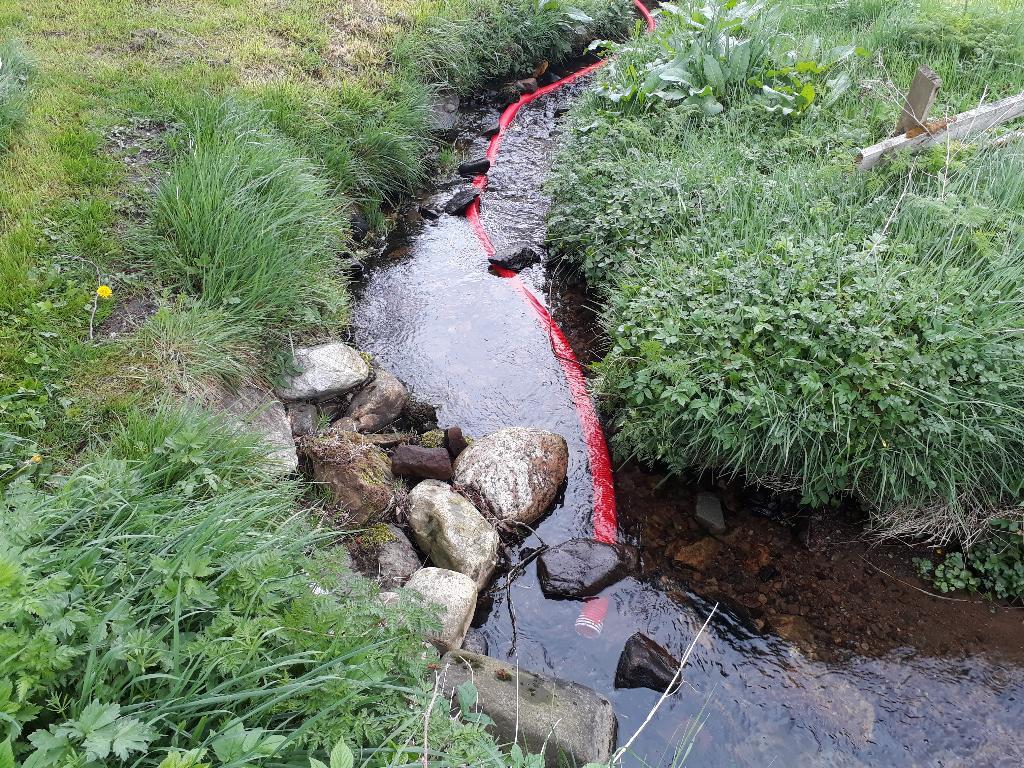
I think what this has done is show how much water you need and how much head to get a useful amount of power. My initial thought was just an undershot water wheel at pretty much that constriction in picture 1 above where the red pipe presently starts from. Although the flow is fast there, the same equations apply and the power you get out is proportional to the flow in litres and the head it falls. An undershot water wheel at that point would deliver in minute amount of power because the head is only what it self creates to turn it.. But yes you could put a whole load of them along the burn. I won't just leave the pipe like that, it will be buried somehow. I have one low power candidate motor so I might just rig up a "Blue Peter" water wheel and try flow I have from that pipe and see what I actually get. It seems odd that 2L per second at 1.3m head only generates about 30W. Why do I feel if I was asking the question, what power of pump do I need to pump water uphill by 1.3m at a flow rate of 2L per second, the answer would probably be a lot more than 30W? -
Small scale domestic hydro power generation project
ProDave replied to ProDave's topic in General Alternative Energy Issues
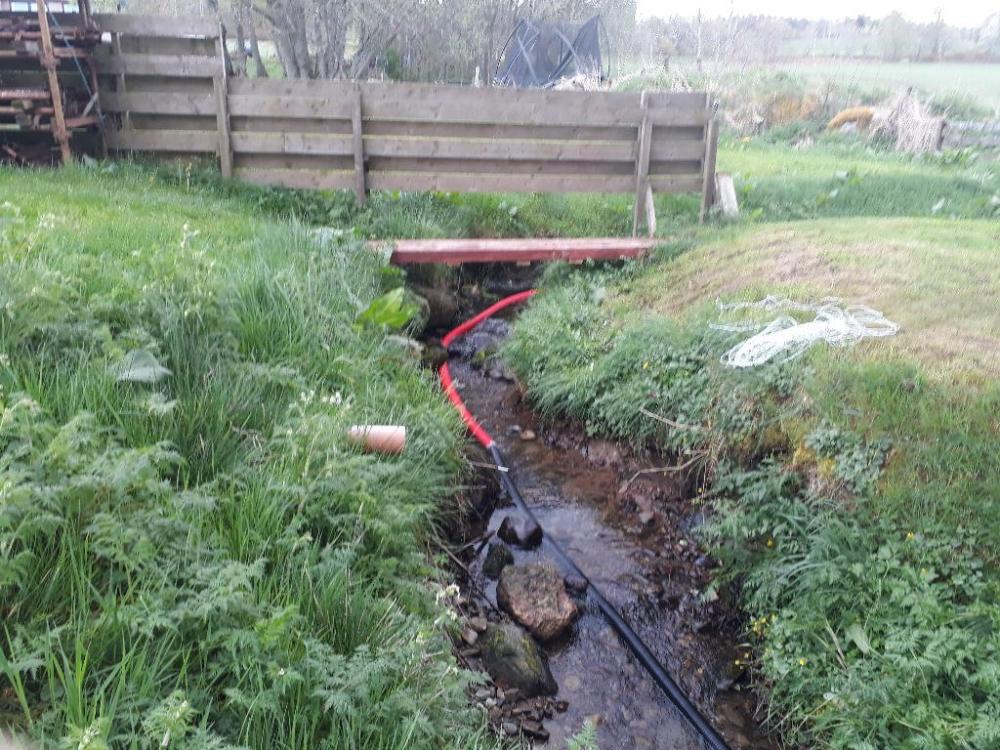
So I have done some more. I remembered where there was a spare coil of black electrical ducting, not ideal but good for my test work. So we have: Spare length of mvhr ducting collecting the water at a bit of a natural header pond right where the burn enters my land. that goes round the S bend in the burn. Where that runs out, it joins to the black electrical duct, a bit smaller and a tight fit inside the mvhr duct That black duct then runs as far as it reaches which is only a couple of metres short of where the burn departs our land At the end of that we still get most of the flow I had before, perhaps 6.5 seconds to fill the 12L bucket so say 1.8 litres per second. The head is now 1.4 metres So putting that into the page linked before gives a grand total of 24 watts I bet you would be lucky to actually get 15 watts of electricity from that. The only way to do this I think is is to treat is as a fun project and make a large water wheel for the water to run over as a garden feature and any power you get from it is purely a bonus. Or find a cheap / free very much larger length of pipe to increase the flow rate.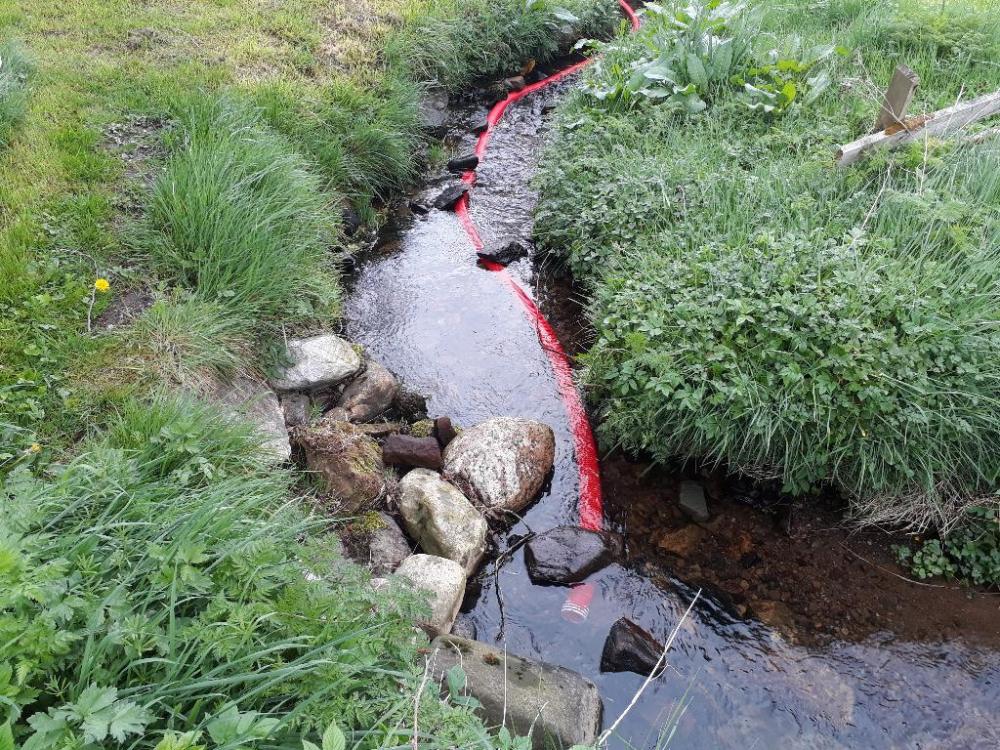
-
It matters not one jot what the pipe sits on, you just need to seal it with fire cement. Cutting a bit off the bottom will mean it sits on the top of the fitting so will sit more level while the fire cement sets. I would hold the pipe up slightly so you can fill all around with fire cement filling the gap then let it drop down so the tapered bit sits on the top of the stove fitting then leave it for the fire cement to set. But before you set it, you want to sit the pipe there, check it's upright, project up and mark and cut the hole in the roof for the twin wall section.
-
Not directly, but you won't get both utilities out together will you? (you would probably be a first if you do) So get water in first and back fill trench to depth for electricity and present that trench to them to install their cable. What I did with my shared 300mm wide trench was water in bottom along one side, partly back fill then duct for electricity the other side thus giving the 300mm horizontal separation.
-
RHI for new build with heat and electric meter
ProDave replied to mrshells's topic in Air Source Heat Pumps (ASHP)
Convert to same units, so it becomes 1625kW * 0.97 -259kW -
You are not the only one. I was at a house near us, on the same leg of this supposedly overloaded bit of the network and noted he had a lot of PV on his house and garage roof. How much have you got? 6kW. How did you get permission from the DNO and how much did they charge you for network upgrades? "I keep hearing about this notification thing but nobody notified ours or even discussed it" It was fitted a year ago by an MCS registered company. Oh and his smart meter has never worked so he has not received a penny in smart export payments.
-
Thanks. Lousy website by the way, the only information of any worth is in the brochure that you can download. My thoughts: That system puts the heat exchanger panel on the roof and the compressor unit in the house. Disadvantages. the pipework and gassing of the system has to be done by an F gas engineer so no DIY install possible, and it puts the noisy bit with the compressor inside your house. On the other hand a conventional monoblock ASHP comes as a sealed system requiring just water and electrical connections, so perfectly possible for DIY install (many of us have done that) and it puts the noisy bit with the compressor outside your house.
-
Your piddly little local tx is likely 20KVA or more. I am still waiting for someone to explain to me how such a transformer might be fried by exporting say 8KVA of PV in the opposite direction. I am convinced the DNO's in some cases are just trying to fabricate a situation to get the customer to pay for network upgrades that are needed anyway for other reasons.
-
Why do you think an ASHP is going to cost a lot to run? The amount of heat it needs to put into the house depends on your insulation and air tightness levels and your local climate. Even up here in the much colder Highlands, and with a larger house than you are proposing, and with the now much higher electricity prices, my annual heating bill is just over £300 It would be a good deal less in a less cold climate and a smaller house. And that is keeping the house heated to 20 degrees all year. Do you have a link to this "solar assisted" heat pump. I am not sure it does have less moving parts than a normal ASHP, just different parts.
-
Is it wise spending too much time detailing the house until you have a plot? I looked at 2 different plots and due to the different sizes, orientation and surroundings, the house I built on each would have been very different.
-
Small scale domestic hydro power generation project
ProDave replied to ProDave's topic in General Alternative Energy Issues
So i had some time on my hands this morning. Time for a paddle around in my wellies. The only bit of "hose" of any size I have is a left over length of mvhr ducting, about 70mm diameter from memory. So I drop that into the burn at a high point, finding a good place that is a natural bit of a "header" and roll it out down the burn. The bit of pipe I have is nowhere near long enough. So at it's lower end the water I have collected has a head of about 0.5 metre. If I extrapolate that to the full length of the burn (assuming the fall is constant, it's not far off) I would get to a little over 1m head, perhaps 1.5 if I get creative with where I take the water at the upper end. The flow rate coming out of my pipe at 0.5m head is 2 litres per second (it takes 6 seconds to fill a 12L bucket) So if I plug those optomistic figures of 1.5m head and flow of 0.002 m3/s into here https://www.engineeringtoolbox.com/hydropower-d_1359.html I get 29 watts. That's before you even think about generator efficiency. Now obviously if i could find a nice long length of some form of hose that was a much larger diameter, I might get better flow rate, or even 2 lengths of this pipe might bet me up to just over 50 watts. Clearly this is never going to be a serious amount of power and is in the "fun" category if ever I actually do anything with it. About the only thing I could say is perhaps catching and piping water like that might work with a breastshot water wheel at the bottom. -
If you want to do it accurately, that is the calculator to use, but you do need a good understanding of the makeup of the building to work out the U values of the walls etc. Heating with an ASHP can be zoned like any other heating system, we have 3 zones for the 3 rooms downstairs, but in practice there is little variation room to room. Many don't bother and treat it as just one big room. i calculated our heating load for an outside temperature of -10 which is actually common for a week or more in winter up here, sometimes even longer, -18 being the coldest night I have recorded so far. You won't get that cold where you are of course.
-
That''s another good point about air tightness. Check what the building regs say where you are. Another builder near me was set on PIV but then he had his air tight test done and the result was "too good" so building control insisted he fit mvhr, which was a lot harder part way through the build. It would seem insane to deliberately make your air tightness worse just so you can use PIV. Also the stove if you are going to fit one, choose one that is "room sealed" i.e. it draws it's combustion air direct from outside through a duct, not from the room.
-
Most people on here have experience of low energy houses "it's what we do" Wood burners are a marmite subject. I have one and use it mainly because we have trees and free wood. If I dod not burn it I would be giving it away to someone else to burn. If i had to buy all my wood I am not sure. Please don't kid yourself they are eco friendly. Some people seem to think that the CO2 that goes up the flue from a WBS is somehow "good" CO2 but to me it is just the same as if you were burning gas or oil. A WBS is a single point of heat (unless it heats hot water) so your problem for whole house heating is moving that heat. We find with a 2 storey house with a central stairwell that is easy, but less easy to move the heat around a single storey dwelling with lots of walls. Once you get a building very well insulated you find if you do the sums that ventilation heat loss dominates, which is where MVHR is good because it eliminates most of the ventilation heat loss. PIV just draws cold air in from outside and expels warm stale air Whatever you do, I would put under floor heating pipes in. Then if you find your passive heating does not work as you expect you can add another heat source such as an ASHP. It would be a major job to fit UFH later on. Some on here have such a low heating need they just use a Willis heater (immersion heater in a tube) to heat their UFH
-
The only way to answer that is get a quote from the DNO for a new connection. Only they know what the local network can support and where you can take a supply from.
-
As I feared, the two "used to be sat on a wall" are now effectively one joist, spanning a longer distance than they did originally, and with the added complication that there is a joint in that now effectively longer joist. Definitely need a SE to first tell you if that joist section can actually span the longer distance now the intermediate wall has gone, and if so is that joint adequate to do so or does it need some reinforcement.
-
In a rough area by all accounts, literally in the shadow of a tower block. Right at the start the local low life set fire to their static caravan and so far nobody else has started on the other 5 plots in the self build development.
-
Another 'Cool Energy' heatpumps thread
ProDave replied to HughF's topic in Air Source Heat Pumps (ASHP)
Any programmable room stat should do that. You don't set on or off times, you set what temperature you want at what time of day, so you set your daytime period to one temperature and the night temperature a few degrees lower. -
Quoted £4000 + on a getting unto spec to EIRC standard
ProDave replied to centralLondonJOHN's topic in Costing & Estimating
So you have 2 separate supplies so 2 standing charges. You would do well to get one of those disconnected and run the whole house from one meter. -
Quoted £4000 + on a getting unto spec to EIRC standard
ProDave replied to centralLondonJOHN's topic in Costing & Estimating
There's a lot that does not make immediate sense there. Two supplies? Two meters? 2 consumer units? So one labelled "house" and one labelled "flat" Is this quote to upgrade both or just one? If both you want separate consumer units. If they are two linked properties under one ownership you really want both upgraded not just one, but I would much prefer to see the flat CU actually moved into the flat. Seeing that the job has got more complicated, but the same principle applies, you only NEED to upgrade the C1 and C2 items. Care to post the actual EICR suitably redacted to anonymise it? -
Agreed that looks great. More details in due course please. And another one here very happy with our builder, but I suspect being in the trade and working on a job with those builders previously so I knew their work and how they were to work with did help in the decision making.
-
50mm liquid screed UFH with Sunamp as storage
ProDave replied to westcoast's topic in Underfloor Heating
But when a SA goes wrong? Some reports of failures. You can't just swap the heating element out when it fails. What will it cost to repair if it breaks after the guarantee has expired? Compared to a HW cylinder, every plumber under the sun knows how to swap a failed immersion heater for not very much money. -
Quoted £4000 + on a getting unto spec to EIRC standard
ProDave replied to centralLondonJOHN's topic in Costing & Estimating
If you just want a satisfactory EICR then just get them to quote individually to correct all the C1 and C2 items. Perhaps you might want to list the C1 and C2 items stated on the EICR and a picture of your existing consumer unit. -
Quoted £4000 + on a getting unto spec to EIRC standard
ProDave replied to centralLondonJOHN's topic in Costing & Estimating
Where I take issue with such a precise quote as that, is it is IMPOSSIBLE to actually quantify the time required to do each aspect of the job in advance. If it were me I would be quoting for the materials cost for each bit of the job and an estimate of labour for each bit of the job. NOT all items quoted are required for a satisfactory EICR. Like the smoke alarms or the sockets in the loft to avoid extension leads. That should be your choice which items you get. Just one working socket in the loft would satisfy the EICR and it's up to you if you get more fitted or use extension leads. Oh and find someone charging less than £85 per hour. Hager are good but not the cheapest, you can get a perfectly good CU for less money. Some things you can do yourself like pop the downlights out and cut the insulation away and pop them back in,