

ProDave
-
Posts
30862 -
Joined
-
Last visited
-
Days Won
427
Everything posted by ProDave
-

Ivt air x 50 ashp ebay bargain or .... not
ProDave replied to Jacob's topic in Air Source Heat Pumps (ASHP)
Or this? https://jsenergi.eu/ivt-spare-parts/by-model/ivt-airx-50/rumstermostat-rt-2000-rc100-lcd.html -
Ivt air x 50 ashp ebay bargain or .... not
ProDave replied to Jacob's topic in Air Source Heat Pumps (ASHP)
Any good? https://jsenergi.co.uk/ivt-can-room-controller-lcd.html -
They don't look anything special to me probably some form of pine.
-
Officially confused about first floor wet UFH
ProDave replied to Tadpole's topic in Underfloor Heating
Our last house, built nearly 20 years ago to ordinary standards of the time had wet UFH upstairs and down and it needed it and it generally worked very well. The present house we finished lat year is built to much higher standards, close to passive house, nice and air tight and well insulated. This one we did not fit any heating upstairs apart from UFH in the bathrooms to take the chill off a tiled floor. This had proved entirely satisfactory even up here in a cold Highland winter, the bedrooms are always warm enough. In fact at times I get the complaint that the bathroom floors are cold and "it is not working" That is because the bathrooms are up to temperature and the UFH has shut off and the floor cooled down. -
Imagine the noise of a 1kW compressor running for 7 hours to charge it. Then imagine a 1kW compressed air generator running for 7 hours to discharge it.
-
Ivt air x 50 ashp ebay bargain or .... not
ProDave replied to Jacob's topic in Air Source Heat Pumps (ASHP)
Can you post as much information as you have e.g circuit diagrams, instruction manuals or links to them? -
3 Phase metering in a 60's built domestic property
ProDave replied to Old Sparks's topic in Introduce Yourself
Electric under floor heating in the 60's with probably not much insulation is going to consume a lot of electricity. Forget estimates take actual readings of each meter. But please post some photos we may be able to explain it a bit. -
Yes I built my own, but I "cheated" and had separate current clamps for power going to the house (consumed power) and power coming from the inverter (generated power) so that made life easy. Before that I did experiment with a single current clamp and comparing the phase of the current waveform to the voltage, but although it worked, some loads, I recall the washing machine in particular, really confused it. If you are going down the road of roll your own, look at the electricity meter chips. They have cracked this to perfection so they should be able to separate import and export for you to use.
-
3 Phase metering in a 60's built domestic property
ProDave replied to Old Sparks's topic in Introduce Yourself
Post a picture or 2 of the metering? -
3 Phase metering in a 60's built domestic property
ProDave replied to Old Sparks's topic in Introduce Yourself
It must be the energy usage that is horendous. If you split my house usage over 5 different meters and then summed the usage, the result would be the same. -
Does anyone understand how ADSL broadband actually works?
ProDave replied to ProDave's topic in Boffin's Corner
Well I just received a message from BT telling me the fault has been resolved. A quick speed test shows that it most certainly has not been fixed. So i have now raised it as a "complaint" that that fault has not been fixed in spite of what they think. -
I have often wondered why those no longer exist. But I suspect they use so little water that unless they were inteligent enough to dump the slug of cold water in the pipe and only actually really start filling when they detected hot water arriving, the saving might be minimal.
-
Planning permission for static caravan in garden
ProDave replied to Guest28's topic in Planning Permission
Yes band A council tax. Have you chosen your house name yet? we had and the static was registered on the valuation list as the house address prefixed by "caravan" so when the house was complete, that entry could be removed and the house address could be added. Strictly you should have PP but Scottish law allows you to install temporary accommodation for workers, and in any event if the planners get snotty, your first redress is to submit a retrospective planning application for the static caravan, and the timescales you are talking of, you will be moved into the house before that is settled, so I would just do it. -
Does anyone understand how ADSL broadband actually works?
ProDave replied to ProDave's topic in Boffin's Corner
Yes that is my belief. A dodgy connection in that underwater connection pit. but an intermittent connection, and annoyingly, on the 2 occasions so far an OR engineer has visited, it has been working fine, and half an hour after they have gone, it is back to rubbish. Now I have found the BY wholesale speed tester has the ability to download and save a log of a test result, I have a load of saved rubbish test results. Right at the start when we had the poor connection when the line was new, BT sent me an EE 4G router (and we know we get a good EE signal here) I could not get it to work. Each time you complained about that, it was a multi day turn around while they adjusted something before you could report a failure again, the hard wired line was fixed before we got the 4G router ever working. -
Boarding a warm roof / cathedral ceiling
ProDave replied to markocosic's topic in Plastering & Rendering
Very much like our roof single boarded with 12.5mm plasterboard, no cracks. The only thing I did different was before fixing the battens to create the service void, I lined the entire roof and all the walls of the house with air tight membrane. Only just started fitting the service void battens then in that photo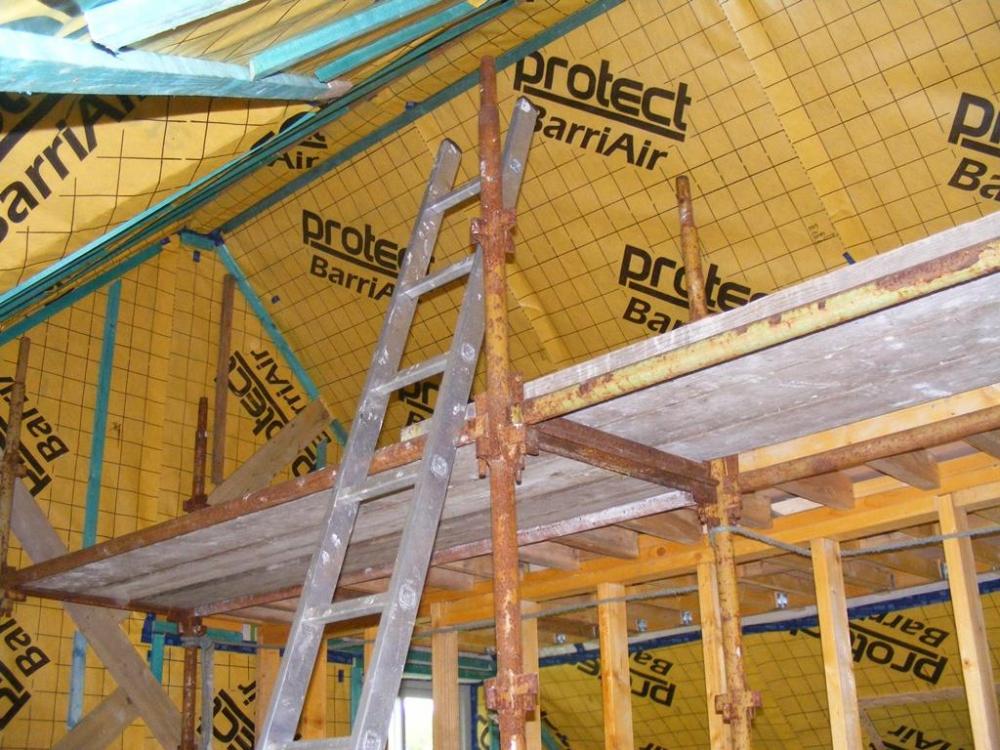
-
Does anyone understand how ADSL broadband actually works?
ProDave replied to ProDave's topic in Boffin's Corner
You are right about getting the fault taken seriously. When the line was first connected about 5 years ago, we had a very poor speed, less than 1MBPS but at least it was consistent. I knew we should get better and on that occasion on the second OR visit the guy checked all the connections in the street and found 2 adjacent connection pits full of water with corroded connections sitting under water. He re made those connections and got us up to just over 3MBPS. So first OR visit this time I encouraged him to go and look, and he found the same thing, full of water, and connections under water. He did not mention if he actually re made the connections or not but he did bale out the water. Second OR engineer was having none of that, "the line tests fine" so would not even investigate further. -
Related of course to an ongoing fault that we have. We are 3 miles as the crow flies from the exchange, no doubt further by the route that a collection of tatty thin bits of twisted copper wire wind their way from the exchange to our house. But when it is working properly it delivers our ADSL broadband at a speed of 3MBPS. although slow it is is usually dependable, usually works, and can even stream tv over the internet. But for 2 weeks now it has been acting up. Instead of being the reliable dependable connection the speed has been all over the place, often dropping out completely (the logs show it was dropping out 9 times per day roughly) So the fault has been reported to BT and so far we have had 2 Open Reach visits, both declare the connection from our house to the exchange "good" and leave saying it is "an equipment fault" but 2 weeks on, the fault is still open and not fixed. so I am trying to understand how this actually works. The symptoms are quite simple, you can run a speed test (I have become familliar with several different ones over the last couple of weeks) and you can get anything from just over 3MBPS to 0. For most of the last 2 weeks it has mostly been hovering just under 1MBPS, Oddly quite often when testing it reports the upload speed as 0 even if the download is working. The router reports it is synced at a line speed of 3.769 MBPS. Now in simple terms I see that as a constant "carrier" over which data can be sent up to somewhere close to that bit rate. So how, if that connection remains there, can the actual speed drop so low so often? Any insights into how it actually works and in particular how it connects at the exchange? The fact the fault is still open after nearly 2 weeks suggests BT don't know much more than me about how to fix it?
-
As they will likely break the 45 degree foundation of the retaining wall, you would need to invoke the party wall act and appoint a party wall surveyor to ensure their construction and any alterations to the retaining wall are properly designed and properly constructed.
-
That's a much better representation of how it will look.
-
Put it right now. I have found planners not to always be very technical and able to interpret drawings. If they think from that front elevation that the roof is not stepped back as they want, they might fail it simply because they cannot properly visualise what you are trying to convey. Or they think you are trying to pull a fast one and give the impression the roof will be stepped back when you have no intention of doing so.
-
Lath and plaster, the bane of an electricians life. DO NOT attempt to fit flush downlighters, been there tried to do that. If the laths are still there and good and it is just the plaster that has crumbled away, I would just fill it with some quick set plaster / filler to bring it back level, wait for that to set thouroughly and then fit the light. If it's upstairs and you have access use longer screws and a batten held in place from above while you fix the light fitting.
-
That is what I was trying to say, you should see a diagonal line on the roof where the main roof steps back to the extension roof. The front elevation suggests is is just the main roof sailing over the extension. You can be forgiven that mistake if you did them yourself, but if you paid someone, sack them.
-
I am not sure your drawing is correct, who drew it? With the extension stepped back from the main house I would expect to see a distinct line in the roof stepping back that your drawings don't show?
-
Plans in for approval keep having to be changed
ProDave replied to Deejay's topic in Planning Permission
If you really really want the room above, let them reject it and try an appeal? -
What capacity supply did you apply for? and on who's recommendation was that? How many existing houses supplied by the present transformer?


