


HughF
-
Posts
1366 -
Joined
-
Last visited
1 Follower

HughF's Achievements

Advanced Member (5/5)
287
Reputation
-
The overall objective is to replace the damaged stuff and at the same time increase the weatherproofing, whilst having something that is low maintenance. There are sections where the oak is deformed to the point of the hornets find every gap and nest in the walls…
-
16mm alpex, as long as it’s wras approved….
-
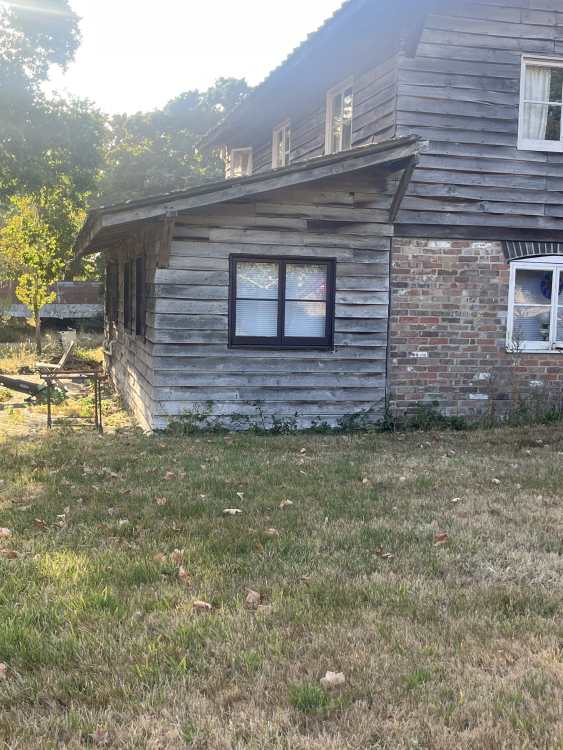
I’m considering my options for replacing the square edge oak cladding on my ‘shack’ (see attached photo)… the wall construction is 4x2 on 16” centers, with building paper on the outside and wood fibre insulation board on the inside. What would people do in this instance, 11mm OSB -> house wrap -> batten -> cladding? I’ve been considering going straight over the top of the 4x2 with insulated industrial wall panels, I’ve also considered importing half a container load of 16mm metal/pu cladding from China, and I’ve considered going for regular wriggly tin… I’ve also considered whether the coated OSB from the US (zip system) is available here, as that would be an ideal product to go underneath whatever surface finish I apply. The current square edge oak is warped in places, and rotting in other places. Is render board and render the correct answer here? Open to ideas and options. *yes, I’m replacing the windows soon
-
Looks like the party is over....
HughF replied to Beelbeebub's topic in Air Source Heat Pumps (ASHP)
Remove the stupid planning restrictions around outdoor condensers and just pivot to air-air for domestic heating - much cheaper, easier to fit, f-gas industry is already existing and the units are already ‘smart’ out of the box which apparently people want these days. Oh, and they cool out the box. -
Looks like the party is over....
HughF replied to Beelbeebub's topic in Air Source Heat Pumps (ASHP)
Even if we do, it’s far more efficient to burn it in a CCGT, transmit the energy to the home as electricity, then run a heat pump with that electricity than it is to pipe the gas and then burn it in the home. Breakeven point for efficiency is a scop of 2.8 iirc. -
Looks like the party is over....
HughF replied to Beelbeebub's topic in Air Source Heat Pumps (ASHP)
We could use the same logic with taxi drivers - Taxi drivers don’t buy premium cars. They buy cars that give them minimum cost of ownership whilst doing the job they need to do. The big house builders fit the cheapest thing that does the job. Generic 70mm uPVC, minimum cavity insulation, ideal logic combo boilers. I’m not talking about the people who frequent this forum and build ‘decent houses’ - I’m talking the big national house builders where it’s all about maximising profit whilst just about complying with the minimum standard set by BR. They’d fit electric panel rads because they’re dirt cheap. -
Looks like the party is over....
HughF replied to Beelbeebub's topic in Air Source Heat Pumps (ASHP)
If you didn’t mandate it, the house builders would just fit electric panel rads as they’re cheaper. House builders always aim for the cheapest option. -
Looks like the party is over....
HughF replied to Beelbeebub's topic in Air Source Heat Pumps (ASHP)
And that is how it should be done…. -
Another 'Cool Energy' heatpumps thread
HughF replied to HughF's topic in Air Source Heat Pumps (ASHP)
That’s a good place for it. A lot of other manufacturers already have flow temperature sensors installed internally so even when you do run them with a buffer/llh/plate/whatever you don’t need for an extra temp sensor. SPRSUN doesn’t have an internal sensor so the buffer probe needs to go somewhere. -
Another 'Cool Energy' heatpumps thread
HughF replied to HughF's topic in Air Source Heat Pumps (ASHP)
Pretty much, yep…. the new grant r290 hydraulic schematic appears to be properly designed (no buffer, no trv heads, single zone)… most of the others I’ve seen are just standard buffer + secondary pump. Especially Chinese ones. -
Another 'Cool Energy' heatpumps thread
HughF replied to HughF's topic in Air Source Heat Pumps (ASHP)
Standard SPRSUN design choice - commonly used in China where electricity is cheap and they’re competing against direct electric heat so any cop is a good cop. I see it in 75% of the Vaillant schematics too, which isn’t very good I just taped my buffer probe to the 22mm that feeds the rads and covered it in insulation. -
Another 'Cool Energy' heatpumps thread
HughF replied to HughF's topic in Air Source Heat Pumps (ASHP)
Got it... yeah that's the exact same terminal strip pinouts as the older invertech units, with the exception that the invertech has an internal pump already wired in. It should 'just work'...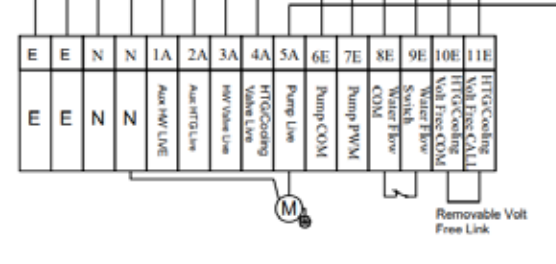
-
Another 'Cool Energy' heatpumps thread
HughF replied to HughF's topic in Air Source Heat Pumps (ASHP)
Looks like the primary pump is inside the unit... What do you need an external pump for, and where did you intend to get the PWM signal from as there's no terminal for this broken out on the main PCB. -
Another 'Cool Energy' heatpumps thread
HughF replied to HughF's topic in Air Source Heat Pumps (ASHP)
Do you have the manual for the ET-10, I can't find it on the CE website... -
As I've been digesting the Vaillant schematics for someone else, attached is the one that will give you what you asked for. Arotherm plus RADS + UFH no buffer.pdf


