


Gus Potter
-
Posts
2383 -
Joined
-
Last visited
-
Days Won
34
Everything posted by Gus Potter
-
From what you say I don't think you are being unreasonable. The following is based on the premis that you have contracted with the Architect to provide a design that meets your requirements and a design information package that is sufficient to enable BC to confirm that, after making reasonable enquiry, your proposals meet with the requirements of the building regulations. I agree. You could end up having to submit endless revisions.. who pays for that and who pays the Builder for the changes? Now that is a good idea. Find a friendly SE and they will easily be worth their fee. Remember that SE's also often know a lot about the Architectural side and so on. The professions cross fertilize. That I find odd as the Architect should at least be providing some guidance here. How on earth are all these different interfaces to be coodinated? What about condensation at the interfaces. Do you have a solum space that you need to infill to install the slab for the UFH? There are lots of things that fall into the Architectural remit. From what you say it raises an eyebrow. To get the best out of BH maybe post your design package after removing identifying info, you'll get plenty info here, as you know, which will put you in a better position to take an informed view. Just check.. the Architect may have copywrited it all so let common sense prevail.
-
Insulating suspended floor from below - VCL?
Gus Potter replied to andyscotland's topic in Heat Insulation
I too have a 1960's house, want to insulate the living room floor. Good news for me is that it's not a kitchen or bathroom so moisture levels will be not too severe. Problem I have is that the joists are built into the inner leaf of masonry on a timber wall plate. Yes.. the inner skin is carrying all the roof load plus two stories of masonry above! I'm still trying to get my head around the best way of doing this. Big worry is that if I cause damp / condensation in the wall plate the whole house will drop! Will keep mulling it over. There must be a way! That is as far as I have got to date, like you that list is a journey.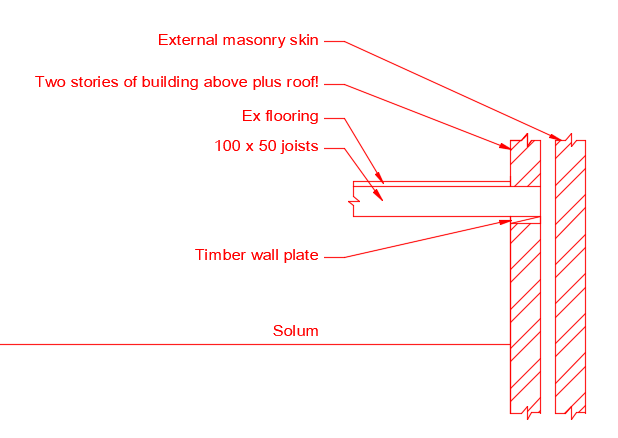
-
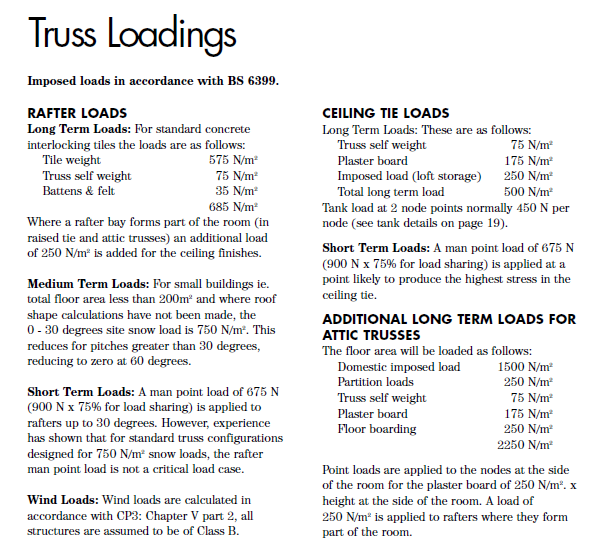
Yes Nick good point. Below is a screenshot from a typical truss manufacture. The loadings they use have been in common use for a long time so you can take these as a guide to an old cut timber roof. For ease of reading 100 N (Newtons) = ~ 10 kg so 250N = ~ 25 kg. The load we are looking at here is in the second column in the ceiling tie loads.. called imposed load (loft storage) .. that also includes anything you put on top of the original timbers @Ferdinand.. any legs, secondary flooring and so on. Confusion often arises as there is a difference between long, medium and short term loads in timber design. A bit of wood will carry quite a bit more weight if it is just subject to a load (short term) like a person of "large stature" walking about in the loft checking the plumbing.. but like glass it is less able to carry long term loading such as storage and the bits and bobs ( eg, extra flooring and insulation) folk put up there long term. Loft storage is considered a long term load for design purposes. But if you put a 50 kg tent and can be sure that after you have put in a "secondary floor" that spreads the load about and it will not overload the roof structure then you are good to go. Roughly you often find that if you put in an extra layer of flooring you can add another 10kg per sq m of say xmas decorations. Now to be on the safe side you need a lot of secondary unloaded floor! What folk often do is to say, can I put the tent over a load bearing wall below? Now you need to use common sense and make sure that the wall is truly load bearing all the way down the building. If so then the tent will have little impact compared to the weight of say a load bearing masonry wall.
-
If you want post your plans. It may be that there is scope to have a look at some value engineering SE wise. It may be that SE wise you can't make savings but at least you'll know you have looked at it and have peace of mind that you have looked at every possibility, important before you start to compromise on the things you want.
-
Prices of building materials moving forwards
Gus Potter replied to James Frome's topic in Costing & Estimating
Very hard to predict at the moment, I've heard Network Rail are trying to lock in prices on some of the more specialist work by not going to competetive tender, on the other hand on the domestic side I'm inclined to think things might cool off significantly. In any event having been in the construction industry for nearly forty years, about half that time being a contractor it seems that every seven years or so we get a big down turn.. you set yourself up, maybe buy some plant, even a bigger yard!.. employ more folk and just as it seems you have cracked it and made a little money it all goes downhill fast! That is me using the seaweed test, and if you believe in that we are due for a downturn anyway. Good news ahead for the self builder.. but problem is you can't rely on the plot / house value increasing to make the finances look good. If you do it right though and spend the time on good design and cost control you should still weather most storms. -
Do foundations look right on house purchase?
Gus Potter replied to HazG's topic in House Extensions & Conservatories
Hello HazG Fantastic, still remember when I bought my first house, was a flat but great feeling. You are a step ahead already! Yes, the general concept (particularly in Scotland) is that once you get the thing poking out the ground you have satisfied all the planning condition in terms of a "start" Check the planning portal to make sure they notified planning that they have started work. Before you think about the founds and the floor slab can you tell us why the seller did not complete the build. You'll get loads of help here on BH but to get the best out of it then you need to start at the very beginning.. and work up from there. -
Thank you for your kind words, much appreciated. It took me a bit of time to craft that. It's not perfect but BH is great and nobody jumps down your throat for a typo etc. That said I learn loads here from other folk so for me it's a two way street. You give what you can and your efforts are returned in kind. Hope tomorrow is better.
-
Hi Kelvin. Yes it looks like a Larsen type but what your drawing shows is the outer stud resting on the underbuilding. Could be a quasi Larsen? great proven concept. the Larsen truss. The true Larsen truss allows you to put the load down the inner studs only and this lets you develop a great weather proof detail at the bottom. If you are going for underfloor heating in particular I would go back to basics. Thicken the perimeter insulation up to 100mm PIR and take it down to the top of the founds. This way you actually insulate the dumpling of soil inside the building. Your designers will turn various shades as it will likely be outwith their scope of experience.. but that is what we do in industrial design from time to time. If you keep the floor screed slab back a bit you can carry the perimeter insulation up to the underside of the insulated plasterboard and now you have minimal thermal bridges. Yes in the round use thermalite for the underbuilding.. but check with the SE as you need to be able to prevent building uplift and sideways sliding of the house and that is hard to make work in thermalite. Often we will have holding down straps and fixings between the inner bottom rail and the underbuildings. Let us know how you get on at your design meeting.
-
Welcome from me also. Gus
-
Hopefully this helps BH folk get a further insight into the ins and outs. Here a few extra of my own thoughts. Take two cases. Case 1.. a simple ground beam spanning over a drain resting on a couple of pads at each end. Case 2.. say an ICF basement, raft slab with a waterproofing system. In both cases SE say works out the loads and designs the concrete and sizes the rebar. Then often produces a basic reinforcement layout drawing showing bar sizes, concrete cover, durability etc and a few important details; say the lap length, key corners and so on. The SE will usually carry out a review to make sure that what they have designed can be built "somehow?? " (I hear some of you laughing) and markup up the drawings with some CDM notes and so on. This is then passed to the "lucky" Contractor who has to get on with it. The temporary works are delegated to the Contractor as are all the other problems that go with this type of work. The SE may then be engaged to come to site to check the rebar sizes, spacing and so on just before it is all ready to pour. Now that can work ok on large projects where the Contractor maybe has their own in house Engineers who can do all the temporary works design, carefully check the rebar type, spacing, that the bars are all in the right place and has lots of experience. On small domestic projects this often causes problems as smaller contractors / general domestic builders just don't have the breadth and depth of experience or maybe the resources in house. They often need to get someone else in to do the rebar schedule / provide a price so they can tender properly and so on and this comes at a hidden cost, then the need to install all the bars and shuttering and hope for the best. In summary when things don't fit up on site and the concrete is ordered a lot of money can be lost (tempers fray..) usually by the self builder / domestic client. Designing rebar so it fits and the schedule. Once you have done your "SE" bit the next step is look at the bars in detail and start by thinking "what can go wrong here". Extra long bars or bars that are not basically off the shelf at local stockists could come distorted due to bad handling or may be on a longer lead time.. important later if one or two get damaged on site. Cutting and bending rebar is not an exact science, even with modern machinery. All bars have a length cutting tolerance and when you are setting up the bender the first bar may not be quite right, but still in code tolerance. The ones made on a Friday afternoon may not be quite the same as the ones made on a Wednesday at 10.00am. Some can be over bent, some underbent. Also you get what is called spring back, steel is springy so when you put a bend on a bar all bends won't be the same and this can result in quite a difference and this causes problems at corners as for example. You can reduce the concrete cover to the bars. Remember that the bars when they go into the bender may not be perfectly straight to begin with. If that is not bad enough you have to allow for a tolerance on the shuttering. A shutter that is leaning in coupled with a sprung out bar can leave the bar with little of no concrete cover, and as @saveasteading says in cases they just won't fit at all. Bars that lean in can cause bar conjestion and that means that you can have zones where the concrete is not able to be properly compacted.. to be avoided. Often you say to yourself. Hey if I put laps here I can avoid problems with bars fitting over a wide length between two shutter faces. If I'm using cranked bars in say a basement slab with top and bottom bars can I allow the contractor to move the bars a little in case the cranked bars are a little off. If so, how do I convey this "get out of jail free card" to the contractor. Once you have figured this out you go back and check that the SE design has not been compromised. The bar bending schedule is then relatively easy to produce as you have done all the hard work. Then you check it all again! It's not just burning it's white hot! Take case 1. A simple beam. I'll do the schedule just working off my 2D cad drawing. Often I'll do this for a nominal sum (fee) especially if it's for a contractor I work with regularly or just "good" for the job. If I make a pigs ear of it then I would expect to foot the bill, but that is a commercial risk I take and is lumped in with the rest of the SE design. Case 2. Ah! Quite happy to do the schedule.. here I say to myself.. 2D is not enough, the risk is greater. What I do is to use say Tekla detailing and model the rebar in 3D and put in the shuttering lines. Now I can really visualise where the problems lie and work your way round the model fixing problems, thinking about buildability, pour sequence and size, the weather / time of year etc.. while all the time asking.. have I compromised the SE design. Another aspect here is to make sure you have all the other information you need to coodinate any service penetrations, water bar details etc. Once all that is done then the schedule is the easy bit especially as the software does a lot of the hard work. But again once you have the output from the software I would spend at least a day checking it, just counting bars and so on and a few other things. Lastly you need to check you rebar spec and so on. Quite happy to do this, put my head above the parapet.. someone has to so why not me? If I get it wrong the bill will land on my door step. However I charge accordingly to carry this risk and am careful about the contract terms. Am I just liable for the bars that don't fit or am I liable for any project delay for example. One claim could be a few hundred, the other many tens of thousands. That is something I discuss with the client about what level of risk they want to take on and how much I will charge for the various risk levels. Usually a sensible agreement can be reached where the risk is shared in an equitable way. The main thing is to have the discussion: Is my fee going to result in an overall saving to the client and deliver what they think they are paying the contractor for in terms of build quality and so on. If yes.. then cart on. Another option is where the Client novates you to the Contractor to do this. Basically the Contractor employs the SE directly and carries the risk. But on self build this is complex contractually especially when you are trying to nail down prices to get say funding for the build. In summary. If you are self building then the above is worth a look at as an approach. It's a balance. The more you spend on the design information the easier (we hope) it is for builders to deliver. Also less risk at tender stage as contractors if they are unsure at tender stage about something will just add on a big number and think to themselves.. if I get the job I can afford to worry later about how I'm going to do it as I have a big profitable lump sum built into my figures.
-
Have a look at this guide to good lead work. Easy reading and should help you out. Tells you all about max lengths of lead and the code (thickness) of lead to use and where etc. It' one of my go to guides. https://www.google.com/url?sa=i&rct=j&q=&esrc=s&source=web&cd=&ved=0CAMQw7AJahcKEwjA-KCI3NH6AhUAAAAAHQAAAAAQAg&url=https%3A%2F%2Fwww.calderlead.co.uk%2Fuploads%2Fdocumentsearch%2Fid4%2FCalder-GTGLW-210213.pdf&psig=AOvVaw07OgmkkR7N57A4sfbm148e&ust=1665355815925499
-
But I know you know, you've just have had better things to do! Yes you get the direct shear and the bending force also creates additional forces that cause localised failure in the masonry. The maths bit I know you know. But it's how you apply the maths to this particular problem of a fixing that is not something that most folk wake up in the morning thinking about unless you are @pocster. We have the direct shear and the bending moment that I have decoupled so we have an approximation of the shearing force just at the point where the fixing enters the wall. The assumtion in this model is that we allow the masonry to crush under the fixing rod very slightly just at the point of entry to the wall. We know the compressive strength of the masonry so we can say.. how much area of masonry do we need under the fixing to resist the load. My guess was 20mm. Now we assume the force acts at the mid point so say 10mm in from the face of the wall. At the embeded end (the force is in an upwards direction here) we assume the same and that give us our lever arm. But for us to calculate the actual capacity of the fixing we need the quadratic function / solution because as the bearing length changes so does the lever arm and thus the forces. What I outlined above is just a very simplistic model. In reality the rod is bending and subject to curvature, the masonry is elastic to some extent and not rigid thus the bearing preassure over my assumed length will not be unifiorm. The masonry is not a uniform material. You could get closer mathematically by using a finite element model. The fag packet calcs above would get you on your way provided you leave say 40% margin of safety at preliminary design stage. In practice Hilti /Fischer say just put their fixings into things, test them physically and produce capacity tables. That is where the problem occurs on BH as folk are using fixings that are into old brick etc and they have not been tested for this.
-
Bar bending and reinforcement quantities! Have written this as I hope it helps all who are doing everything from ICF, piled extensions or just using rebar. I often do these on small domestic projects. I sell this as an extra to the Client by discussing first what type of builder they may want to employ. Take two cases: 1/ A house extension.. a few piles with a ring beam. Here your local builder (or you) could maybe get a piling contractor that leaves the pile heads. These are commonly designed at SE stage to be up to 75mm out of alignment and still be code compliant. Next the builder has to figure out how to connect the piles to the ring beam, the shuttering to say get the concrete cover right and all the bars in the right place. Now your local builder may find this a challenge. I say.. hey I'll do the schedule and a shuttering detail. Your builder can then send my schedule to the benders for pricing, make the shuttering and I'll nip by and check it before you pour the concrete. If you want the builder to sort it all out it will probably cost you more than getting me to lay it all information wise out on a plate for the builder. All they need to do is send my schedule out for pricing.. no hassle for them and if no hassle less tends to be added to the price. Or you can get a ground worker that will sub out the piling and do the ring beam.. but someone has to coordinate all this and that is something that comes at a hidden cost.. and you have to take a leap of faith that they are doing it correctly. Better to spend more on good pragmatic design info than have a bad day when it comes to the concrete pour or worse.. once the concrete has been poured and you discover all is not as you expected. Stepping up to say an ICF basement. Here I would push the Client to pay me to do the steel (bar bending) schedule. In fact I would be reluctant to do the job unless I had sufficient design control over it and be able to check on site. What folk don't realise is that when you bend rebar it is not an exact science (bends vary a lot!) and that you need to be very careful to maintain concrete cover, the correct lap length and make sure the concrete can be well compacted at particularly the corners and junctions as that is where you often get leaks. The folk that provide the ICF stuff don't cut you much slack if your bars and in particular the bend radius is a little off. The steel fixer will use what they are provided with and while they will often do their best they can't make a purse out of a pigs ear. Remember that rebar is very heavy and if a rebar cage falls over it could kill someone. I want to make sure that the tying of the bars and temporary stability bracing will be sufficient for it to stand safely during the construction phase. ICF suppliers.. their interests / priorities are not the same as yours when it comes to rebar and so on. Yes some SE's don't do schedules.. years ago it was part of an Engineers training to design a concete beam / slab and produce the bending schedule.. I still remember learning how to do it. The main thing for me is that if I do it say for a basement or say ICF, a retaining wall I have to really look and draw/ model how it is going to fit and if it can be built /poured. It's almost like a last design safety check as when you have to sit down and do the schedule / shuttering you can spot things that you may have missed. It's like another design review/ safety check. If it can't be built as per the design then it's not safe. I could pass design responsibility to say.. well who is going to carry the can.. that is what you need to ask. The sad reality these days is that few designers want to carry the overall design responsibility as modern Clients are often not willing to pay for what they percieve as an extra. Why.. because modern professionals often don't explain (and have often not been taught how to) to a client how they can make savings at the end of the day. I minded to blame the telly.. too much Sarah Beany, Homes under the hammer and Grand designs etc .. well I'm not going to blame myself? If you have the skill to convey to a Client that your way is the most cost effective, efficient and delivers and the Client is not of like mind then you need to walk away from that Client, let them get on with on it. Projects like that often only lead to disappointment on all sides.
-
Hi Jilly. Yes builder is onto something here. It might be worth seeing if you can fix a bearer to the external wall. Use that to support the high end of the roof. At the outside corners on some thing like this you could use a couple of essentially galvanised scaffold tubes to support the outside corners. If these look too slender then you could use a 76mm circular hollow section to get the appearance right. Your issue is going to be the ground if BC get involved. The loads are really small so you if you need to get this by BC you could say.. look this is a canopy, if so you may need to decouple from the dwelling and argue that it is akin to a smoking shelter and if it settles then so what. Here as the loads are so small you could go back to your driveway design and say.. hey the area under the canopy is the the same make up as the drive and this is designed for a 5.0 tonne axle load so the canopy on a concrete platt will be ok?
-
Hope this helps give some pointers that will help you frame your questions in the way you want. A 7.0 N/mm^2 unit strength dense concrete block wall weighs about 1800 to 2100 kg per m^3. An aerated (say Celcon ) concrete block wall weighs about 400 to 900 kg/m^3 and has a varying unit compressive strength. Remember that the light weight blocks contain air pockets.. the more air pockets the less concrete material to resist the loads so lower compressive strength but better u value. To make an aerated block the same unit strength as a dense block you need to use more cement for example and that is one reason why they are more expensive. The density is not usually a primary issue, it's the block strength that is considered first. In principle there is no reason why you can use an insulating block provided it has the same compressive unit strength. Just check you are not in aggresive ground for example.. always check with your|SE before you swap out materials. Also, check the mortar mix in case the blocks need a different spec. If the mortar is too strong it plays havoc with aerated blocks.
-
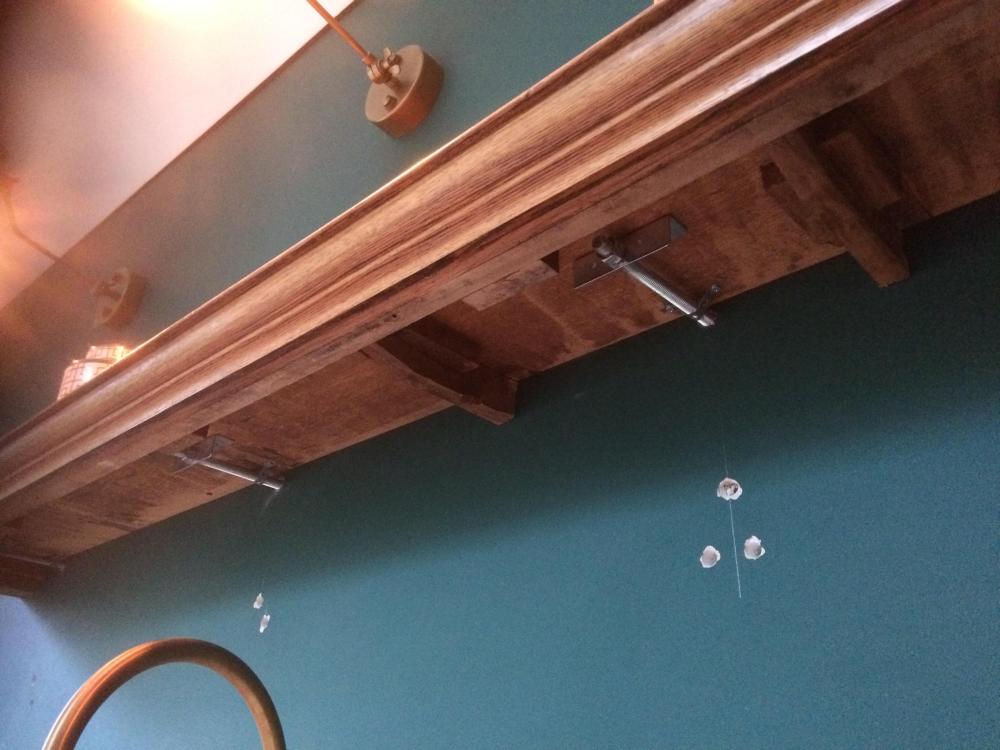
For ones into masonry have about 70 - 80mm embedment with really careful drilling so did not punch through the half brick thick wall. The ones in the photo are drilled into timber studs. These are structural studs but only have a modest axial load and very little wind loading so not getting bent top to bottom. Good point markc. Yes these kind of fixings are subject to a bending moment as well as shear. For non safety critical fixings like this you can calculate it out as a fag packet check. Have to say I did not do detailed calcs as it is my own house but if asked here is roughly how you prove it for a non safety critical fixing. The key is to let the shelf sit a fraction off the wall so it does not pry the fixing.. a tension force. Lets say you put 100 kg on the shelf and it is 2.0m long and your fixings are at 400mm centres so direct shear load per fixing = 100 * 0.4 / 2.0 = 20 kg per fixing. 20 kg is about 0.2 kN.. call this the working load.. an unfactored load. The 20 kg acts straight down the direct shear. A M10 /M12 threaded rod in a typical resin in soft brick will carry about 1.0kN to 1.2 kN in direct shear... all looks good. Until you see what @markc say about cantilevers. Say your shelf is 300mm deep and it is loaded front to back with books. The centre of action of the books is 150mm out say. Now you have a leveraging (bending) effect also.. which is 0.2 kN * 0.15m = 0.03 kNm.. seems a very small number until you start to think.. hey this rod only goes a little into the wall .. 70mm , the bricks / timber are soft and just where the fixing goes into the wall you have a highly stressed area of brick / timber. Lets say here that your first 20mm of rod penetration is required to resist the compression under the fixing.. and you need about another 20mm at the far end of the rod where it wants to move upwards. So the effective lever arm is now 70 mm less (20 + 20) / 2 = 50mm. Now a bending moment can be what we call decoupled into an up and down force in this case. So we convert the bending moment into an up and down shear as follows. 0.03 kNm/ 0.05m (the effective lever arm) = 0.6 kN .. and this is the extra force that is generated as marc says. Now we have to add the 0.6 kN force to the direct shear force = 0.6 kN + 0.2 kN = 0.8 kN. All of a sudden we have significantly increased the load on the masonry / timber although in this case it still looks ok. One other check to do is to check the rod in case it bends or deflects too much. That is why I tilted the rods up at a bit of an angle so when the shelf is loaded it lies level. Remember that the shelf in the photo is just for a few pictures and stuff... no where near 100 kg. For safety critical stuff we start with a fag packet sum to get a feel for things then we check carefully. We use some theory from steel column base plate design and write a quadratic equation and or use excel to solve iteratively.. then we get close and do further checks and so on. You often see something like this on the side of a motorway or the base plate stantions for railway pylons.. the base plate sites proud of the concrete base.. your shelves are the same .. but hopefully cheaper! There you go.. a bit of theory on flying shelves for a Saturday nights fun. That said this can be applied to all sorts of cantilever structures that require fixings into masonry.
-
Sorry.. Yes SE = Structural Engineering.
-
Floor loading understanding check please (long(ish) & maths content)
Gus Potter replied to dnb's topic in Boffin's Corner
Hi dnb and all. I'm a bit late to the table with this but will have a go at exploring as this kind of thing drives early design decisions / cost analysis / cost curves when you are planning your self build, extension or just renovating part of the house. Firstly have enjoyed reading all the other posts. Everyone makes great points. I'm going to have a go what goes on behind the scenes first then touch on some of the in's and outs. Ok you are doing a domestic dwelling, you get some calcs from the SE that reference various design codes. Could be Bristish Standard 5268 or Eurocode EC5. Both these design codes (as are nearly all design codes) are based on the probability of a loading event occuring. For example lets take snow loading on a roof. In the UK we design houses for a snow loading that has a recurrance / return probability period of 50 years. But we could get two snow events two winters in a row that may meet the maximum predicted fall over the next 50 years and then nothing for the next two hundred years. But if we design for a longer return period say snow in two hundered years then houses would become so expensive that we could not afford to build them. Also we need to look at the overall risk over the whole UK and what would be the potential loss of life and balanced that against the benefit to society of taking a pragmatic approach to how we calculate loadings. We may of course not get anywhere near the design snow fall. All I would say is go back and look at the last time all the farm buildings collapsed, they were designing these on a two year snow return period and had got away with it until they didn't. That was a main driver behind changes to the argicultural snow design part of the code. @dnb The floor loadings of 1.5 kN/m^2 ( about 150 kg/sq metre) roughly equates to a value of what has been deemed on basis of probability to be a reasonably safe figure given normal human behaviour in a house. What Engineers then do is to say.. lets put a factor of safety on this loading to account for the fact that folk may a bit daft and have a big party. Lets also add a factor of safety to the materials in case the timber joists you have may include one or two that have a load of knots or just be a bit of duff timber. Also lets say the floor may not be truly uniformly loaded. But we then say.. the floor boards will mitigate by spreading and sharing the load out a bit so we add a bit back in. Now you'll often hear a builder saying.. I have been doing this for years..etc and nothing has fallen down.. I say.. not yet. What SE's (unless you have briefed them) don't do is start out by saying.. someone is going to not use their common sense, go nuts and turn a domestic floor into a library floor. The codes prescribe different loadings for libraries and storage areas and they are much more onerous. I think you may need to come clean with your SE! For all. Here you need to be careful when doing your research (delving into structural design) as the BS code is what we call a permissible stress code. The factors of safety on the loading are all lumped together and not immediately apparent, but the EC codes split this out between a visible load factor and a material factor of safety. In summary though design to the two codes gives pretty similar results, there are caveats but for another day. A big elephant in the room here is that while you may get away with a big stack of book shelves on a house with solid timber floor joists it won't fly with engineered joists as they often buckle and crush at the supports unless you have designed in end struts and so on.. and if they do buckle / crush so will anything else that is relying on them for support also fail! Big trouble. What happens is that one end of the joists get much more heavily loaded in shear even though the overall load on the floor has not increased. @SteamyTea Below is copied a bit out of the BS 6399 part 1 code for loadings.. you can split hairs here but you can see that you may have a "reading room" case thus your 1.5 kN/m^2 live floor loading now jumps to 4.0 kN/m^2 or 2.4 kN/m^2 for each available vertical metre of storage height. You can see that you are treading on thin ice here! That's my thoughts so far folks but if there is any interest then I'll do another bit on defections, preliminary sizing and costing.. the other things you need to think about when you are embarking on your journey. To finish @markc makes some good points about concentrated loading.. but the first thing to do is to get the general concept sorted and then you deal with the concentrated loads (see table above) and check something won't punch through the flooring locally. Once you have done this you go back and check the whole design again as a complete system.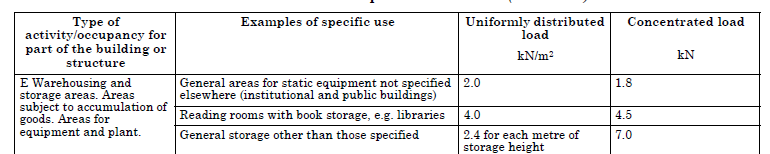
-
I've made a few of these. The ones for taking heavy stuff are made out of 2 bits of oak faced MDF 18mm thick glued together to give a thickness of 36mm. I glued a solid oak edge trim on and it looks passable. The main thing is the the fixings. Here I resin anchored two M12 rods into the masonry behind and tilted them upwards a fraction. Rods project about then offered up the shelves and gave them a "dunt" so the rods marked the back of the shelf. Then drilled them out to the rod depth and slide them over the rods. I also made another lot (out of a recycled bit of oak furniture) that go onto a TF stud wall, they don't project so far though, ~ 275mm. Again I experimented and drilled the studs and used resin. A year later disaster has not struck.. I will obviously come clean if it does later on.. promise. Have attached photo of the lighter loaded shelves.. will try and take photos of the MDF shelves once I have tidied them up.

-
Yes as Joe says.. photos are the key. That's you underway.. the build has started!
-
Welcome from me. You'll find all sorts here from folk just starting out to some real experts in their fields. I'm into SE type stuff but always learn loads on BH so anything you can chip in is appreciated. Great friendly site, a good few great characters too!
-
Hi Jilly. My own thoughts are: Have a Firestone rubber roof on part of my own house, from memory it was the thickest they offered 1.5mm thick. Performing well so far. Also, as I did it myself know how to fix it if hit by astoroid. Fibreglass, yes does well, but less easy maybe for DIY / local builder to maintain? Also edge detailing and you need the weather to be ameniable as the resin cures If you want have a look at Sika Sarnafil, you get an approved installer to install, bit more expensive but is a well tried and tested system. Felt and bitumen.. used to do this but the weak points can be the seems / joints. For me I would go for a more modern system even though old sckool at times myself.
-
Installed channel glass balustrade wobbles
Gus Potter replied to rhymecheat's topic in Windows & Glazing
Hiya. Sorry to hear about your experience. Good news is you have caught it early before anyone got hurt. Hope this helps and for all. When you design glass ballustrades the following steps are roughly this: 1/ You get the Clients spec. Say height, configuration and if it is say domestic or industrial / public ( say a pub) loading. 2/ Obtain the manufactures' data sheet. This tells you how the glass will perform under load coupled with their track design. They are mostly tested as a unit / system 3/ Look very carefully at what they say the substraight is.. often they say "concrete non cracked ".. or "solid" etc... so could be steel. And this is where it all tends to go badly wrong, things become unsafe and the continuity and liability in the design breaks down. To get say a BBA, CE mark & comply with the standards the manufacturer bolts their glass and track to a very solid test bed in a lab and checks to see if it will carry the load (not fail) and not deflect too much also a failure.. the 25mm often mentioned. The fixings are bolted to the test bed and so long as the fixings don't fail when connected to the test bed all is good. If you read the manufacture's literature this is often where their liability ends. Some don't even specify the fixings! They just give you a hole diameter in the track (could be side or top mounted etc) and the grade of aluminium that the track is made from. I have seen this from a German manufacturer for example. If you are say an SE you then need to calculate the tensile and shear forces in the fixing based on the track dimensions. Check to see if the fixing will pull through the track, check the fixing for all the forces (tension and shear) and often the key is what the fixing goes into and if it can resist the forces. Then you as an SE need to check to see how much you substraight will bend (deflect) by as this is included in the 25mm deflection at the top! Now this is tricky but can be done. All BC sees is the total deflection.. there is only one cake to share deflection wise. In general laymans terms the fixing is subject to mostly tension (the levering effect from the glass), the shear forces (sideways forces) are relatively small. But imagine the glass is like a long pinch bar.. there is a rotational force at the level of the track, this generates a rotational force called a bending moment.. and brickwork is very unsuited to resist these type of forces unless it has a huge amount of dead weight above. In other words you can't put bending moments into the top of a brick wall and expect any good result. You can put bending forces into concrete if it is adequately reinforced or thick. Yes I think the manufacturer is likely in the clear... will be caveated in their spec. The installer should have known better so they are in the line of fire. In the round while I think you have a good case for a claim against the installer for negligance that resulted in damage to the wall. You may want to say.. look.. I'll keep the glass and track, may sell it on ebay and that will cover the damage to my wall due to your lack of experience / knowledge. OR you can sue me as I have not paid my invoice and see how that goes boys and girls. But before you do make sure you have got an SE on board that can justify why you installed a potentially dangerous system.. contrary to the manufacture's recommendations and if you have broken other regs such as CDM etc.. as we will need to have a look at that too! In the round, with a bit of careful thought you may break even cost wise. -
Garage foundation design - borehole plant ducting
Gus Potter replied to Kelvin's topic in Foundations
No reason really. A caveat though. When you create duct routes or routes for drains under founds you need to just check the ground water flow and the type of soil. What we want to avoid is creating a route where water can flow in a trench under the founds at a significant rate. A big risk is in say soft fine sand and fine silts as the flow of water can wash away the fines and reduce the bearing capacity of the soil around the trench. Some amount of seepage is normally ok. If you take say a power cable coming into the house it normally has a hockey stick.. a short duct but the rest of the cable is normaly just backfilled with normal soil. That said the cynical may say it does look a bit like the SE is kicking the can down the road and buying time. -
We too, but not hundreds of sq m, that said we have one room that is big and a U shape. The U shaped room has a concrete slab under part of it, the bottom part of the U.. the rear house extension part and a chipboard suspended floor which forms the legs of the U which is where we knocked out the back of the house to make a big open plan space. Flooring is 15mm fairly high end engineered flooring. The flooring interlocks with some clever plastic bits to join the butt ends. You can also glue it if you want and fix down with adhesive. In the end I used the basic foam underlay to create a bit of a slip plane as the concrete and timber floor will move by different amounts. Yes, the basic foam underlay acts as an insulating layer but when you look at it it's not much of an insulator. My though process was partly.. if it gets damaged / wet can I easily lift some and replace, what if we want to change it later (hope this never happens), if it's glued down will be a nightmare to lift. If we did want to lift it then we could use the unworn bits in other rooms maybe. In summary it's all been down a nearly 18 months so full year of UFH cycle.. heating on and off different humidity levels and all still looks tight. What I would do is if you have some really heavy furniture then maybe just move it from time to time to let the floor move / de stress? We faced a dilemma in that we have an island unit in the kitchen with waterfall sides. Conflicting advice was offered. Do you put the floor down first and then the water fall sides on top or do you do the water fall and butt the floor up to it. In the end we put the floor down first and put a bit of plastic under the bottom of the waterfall sides to make a slip plane and then trimmed off. So far no signs of overstressing on the island unit and the flooring. All looks good.



