


Gus Potter
-
Posts
2383 -
Joined
-
Last visited
-
Days Won
34
Everything posted by Gus Potter
-
Dave .. was not sure if you had continued the newel post all the way down. But for BH folk and for simplicity had assumed that your good photo showed a clear spanning trimmer. On the upside Dave.. given your neck of the woods I expect, as does a lot of my family that live on the islands, you will be putting on a bit of weight on "for the winter months to keep you warm ", partying over the coming festive period.. I referenced a floor loading of 150 kg per sq metre.. there are some big fishing folk up your neck of the woods? 150 kg... would that would be their weight with no clothes on? Of course we in the central belt of Scotland will be living on lentils in the lead up and during xmas.. have electric blankets (PV supplied of course) and be having a "quite time" at so don't need to worry about over loading stairs and floors. We will be miserable but convince ourselves we are happy. You stair looks good by the way.
-
I'm being very general here but to give you a flavour of the way things operate. For the avoidance of doubt I'm including some of the companies that are major developers and medium sized ones that are underwriten by the major warranty providers in the UK. I'm not going to name them.. suffice to say that I have won a number of claims again them similar to what you describe. Small builders that may be building you an extension,.. don't say much here on small builders as this may require a partially differant approach.. assuming there may be a cash element to that type of transaction. If you are a domestic home owner then surprisingly you often do have legitimate recourse against the medium and bigger developers. But you will probably need to spend a bit of time and possibly a bit of money to overcome this hurdle. If a new build.. in the first couple of years the medium sized builder upwards is probably playing the war of attrition.. they know a lot of folk complain but only a few will take it any further..(some folk post bad things on facebook etc) the warranty provider often does not hold the ball until two years have elasped.. hence the lack of initial response. Take a young couple who have saved up to buy a house and they move in. Cracks appear / drains block say and they feel that they have not got what they paid for. Over the years I have become aware that this is a numbers game for builders and their warranty providers. The warranty providers are essentially insurance companies so this is all about paying out less than you get in premiums and the difference between the two is essentially their profit. Just like car insurance they have a "claims avoidance" department / culture..? I'll deal with the jobbing builder (say a small extension) in another post if there is any interest. But the some of the same rules apply.. often you won't have a formal industry standard contract with the very small builder.. you may be doing a deal.. part cash? Take a medium builder up to the majors. They send their "surveyor in a suit" and offer to do a bit or just send the decorators.. that reduces the field quite a lot.. folk feel.. well we got something out of them. As a domestic home owner you are entitled to a certain standard of workmanship. You are also entitled to a structurally safe home.. all covered under the consumer protection act not least. You are as a home owner are entitled to a product that will perform. @Scots Build If you want to pursue this you have options, there are others but here are a couple. Builders/ house developers often give domestic home owners the run around. They are experts at it and they caveat the sale conditions very heavily.. you need to clear a lot of hoops to gain satisfaction. Caveats include cracking / shrinkage and a whole host of other things in the fine print. What I do is this when acting on behalf of a Client is this.. Rather than arguing about crack sizes / workmanship on say sticky doors, opening mitres, floor levels say on facings that are open to interpretation in the desing codes I look under the bonnet. I always ask myself.. what is causing the cracks, blocked drains, in adequate wall ties for example, walls out of plumb. I then look at the what could be structurally wrong. I can tell you that I will 90% of the time I will find a "structural non compliance" when I look under the bonnet. I don't do random opening up stuff as I know from experience where folk cut corners. I would focus on for example and investigate.. the things that are cheep and simple to do SE wise as it keeps your bill down ...is it the render.. but that could be a symptom of underlying malaise.. I would check the wall for alignment.. is it out of plumb, are the wall ties correctly installed, are the cavities the correct size and clean? If the cavities vary too much coupled with the outside leaf leaning out and the inside leaf leaning in then they are often stuffed as the wall ties no longer comply with the design codes they have probably used. This is easily checked with a plumb bob. simple technology. I check the connections of floor joists for example. Fire protection is a cracker.. one failure is a no no in this day and age. I look at a load of other things too.. could be that I notice that electrical cables are too close to heating pipes.. on the face of it you may think that it is not within an SE remit.. but anything that could potentially cause a detrimental effect to the structure.. say cables or heating pipes that could cause fire or comprimise the strength of a stuctural member does fall in my remit. I only need to ask.. hey I see this.. can you confirm it is OK? I don't need to be an Electrician I just need to apply common sense and are entitleled to ask these queations as a professional. Now it may seem harsh. But if I write in my SE report that you instructed me to do a prelimiary survey and I look in two places that are of interest to me and find one out of two items that are non compliant in terms of fire design.. that is a 50% failure rate.. it raises questions.. I guess where I need to look, say open up a small part of the ceiling to expose a joist hanger.. is it fully nailed, it it installed as per the manufacture's instructions. Find one thing wrong and you have them over a barrel. I have found in the past that the developer comes back with.. what are you on about.. we are big boys and you are not.. our SE says its ok. I call their SE and say do you know about this.. they say no.. In then say who is responsible for the fire design? now the the developers own SE has washed their hands.. and the deveoper has lost the support of their own SE. As soon as the SE bails out all the stuff about shrinkage is blown out of the water. I have found that as soon as you say.. Hey I have found evidence that the building does not comply structurally and I need you to come to the table to discuss it changes the game. If you don't come to the table I'm going to report you to the HSE and my Client is going to sue you as you have sold them an unsafe building. The HSE stuff will impact on their insurance premiums.. you aim for their pocket. Have found that this approach gets their attention as you have moved the goal posts big time. From experience your complaint will rapidly get moved up to "director" level. Funnily I have had quite a lot of success with this approach.. maybe I'm just lucky? The above is a bit of an insight into how you may approach your problem. If you want to pursue this you need to pick your battles and hit them where it hurts. Always remember that you bought the house in good faith.. you are not at fault. Hope this helps you either rule in or rule out how you may want to progress.
-
Yes there are so many ways of doing it. Say that landing you have is max 1200 mm wide .. ~4 feet. 4 feet /2 = 2 + 2 = 4 inches target joist depth at 45 to 50 mm wide in grade C16 or above timber. Your 8 x 2. Say that spans tops 2.4m ( 8 feet) .. 8 /2 = 4 + plus 2 inches and extra inch for the point loads from the stringers = 7 inches ~ 170mm metric deep joist. That will probably work in terms of strength but you are looking to reduce deflection = bouncy stair.. so your 8 x2 is a good call. Looks good to go Dave. For all.. there is no point in having a good beam if the end connections (joist hangers / nails etd) are rubbish.
-
General structural advice needed please
Gus Potter replied to SilverShadow's topic in General Structural Issues
Top stuff and welcome. I've made a few comments below which will I hope will help. First things first. In the past I have bought and sold properties that are suffering apparent distress. Mostly now I do a bit of design for Clients that are interested in these types of "distressed" properties, some buy them to "sort out" and sell on, some buy as they are cheep and turn them into their "forever home". Both are fascinating for me as a designer as I often get involved right from day one and see the project through to the the end. Now there is no free lunch here. Much depends on your attitude to risk and MOST importantly how much work you are willing to put into researching the problem, understanding it and identifying cost effective solutions, if there are any. Some can be stunningly simple and cheep to implement. Spotting this opportunity where others have missed it can be the key to unlocking it all. Making / saving money that let's you make a good profit or spend it on the things you want.. finishes etc or just make it affordable as a project when you are on a limited budget. What I'm saying is keep your enthusiasm up! A question. You mention the word "sewer" To the lay person this could mean just a drain that carriers water from say the toilet and maybe the roof from your house out into the street from your house alone. But in technical terms a "sewer" could be a big public asset.. a very big infrastructure pipe. You also have what is often called a public drain, that is a pipe that serves a few houses before it goes into the "sewer". Public drains are often more manageable.. but if you want to build over them later you'll need build over permission. This is often doable if you plan ahead for a future extension. Your SE report will likely be an "observational report with some limeted technical comment" not offer up solutions and be heavily caveated. It's the solutions bit that cost the professional fee money as the SE has to step up to the plate and carry the can if it does not work out. You mention various options.. underpinning, structural repair etc and how that is treated in terms of insurance and resale value. If you involve an SE to give you advise on solutions and thereafter design them up this should cover you as the SE carries insurance that should satisfy most folk... lenders etc and selling later. Also you will need to involve the local authority who will provide a completion certificate. That also adds weight when selling. Your project sounds really interesting. If you wish post photos, provide more info and you'll get loads of help and suggestions on BH. Try if you can not to reveal the location as it may be a live bid. If in doubt PM folk here.. but if you end up buying it then you should post about how you won the bid. And if you benefit from it you should make a donation to Build Hub! If you don't get this one then keep your hopes up and look for the next as you'll learn loads on BH. I do every time I log on. All the best. Our questions are around the following: 1) I've read that resin injection with geopolymers can be a cheap & effective alternative to underpinning - just wondering if anyone had used this & what their thoughts were (we're thinking of using Geobear, unless anyone can recommend a better UK company)? Have heard it's around £1200/metre.... 2) When using something like this, are there any implications if we decide to build a house extension over/around that area at a later date? 3) I've read that house structural rework can cause problems with insurance & resale value. Apparently, resin injection avoids this, as it doesn't 'break the ground', hence no need to declare it. Does anyone know more about this claim of avoiding the insurance/resale issue? 4) Does anyone know what is classed as 'structural repair' that may affect the house value/insurance? Eg, if we use helibars to repair the brick mortar cracks will this need to be declared or just part of the normal process of house repair? 5) Any other advice/tips/gotchya's from anyone who's experienced similar when fixing their property -
Hello dnb. The half landing needs to be compliant with the regs in terms of width. @ProDave His photo is a good example to explore as to what you need to do SE wise and how you start checking / designing it. First in terms of a domestic stair. The landing is just like a floor so the live loadings on the floor (people etc) are 1.5 kN/m2 which is about 150 kg per m2 If you have 18mm thick V313 say chipboard this will need supported at 400mm centres, if 22mm thick then 600mm centres under normal loading conditions.. no other hidden loads. The next thing to do is to design the joists that support the chip board (landing) . As a rule of thumb if you take the span of the landing joist in feet, divide it by two and add two inches.. convert this to metric if you have to and that will probably work in terms of joist depth based on a 45mm (C16 grade) thick timber, subject to final checking. Final checking includes working out the self weight of the landing, any ceiling under etc and if the load goes onto the trimmer or side walls and what that load is. Pro Dave's joists could span from the wall with window opening back to the trimmer at the top of the lower flight or side wall to side wall. Can't see from the photo but the same principle applies. Next thing to do is to work out the loading on the lower and upper flight of stairs. There are a number of different loads that the codes require you to look at. Evenly distributed loads and point loads. In general it's the distributed loads that govern the design. The loading on the stair flights that tend to govern are the self weight of the stair plus the live load (150kg/m2). The stair flight is like a roof rafter and often we assume that the stringers are simply supported at the bottom and top. Yes the outside stringers could be fixed to the side walls but let's assume they are not as the side walls may be non load bearing walls. Now we can work out what loads the stringers are putting on the trimmer, add to that any load from the landing and this lets us design the trimmer. Say the landing joists span onto the trimmer. The trimmer is checked for the four point loads from the stringers plus the uniform load from the landing. In this case as we have point loads from the stringers close to the side walls we need to check carefully for both bending effects and shear effects at the ends of the trimmer. What we do though is to make the trimmer pretty stiff so that it does not deflect very much at all. Every bit of deflection adds to a "bouncy stair" The next stage is to check all the joist hangers etc and any directly nailed connections. There are a lot of ways you can put a stair like this together but hopefully this gives an insight into how you go about designing it structurally. Now if anyone is intersted in how you design cantilevered type / winding stairs with no trimmers or central supports please post. These are fascinating to design and make work. Master stone masons have been doing this for centuries and the laws of physics have not changed. A lot of modern cantilevered stairs are designed with each tread as a cantilever extending out from the side walls but under the right circumstances there is another very elegant way of doing it that can deliver a great aestetic result. When folk look at them they may be inclined to think.. how does it stay up?..
-
Like that. Often I'll do the same as just like to do a good job in the round. Look at this another way... last man on the job gets the blame. No point in doing a great SE job on the house if the garden / retaining wall falls down.. even if you had no hand in it!
-
Yes that new to me too. It looks similar to a small grid geotextile fabric. Now we put polypropylene firbres (usually non structural) in slabs to stop shrinkage. @saveasteading et al have posted lots about this. Plastic fibres in concrete slabs with UFH above. Can see how this could work but would love to know more about this and see some data / calcs / design rational. Every day is a school day on BH!
-
Yes there may have been a water leak from the old kitchen, that said it doesn't look like it has impacted on the floor joists structurally. With my SE hat on I need to say that screeds are heavy so you should check this out in terms of the main floor joists being able to carry the extra load from the screed. Have put this caveat in as have seen some floors that run off level by 75mm say on old tenement flats.. thus a 75mm thick levelling screed is going to add a fair weight! In terms of moving forward (SE view accepted) I would also put some noggings (dwangs) in under the weak spots in the floor boards with D4 expanding Pu glue to make sure you don't get a squeeky floor later on. What you are aiming to do is to just support the edges of the floor boards where they could rub together later on. Fifteen minutes work and less than a tenner to avoid that annoying squeek.
-
A few more panoramic photos showing what is above and below would help towards reaching a reasoned diagnosis. Has the room above been used as a bathroom in the past.. what do you know abiout the history of that part of the house? The metal lath is a bit of a puzzler for example.
-
If you can post a photo or two. On these ones that are completely done.. It's just the shell you intend to work with.. things we do are: On the ground floor make sure any solum vents are clear and free. Make sure the worst of the gutters are made leak proof. Clear the rain water drains.. if they are done then dig a few channels outside to take the water away from the walls. If you have water running down the garden and into the house then look at some French type drain but keep it away from the walls a good bit so it does not cause a problem later on as you develop up the design. Kill off any small self seeded sapling trees and other vegitation that is growing near the walls. Lift some ground floor boards to encourage ventilation. Open all internal doors or take them off. If you have sash and cash windows then open them 50 - 75mm at the top and screw so they can't be opened any further, or if windows are broken then board up leaving a 50 - 75 mm gap at the top. Cut a few holes in the roof soffit.. if you have one. Open up the ceiling under the roof, especially at the corners of the building. Ventilate the roof at the ridge. You can just cut a big slot at the ridge, make an small timber A type frame and put that over the top and fix down. The A frame can be water proofed with a wide DPC. In essence it's like a ventilated dry ridge but a lot bigger. The idea is that you let loads of air circulate at as low cost as you can and even in the winter the place will start to dry surprisingly fast.
-
Plus one to that. Much will depend on the type of soil you have. You'll often be surprised at how much load a wall like that needs to resist. What you are doing is interesting to us "soily / foundation" types on BH so if you want post more info folk will hopefully be able to help a bit. Things I would like to know as a starting point Where is the boundary. What kind of soil do you have How far is the neighbour's house from the wall Where is your house in relation to the wall What are the ground levels in front of the wall.. do they carry on sloping down or flat? How long is the wall. How are you wanting to do the returns on the wall? Are these close to the boundary? Good drawing by the way.
-
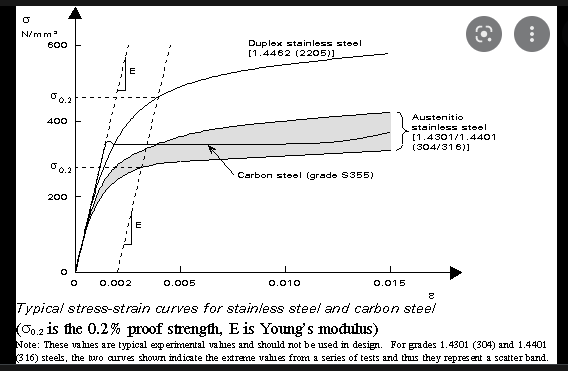
Good point. PU foams may behave more like say stainless steel or cold formed steel. For all. A typical steel beam you get for your house is quite stretchy (elastic) and you can load it up a fair bit until it starts to "yield" . If you take the load back off it before it gets to the yield point it will return to it's original shape if say the masonry above allows it to. But stainless steels and cold formed steels are different. The elasticity changes depending on the load.. how "stretched / compressed they are. Have been lazy and copied a graph off internet below that shows you how carbon steels behave linearly up until a defined yield point but stainless does not. Cold formed steels are similar but the shape is a little different. Youngs modulus E is the stress / the strain. Now it may be and I suspect as @SteamyTea is alluding to? is that PU foams and say EPS may have a similar behaviour to stainless steel in that they may not be quite as elastic as we think when heavily loaded on a long term basis. Now you may have wondered in my previous post about why I chose a value of 2% compression to get a bearing capacity... a spin off is that we are not pushing the insulation that hard in terms of it's elastic performance. In some way we are mitigating / minimising risk where we are not quite sure just how well a material may behave when pushed to the maximum declared manufacture's loadings. That's a long building. On something like that you could have a lot of changes in the ground, need free movement joints, big floor slabs that will shirink a lot end to end and thus the roof should be designed to move / have joint's that suit the building under. I thing the roof sheets tend to move less than the building underneath so they don't dominate the movement / settlement design. Quite common up my neck of the woods. After the second war there was a drive to upgrade the housing stock and re purpose the factories that had been concentrating on the war effort. This manifested in what we call "non traditional housing" To us now it seems "daft" but back then there was a great need to provide houses that were forecast to have a lifetime of 20 - 50 years. Remember that a lot of folk were living in slums, outside toilets and so on. My house would have seemed like paradise at the time. My ex council house is now some 55 - 60 years old... but know if I insulate the wrong way it and rot the built in wall plate there will be trouble.
-
Steamy, it all sounds like a can of worms. Yes.. If you are talking about say a ground bearing floor slab that has PIR under then the possibility that the PIR could shrink.. due to a change in the chemical structure, could cause a potential issue say in 20 to 30 years time. If you extrapolate this further then could the chemical structure change such that say the material completely fails and turns to dust. You could apply this to a lot of products we use.. EPS for example.. we just have to partly rely on past experience of the perfomance of the material or similar materials, the expertise of the "Chemists" when developing new formulas and the knowledge and experience of the people developing the test and validation procedures. In terms of how SE's may approach this. I'll work in kg a bit as this may help BH members get a feel for the "weight" of things. Take an insulated ground bearing slab or say an ICF structural raft foundation that both sit on a layer of insulation. Say the insulation is 150mm thick PIR with a compressive strength of 150 kPa ( 150 kN/m^2 ~= 15 tonnes per m^2) at 10% compression. Now say we load up the insulation at 15 tonnes per m^2. 10% of 150mm is 15mm. To carry the full load the insulation is going to compress down by 15mm. Iif we had say a concrete slab that was isolated from everything else and we could guarentee that the load was always going to be perfectly uniform then in theory we could maybe get it to work and just let it slab / house move up and down by 15mm. But in real life we have concentrated loading, loads that occur at the edges. These types of uneven loads could introduce a potential 15mm differential movement.. thus we could need a serious concrete slab with a lot of rebar and invite other problems. Then you have to add to that the fact that the ground under the insulation may also settle, swell and shrink as moisture levels change say. The building above will also be moving about thus in some cases you could suddenly end up with 40 - 50mm of movement if all the cards fall the wrong way. In the round as a rule of thumb a medium sized house can cope with say 20 -25mm of movement over all, say corner to corner before bad things start to happen... a few cracks accepted. Yes we can design for more movement if need be.. but that all adds to the cost. Now on slabs and ICF raft founds in particular we say.. we may need a raft as the allowable ground bearing capacity of the soil is say 60 kN/m^2 =~ 6 tonnes per m^2. Now you may have a soil report that mentions a presumed allowable soil bearing capacity. This value is a prediction of what load you can put on the soil without it settling / compressing by more than 25mm.. and / or not completely failing. Now you can see that we have 15mm compression of the insulation and potentially up to 25mm in the soil = 40mm + plus any say other superstructure shrinkages / movements. To come up with some sort of initial answer we say.. Let's look at the insulation. What compressive strength will it have at 2% compression say. 10% gives 15mm thus 2% would be 3mm. We assume the insulation behaves like an elastic band so the response is linear. At 2% compression we can load the insulation by 150 kPa x 2% / 10 % = 30 kPa. Then we could say the soil has an allowable bearing capacity of 60 kN/m^2 based on 25mm of settlement so half that (as that is what the insulation can carry) gives 12.5mm of settlement. It's a massive simplification but for ease of argument just add the insulation and soil movement together = 3.0mm plus 12.5 = about 15mm. That we could live with as a starting point. BUT.. all of the above is based on a building being fully loaded for often a long time.. Clay soils can often take a high short term load as they can't settle until the water is squeezed out. So in summary we kind of design for full loading which does not happen very often so that is maybe why we get away with the insulation shrinking a bit and not see it cropping up a big construction/ design problem? ----------------- Yes can't quite remember the max lengths but there are a number of guidance notes published by the SCI / BRE that mention designing in movement joints in the roof. I'll dig out the info when I get a chance. I think if you follow this guidance the shrinkage of the PIR roof panels can end up being a mute point. If you have an long shed / office say with glazing panels you need to make sure you put in enough movement joints so you dont' jamb the doors and break the glass. It should be obvious that if you don't put enough joints in the roof then something is going to give. A dilemma I face is that my timber floor joists are built into the external walls in my 1960's brick cavity walls. The joist ends are not wrapped, they may have a splash of bitumen but I doubt it. The cavity is drafty but that is why maybe the timbers have lasted so long. Also I have a timber wall plate that is built into the inner leaf of masonry which is the main load bearing element. Any rot here is going to cause the building / walls / roof to settle badly.. very badly. I too have been mulling over filling the cavity but I just can't convince myself that it's a safe thing to do. I would have a look at how all your structural elements interact with the walls before progressing.
-
Buying tiles. Discount to expect, comments on wood effect.
Gus Potter replied to saveasteading's topic in Wall Tiles & Tiling
I think it's a far do at 10% Take a bathroom. Do the floor tile joints need to be symmetric with the wall tiles? It's a steading.. the floors will not be square so can't have slivers of tiles running to zero at the skitings as it will look crap. In the round though.. if it's a forever home it's a big ask to get it all right straight off the bat even if it is your day job. I would live in it a bit, do the main rooms and then finish once you have got to grips with how you are actually using it from day to day... that is part of the fun of moving into a rural location.. new friends.. new way of life. -
We're out of the ground....(Nudura build)
Gus Potter replied to Mulberry View's topic in General Self Build & DIY Discussion
We have all been there and I hope you are still friends. Have done / started a quick post for all. -
External air ventilation for log burner
Gus Potter replied to SBMS's topic in Energy Efficient & Sustainable Design Concepts
Just edited my post to lay it on a bit thicker. -
External air ventilation for log burner
Gus Potter replied to SBMS's topic in Energy Efficient & Sustainable Design Concepts
Stuffy room.. You light the stove.. big flames.. warm the room up.. then you turn it down to ticking over. After a while you'll notice that the air in the room does not "smell fresh".. very difficult to desrcibe but you just know that the air in the room has changed since you lit the stove. Your nose is very sensitive so trust it. Another way is to think of this. If you are a parent with a young child and you go into their bedroom.. instinctively you know if the air is bad.. "just not right". You open a window for example. That is the test.. it's in our genes as parents. Yes MHVR is great but I have Clients that send their kids to "outdoor schools" see my point? And no amount of technology is going to over ride a mother's instinct in terms of air quality. That is a diffucult question. For me having grown up in the country and abroad (Africa) I'm not that keen on relying on the gas / electric company / modern interconnected electronics to save the day in the short term when the shops are shut for a few days. At least with a stove you could keep one room warm for your kids, boil a kettle and cook a meal on the top in the short term. I'm not a "survivalist" say like in the US but have lived in the borders of Scotland where the power used to go off for days. I admire what you are trying to achieve and hope this helps you to reach a conclusion that works for you. -
External air ventilation for log burner
Gus Potter replied to SBMS's topic in Energy Efficient & Sustainable Design Concepts
Ok on paper if you have a floor vent directy under the stove that is not connected to the stove air inlet and you do an air test.. it will contribute to a bad result. Yes.. I acknowledge that folk want to have an air tight house and agonize about having a stove that is "room sealed" like a gas balcanced flue boiler. But if this is your forever home you need to be aware that unless you want to change the door seals on your stove yearly you'll end up with a "stuffy room". Your strive for air tighness could come back and bite you! For those that are concerned about PM 2.5 levels this is the last thing you want and for those that want an easily maintained house it is also the last thing you need. If you don't create a negative pressure near your stove then these PM 2.5s are well into the house! Buy the time they get filtered out by any other system you'll have breathed a lot of them in. You may have some semi automation or internet connected central heating thermostats that need some wireless control. The idea of a stove is often to give you a "Flintstone" backup when all your electronics/ phone apps break down. This is not the time for "posing" it's a time for praticalities and thinking.. what if the gas / electricity goes off and god forbid.. my phone stops working! Keep it simple and stupid. Think about it.. are you really going to do this (change the stove door seals every year) with all the other things in life you need to do. What I have is a duct from under the floor that rises directly under the stove.. there is a ~75mm gap. When the stove is working cold air gets sucked directly into the stove bottom air intake. When not it provides trickle venitlation.. in the summer. If the door leaks a bit during use there is some positive suction that stops the PM 2.5 from getting into the room as they are sucked mostly back into the intake flow by the Venturie effect. I would encourage all to think about this in the round.. how you are going to live and use your home rather than blindly following the air tight current doctrine. In summary it's your house so make it suit your and your way of living. -
No not mad as asking good questions. I would try and insulate as best you / seal up drafty areas for the winter at least cost. Keep it all (stair) in place for now until you make up your mind if you want to convert the attic or not. You could spend £1000+ mucking about.. that could go towards the extra heating cost anyway.. pragmatically look at in the round? What Peter says can be really important, you could indavertantly blow it and regret later. Take plenty photographs and record.
-
Timber Frame Construction- when to fit windows
Gus Potter replied to benben5555's topic in Timber Frame
Now that is "arse" covering" or maybe the lift supplier (like a good few contractors do) was pointing out to the SE that they did not know what they were doing and should stick to designing garden walls? Off the top of my head I would go for 25- 30mm shrinkage on a three storey at concept design stage.. with some good site contol.. big difference.. as any more than that all the wall ties will be out of spec for example.. and they won't sell any lifts these days based on that 50mm caveat. The Architect will have a blue fit if you go back and "give them the good news".. on floor levels and how they may change. I suspect that if you went to an Architect as an SE and said.. this is the best I can do you may not be invited to work with them again. Ok.. what do you do when you have to meet the accessibilty threshold for BC at say 10-15mm.. then a year or so later disabled folk can't get out their flat as they need to wheel up 30mm to get to the communal landing as the flats have shrunk but the main stairwell is as built.. storey for another day.. but is goes along the lines of once the completion certitificate is issued then disabled folk are left to their own devices... which is bad design and bad for everyone. For all.. timber frames shrink and swell a fair bit! But with careful design this can be effectively managed. Good advice. -
Buying tiles. Discount to expect, comments on wood effect.
Gus Potter replied to saveasteading's topic in Wall Tiles & Tiling
Are you getting that "twitchy feeling" I'm making a bit of progress on my own house, the big part of the job is done internally, now moving onto master bathroom downstairs. Lucky here as my wife is pretty strong on the interior design side. Anyway this bathroom has a suspended timber floor with UFH so it is going to move about a bit. Wife has spied some large format tiles but I'm saying.. hey last house I built with UFH the floor tiles cracked.. very embarrassing as it was in the bathroom that every visitor used. When I say cracked it was cracked! Thus large format tiles 1200 x 600mm are proposed for the walls, smaller for the floor... tonight! Design is a journey although fun. With the lastest tile printing technology we are looking at wood effect printed tiles in a smallish format. If they crack then I maybe can replace them.. hopefully not as will be using a decoupling mat. I know you know @saveasteadingbut for all ask are the tiles and substrate compatible with under floor heating. Target advice. I reckon if you pitch in with a 300 sqm order then you'll hold the whip hand. Also do you want to include a decoupling matt. What about adhesive and trims / threshold bars. Also what about the shower rooms etc. It is all these things that can make or break a good deal. Yes you may get a good deal on the tiles but it's always been the "other bits" that make a good deal a real deal. Remember when Topps set up in Edinburgh.. they knew how to sell even to the "pros" Problem is that when you're in the heat of battle doing a big renovation you struggle to find the time to do it all and still do the day job. At this area you are talking about, and I think you said you have a good few bathrooms to do, then you are into the teratory of saying.. a pallat of tile adhesive.. xxx amount of packs of tile trims in these sizes and types. I know it will take a pile of work to do a material list for all of that.. the trims and gestimating how much adhesive you need is a big challenge.. @nod can you help? -
Timber Frame Construction- when to fit windows
Gus Potter replied to benben5555's topic in Timber Frame
Now that is a dilemma. Here are two facets. In the past lenders would release funding at certain stages. Underbuilding out of the ground, wind and water tight, first fix, completion say. Their idea of wind and water tight was that the windows / doors had to be in and the roof weather tight but no tiles say. But for self builders windows and doors are a big ticket item so you wanted to buy them as late as you can in terms of the cost curve / interest paid on the loan. Also windows and doors can get damaged so best left until you have stopped using Sthill saws etc in close proximity. Structurally wise the windows are often fitted to the timber frame which moves up and down and thus so does the window with it and the finishes on the inside. To accommodate this movement we put a compressible material under the cill where it extends over the outside leaf of masonry which for all intents and purposes stays still. Over the head we allow a gap between the top of the window and the timber frame lintel (to account for deflection from roof loads.. tiles etc) and a flexible mastic joint between the outside of the window frame and the outer leaf of masonry. In Scotland we have been doing this for decades so know that it works ok if the drawings are followed... that is what we strive for! Remember that a timber framed house is very much a "living" structure. Yes when the frame is first built it will shrink a fair bit but in autumn after the heating has been off over the summer it will swell a bit. It is always moving. The problem is that if you fix your windows to the outer leaf of masonry is that it is much harder to create the aesthetic movement joints between the timber frame / attached finishes and the inside face of the window frame. The window frame then be still as it is fixed to the masonry, the window cill, wall paper ect will then be moving up and down. Best to keep the big flexible mastic joints outside than on the inside? Would I fix a window to the outer skin of masonry on a standard structural timber frame if it was my own house.. no. -
Bay windows for complete beginners
Gus Potter replied to MortarThePoint's topic in Windows & Glazing
That's looking good.. everthing looks nice and clean. Nice brickwork / blockwork, lead flashings not over length (as per Cookson guide to good leadwork), good drip (min 40mm recommended) on the cills. Looks like a clever detail at the bottom of the wall abutment flashing.. any chance of a close up photo? Well done I say. For all. In principle you can stick a lot of load down a short strut bay pole before it buckles. Hence the two tonnes mentioned. But when the manufacture's test these they work on the basis that you have a material top and bottom that has a high compressive strength and is stable side to side (laterally) which is not often the case as you may have brickwork below and timber above. SE wise I would always look at any bay pole visually. Any more than 200 kg load say invites a fag packet calculation check on the suitability / stability of the materials that are above and below it. In summary.. if you are putting more than say 200kg down a bay pole then don't take just the advise of the window fitter, always use common sense and look at what is below it.. old brickwork, soft stone.. and what is transferring the load to the bay pole at the top.. say timber... let common sense prevail. Also remember that what is above and below may want to move sideways as it is essentially "balanced on a pole" so you need to take measures to prevent this. Remember that if the material starts to crush a bit at the top and bottom of your bay pole load will be transferred to your new windows which may start to "protest". -
Safety first here for me. Now winter is coming can you smell any flue gasses. I would make a hole in the plaster where there is a void behind and put a CO detector there and monitor. You could also get a Gas Engineer to investigate with their gas analyser but the nighbour's fire would need to be on. Or you could ask your neighbour when they last had the fire serviced ect in passing. Remember that burnt gas contains water vapour that can condense if not properly controlled. If all the roof leaks have been fixed it could take a good few months for things to dry out.. but I would want to know more about the gas fire on the other side. Is the neighbour's old chimney lined with a flexible duct for example. Is the duct installed the right way up? Next would be to open up the wall more and look inside, then lift the floor locally and look under. Have a go at this and report back on BH and folk will give you ideas on what and where to look next to help diagnose the problem.
-
Off to Stockton on Tees .. to buy a bath.. but
Gus Potter replied to Gus Potter's topic in Waste & Sewerage
Just as well you did.. for me.. thanks.. another thing learnt!



