


TerryE
-
Posts
3826 -
Joined
-
Last visited
-
Days Won
30
Everything posted by TerryE
-
Nick, my only comment is that I'd avoid mixing potable water and UFH so you need a PHE somewhere, probably the one that both Jeremy and I use would be fine. Plus a lot of insulation. Not sure why you need 2200 Kg × 50° worth of storage though. I have this vision of having a Rocket Stove below ground level under my workshop / shed together with a couple of 1 tonne tanks and maybe 200mm EPS wrapper. IMO, the trick with a RMH is always to use power assisted draw so that you can take the exhaust gas through cob store / exchanger well below 100°C so that you recover the latent heat of evaporation -- so the combustion is getting close to 100% efficient, and with flue gas getting over 1,200 K in the main burn chamber there are none of the usual nasty particulates left -- but it's only a dream, as the boss has the veto on such ideas One of the downsides of an otherwise superb wife.
-
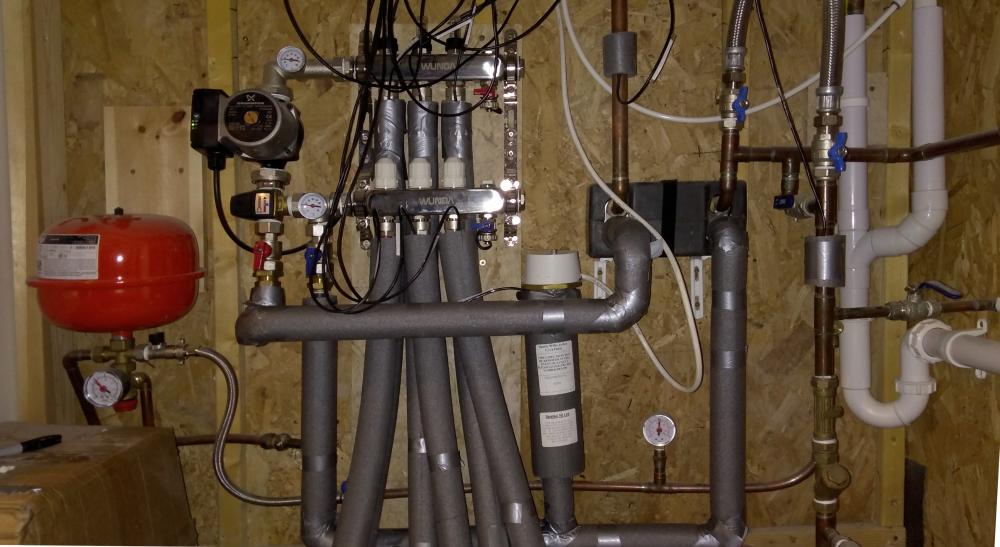
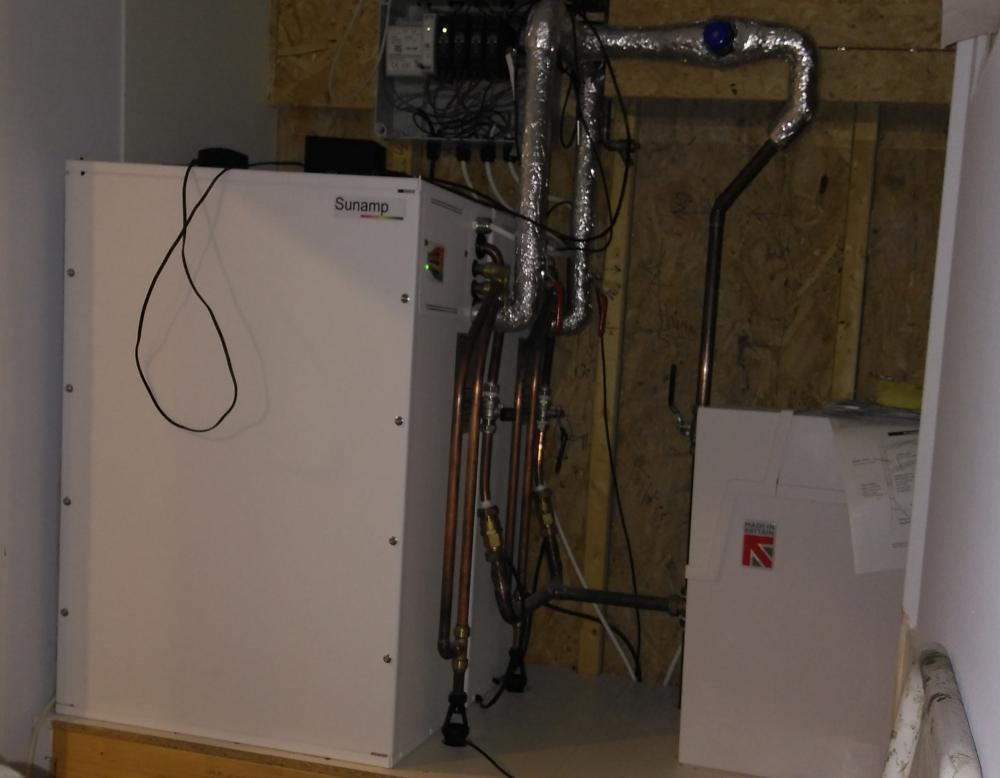
I've included the upper and lower levels of my system. This is the lot -- CW + Filter + DHW + CH all in a cupboard some 1.2m × 0.7m off the side of my ground-floor loo. The hot-works are all lagged. The system is stripped down to its bare essentials, and only electromechanical bit is the UFH pump. If running your CH on this costs maybe ~ £200 a years and my current BGas boiler maintenance contract is over £300, then its hard to make any payback case for anything more complicated. At the moment the heat exchanger preheats the DHW mix (which is the reason for the notch in my output temp above. If I do decide to use an ASHP, then I'll pinch this HE and prime it from the ASHP.
-
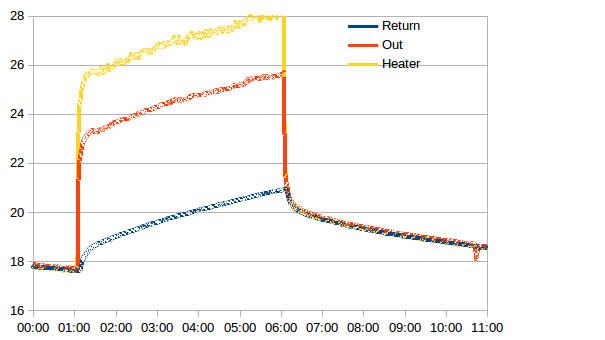
Just out of interest for those that want to compare "real-world" results to the model shown on the previous page, here is a plot take from our commissioning runs where I had our Willis heater running for 6hr at Economy 7 low tariff (cost ~£1.40). The house is still warming, hence the slab is still dumping heat into room space. But it's already got to the point where I am stripping off jumpers when working. The overall conclusions are: The slab is reacting pretty much as I modelled it. The output of the Willis is easily enough to heat our house. Our actual flow rates through the slab on the pump's middle setting are about half what I estimated, hence the out:return delta temp is nearer 5° rather than 2° but this doesn't matter. At this cost even if I use E7 electricity to heat my house the annual running costs will still be less than out BGas maintenance contract on our current boiler. The Willis is simple cheap and effective. Even if you have an ASHP or alternative, then it;'s still worth considering fitting one as a fallback heater Trust the physics, but validate your assumptions.
-
I've got an outer stone skin sitting on Foamglas. The structural engineer was fine with this approach. Download the date sheets and have a look.
-
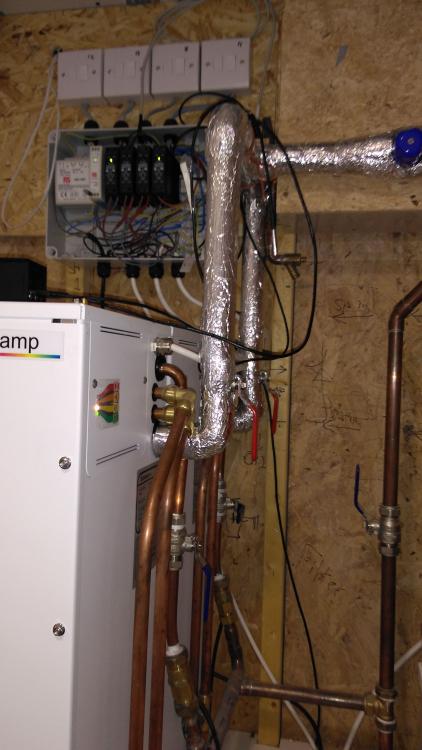
Here's mine. The relay box is open at the mo, and the thermo cables need tidying. But the 4 SSDs cost about the same as the rest of the computers and electronics. As I said, I am overdue writing up my system, but the heating and DHW is run by a battery backed RPi3 and 2 ESP8266 FEPs handling 4 relays, 14 thermostats, 2 flow meters, 1 pressure transducer and 1 PWM fan. The HA is handled by another RPi3 with HDD running Node Red.
-
I will have a similar issue when I come to integrate my MVHR into my overall control. The unit has a serial interface for a NAME and a set of contact connections to force boost, bypass etc. The simplest approach for me is to use a couple of SonOffs or my own project box. In the latter case it would be my own custom code, and in the former it would be a case of re flashing the SonOffs with a standard MQTT driver.
-
One think that I would caution when it comes to renewal time is that you are totally honest with yourself on timescales. The cheapest way to get 2yrs cover for example is to get a quote before for you take out the insurance. The most expensive way is to take out a 1yr cover and then extend it in 3 month chunks.
-
Eh? How? There is also a fundamental difference between resistive and inductive loads in terms of the power and peak current in back EMF on circuit make/break. The power of the device is the other key issue. After some debate here on the forum, l decided to use DIN mounted Crydom SSRs which can be driven by a TTL GPIO. One of the main advantages with this approach -- apart from the simplicity -- is that my sparky is happy to wire and certify the 240V side since these just look like MCBs to him. The whole system is working just as I planned, but that is the subject of a separate overdue blog post.
-
Insulation, Heating, time constants etc. Am I expecting too much?
TerryE replied to ProDave's topic in Boffin's Corner
I agree that the lack of a toggle is a PITA, but if you cut then paste and select the "remove all formatting option", then this gets rid of any formatting including strike-through. -
UFH in slab or screed, eps or pir insulation?
TerryE replied to Tin Soldier's topic in Underfloor Heating
I have the same system as Jeremy. Once the crew know how to do it, then they make it look easy and you have to wonder why it isn't the standard way of doing it. It is cheap to do and very effective. The answer, in my opinion, is training and skills or the lack thereof. Why use a new more effective approach it requires learning something new when the customer will end up paying for it anyway? -
I am looking for single box wall-plates with 2 × Satellite and 1 x RJ45 Ethernet connector. Anyone recommend one? Thanks
-
Out interest, what is your actual requirement? Viz what are you switching 230-240V AC, DC? What load? How are you planning to drive it? What sort of duty cycle are you looking for? What sort of MTBF? If you are using TTL drivers (e.g 5V Arduino) then here are loads on eBay and the Chinese suppliers, (e.g just Google AliExpress 8 channel relay) or you can get USB varieties which you can plug into an RPi USB port ... Or you can get the SonOff range of plug-in devices. Most have Songle relay cans on them (or clones which have a far lower switching life). For hobby stuff, I jus use the cheapo's at <£10 for an 8-port, and keep a few ports spare if one fails. Running something critical like your central heating is another story. I use reputable UK suppliers like RSS for this type of kit, but at a significantly higher price.
-
Ian, old fruit, why????? I can think of lots of projects that i'd want to do. And lot's of them woodwork ones, but making my own battens, naaahhhhh!! You need to have decent preserver on them, and that stuff is nasty. Battens are cheap as chips. Get yourself a table saw, radial arm saw and planer thicknesser and get the knack of getting your hand tools scalpel sharp, and do some (other) more value-add projects. Sorry if I am saying the unthinkable and feel entirely free to ignore me, but someone should air this PoV
-
Now that you are going to be living here, we and @RandAbuild are pretty much within spitting distance
-
As a general issue, neighbours can be a bane with building: objections and complaints to planning enforcement. It is usually well worth your while spending some effort on keeping them on-side by keeping them well informed and listening to their concerns and where practical helping to address them positively. This can be a pain, I know, but it is usually a lot simpler than a consequential debate with a planning enforcement officer.
-
Vacuum cleaner recommendations?
TerryE replied to Jeremy Harris's topic in Kitchen & Household Appliances
An easy way to get a powerful vacuum is to leave out the filter. I am not suggesting this seriously, but my point is that in all of this discussion there seems to have been no consideration of the residual particle size in the exhaust. And 20+ year old vacs might suck like the devil, but they perform terribly when you use this criterion. The Henry-style vacuums definitely have a use: lifting loads of heavy course dust -- so long as you don't mind leaving a fug of micro dust in the air. Great for a build, but terrible for a home. I would suggest that you consider filtration performance if you are thinking about use in your new airtight, MVHR-served house. To be honest, we have a couple of Henry-style vacs that we use for heavy duty stuff in the new house, including doubling as dust extractors for my power tools, but we also have a Dyson cylinder vac, and a Dyson cordless that we use in the one we are currently living in. The one we use the most and the one that I like the best is the cordless. Why? It is extremely light and manoeuvrable, and its exhaust is very clean. So it's easy to cart around the house especially up and down stairs, and it removes the dust once and for all. -
IMO, the odd 0.1 U-value delta over the area of windows makes bugger-all difference to the overall thermal budget of the house. Again, its personal view but architects seems to have a great love of large expanses of glass. From a thermal management viewpoint this is really bad news. Not only is glass 7-10× more conductive than an equivalent wall profile, the per unit area cost is also 10× or more than wall. Solar gain and its in part in the thermal management of the house are major design complications. People also seem to forget that the ability to see out also means that neighbours and passers-by can easily see in. My strong suggestion is that you thing hard about how much glass you really need. For adequate light, yes; for access to stunning views, yes. However, I've also seen members post pictures on the forum of internal views of acres of south facing glass looking out onto the fence-line and the backs of neighbouring houses, and I really have to question the wisdom of this design when it has so many disadvantages and almost no gains.
-
@Heppy Have a look at Jeremy's calculator and blogs such as his and mine where we go through some of the calculations. If you've got an MBC frame and warm slab, and decent Passive-class Windows, airtightness and MVHR then you'll only need to sustain maybe a 1Kw into the slab at peak during Dec/Jan. Putting enough heat into the house isn't the issue, as others have said: you will need to pay more attention to how you keep it cool in spring through autumn, plus how you trickle heat the UFH to stop roller-coaster overruns.
-
The Hep2O installation manual explicitly states that you can use copper compression fittings on Hep2O pipe but that the inserts are essential. I haven't got any now Hep2O into copper compression now, but I used a few after we put in the manifolds including during the 7 bar pressure test and didn't have any issues. You can also put 15mm copper pipe into Hep2O fittings and that's how we did our tails using Hep2O elbows to do the change from Hep2O to copper. "Feel the rumble" twists are essential even if you don't feel the rumble -- said the actress to the bishop -- to cut the lock ring into the pipe.
-
Jan and I agreed on using copper tails of of the wall, but had a big deal debate over whether to use a hep2O area straight coupler and a copper tall with and end feed elbow, or a hep2O elbow. Guess who won? So now I have discovered the big downside of Jan's keep-it-simple approach: it's bloody impossible to use a pipe cutter to trim the tail to length. I kept the excess to a few cms to keep the walls as clear as possible for the plasterers and the tiler, but when you try to use a pipe cutter, then the tail just twists at the other end in the hep2O connector, and I don't have enough protruding beyond the cutter to grip it and stop it turning with the cutter. So it's back to using a small hacksaw and then deburring tool. Even so, I can still do these neatly to within a few mm tolerance. I guess having a few mm copper exposed is the best compromise.
-
A year later and we are just finishing the fit out of or last ensuite, and we have the issue of what to do to finish the Duravent wall hung basin. We chose a one that doesn't come with a semi-pedestal, because Jan has chosen a monobloc tap with hand shower attachment. So now we have an immaculate wetroom ensuite with the guts of the under-basin exposed. We've got a nice smart chrome waste, and we are now faced with the challenge of how to mount flexible tap connectors to the supply without the overall effect looking totally naff. The best way if I had thought this through properly would have been to terminated the 15mm tails with a pair of tile-flush ½" BSP female tap connectors and use a pair of the vales shown below (or the like ). However, I don't have a Tardis and the tiling has been done so there is no simple way to add one even if we use a deeper cover plate. So the only thing that I can think of is using a pairs of the shower plate mounts that slip over the 15mm tails and present a pair of ¾" BSP male heads. I can get 10mm × ½" BSP female flexible connectors and also a pair of 90° ¾" BSP female to ½" BSP male chrome elbow, but I feel that this will still look naff. Has anyone, esp the Welsh wizard (a.k.a. @Nickfromwales) have a better idea.
-
Just in case anyone else comes across this, IMO the separate plates have the advantage that they are mounted on the tile surface and hidden by a cover. If you still haven't got enough exposed thread then an alternative to start trimming covers is to put a 5mm patching piece (that is cut to less than the internal diameter of the cover) behind the brass plates and use longer screws. This lifts the exposed ¾" BSP out correspondingly increasing the exposed thread.
-
David, it looks really nice. Have the neighbours forgiven you and started talking again? The house doesn't intrude and surely enhances their views.
-
This is a hard one. Self-build is definitely stressful. Maybe Ian can comment on this one but I remember an analysis of job stress and there was a general observation that top managers had little stress or managed it well fundamentally because they were in control and had the power to make decisions. It was people that were in middle management that were the most stressed because they had lots of responsibilities in their job, but also had to work within (often incompatible or even impossible) constraints imposed by their senior management: caught between a rock and a hard place. This is a situation that you should try to avoid wherever possible. So perhaps the biggest issue is time and time management. It is bad enough trying to get subs and suppliers to deliver to quality, but you have absolutely no leverage as a single buyer, so you can forget promised timescales. And you miss dependencies. And you miss work items that youneed to resource / source at the last minute. So the build will take a lot longer than you plan. I remember in our initial preplanning advice that Jan mentioned to the planer that we were hoping to be in the house in 8 months and his chin almost literally dropped. That was 3½ years ago and we are still finishing off decorating and a few 2nd fix odds and sods. So plan for the long haul and make any milestone aspirations rather than hard deadlines wherever possible. If you need subs to deliver by a date then consider offering them a "completion by date" incentive -- but make sure that you include quality checks, so they don't cut corners to make the bonus. With any build, especially a passive-class one, the devil in in the detail. So review, check and double check. Don't trust your subs/suppliers, or if they've earned it trust, but verify. Make sure you or someone that you trust is on-site to monitor critical stages of the build in real-time. The key here is the "tear it down and do it again" test. If you do find some total crap work that needs redoing, then what is the true cost of doing this? If you can't afford this, then you need to be there to correct the mistake as soon as possible. Mistakes always happen whatever you want to happen: you make them; your suppliers get it wrong. your subs don't deliver the quality you expect. But the sooner you detect and scope the mistake, then the smaller the knock cost and time consequence. The other thing that fucks you up is interfaces:between contractors; between you and your contractors, so even if individuals feel that they are doing a decent job, if their assumptions are consistent then you can still get a balls up. So try to keep interfaces simple, and always do extra checking at the interface. We had 3 main suppliers/ subs do maybe 80-90% of the build by value, and even then the management issues were complex. We also ended up doing pretty much all of the second fix (apart from boarding out/plastering, electrics and tiling) ourselves. That way we were in control of detail and quality. So one more: accept that you will need a contingency and that shit happens and you need to call off on it. If you end up using less than this then you are ahead. I am sure others can add or amend these leaning :-)
-
This is not an easy post to write.....
TerryE replied to ToughButterCup's topic in General Self Build & DIY Discussion
Ian, Jan has already given our thoughts, but it is still upsetting to here this. Clearly the priority now is to get the build in a suitable weatherproof state for winter, and to give you time. As Jan said, we found a BSoc that was willing to remortgage our existing home funded on our pension income. For them it was a safe bet as the loan value was less than half the house value, an a lot safer bet than trying to estimate the value of a new build in progress. It also avoided the issues of trying to sell a house next to a building site and finding somewhere to live, whilst we completed the house.



