


TerryE
-
Posts
3826 -
Joined
-
Last visited
-
Days Won
30
Everything posted by TerryE
-
Sometimes nightmares are real.
TerryE replied to ToughButterCup's topic in General Self Build & DIY Discussion
Ian, I am not sure what to say other than to give you both our thoughts and sympathy -- that's from both Jan and me. 20/20 hindsight is a wonderful thing, but you really can't beat yourself up over shit that's happened that you didn't expect. It's bad enough that you have to mitigate and remediate what has happened with the time and cost implications --- without the double hurt of letting the stress and self blame get to you. -
Yup, we use a dual parallel SunAmp configuration, E7, no PV. As Nick says, no UVC related costs or constraints, small heat losses. But another big decider for us was the small footprint compared to a TS. We are very constrained on the ground floor in the size of our services room - it's a 1.4 x 0.65 m² area panelled off from our downstairs toilet. We've got all of our UFH & DHW installation fitted into this, with room for sundry storage as well.
-
Elliot, I am a site admin and also incidentally have 2× SunAmp sitting in my new build. Feel free to use the site as a resource of info and a vehicle to PM members for their experiences. The information here is all provided by its members for general use under a common originator attribution licence. So by all means mine the site for info / experiences for your SunAmp hosted blog. Also feel free to engage in discussions, but leave any hard-sell to general members who have personal experience of using SunAmps. We discourage vendors using this site for hard selling their own product.
-
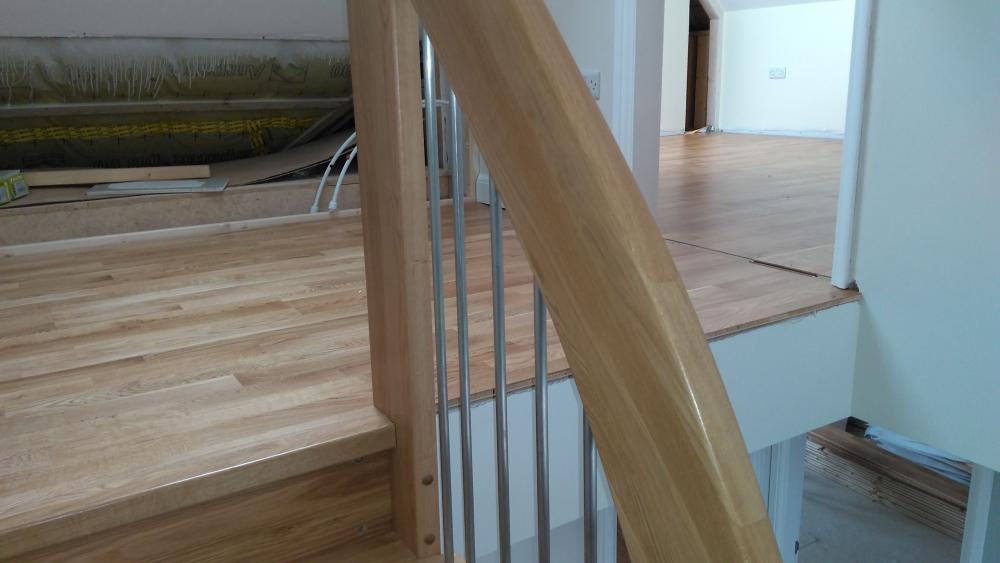
Out of interest what we did in the end was to use a thin floating membrane under the engineered flooring on the landing area (which is only ~ 2 × 1.5m but fixed this on one side, where is meets the void and the top of the stair. We used screw fixings under the section to be glass-panelled so that the panel bottom carrier will sit on the engineered flooring. Where the flooring meets the stair head, the top surfaces are at the same level, so I fixed the floor panel to the underlying floor with a long bead of Sikaflex EBT and but jointed the floor to the top stair nib using a decent wood glue. My thinking here is that any diffeential expansion between the engieered floor and the underlying chipboard floor will be tiny as they are both an enigeered wood and the temperature in the house is extremely uniform. Even so, the engineered floor is still free to move on three sides and the top layer of the engineered floor is almost an exact match to the oak used in the stairs,, so both Jan and I are really pleased with the final look, and there absolutely no trip hazard. We'll cover the engineered floor edge with a thin oak strip.
-
J, surely it would be quite easy to put a small patch of tape on the inside of your window that would provide a modesty mask of her window. Once it is trimmed and working, then you can tell the neighbour and if necessary show him a capture to show that you are respecting their privacy.
-
Yup the Internorm doors took a lot of abuse, and I am really glad that couldn't get in, but it didn't stop them doing some damage, that will be quite costly to fix properly. We tend to buy the budget end of tools, Ebauer, Titan -- apart from the drills which are decent deWalt -- because we don't need a long working life. Unlike a jobbing tradesman once this job is done, then we won't have much need. But even so, we had about £2,000 worth and have lost almost a half of that.
-
I think that we'll need to get a couple We just had someone(s) attempt to break into our new build last night. They tried to get into the house by jemmying a set of Internorm French doors. The doors defeated them so 1-0 to Internorm, but they eventually got into our shed onsite and pinched about £700 worth of tools. However the really pisser is the crowbar damage to the aluclad door frames: 12 weeks replacement delay and ?? in cost.
-
Stage 1 Is Very Nearly Complete :)
TerryE replied to Construction Channel's topic in General Self Build & DIY Discussion
Jan's mastered the chop saw and I've even got her measuring cuts to the nearest mm, but she still leaves me to do the table saw work. -
Have a lock on the Vbox user forum and also make sure that you are running the latest VBox version (5.1.22). I used to be a contributor to VBox and a moderator on this site so I do understand quite a lot about the internals, but I just stick to using it on Linux these days, so I don't track the interoperability issues with M$.
-
A related point, so I hope that you don't mind me adding it to this topic. It's now free free two years since we broke ground, and we are in the tail of second fix, mainly because we are doing the work ourselves and we are stringing out the cash out until we sell our old house. From a building control completion perspective, the main constraints are that we are waiting for our tiler to do the wetroom floors before we can finish the rest of the walls and decorate then fit the fittings. So we might be in the position of going for completion certificate in 3 months -- just about the time that our current building insurance extension runs out. The price for extensions is rediculous (captive market). So to my Q: at what point can you switch from building insurance to normal house insurance?
-
Jeremy, offset hinges work fine. We had to have them on our last gates. You just need to get the offset correct. The guy who installed the gates welded them himself.
-
Martin, do the maths. Do the (over) heat calcs and see how much heat you need to suck out of the slab to maintain an overall thermal equilibrium. For a typical MBC house, it will be at most a few kW (unless you've got silly solar gains). If you've got 100m2, say of slab, then you'll need the slab at 18°C instead of the normal room environment of 21°C, say. At an RH of 40 - 55 %, that's way above the dew point.
-
You have to be careful with MBC not to compare "apples and oranges" MBC typically do a passive slab power floated to FFL with the UFH included for a relatively small add. With a more traditional builder you'll pay for base slab, insulation, UFH, top screed.
-
@Vijay, as everyone else says: gun every time. If you use a gun, then you'll never go back to the use-once plastic nozzle. If is just so much more precise. The Screwfix No-nonsense stuff is fine, IMO, and you can leave the can on the gun for a day or so. After that you might be building up a decent decoking job. Once cracked (or even if left on the shelf for long enough) then the foaming agent loses its vigor, that's another reason to go to a high turnover supplier like Screwfix. Also, don't make the mistake of putting in too much on the first pass. It expands a good 3× unless you get the low expansion stuff. You can always go back and put in a second layer if needed.
-
Stage 1 Is Very Nearly Complete :)
TerryE replied to Construction Channel's topic in General Self Build & DIY Discussion
That's what we said a year ago - except the babies bit; did that 30 years ago. The only sort that we look forward to are the grand kind. 1 down and ? to go. -
Lifting and Lowering (useful "rule of thumb")
TerryE replied to B52s's topic in Project & Site Management
For my sins, I did a spell in Royal Engineers in my youth, and one earning that I retained from officer training was the correct way to lift weights. Very few people that I've seen in the building trade seem to have been taught this and break some basic rules and as Clive mentions end up with spine an spinal muscle / tendon / ligament damage as a result. Avoid using your back as a cantilever, especially for weights over 10kg, so knees bent, arse in and back straight is best, and use the leg muscles in preference to the arm muscles to move the load. Lifting aids can make all of the difference, especially when working alone: levers, block and tackle, dolly cart, and I have a length of timber on some of my son's recycled skateboard wheels that I can also trundle heavy stuff around on. -
The guts of a fridge would be the sort of cooling system that I was thinking about. As to drying room, well you if you dump the heat int a smll room then it will be hotter than the rest of the house, but a drying room really uses the delta temp to drop the relative humidity of the air, and an MVHR house, as Jeremy commented, a cloths drier in a utility room will work pretty much as well.
-
We ho-hummed over this one, but in the end the footprint issues didn't work. If you have a 1m2 larder then its going to have ~10m2 surface area with the rest of the house and if you assume a internal partition U-value of 0.4, say and a 15°C delta from the room to the rest of the house, then you are going to have to pump a continuous ~60W of heat out of the larder to keep it cool. IIRC , Peltier effect coolers have a CoP of <1 so you'd really need a fridge-type system which have a CoP of nearer 3 and a heat pump rating in this range. Unfortunately, there's no free lunch.
-
As far as I can see you fit this inline into an MVHR inlet to chill down the air -- assuming that you have a supply of chilled water. So where are you getting your chilled water from? And you are in effect pumping heat from the larder into this water supply.
-
Building Regs requesting ramp approach
TerryE replied to hmpmarketing's topic in Building Regulations
Thanks Jack. The link just shows how Part C and Part M are really inconsistent, IMO. I personally can understand the sense of future proofing a house internally for access as changes to the interior are a big deal. However the requirement to put in a mandatory access ramp for a private dwelling is just daft in my view. For the vast majority of home owners / occupiers it is totally unnecessary and is trivial to add if and when it does become a necessity. In our case our GFL toilet is off the utility room adjacent to the rear door. Our rear garden is quite shallow (7-10m) and rises up from G/L around the house some ½m at the boundary. We have a concrete skirt around the house (mainly to protect the EPS of the MBC warm slab). My current thinking is to step the garden up 15cm at the edge of this skit and deck the concrete skirt so that the garden and decking is pretty much flush with the house FFL. Drainage /damp isn't a problem since the actual drains are at GL. Mobility access will down he side of the house and through the rear entrance. -
Building Regs requesting ramp approach
TerryE replied to hmpmarketing's topic in Building Regulations
I can't recall where but IIRC, elsewhere in the regs there's a guideline that the FFL should be a minimum 150mm above ground-level and that's what we've got, so whatever you do you will normally have 150mm step from GL to FFL. The maximum "level" gradient is 1:20 and that means a 3m ramp. You see lots of those on new estate developments, don't you? -
This might have been the advice from your PM, but it is also not true, so it is bad advice. As to hot return loops, these should not be done in plastic, but this isn't regulation. Yes, they have a role if you've no control over the layout of your house. However, no matter how good your insulation is, in practice you are still using your DHW as a secondary heating system. IMO, not a good idea in a passive house or near spec. My current farmhouse is a typical layout mess: ~5m from boiler to HW cyl, and then ~9m back to the kitchen. water takes an age to run hot in the kitchen. In the new house we clustered all of our wet rooms around a central services cupboard where our DHW + manifolds live. The path from the SunAmps to the manifolds is <1m and lagged, the average pipe run form the manifolds is 3m or ⅓ ltr which is a couple of seconds running time. It I'd used 10mm HEP2O for the low flow rans then this would have been closer to a tenth of a litre.
-
Have a look at my post: Where I discuss some of these issue and give a couple of good references. We have a HEP2O + central manifold system. The largest copper run is less than 2m so I ended up doing all of mine in 22mm as the TMV, water softener, etc. dominated both the pressure drop on the acoustic output. All of our radials are in 15mm so keep it simpler an minimise costs (our runs are fairly short, so the pipe cost savings in going down to 10mm for some run is less than the cost of the extra 15/10 reduction couplers). There was an argument fo using 10mm on all of our low flow hot taps, but quite honestly when I look at the usage and costs of dead water heat loss, it just wasn't worth the hassle.
-
We've got two DPCs as well. In our case its because of the risk of bridging from stone laying snots (See below for a laugh). Because of mitigating the thermal bridging issue the engineering brick plynth stands up a couple of courses above the FFL. So our builder put a second DPC to the top of the engineering brick. The stone skin sat on the outer side and we cut the blue tenting about 200mm above the top of this and tucked the other side under the top tenting before stapling it back. We have some drainage holes in the EB courses, bt our main line of weep holes was at this level. This way there was no risk of an residual snots bridging between the stone and the TF. Details, details. Sighhh.
-
Recommendations for expanding window sealing tape
TerryE replied to joe90's topic in Windows & Glazing
John, this might horrify you but we didn't use any sealant. We have AluClad windows which are fixed into an inner (MBC) TF, and an outer stone skin. There might be mm's of movement between the two skins and so we needed a slip surface between the stone skin and the windows. The stone skin was added months after the windows were in place. But we used a similar counter reveal approach with the windows standing ~45mm forward of the TF, and a 25mm overlap on the stonework. The windows had cavity closer / fire breaks around them My solution was simply to cover our windows with building grade clear polythene, and this both protected the windows and provided the slip surface. The mason just laid his stone courses and quoins to provide this overlap and closed the gap with a mortar fillet. When the stonework was all complete we carefully cut back the polythene at the junction of the window and fillet and ran a clear silicon bead along the join. Worked a treat. In your case, I would have expected the windows to be fixed to the blockwork rather than the brick skin and the airtightness layer here. A similar mortar fillet might do the trick, but clearly if you are doing the more traditional approach of fitting the windows after the brick skin is up, this might not work for you.

