


TerryE
-
Posts
3826 -
Joined
-
Last visited
-
Days Won
30
Everything posted by TerryE
-
The first challenge is finding a suitable plot, and the second obtaining planning permission followed closely by your financing strategy. All of this can be a total bastard or a source of heartbreak, as one of our leading members is currently experiencing. Actually the build technology is fairly late in the list off issues that you need to tick off. As the the technology, there are lots of choices, but what you are trading off is flexibility and the ability to plan your house down to the last detail vs risk and skills-gap with the trades that you rely on. The active members here have between them picked pretty much every possible one you might consider. In our case we split our existing large plot to get our new build site, and took out a mortgage on our existing property to top up our savings to finance the build. We also used one of the specialist Timberframe manufacturers and designed to our own requirements. They put in the slab and errected the frame 3 weeks later; the windows went in on the last day of the erection so we went from hole in the ground to lockable weather tight shell in just over 5 weeks. A good local builder did the external stone skin, slate roof and external groundworks. Two years later and we are almost finished second-fix.
-
If I don't ask this I will inevitably get it wrong...
TerryE replied to Crofter's topic in Rainwater, Guttering & SuDS
We have similar problems, but this only occurs in extremely heavy rain and like you, the overflow is pretty uniform along the gutter length. Our current thinking is to live with this as it isn't really anything other than a cosmetic issue. The walls get pretty soaked anyway with this level of rain. -
Insulation, Heating, time constants etc. Am I expecting too much?
TerryE replied to ProDave's topic in Boffin's Corner
Dave, this is one to note. If you are driving off moisture then you either need a dehumidifier or your MVHR (not in bypass mode) or both. As Nick explained converting water to vapour sucks up a lot of heat so the best thing to do is to convert it back to water before it leaves the air-tight envelope. We had a small domestic dehumidifier which we ran 24 hrs a day when we were drying out the build. Better to dump water by the bucket load than as moist air. -
Insulation, Heating, time constants etc. Am I expecting too much?
TerryE replied to ProDave's topic in Boffin's Corner
Dave, our slab is around 10 tonne in total and I suspect that yours is similar. That's an awful lot of thermal capacity. And as Nick says, if you have above steady state levels on residual moister then evaporating this off takes a lot of energy. Having a large thermal capacity is good. It means that once your house is up to target, then it will "resist" temperature variation. Consider an analogy, an oil tanker: once it is up to its cruising speed, then a very small amount of power is needed to sustain the speed on a straight course, but getting it there, stopping it or changing direction takes a of of power. -
I use an old Wickes Henry-style vac but have a look at the series of videos by this guy on making dust extractors: Matthias Wandel - Building a dust collector blower. And Nick, the fence could be improved and replacing the handle largely did the trick. I also clamp a second fence on my frame if I am cutting 125mm planks (2×65mm and run through the planer thicknesser). Elsewise it works fine for me: it is sturdy and right (once I replaced the clamping handle so I could easily tighten it).
-
And possibly sold by the bastard who broke into our shed and pinched a load of tools!
-
Jeremy, its a personal judgement call, but I bought this Titan TTB674TAS 254mm Table Saw 230-240V and it has done a lot of heavy duty service in the past two years and saved me many times its purchase price of just over £100. But at this price, and with the ability to set height, tilt angles and fence positions, I can't see making your own table worthwhile. Do it as a project if you are running out of things to do, but don't do it to save money. I have made changes to the Titan -- like dumping the riving knife and guard, because I came to agree with the US sites. It just gets in the way and halves the functions that you can use the saw for. (For example dadoing) It also means that you can't see your cut so I find I can cut a lot tighter without it, I have made other changes like replacing in the handle on the fence to increase the grip and square framing the whole table on the sides and back so that I can clamp a running fence to wider pieces and cut pieces like sheet materials. Again any form of guard gets in the way with larger pieces. I have a couple of rules: (i) I treat the "cone" above the centre plate as "death" and never put my hands inside it whilst the blade is spinning. I always use push stick if I need to control a work piece within this area, and (ii) I always set the blade depth to no more that a few mm higher than the work piece. (iii) I make sure that I can see the teeth stationary before I move my hands over the table. I also have a couple of roller props -- handy for managing longer cuts.
-
Being pedantic, it has zero rest mass, but it also has a defined energy E = h/λ and hence a defined momentum = h/λc in the direction of travel, which means that it can be kinetically modelled.
-
Eh? I assume that this Nick humour. Both statement are true but misleading as is: photons last at least one second and weigh less than a kilogramme. At least the life of the universe, or there'd be no cosmic background radiation, and no theories that I know of postulate a half-life. Photons travel at the speed of light so they must be massless within Special and General Relativity.
-
How to terminate soil pipes prior to concrete pour
TerryE replied to Pete's topic in Waste & Sewerage
Have a look through the posting history. I for one did a thread on this. It's a lot bf better if you terminate in a female socket. Also don't forget any services ducting. We used a couple of 110 drain pipes for this coming up into the services cupboard. But remember to use slow bend or better a 45° to come up into the slab - a lot easier to pull stiff pipes and cables. -
Nick, the Oxy Time for bed, I think!!
-
It depends on your house's construction technology, but in our case with 300mm cellulosic filler and an external stone skin the decrement delay factor is so long (multiple days) that you can ignore diurnal variations in any calculations. IMO, Jeremy's level of detail is fine, though I use my own variant in my spreadsheet. You also need to understand that there are two separate measures that you need to consider: (i) a calculation based on your local area seasonal temperature averages to give you your expected heating costs, and (ii) the worst case heating demand if you are in the middle of a stuck jetstream cold-snap which lasts for days. IMO, this second case is so rare that I am quite happy to use a small electrical heater for a couple of days, once every few years if needed to keep the temperature up. IMO, the biggest risk is not in the heating but in some construction flaw which leads to thermal bridging that you have missed in your calculations, and again in my view the answer this is down to you. The devil is in the detail and you can't just assume that any construction crew will always get this right: trust but verify.
-
Reader, he survived.
-
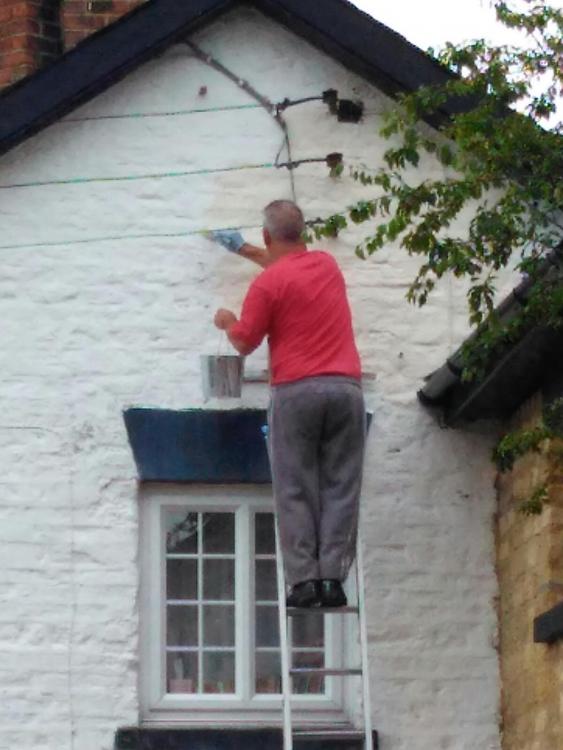
A picture of our neighbouring house. Yes, that's an old-fashion unshielded copper connection, two phases for both halves of the semi. The guy was reaching through the live 240V copper lines to paint the wall behind. I think that this is just crazy, but what's the correct / moral response here? OK, I am standing by with my CPR, but if I threaten to report him, I will piss my neighbour off. She and the painter have obviously agreed to take this risk. If I suggest that he at least sheaths the lines with polythene or some other insulator, then I become a party to this madness. What would you do in this circumstance? The back-story is that I'd agreed to do some work in her garden as a sweetener for the inconvenience of our building the new house adjacent to her property. I initially suggested a £5K for her to spend as she wished (to avoid arguments), but she felt this was too much. However as time on this sort of became open ended, and I estimated that including all of my time the bill had racked up to just under £10K (though this included a shared new fence which was to common benefit). But she then added painting this wall to her wish list and I said that I had done enough -- and I certainly didn't want to get into paying for the supplier to replace the house supply with a modern shielded one.
-
The strength and the weakness of the MBC-style passive slab and Larson strut system build from custom factory-made cassettes is its precision. For traditionally built houses this often an aspiration that most construction gangs don't even bother with. The build technique can tolerate sloppy workmanship. I was showing someone our bathroom and the double steel bath fits exactly in the width of the room. Even my tiler was amazed at this "lucky" coincidence -- until I explained that the reason that the steel bath fitted so well was that I'd designed the width of the bathroom so that it would. We got to Rev J before I finally signed our build plans off. This construction technique gives far better build tolerances -- on average -- but this is because it is also for more susceptible to the ripple consequences of off-spec work. The reason that we got our foul water runs in the right position, etc, is because I was on site during the slab work and ditto during the frame erection. Trust but verify. IMO, independent engineering design / quality assurance is absolutely essential during these intense weeks. The crews are working flat out 12-hr days and they just don't have the time to halt work to check on issues. Someone needs to be working along side sorting issues before they occur and with the will and authority to call a halt whilst something really need resolving. It doesn't matter whether this is the self builder, project manager or architect, but someone needs to be onsite doing this design and QA role, IMO. If the self-builder has a day-job, then I would suggest that an engaged PM or equivalent is needed to fill this gap.
-
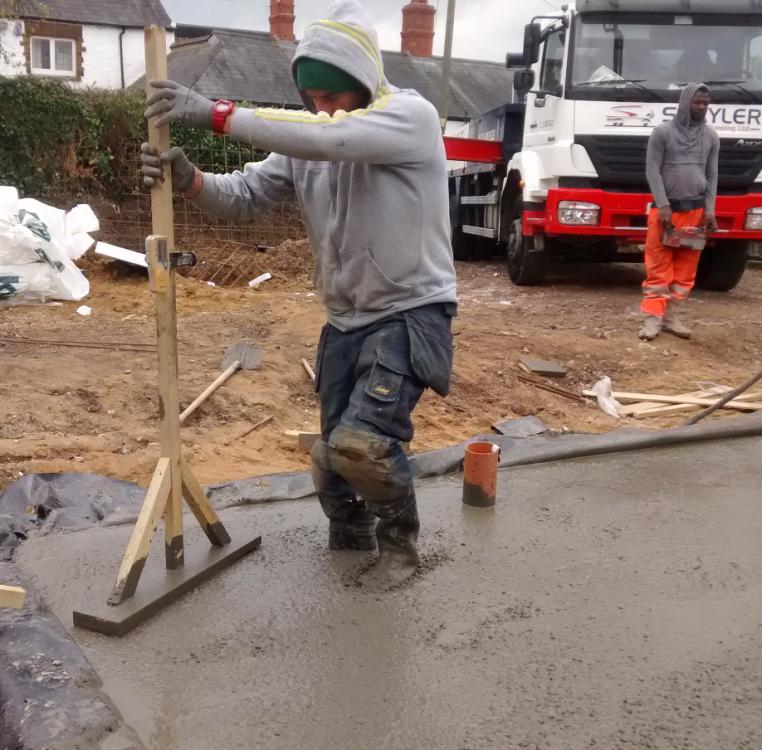
@Barney12 It sounds like MBC have got real quality issues with one of their foundation / slab crews. In our case they were very particular about getting the entire site level at each compaction layer as well as at the sand base and the formwork before they started the pour. We later found a slight low point in one room (about 4mm in a 6.5 m span), that they missed during floating. We didn't have Brendan, but his #2 Mick. I asked Mick why they were so particular about the layered compaction, and he said that the main risk with this type of slab was differential settlement across the slab if the underlying ground or the layering / compaction across the area wasn't uniform and this could lead to local slumping across the slab before it properly started to cure. If they did the same on your slab, I can't see them getting the concrete levels out by 20mm. Do you think that it could have been differential settlement? Even so the right thing to do would have been to fix it by levelling before doing starting the frame. And the framing crew should have highlighted this issue. Not good.
-
Personally I'd ignore formal PHPP certification as it has little worth to you or on your market value, and concentrate on identifying your own design goals, then you understanding how these constrain / influence the design. Within these constraints, try to keep it as simple as possible. E.g. ASHP as most others have said. Mains water and sewage. Walls of glass are loved by architects but are a pain in the arse for the occupants. Even the top range have a very poor U value compared to a decent twinwall frame or equivalent. Decrement Delay Factor absolutely terrible. Excess solar gain even with electronic shuttering. Privacy issues from neighbours and passers by. IMO, only use glass walls when you feel that the connection to the outside is essential to the room and you can control the privacy issues. Think about the build dynamic and subs. Keep this simple and keep control. I personally would strongly endorse an MBC package as this wraps a high percentage of the risks in a single supplier that many here can personally endorse.
-
I used the engineering brick plinth to wrap the Foamglass and to ensure that there were no rodent entry points into my foam under-slab. I used Foamglass because the SE "signed-off" on confirming that it could carry the external skin. It's only a 75mm high layer: this was enough to pretty much eliminate the thermal break, but also meant that the plinth was well proportioned. I added extra shuttering and rebar at the door and French door positions so that the slab has a 45×50 tongue positioned to support the door and the door exteriors are flush to this. You can see from the pictures at the bottom of the second blog post referenced above that the external cills are slated. I put another row of Foamglass under the slate butting against the tongues, to act as a thermal break here.
-
Shit sticks.
-
@Barney12, ours is slightly different in that Hilliard decided to link the inner and outer ring beams by dozens of 20mm rebar links so that they act as a single structure. This was a flawed design thermally, but luckily I was able to mitigate the bridging as I described this in my blog post Coping with a Thermal Flaw in the Design. If I hadn't done this then we might have had similar issues to those described in the Thermal Bridging article. This double skin also meant that the window and door treatments were somewhat different to those for a clad house as I describe in the next post. The external stone skin has pretty much zero impact on U-values. It's really there for looks and weather protection. However, one major upside is that it's thermal capacity means that the decrement delay factor is measured in days on this wall profile.
-
As you say MBC-style. Very familiar to anyone like us who has an MBC house.
-
Jeremy's first comment is accurate, but IMO there is still a trade-off to be made here. At one extreme bridging could the interpreted has any extra heat loss due to the construction at the interface. We have an outer stone skin covering an MBC timber frame, and the window sit half inside the frame and half closing the gap between the skin and the timber panelling. This arrangement definitely has more heat losses then positioning the windows in the middle of the timber frame, but when I do the sums, it works out at only a few W. Yes, the reveals adjacent to the windows will be a few degrees colder, but not sufficient to result in a risk of condensation. The benefit of this arrangement is the improved external aesthetics, and the far better construction of the interface between the stone and the windows means that there is for less risk of weather compromise between the frame and the outer skin.
-
I'll have to remember his for the next house we build.
-
We had this as an option, but I decided that I preferred not having the movement interface at the visible meet of the wall and stringer.
-
Rob, we bought our stairs from Complete Stair Systems. The total tolerance was less than 5mm, and we had one measurement 10mm out so I had to do some careful surgery to accommodate this. The build order was almost unique -- a bit like doing a Sudoku or Rubik's cube, but without an assembly manual. I did the entire fit myself. I had zero confidence that a typical joiner would be up to the job. The final look is fantastic and my only complaints are quibbles that probably only I would notice. Everyone else says they look amazing. We are not over two years since the MBC slab was laid and we're just commissioning our bathrooms. Our top stair went in about 4 moths ago, but Jan and I made a conscious decision to defer putting in the stair to the first floor until pretty much the last thing. We are still using our temporary stairs here. But that's because the temporary stairs are just as functional and we didn't want to be hauling building materials up an extremely expensive custom oak staircase. The extra 5mm error was because we did the measurements before boarding out and we didn't allow for the pink plasterboard in the safety corridor being 2.5mm thicker than the stuff we've used everywhere else. So my recommendation is to make a decent temporary staircase that will work for the duration of the internal 1st and second fit. I made ours with the odds and sods left over by the MBC guys, so it cost nothing. It only took a day to make and erect, and it's as functional as the final staircase. Measure your staircase and order after boarding out and plastering. That way you can easily work to a tolerance better than 5mm. Leave putting in the stairs as late as possible, because there's no point in getting them damaged by material haulage during second fit.


