


TerryE
-
Posts
3826 -
Joined
-
Last visited
-
Days Won
30
Everything posted by TerryE
-
Nick, an RPi model A costs what? £25? or thereabouts. IMO, it is a big mistake trying to overload a single board and be miserly about keeping GPIOs free. SPI is point-to point and buffered so you can drive it at high clock rates so is good for high bandwidth connections like to Flash 3pins for one SPI connection, 4pins for two. I2C is a bus with a bus protocol. The complexity of all this his handled by the I2C drivers both on the RPi (and on the ESP chips that I use), so don't let this put you off. Even if you want 10 of the buggers at 2 per I2C bus, this is still only 20 IO pins. I guess I am a bit more relaxed because I only use an PRI3 ModB for my main server and the Wemos ESP8266 boards for everything else at under £3 per board ( I don't connect any physical devices directly to my RPi). OK the project box, grommets, cabling, vero board, etc., bumps the price per unit to maybe £15 but this is still pin money. As for as addressing OW by meaningful names is concerned, this is what high level languages like Python and Lua are for: you can have keyed lookup into arrays.
-
Nick, the BMP supports both I2C and SPI 3 and 4 wire. SPI is fast and point to point I2C is a proper bus so you can run your RTC and your BMP280s on it (two per bus). I am not sure what the issue is. The RPI GPIOs and the BMP280s will all coexist on an I2C bus with a 3.3V pullup. Section 5 of the DS describes the electrical configs. You can have two devices per I2C bus at addresses 0x76 or 0x77 depending on whether pin SDO (not used on I2C bus) is pulled high or low. The other pins used are SCK used as SCL and SDI used as SDA. SDI needs a 4.7K pullup which is what tells the chip it is talking I2C. PS. Just looked at the module in zoom. I can't understand the layout since it also has a reverse side which isn't shown. This seems to the the same part except both sides are shown and a description of the pinouts are given and this module diagram: Hope this helps It looks as if it is wired for I2C but you will need to remove R4 and pull up SDO if you want to use 0x76 address.
-
Peter, I've just spent the most of the last three years building my bloody house, so the last thing that I want to do is to plan for selling the bloody thing. Preparing for that eventuality is very much a quite separate phase for me. In a way, I think that you are 100% wrong here. If you need to replace any control component these days, then what is a realistic spares and replacement life? 2 years? 5? If some bit of kit goes wrong in 3 years time then I suspect that you might have to do (major) work to replace it. Forward buying is a expensive game if you are only have one of each and they cost a few hundred £. Jeremy and I have both work with the armed forces and understand their logistics models. They easiest way to guarantee a service life is to buy a sufficient spares holding at the point of commissioning / procurement that you have a set of plug-in replacements for any sub-components likely to fail. So in my case my basic IoT compute module currently costs £2.61. It plugs into a 2 × 8-pin header on a passive board, so is a quick swap out. I think that I can afford 10 spares; just in case since I use the same module in all of my IoT sensors and controllers.
-
Jeremy what I didn't want to get into is trying to out and find OTS (off-the-shelf) control components, put them in and then find that I needed to rejig everything and by more bits. OK, I am also a software geek which helps. Hence my two phase approach: Gather lots of data. Have some basic on-off control output, and do the algos in SW until I've fully characterised the system and have confidence that it works as I anticipated. Once I know how my house behaves and how to control it, then do a second phase productionising / procurement of an OTS solution. To be honest, watching / tracking your learning curve was one of the reasons that I decided to go down this route. The main advantage of this split, IMO, is that (2) isn't time critical as the house will be running happily. I can take my time over finding the right kit for my needs.
-
I am getting better than a repeatable 0.03°C accuracy out of my calibrated ds18B20s. It's just a lot easier when you are working to a known accuracy, IMO.
-
My general issue is that I have to control of house where the winter losses are of the order of 1kW or less and the number of net heating days maybe 90 or so and the number of net cooling days is possibly greater. Doing this is actually going to be fairly easy, but the reality is that this is such a niche market that there aren't any off-the-shelf control systems to do this. Jan was asking me why I am proposing to use so many thermometers; did I need them all? My response is that I think that I actually only need three for the control, but that the rest are logging only to validate that the control is working effectively and in some sense near optimum. By going custom, I can quickly and cheaply build a system that does what I want and I can also tweak it post go live in software rather than having to reconfigure hardware and buy new bits and pieces. Once the system is stable and working, I've then got a few years to let the off-the-shelf market catch up and I will know exactly what I am looking for. In the meantime, so long as I have a complete stock of LRUs (line replaceable units. -- pluggable spares) and my son-in-law understands the system, then there isn't a maintenance risk for Jan.
-
Chicken ;-?
- 22 replies
-
- 1
-

-
- ashp
- thermostats
- (and 1 more)
-
We just used the same sort that MBC used. We have an 15mm ply (IIRC) liner which acts as a sleeve within the frame window opening to carry the front of the window to the back of the cavity. The closer is essentially strips of rock-wool with the reqired depth in a polythene tube which you staple around the window.
-
Be careful about doing this. It definitely has pros and cons. We didn't in the end, and I am glad that we didn't. The pros are self evident so let me just list off the cons that you might want to consider: The plastering crew might want to provide the PBoard themselves. Ours did and it was part of the job lot price (which was very competitive, BTW). They walk PBoard into building and up floors all of the time, so this was absolutely routine for them. It is amazing to watch two chunky guys passing 2.4×1.2m sheets between each other in a stair well and stocking out for a floor in less than 30 mins. Getting the quantities and spec correct is quite complicated. You might have different thicknesses for ceilings and walls, and you need pink and green boarding for safety corridors and bathrooms. You definitely do not want to have PBoard stacked on the ground floor whilst the slab is drying out. You probably don't want to have PBoard stacked on the upper floors because leaving aside the structural risks mentioned about, it just gets in the bloody way and can get damaged or degrade. It is also often in the wrong room, and it is just as easy for the plastering gang to pass the board up the stair well and into the right room and by the right quantity, rather than carry it from room to room. OK, we are working to a budget and doing a lot of work ourselves including a lot of the internal first fit, so our build time-scales aren't nearly as tight as some on the forum, but it was a year between the frame going up and the PBoard skin going on. A long time I know, but this also had a lot of incidental benefits for us: We saved a lot of external costs because we had time to do work ourselves. We had time to experience the space and as a result made quite a few internal changes: we added a couple of en-suites, and moved an internal partition wall, as well as moving the racking from one side to the other on a couple of walls. The delay meant that the slab had totally dried out and the frame stabilised before the boarding out. This in turn meant that we had no drying out cracking at all on our plasterwork.
-
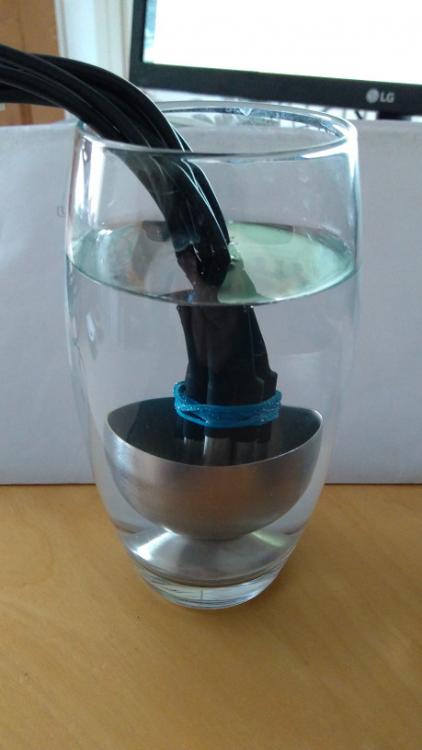
@SteamyTea Nick, I've actually done a few runs now, including shuffling the cans in the bundle just to make sure that there aren't any material differentials for the probes on the outside of the bundles. My test rig went through a number of refinement steps and I now have enough confidence that the test rig is working well. Having the water in a heavy tumbler starting as ~35-40°C and naturally cooling to room temperature over 6hrs or so is enough to generate a stable temperature glide that allows you do fit linear regression curves to the XY plots. Letting the water cool naturally at this ~1-2°C per hour is slow enough that the internal temperature gradients within the tumbler are smooth and there is no material internal convection. Tying the probes in a tight bundle around the fat part of the sleeve overlapping the can keeps them at the centre of the water mass but with 1-2mm separation between cans Sitting the bundle in a metal eggcup keeps it clear of the glass surfaces and at the centre of the slowly cooling water mass. There is little point in over sampling, so I take one set of readings every 5 mins, and log the average reading, pus the error against average for each individual probe as a tab-separated listing. I can then cut and past this log output directly into Calc (or Excel ...) for XY plotting and calculating linear fit using the slope and intercept functions. These calibration results are stable to <0.02°C from run to run, so I have confidence that the readings adjusted by this calibration data are mutually accurate to this sort of precision. And just for interest to give you a flavour of what coding this ESP8266 chip in Lua is like, here is the small program which logs the tab separated results to the USB serial comms port. I could have logged this to a UDP listener socket on my PC instead with another few lines of code, but USB was easier in this instance: -- make the timers global so I can stop them from the IDE. tmr1,tmr2 = tmr.create(), tmr.create() local ds = require("ds18b20") local to_string, print, gpio2 = ds.to_string, print, 4 local saddr, addrs = {} local tmr1,tmr2 = tmr1,tmr2 ds.init(gpio2) addrs = ds.get_addrs() if addrs and #addrs > 0 then local n = #addrs for i = 1, n do saddr[i] = to_string(addrs[i]) end print("Avg", unpack(saddr)) tmr1:register(1000, tmr.ALARM_SEMI, function() local t,avg = {}, 0 for i = 1, n do t[i] = ds.read(addrs[i]) avg = avg + t[i] end avg = avg / n for i = 1, n do t[i] = ("%8.3f"):format(avg - t[i]) end print(("%8.3f"):format(avg), unpack(t)) if avg < 20 then print(("Stopinng at %8.3f"):format(avg)) tmr2:stop() end end) tmr2:alarm(300000, tmr.ALARM_AUTO, function() ds.convert_T(true) tmr1:start() end) else print("No OW thermometers found") end
-
I had reformatted these articles to make them printer-friendly and so I pinged off an email to him in Feb asking for his permission for post these either here or on his site. Anyway, I got an email back from his widow today, letting me know that he died last May, so I guess that it would be better to leave his content as part of his legacy.
-
I've just kicked off an overnight calibration run with my Wemos ESP module logging 15 thermometers in parallel. The cooling glass trick is very useful to produce a nice temperature glide for relative calibration purposes.
-
Automatic curtain opener recommendations?
TerryE replied to readiescards's topic in General Self Build & DIY Discussion
Now there's a challenge for you. I am sure you could make one for a quarter of this PS. on a serious note, You can get manual roller and Roman blind kits pretty cheaply. A small project box with an Arduino, esp8266 or RPi3 Model A+ to give you WiFii control and a small servo motor and pulley on the inside or outside of the box -- just mounted in the reveal. Maybe not as neat as hidden in the roller barrel but still entirely doable for well under £100 and more like £30 if you use the ESP board that I use and source the components direct from China. -
I don't know, but if we start on that line of argument then we would have to empty most of the content of the British Museum. Did we really have a licence for taking the Elgin Marbles or our sack of the Imperial Summer Palace? ... US (and UK) copyright law is bizarre, IMO. We see patents for the bleeding obvious. I've seem so many huge abuses of this system over my career -- the situation where knowledge has been widely circulating for years and that has been picked up by someone who dots the i's and and then files a patent. Case in point: Penicillin, initially discovered by a Brit, all of the main development work by an Australian leading a British development team, but the patents were all held by the US pharmaceutical company that did the production work. I don't want to belittle what Pfizer achieved, but it benefited because it was building on knowledge created / identified by people who felt this work was sufficiently important that it belonged to the commons. All of computing; the existence of the technology and sciences is based on the work of a young undergrad at Kings Cambridge who basically invented the formal foundation of the whole domain in the early 1930s. Has Kings, the UK or even Turing's family ever benefited from this -- financially that is? OK, the OW protocol is a nice protocol. The DS18B20 is a nice use, but not "rocket science". Do I think that the Chinese clones have pinched any engineering know-how from Maxim? No, IMO. What they have done is to manufacture silicon which does the same job using the same S/W interface for compatibility. So I will happily use the Chinese versions. This is a commercial not a moral issue, and Maxim has commercial mechanisms available to it, if it feels wronged. Not my job. PS. Nick, I've just pulled out my last tongue stitch and had one glass too many of wine! Sorry.
-
I've just done anothe glide with a mixed bad of the themos and slope / intercept corrections from my calibration runs and getting a 1-sigma of 0.02°C compared to the basket averages of the measures on the glide. I can live with that And yes, I know I should multiply this by 8/7 since its a sample variance but this is just a ball park -- they are really accurate.
-
What are you using for you microprocessor? And did you see you I wired up my through-hole board?
-
These come with a 1m lead. You can get them shorter or longer, but also note that these aren't parasiticly powered. you do meed to wire up the VCC wire.
-
Sorry, fixed.
-
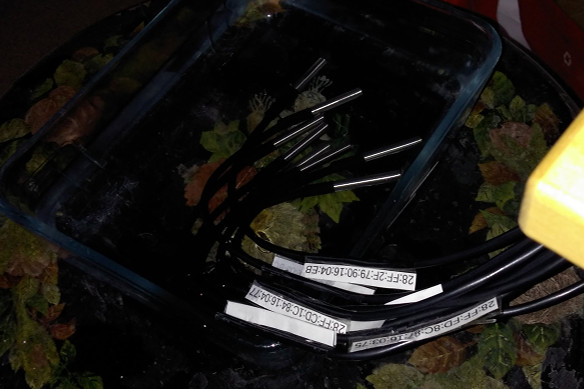
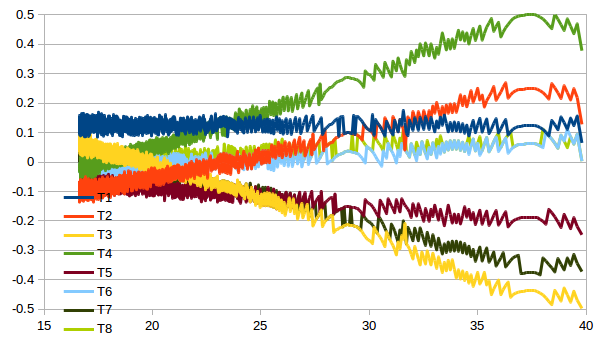
I've plugged 8 of my my batch of waterproof DS118B20s into my prototype rig and did a quick temperature ramp on them, by filling a glass dish with hand-hot and dropping them in, then stirring and dribbling in cold water to gradually cool the solution down (note that I've labelled each DS18B20 with its PW address): The error range was a lot less this batch: ±0.3%, but it wasn't at all clear to me how much of this was due to inhomogeneities in the liquid temperature and the positioning of the cans relative to the cooler glass surfaces, etc. So I had a brood and decided to bundle the probes with an elastic band around the sleeve part to the cans were still separated by water and then stood them in a metal egg cup in the centre of a glass again holding water at an initial ~40°C and left them to cool overnight logging the temperatures every 10 mins. I then pulled the data into a spreadsheet, so here is also the error vs. average XY plots for all 8 thermo's: What I'll do before heading off to bed is to leave 8 of the devices in a hot glass of water and let this cool naturally overnight and then repeat tomorrow. This should give me two reasonably homogeneous and steady glides to calibrate the thermometers What is clear here is that the thermometers give stable and self-consistent readings over the temperature range that I am using these for. They are consistent to within ¼°C of the average over this range, and once corrected by a linear regression derived from this calibration data, then they will be accurate within the least significant bit of their sampling resolution. As I said, I am less concerned about absolute accuracy so long as the thermometers are mutually consistent. IMO, there is little point in paying a 200% plus premium for Maxim parts from a main UK distributor or doing any waterproofing given that these 10 Pcs 1M DS18B20 Temperature Temp Sensor Thermal Thermometer Waterproof Control cost £1.30 ea. I will do the second batch tonight.
-
The pipe is cheap and very easy to pull if there are two of you working and you can use 10mm for all of these runs so it will be a doddle. The main benefit is that you don't need any T's or joins behind the PBoard and you've got one pipe, one valve per appliance (or two where you have hot and cold). This makes incremental commissioning and any testing / maintenance just so much easier.
-
Automatic curtain opener recommendations?
TerryE replied to readiescards's topic in General Self Build & DIY Discussion
As I said the ones I came across used PV and internal batteries, but they did have a 5V charging point just in case they needed a top up charge in the depths of winter. They used one of the standard RF protocols. I can't remember which as I don't use RF at all, just Wifi -
@dogman, Martin, One thing to check when the panels arrive is whether the strut lines are properly marked on the outer breather fabric. If no, then go around each panel with a sharpie and put a mark on the outer fabric over each upright. We didn't do this, and they weren't marked in the factory (the staples lines were only approximately over upright), and we needed to fix through to these uprights to tie out outer skin. So missing a 20 min job when the panels are on their sides meant that I later spend hours playing tapping games with a hammer and drilling pilot holes to find these lines again. Also double check all window and door frame openings. If there is an issue then let the gang boss know. You'll probably have no problems, but if you do, then this is the time to get them fixed.
-
Bath Surround / Boxing In, and concealed pipework
TerryE replied to Onoff's topic in Bathrooms, Ensuites & Wetrooms
But even Clive doesn't work to these tolerances -
Picking up Mike's point, if you are constrained on overall footprint, then another option would be to have an annex - basically an adjacent garden shed or custom equivalent - that can be used by the guests as a boot room / drying room / luggage store and you could put stuff like the washing machine in there. You could even consider this as a phase II project if the demand was there, and all that you'd need to consider at this stage is preprovisioning the services.
-
Automatic curtain opener recommendations?
TerryE replied to readiescards's topic in General Self Build & DIY Discussion
Jan had a sole-trader business making up-market curtains before she retired. She used to offer manual closers, and we have them on our curtains. Drawing heavy curtains across a decorative poll can require a surprisingly large force, so any automated system would need pretty high torque and be wired or have difficult to conceal batteries. Have you not considered a Roman blind? You can now get RF / WiFi controlled rollers where the motor, gearing and batteries are concealed in the barrel and there's a PV strip on the outer facing side which generates enough power in most uses that you don't need any external cabling at all.

