


Mr Punter
-
Posts
8582 -
Joined
-
Last visited
-
Days Won
27
Everything posted by Mr Punter
-
I have had similar with a plumber whose GAS SAFE expired but luckily I had another plumber who was willing to do all the commissioning. Like @ProDave said, just focus on the bits essential for FIT and I doubt that means BC completion cert for the whole job. If you need the EPC you will need an air test, so doors and windows need to be in. Good luck and sorry these idiots let you down.
-
I don't quite get it. It looks like the screws are going through the back of the hanger. Also you would probably need to screw through the chords into the block first so it is set the right distance. Fairly odd but I am sure they know what they are doing.
-
The chords on your joists are nice and wide and the joists tend to be much straighter than normal timber, so boarding and flooring is much simpler and you are not having to screw too close to the board edge or at an angle.
-
We have some timber end pieces on a river wall and they were countersunk to over half way.
-
not if is 20mm on a 47mm timber.
-
I can't see why not, unless there is something that says they are only single use.
-
Undo the thunderbolt, countersink and wind back in
-
CRL underwriter declared bankrupt
Mr Punter replied to divorcingjack's topic in New House & Structural Warranties
Or a professional consultant certificate, but I would save your money as the cost will probably be £2,000, you can't realistically make a claim against it and you may never need to produce it. -
Ian is it the case that your previous order had the top chord designed on top of the wall plate and with this one it is designed to be flush with the face of the wall plate? If this is the case it may account for the 100mm anomaly (although I am unsure who is at fault).
-
Long + narrow, single storey barn, our chosen layout.
Mr Punter replied to Jenni's topic in New House & Self Build Design
If you type the "@" symbol before their name you get to pick the member from a drop down list and they get a notification that you have commented. Why not extend the WC down and make it a dog shower / boot room? -
I think most on here will have had similar. I guess the current one with the joists is also "Measuring / Specification". The "Big Boy" contractors do all they can to make sure they don't carry the cost of any errors - in fact may of them make much of their profit from what they consider extras / prolongation costs etc. The poor self builder just has to take it on the chin it seems.
-
Wall plates can be anything from 38mm to 47mm, so why / how they deducted 100mm I am not sure. With regard to trimming, with ICF you are unlikely to get the walls dead straight, so to ask for a 50mm trimmable allowance either end seems fairly sensible. They messed up and will have to re-make. They may be able to modify some of the longer ones - that is up to them - but they need to get a wiggle on or it will hold up your job.
-
Confused by MDPE mains water pipe price variation.
Mr Punter replied to epsilonGreedy's topic in General Plumbing
I have used Pipestock for a few things the normal merchants could not supply and would recommend. -
Are these meant to be top hung - with the top chord resting on the wall plate?
-
The bucket fill does not test static pressure, just flow rate. If you want lower pressure, fit a pressure reducing valve.
-
Agreed with the above. We had a flood from the 1st floor in a completed unit and went for doors and windows closed and industrial dehumidifiers and radiant heaters on full blast for a couple of weeks. It limited the damage and there has been no mould growth, just redecoration.
-
Long + narrow, single storey barn, our chosen layout.
Mr Punter replied to Jenni's topic in New House & Self Build Design
OK @Jenni, with barn 1, can you put the bathroom where you currently have the stairs and incorporate the current bathroom into the living space? If the stairs are just to loft space (as the height looks far too low for a second storey) you could just have a loft ladder. The main living space might be nice vaulted. I might look at barn 2 later.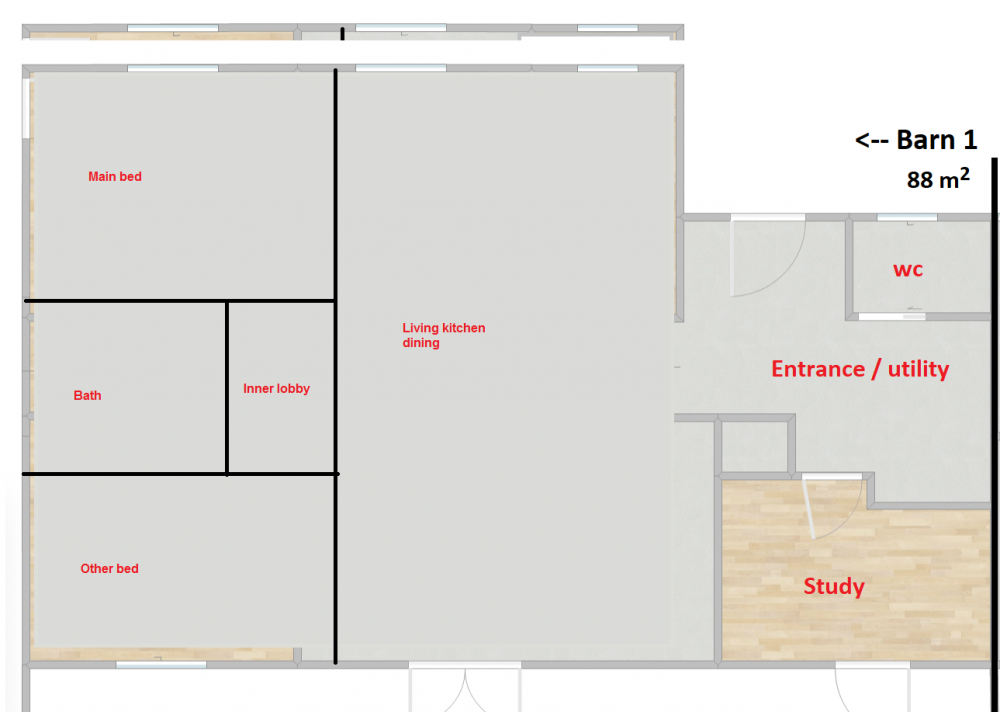
-
How are these supported - top chord on the top of the wall plate or joist hanger or what? Just that the wall plate does not look as deep as joist.
-
How many joists? If you are at fault, can they be used elsewhere with modification or did you get all the joists for the project?
-
staircase Staircase - straight or turned?
Mr Punter replied to Bored Shopper's topic in General Joinery
If you have a half landing as per @joe90 instead of winders and build it, say, 1300mm deep, you should be able to get all but the largest of items upstairs. The half landing is also safer should anyone fall. -
The retrospective app will prob be cheaper than demolish and rebuild. Maybe discuss with the council. Can you lower the roof near to the neighbour? Who set the building out, and what plan were they using?
-
Our last house (1950s which had no special water efficiency measures) was detached with garden and occupied us - a family of 4. The water company would regularly send a bill with usage information that we were using the equiv of 2 people in a 1 bed flat. Maybe we just lack personal hygiene.
-
When you submit the rest of the stuff for the final inspection (air tests, elec and gas certs etc) you also submit a statement confirming that "Water consumption is less than 125 litres/person/day using fittings approach". You no longer need to do the calculator.
-
Splitting Title and covenents.
Mr Punter replied to nubbins's topic in Party Wall & Property Legal Issues
Also if you transfer the plot you may need to declare it at open market value and pay stamp duty on the value. If it is an issue you could do the transfer before you obtain planning - to keep the value low. I have only come up against this issue with a transfer between companies owned by me and the position between spouses may be different. -
Architect - Planning permission awarded bonus
Mr Punter replied to Moonshine's topic in Surveyors & Architects
I have an architect who likes to work this way. I think the bonus was about 5% on top of the planning stage work.


