


Mr Punter
-
Posts
8581 -
Joined
-
Last visited
-
Days Won
27
Everything posted by Mr Punter
-
Where we are the water authority guarantee a flow of 9 litres per minute from a ground floor tap. Perhaps if you are on mains water the water supplier should be doing something if the flow is below this.
-
Housing market outlook worst 'for 20 years
Mr Punter replied to Triassic's topic in Housing Politics
893 words. Phew! -
This looks terrific @D Walter. Is this a self build or main contractor? All looks very professional. I like the blue bricks on the curved retaining wall. With the reinforced concrete walls and floors it will feel bomb proof! Did you look at doing a blog, as I had to switch between this topic and this one If you did this as a blog it keeps the thing together and the comments appear at the bottom of each blog entry.
-
Housing market outlook worst 'for 20 years
Mr Punter replied to Triassic's topic in Housing Politics
The BBC article mainly focuses on sales volumes, not house prices. -
Preliminary plans have arrived
Mr Punter replied to Robert Clark's topic in New House & Self Build Design
Very nice plans. I would be concerned with overheating and would want this modelled. The proposed overhang does not look like it will mitigate this. The lounge looks the most vulnerable. Hoping that is not a wood burning stove in the lounge as this is at odds with clean, modern living and if the house is properly insulated it would need to be minute to prevent overheating, even on a cold, cloudy day. -
That is no way to speak of your HMO!!
-
I like the entrance and hallway. I would do 4 beds, 3 baths, level the site, lose the garage the woodburner and the steps on the ground floor. Also get the bathrooms properly designed so that they look sleek, modern, hotel-like (unless you hate the look). The kitchen should be the centre of the home but yours seems a bit disconnected. Where will the big telly go?
-
Yes to the 4m top plate in 1 piece. As @ProDave doubled up even better. If you can, ply or osb will be better than plasterboard. Maybe stagger the laps and board orientation from one side and the other.
-
Looks like it has a fair bit of recoil, but at £73 per week before discount it initially seems mad that the timber frame teams don't use them until you consider they are supplied the normal framing nails etc but not collated ppn nails. They just get supplied shedloads of twists. They are on a price and not earning a fortune, so spending £400 on materials when they have a foc supply on site does not work for them. It took an age to do all the hangers by hand.
-
I thought that was just for paving...
-
You would need EPS about 50% thicker than Celotex to get the same insulation values.
-
Google says https://www.jewson.co.uk/tool-hire/power-tools/fixing-equipment/products/3301/paslode-ppn35i-positive-placement-nailer/
-
I think smash off the tile and start again. You don't really want a cut edge at the bottom anyway.
-
Thoughts on the external appearance?
Mr Punter replied to Sjk's topic in New House & Self Build Design
This one was well received by the planners and quite a compromise from the architects original proposal. A similar form to the next door house but a modern look. The owners have put planting at the front so the house now looks distinct from the front wall.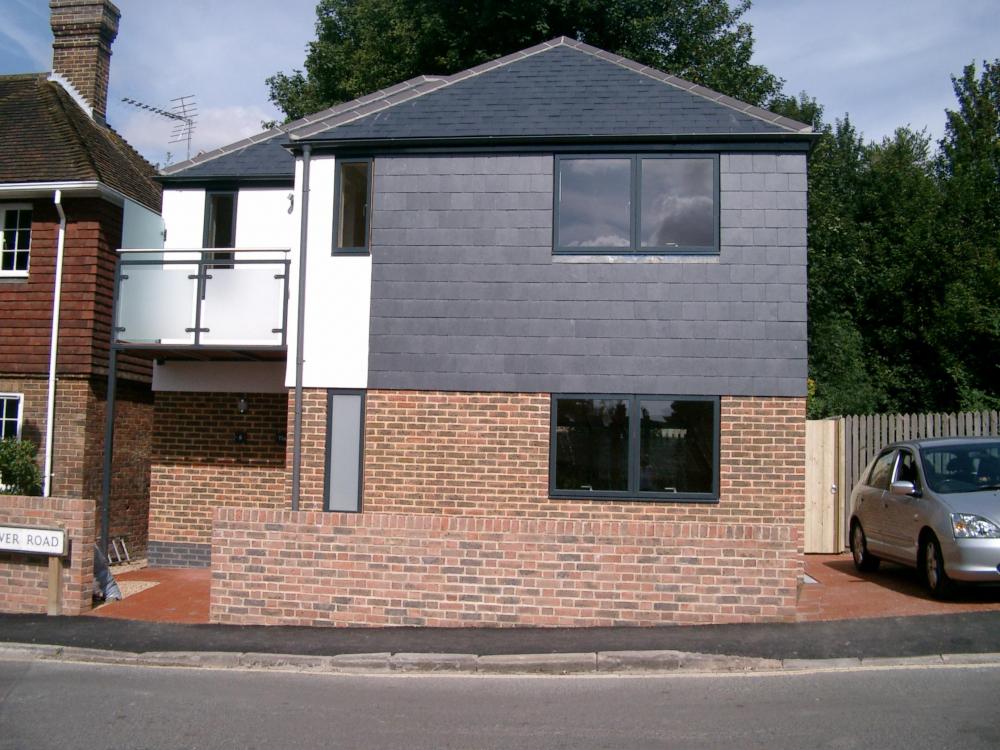
-
Even on big projects I never see these used. On recent project we had about 800 hangers and they hand nailed the lot!
-
I have seen pictures of buildings in Japan with this finish. Very striking. I would not want to brush past it in my wedding dress though.
-
Perhaps get your device to forget the BT hub SSID as it may be trying to connect to that. I have 2 Unifis in a 4 storey house and they work flawlessly.
-
I am not sure why you are cladding over the render? Be aware of fire spread if the building is close to any boundary. Natural timber weathers to grey which is not to everyone's taste. You can coat it but it needs frequent re-coating. You could look at some of the pre-coloured cement cladding options. If you go with timber, it is just decide what you like and shop around for prices. The suppliers can give useful installation advice. Can be installed by a reasonable pair of chippies.
-
This bit of the Building Regs is nonsense. All that needs to be done is a letter from you stating "Notice under regulation 37 that water consumption is less than 125 litres/person/day using fittings approach”. Spend no more time on this!
-
You need a continuous gap from eaves to ridge for airflow to prevent condensation. Perhaps use 75mm Celotex cut between rafters with 25mm air gap above. 50mm Celotex under with ali tape over joins and finish with plasterboard. It won't win any prizes for low energy but is fairly cheap and effective.
-
You could pave the half nearest the house and have a step or 2 up to decking at the back, where you could have a properly fixed rotary washing line. Dig out where you are paving and put that under where the deck will be. Consider keeping some borders / planting pits. A bit of effort on design will cost next to nothing and the finished garden will be much better.
-
Looks pretty awful and may have been better had it been a proper step, say, 150mm high. The fact that it taper does not help. I would have gone for ramp, but at least a bit of tape shows you have done something. A pissed person, someone carrying a tray or someone taking a step back at a party look prime candidates. If anyone is all three, odds on you get sued!
-
No DPC below the foundation. The base plates were bolted to the foundation with grout under and bitumen coated to above FFL. DPC on the blockwork to support beams for Beamshield floor, DPM, mesh and concrete topping.
-
Minimum practical distance between two houses
Mr Punter replied to Sjk's topic in New House & Self Build Design
I once built very close to a boundary wall and had to modify the wheelbarrow with a club hammer to make it fit down the alleyway to do the back gardens. -
What an epic job! Are you tiling the whole ground floor? If it was my choice I would have the corridor looking right as it is such an important part of the design. Are you doing anything special with the ceiling / lighting / skirtings along this? Before and after pics please. Chop chop!



