Mr Punter
-
Posts
8302 -
Joined
-
Last visited
-
Days Won
24
Everything posted by Mr Punter
-
I cannot see an issue with this draining onto the patio.
-
@Hecateh How did the other guy know about where you live and who you had chosen to lay the flooring?
-
Party Wall Act and Utilities
Mr Punter replied to Temp's topic in General Self Build & DIY Discussion
I can't see how the PWA would apply because the water company are not an owner and I assume the land owner has no right to refuse the work being carried out. -
Party Wall Act and Utilities
Mr Punter replied to Temp's topic in General Self Build & DIY Discussion
If this is excavation within 3 metres of and deeper than the bottom of the foundation of the adjacent building it could apply, but I doubt it as the water company are not an owner. The adjacent owner would need to take out an injunction to stop the work, which would be very expensive. -
I have had places sprayed in the past. Lots of time to mask. You can fix sockets and switches and plastic bag them. The finish is perfect but impossible to touch up, so if anything gets marked it is a pain. I am not a fan but some on here are.
-
Good points by @Tyke2. We recently had a building where a wall had to change direction by 3 degrees, so on elevation the window openings appeared slightly narrower.
-
How to make a dual fuel towel radiator work?
Mr Punter replied to Mr Punter's topic in Central Heating (Radiators)
OK one valve makes sense. Thanks. -
How to make a dual fuel towel radiator work?
Mr Punter posted a topic in Central Heating (Radiators)
I have got dual fuel towel radiators that are on the central heating radiator circuit and have an electric element with fancy electronic control. I don't really want to use the central heating bit, so for electric, should I close both the valves, or will this potentially cause a problem with hot water expanding? -
If you want really want concrete you will probably need to do beam and block or poured concrete as the hollowcore plank firms will not be interested in small footprint. Concrete will be more expensive and require more lifting equipment than timber. By the time you have space for services, finishes and ceiling it will probably be deeper than a timber floor. I would recommend an Easi-Joist type engineered metal webbed floor with 22mm Egger Protect chipboard. Specify that the maximum deflection must not exceed 8mm or 0.002 x span. You will more easily be able to incorporate services, including your MVHR, and ceilings are easy to fit. The floor supplier should be able to produce the design for you.
-
They seem popular on the Tilers Forum for plank type tiles.
-
I have a garage with no electrics and I am looking for a recommendation for solar lighting. I am having the roof replaced with twin wall metal. The garage is to be used for tools etc, so I don't need the lights to work for more than, say 30 mins, but I want them to be very bright to properly illuminate the space. PIR would be nice (but not essential) so I don't leave them on by accident.
-
As long as the floor is clean - no dust - sticking will be fine.
-
Pitched roof thickness and insulation
Mr Punter replied to Moonshine's topic in Roofing, Tiling & Slating
It is a pain to fix counter battens through thick sheets of insulation to a roof as you are aiming for a rafter less than 2 inches wide and about 5 inches down. The fixings will be 160mm and need to be corrosion resistant. May be better to go for most of the insulation between rafters and, say, 30mm underneath, taped with ali. Easier and safer to fit. -
Well done for getting the roof fall towards the outside. Much safer.
-
Depends on budget and current / required finish. Floor paint is cheap. Porcelain plank tiles are hard wearing and look good.
-
Intumescent paint for protecting beams
Mr Punter replied to MJNewton's topic in RSJs, Lintels & Steelwork
The paint is really expensive and you have to coat it lots. Doesn't' the ceiling give it 30 mins anyway? -
Firstly, well done to your builder! Probably less than 1 in 10 would offer these options. I would go with option 1 but perhaps negotiate on the money. Option 3 seems a bit of a bodge. They will need to penetrate the existing membrane to fix the firrings and new deck.
-
Unless the existing structure is showing signs such as cracking, doors and windows not fitting etc. the existing footings are probably OK for what you propose. A trial hole later will confirm.
-
@recoveringacademic what is the external wall finish? It may be that this needs to be installed before sealing the windows, which can be done with Compriband or mastic. Compriband is vapour permeable so I understand that this reduces the risk of condensation forming between the window frame and the wall. An airtightness tape sealing the window to the wall structure on the inside reduces the risk further.
-
The windows were Velfac. IdealCombi do a similar looking system. The doors were another make. The lower part of the windows was obscured due to planning / overlooking constraints.
-
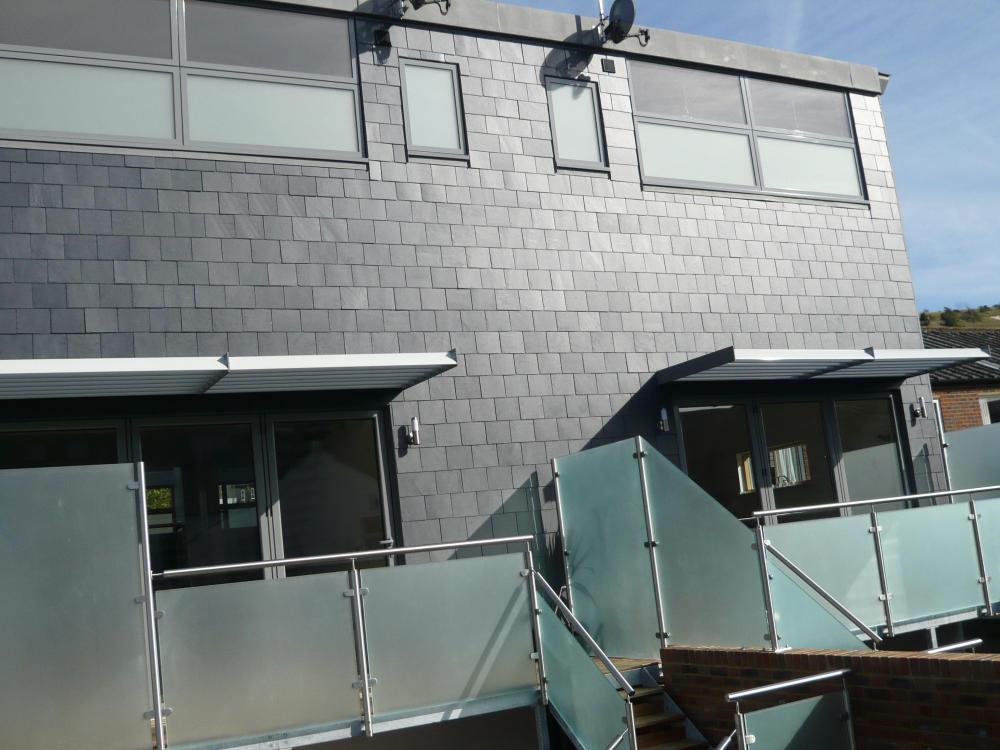
Do you know what materials you want this to be constructed from? Do the louvres need to be variable or fixed pitch? Do you need access to clean the windows? I can't see why these would be tricky. Can they not sit on the ground at the bottom? Have a chat to several potential suppliers then send some drawings to price. Get the price to include detail design drawings and better to do supply and fit. If the cladding is not yet complete all the better as there may be more fixing options, but this looks like a second fix item to me.
-
We did these horizontal ones in powder coated alluminium. There is a bracket at each end and one in the centre behind the slates which fixed to the outside of the timber frame with several coach screws.
-
Although it can make sense in a commercial building to have a main service duct / core, for individual houses the service runs are more ad hoc per service.
-
Often the people supplying the MVHR unit will do a plan showing unit and duct locations. They can also do a take-off of what ducting / connectors you need.
-
It is worth being very careful that your warranty provider is on board with your proposal if you use external insulation on a timber frame without a cavity. The Diffutherm system (no cavity, like @ProDave's) BBA states: "NHBC Standards 2008 In the opinion of the BBA, the use of the NBT Diffutherm External Wall Insulation System for use on Timber Frames, in relation to this Certificate, is not subject to the requirements of these Standards." Where the ventilated systems all state something like: "NHBC Standards 2016 NHBC accepts the use of the Jubizol CR External Wall Insulation System (Timber), provided it is installed, used and maintained in accordance with this Certificate, in relation to NHBC Standards, Part 6 Superstructure (excluding roofs), Chapter 6.9 Curtain walling and cladding."