


ADLIan
-
Posts
771 -
Joined
-
Last visited
-
Days Won
1
Everything posted by ADLIan
-
EPS needs DPM under it too.
-
PUR/PIR has no acoustic properties so do not use this. Fully fill the studs with glass wool (check with manufacturer that its the right type). To improve things further add 2 or more layers of plasterboard each side to add mass to the wall or consider use of resilient bars to decouple the plasterboard from the studs.
-
The Great Thermal Mass Myth................
ADLIan replied to Jeremy Harris's topic in Boffin's Corner
Don't know the exact construction of your caravan wall but the decrement delay would typically be approx 0.5 hr! Decrement factor of about 1 -
Do I need to Use A BBA Certified Render Board
ADLIan replied to Triassic's topic in Plastering & Rendering
The BBA logo should include a number, normally in this format 'Certificate No. ??/????' at the bottom. You can check on the BBA website that the certificate is real and is valid. The packaging on the product will also include the BBA logo and number. Once outside the packaging however very difficult to prove if BBA certified or not - if the boards are printed with manufacturer details, shift codes etc this can help traceability. The BBA will take action against abuse of the logo but I imagine with the growth of Ebay (and similar) it's almost impossible for them to follow every case. -
With glass wool batts you can squeeze them together to make sure no gaps
-
Internal wall insulation 600mm masonry wall - condensation risk
ADLIan replied to Robbie's topic in Heat Insulation
A VCL always goes on the warm side of the insulation - in the UK this is internal to the insulation. Some studies of upgrading existing masonry walls suggest the use of a totally breathable insulation system (no VCL and careful choice of insulation) to allow the wall structure to dry to both the external and internal environment. See Society for the Protection of Ancient Buildings website for more info. -
Seen it done but it not in most MIs or BBA cert instructions. Plus a foil tape on the external face creates a localised VCL on the COLD side of the insulation which can lead to condensation.
-
The condensation analysis normally ignores the effect of of the timber frame proportion - both thermal and vapour properties. I don't think the Glaser method is sophisticated enough to include these 2 items. I cannot find the reference section in the BS but the software I use certainly ignores it.
-
energy... I stand to be corrected.
ADLIan replied to Big Jimbo's topic in New House & Self Build Design
Try 'The Green Guide to Specification' available as a download from the BRE, though I think there is a cost involved. It's used as a reference document in BREEAM & Home Quality Mark (new alternative to the CfSH). -
Comical EPC thingy
ADLIan replied to Russell griffiths's topic in General Self Build & DIY Discussion
I was referring to misuse of the EPC and RHI system rather than TFEE/DFEE & air test. The cost of fabric upgrades to offset using 15 as the air leakage rate will be considerably more than cost of an air pressure test and this is the point I was making. As well as impacting DFEE the DER is also affected though not so much of an issue if using a heat pump - different if using gas, oil, electric etc. -
Comical EPC thingy
ADLIan replied to Russell griffiths's topic in General Self Build & DIY Discussion
The backstop air leakage of 15 is unlikely to comply with the fabric energy efficiency standard of the 2013 Regs. Normally looking at 7 or better so test must be done. Air pressure test cert and confirmation of make, model etc of heating system required for the as built SAP and EPC. Wouldn’t want to get involved in this type of fraud! -
I assume Building Control are involved. Have they picked up on the fact that the extension is over glazed? This has an impact on overall BR compliance. I would guess it will be difficult to heat in winter and may also overheat in summer time (and the shoulder period?)
-
New build: Solid walls vs cavity walls
ADLIan replied to Sjk's topic in General Self Build & DIY Discussion
Celotex had also been overstating the thermal performance of this range of products! -
New build: Solid walls vs cavity walls
ADLIan replied to Sjk's topic in General Self Build & DIY Discussion
Not a recognised method of insulating cavity walls and not BBA approved so would not comply with the Regs (north or south of the border). Injection of foam once the wall is complete is allowable but some of these systems are to cure wall tie failure and are not certified thermally - the completeinsulations.ie system referred to above falls into this category. -
Check with kingspan technical dept? Probably more expensive than flooring product if it’s for flat roofing.
-
Details are in Appr Doc L1A and Building Services Compliance Guide - primary circulation pipes for HW services should be insulated even if inside insulated envelope
-
I often see this planning requirement - sometimes asking for a general 10% improvement (allowing the use any measure to reduce CO2 emissions) and sometimes specifying that it must be achieved using 'renewables'. I would check with the Planning Dept as to what they will allow here as often heat pumps, combined heat & power and biomass are acceptable (perhaps strictly not 'renewables' however). MVHR is not classed as a 'renewable'. A heat pump should get your 10% reduction very easily!
-
Important to follow manufacturer instructions and BBA certs here. Some membranes can only be left exposed for a matter of weeks, maximum I've noted recently is 4 months. All state however that the roof should be tiled asap and the membrane not left exposed for any longer than necessary. In the case of Roofshield the manufacturer specifically mentions the damaging effect of wetting and subsequent freeze/thaw cycling (they reference, along with others, BBA information Bulletin No. 2 Permeable Roof Tile Underlay — Guide to Good Site Practice) As regards fire the membrane is protected from fire internally by the plasterboard ceiling and externally by the slate/tile finish so will never be involved in the development stage of a fire. They are also very thin so the heat energy will always be limited and peak very quickly. As per JSHarris they cannot be any worse than the old bitumen based products!
-
Fire spread/ garage to house.
ADLIan replied to Russell griffiths's topic in General Self Build & DIY Discussion
Normally plastic = combustible! Above details look ok and in accordance with appr doc B. -
Self-Build - window regulations - Danish windows
ADLIan replied to Klim's topic in Windows & Glazing
Part K 5.4 does not apply to dwellings. The clause in the Scot Regs only applies to windows 4m above external GL or internal floor level so I can only imagine this applying if there is a tall, double storey atrium, staircase or similar. -
Calculation of heat losses into he ground is covered in BS EN 13370 and covers normal ground floors (solid & suspended) and basement floors and walls. Very simply for solid ground floors the U-value is dependent upon the P/A ratio and the the thickness/type of of insulation. With basement floors the depth of the the basement is also taken into account. In basement walls the heat loss is dependent upon the wall construction (including insulation), the depth of the basement but is is also linked to the basement floor P/A and insulation type & thickness. In solid floors/basement there is a correction factor for the ground type with an assumed conductivity of 1.5 W/mK for clay or silt, 2 W/mK for sand (these normally make little difference to the U-value), rising to 3.5 W/mK for rock (which can make a big difference to U-values). At face value the above wall U-value (0.16) with 2 x 70mm EPS look to be of the right order of magnitude.
-
First self build - a southerner in Lancashire
ADLIan replied to Nelliekins's topic in Introduce Yourself
@Nelliekins I often see planning conditions asking for DER 10% (seems to be their favourite number) better than TER and/or DFEE 10% better than FEE. I suppose it depends how exactly the planners have worded this condition - if it states DER/TER equivalent to Code Level 4 (or similar wording) then its probably enforceable. It does however show a complete lack of understanding of the CfSH - Code Level 4 is a world away from Code Level 6 as table below from the last version of CfSH in May 2014; Getting a 19% improvement of the DER over the TER will be tough and probably not possible with fabric (insulation, glazing, air infiltration etc) upgrades alone. You will probably need to look at high efficiency heating (heat pump?) and/or renewables such as solar PV. I suggest that you clarify the exact requirement of this conditions (perhaps post extract here) and have your SAP assessor look at it asap - it will be tough and potentially expensive this far into the build.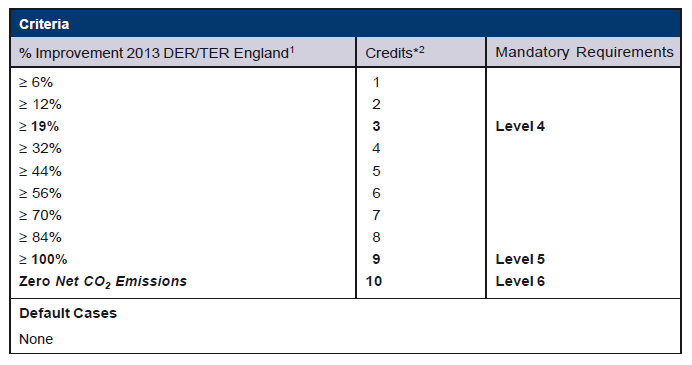
-
Is this unit electric only? If this is the case I believe the best achievable energy rating is a C as the inefficiency of burning fossil fuel must be accounted for (blame it on a quirk in the EU legislation).
- 186 replies
-
- 1
-

-
- sunamp
- energy efficiency
- (and 1 more)
-
Nothing wrong with the basic construction The important issue for the U-value is to get it calculated correctly with; correct timber bridging for the top & bottom chords of the easi-joist (BASF only have it at 6% and Ecotherm at 12% when it is actually 18%) correct thermal bridging for spray insulation within the joist depth (between the metal webs) correct thermal bridging for quilt (perhaps not filling the metal web void) correction for the metal webs passing through some insulation layers (the 60mm PIR under the room will mitigate this to some extent). U-value probably nearer 0.15 W/m2K rather than 0.10 W/m2K.
-
No problem with the condensation risk analysis - generally you have decreasing vapour resistance materials from inside to out plus the ventilated airspace so all should be OK. As you have a cold roof there should be a vapour control layer on the warm side of the insulation, this will increase the margin for safety in the assessments. However both sets of U-values do not include any correction for the thermal bridge created by the metal webs passing through the insulation layers. I've had a look at the easi-joist brochure (https://www.wolfsystem.co.uk/products/easi-joist.aspx - see page 39 of technical guide) which shows U-values including the effect of the metal webs and they add about 0.08 W/m2K to the basic U-value (higher than my guess of 0.03-0.05 above). Also the Ecotherm calculation has the chord width as 47mm when it should be 72mm for easi-joist and this increases the bridging from 12% to 18%! Ecotherm calculation also does not correctly address spray foam between the easi-joist metal webs

