


ADLIan
-
Posts
771 -
Joined
-
Last visited
-
Days Won
1
Everything posted by ADLIan
-
Thanks for that. Yes the 'breathability' of the breather membrane is swamped by the materials internal/external to it so it becomes irrelevant. Just one warning the U-value does not include any correction for the metal webs (see dUf = 0.000 approx 5 lines from bottom of 1st page). All this metal bridging 2 layers of insulation will impact the overall U-value though offset to a degree by the continuous layer of 60mm PIR. The correction should be included in the calculation and may add 0.03 to 0.05 (?, more?) to the calculated value of 0.09 W/m2K.
-
I was always told a rising butt hinge is not a self closer. Building Control & Fire Brigade would not accept them in my experience. Appr Doc B states a self closer must be able of closing the door against the resistance of the latch. In dwellings there are not many instances where a fire door needs a self closer!
-
The 60mm of pir under the joist will mitigate the thermal bridging to a degree. The spray foam onto the breather membrane will make it non breathable but probably not a big issue. Can you post the details provided?
-
The amount of thermal bridging will be considerable; Series of 'metal fixings' penetrating the insulation layer which can be included in the U-value calclation Possibly no insulation in the depth of the joist unless you risk loosing fingers pushing mineral wool in there before insulating between I'm surprised the insulation manufacturers cannot model this. Perhaps also an issue for the easijoist manufacturer to look into this in more detail.
-
There is no issue between EPS/XPS and RIGID PVC conduit or pipes. There is the well documented issue of pasticiser migration with FLEXIBLE PVC cable insulation. I'm sure cable needs to be derated too if ran in conduit in any insulation.
-
"Thermal Bead Screed"...anyone used or heard of it?
ADLIan replied to JohnW's topic in Heat Insulation
Your energy assessor looks to have the correct U-value (comparing the 125mm PUR). To get the same U-value would require twice the thickness of the insulated screed product (0.022 W/mK vs 0.043 W/mK).- 4 replies
-
- 1
-

-
- insulation
- ground floor
- (and 1 more)
-
What do they want the insulation testing for? Type of insulation? Correct installation? If done in late 1990s/early 2000s I doubt it will be urea formaldehyde based and I don’t think there are any health issues associated with it - mostly likely to be blown glass wool. Try contacting Cavity Insulation Guarantee Scheme ( google CIGA) they issue most guarantees for these systems and copies can be obtained. Other guarantee providers also possible so you may have to search around.
-
You’re welcome.
-
In a warm roof condensation may (will?) occur on the underside of the waterproof layer and BS 6229 gives maximum allowable winter build-up when assessing the condensation risk. The VCL should be taken up the sides of the insulation and onto the top of the insulation (or up any upstand) and sealed to the waterproof layer so that the insulation is encapsulated. See guidance from insulation or waterproofing manufacturers.
-
Block And Block With Render Wall Design - Questions
ADLIan replied to Johnny Jekyll's topic in General Construction Issues
Are you looking to just meet Building Regs or looking at a much better standard. The 100mm cavity makes things difficult but can work if you only want to scrape a pass. The 2 full fill options above will be expensive (especially phenolic foam as Kingspan have a virtual monopoly on this product!). Suggest you look at the SAP assessment numbers to see what is possible. I'm not convinced with any injected insulation in new build as there is no way of telling if there are missed areas or gaps. At least with built in you can see the quality of workmanship. -
EPS will initially melt away from a heat source but ultimately it will burn fiercely with plenty of black smoke typical of most petrochemical based products. Try to set fire to a sheet positioned horizontally then do the same with sheet held vertically - the latter will give a very different outcome!
-
There are 2 issues here; 1. Calculation of the floor U-value, as above, with little benefit from the vertical edge insulation in the calculation 2. The linear thermal bridge at the floor/wall junction (along with may others) which is an input into SAP 2012 (& 2009). Default and/or accredited psi-values are available for 'standard' details however these would penalise a 'non-standard' but well designed floor edge detail such as the JSH detail. With high levels of insulation poorly designed junctions can have a major impact on the SAP rating & Building Reg compliance.
-
As stated the heat loss from a ground floor depends upon the size, shape, edge conditions and soil type. Best analogy I've heard is consider a ground floor like a bowl of hot soup - it will be cooler at the edges (=greater heat loss) and warmer at the center (less heat loss). This table from BR 443 may help - larger, square floors having a lower inherent U-value. With current levels of insulation in the general floor area (>100mm PUR or equivalent) vertical edge insulation has little effect on the overall U-value but is important to minimise the linear thermal bridge at the floor/wall junction (which is where BR 497 comes into play as guidance and standard conventions when using BS EN 10211).
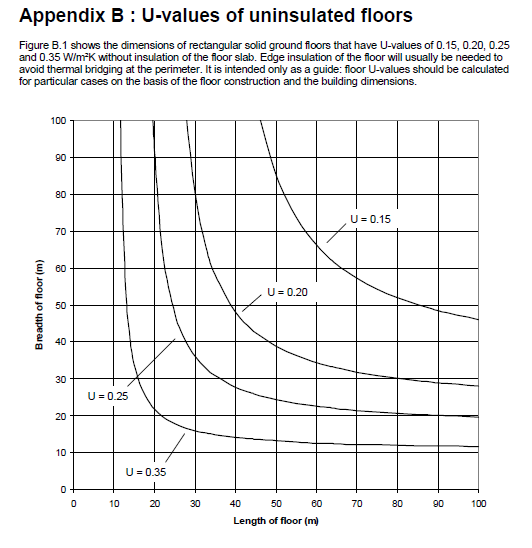
- 13 replies
-
- 1
-
-
- u-value
- calculation
- (and 3 more)
-
Sorry but PIR will not create a cavity barrier (look at Grenfell Tower!) - needs to be mineral wool.
-
Does the window sit on the Sarna membrane that continues from the outside flat roof to the inside? Are you then trying to weatherproof this detail using sealant? If this is the case this detail will always be a problem and I doubt complies with Sarna recommended detailing. Would normally expect the window to be sat on an upstand with the Sarna membrane dressed up the outside of this.
-
Check loading with insulation manufacturer. Celotex (and probably other pur) is BBA approved for domestic type loadings only. XPS has higher compressive strength and often used in areas subject to vehicular access.
-
Cavity wall requirements around windows
ADLIan replied to Adamantium's topic in Building Regulations
Is this new build in England? Probably OK returning the blockwork but leave space for a 50mm (min) insulated cavity closer - not ideal but will meet BR minimum requirement. Better to use 150mm insulated cavity closer and use bracket/cleat to fix window frame - may be much simpler to install too, saves a lot of time cutting and laying blocks around each reveal. Cavity closer manufacturer may offer values for linear thermal transmittance - enhanced values can be used in SAP which can be advantageous. -
+1 on above. I doubt the frame material has an impact on the acoustic performance. Acoustic performance depends mainly on number of panes, glass thickness (better with 2 or more different thicknesses), gap between the panes and addition of an acoustic absorber between the panes. Remember as soon as you open a window its acoustic performance reduces to zero!
-
With a buried roof the slab should not be cast directly onto the waterproof membrane. A drainage layer of gravel or specialist drainage membrane should be used. Water drainage should be a 2 levels - at the level of the epdm membrane and at the finished roof surface. Specialist drain outlets are available for this. Level, flush fitting, roof lights are also a specialist product. Can’t help feeling that the roof will be forever problematic without a major renovation and correct detailing and product selection. Lots of info on internet on buried roofs or podium roofs.
-
15% is about right in my experience for standard stud TF (not larsen truss or I-beam). I've seen it as low as 12% but also as high as 20+%- a value mentioned by Warmshell in one of their design guides! The Appr Docs refer to BR 443 which gives the 15% bridged value. I note Warmshellinsulation has a BBA cert for a rendered external wall insulation system but it limited to masonry background. They also mention that they have an applied for BBA cert for this system on TF. It appears this goes back to 2015 and still no certificate issued. As mentioned above a similar certificate (based on wood fibre) was withdrawn or allowed to lapse a few years ago. I would still refer you to the above documents and the fact that render onto insulation direct onto TF is not accepted good practice.
-
Bit late to comment on this but Google ' buried roofs' or 'podium roofs' and you'll see how difficult these are to design and really need specialist input especially with your flush roof lights. Need robust design and robust materials as remedial works are difficult (=expensive). Have you arranged for drainage of rainwater from directly above the EPDM membrane? Without this I imagine the roof will be plagued with problems.
-
I had included the 100mm external insulation - as you say this does mitigate the effect of the TF fraction. 15% bridging is the default value and includes for the additional timbers around openings, at floor levels, corners, head & sole plates etc and is normally about right, may reduce to approx 12% if you're lucky. Bottom line is the U-value has not been produced in line with UK BR Appr Doc requirements. This is all a bit academic now as the wall is done! The important point, and where this thread started, is the requirement for a vent void behind the render system in TF walls.
-
An additional comment. The U-value calculation from ProDave is wrong as there is no correction for the timber frame creating a thermal bridge (normally 15% bridged proportion) and this would increase the U-value to nearer 0.16 W/m2K.
-
Most of the insulation manufacturers in the UK will provide a U-value and condensation analysis calculation. Some may also do the thermal response/phase shift numbers. Note that it is NOT accepted good practice to render onto insulation onto the timber frame - see 'Timber Frame Construction' from TRADA, Bldg Reg Approved Docs, TF kit manufacturers details etc. One of the wood fibre insulation manufacturers had a BBA certificate for a direct render system but this appears to have lapsed or been withdrawn. The issue is not so much condensation but liquid water penetration through the render system as referenced by Mr Punter.
-
They’re only the soakers ar each course of slate. Lead cover flashing (longer length, approx 1~1.5m) still needs fixing, chased into wall.
