


jfb
-
Posts
668 -
Joined
-
Last visited
Everything posted by jfb
-
looking at comparable prices I can get graphite EPS 75mm @ £13.37 a board compared with celotex at around £34 a board. I think i know which one I will go with………...
-
Terry, I like the idea of a small horizontal ceiling near the apex to allow a bit of ventilation under the ridge beam. I am looking at 60mm wood fibre board insulation as IWI to keep the wall build up breathable. Not the best thermally but less risk of interstital condensation and it has worked very well in our house. Hadn't heard of Diathonite but ill take a look Simon.
-
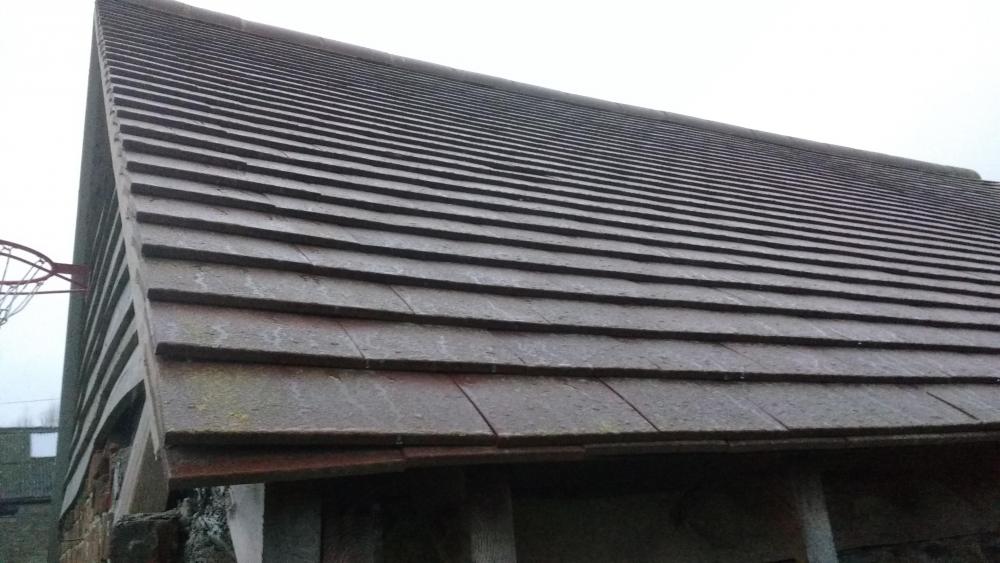
not sure of exact type - look like this Ian
-
i don't mind the idea of 75mm of solid insulation between rafter to allow a gap but I still don't quite see how that actually provides ventilation since at the moment it doesn't have anywhere to go at the ridge (though clearly has to be much better than no gap). If using celotex between and below the rafters and taping joints presumably I can do without a vcl/airtight layer but am losing a breathable build up. If using 75mm EPS between rafter, 75mm EPS below rafter and intello the u value not quite so good but more breathable.
-
no counter battens, just horizontal battens straight onto the rafters. Not much sag either.
-
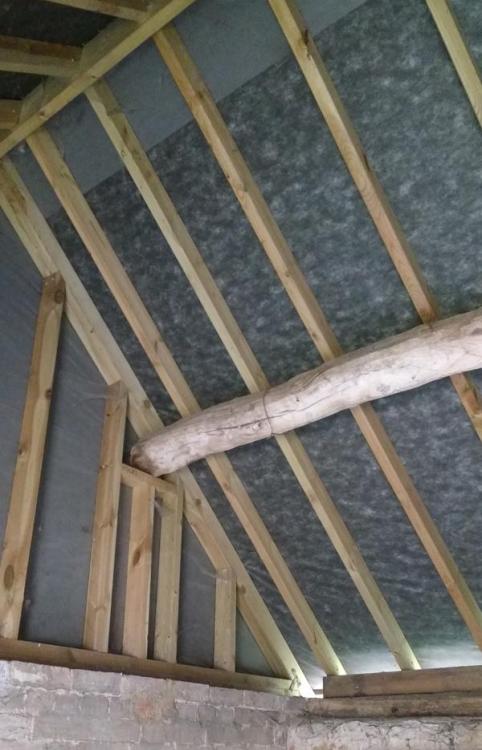
I am converting an old barn into an office space and am considering the best option for insulating the pitched roof at rafter level. A new roof was put on it just before I bought it to ensure that it wouldn't fall foul of a planning timescales. So I am very reluctant to reroof but that makes it harder to work out a sensible insulation plan. There are no plans for cooking facilities or shower but there will be a toilet/basin. At the moment the structure is: new clay tiles (tight fitting) battens breather membrane (2 types, don't know what sort, but modern, not felt, so I presume is breathable) rafters (100mm) purlin (minimum 150mm, max 200mm) Rest of structure is 500mm thick stone walls where I will put on lime render/wood fibre board and a limecrete floor. For the pitched ceiling I was hoping to do something like this: tiles battens breather membrane rafters (100mm full filled with fibre glass) graphite eps (75mm) intello airtight/vapour control layer batten (25mm) plasterboard +skim (15mm) This leaves all the purlins exposed as I want and as much insulation as can be had but doesn't have any ventilation under the breather membrane. Except that the build up is breathable and there will be some ventilation through the tiles. Even if I try and reduce the rafter insulation so it is not fully filled air getting in at the eaves wouldn't have any where to ventilate without installing some sort of tile/ ridge vent. Even then there isn't any cross ventilation that you would have with counter battens. In an ideal world I would have the roof off, cover with 100mm eps, breather membrane, counter battens, battens, tiles. But that is going to be so much more work building up walls, planning issues, reproofing that I would really like to find a simpler solution. Any thoughts appreciated.
-
I'd go for a 3 tonne digger rather than smaller if you have land and lots of landscaping to do.
-
Achieving a clean square cut with plastic 110mm pipe, how.
jfb replied to epsilonGreedy's topic in Waste & Sewerage
if you have a bunch of cuts to do - fix a couple of bits of wood (parallel to pipe)to a surface that hold the 110mm pipe nicely on the surface (stop it rolling on surface). Much easier then to do cuts/chamfering. -
It sounds you are doing all the right things and I would not be surprised if you didn't get well below 3 ACH. I did a full renovation on my old stone farmhouse and got a result of 1ach. Like you at the beginning I was not sure whether to go for Mvhr or not but I am glad I did. I had the benefit of doing the whole renovation in one go so easier to deal with tricky ceiling/wall junctions, etc and the more I read up on it the more further lengths I went to. So go for it. Make sure you plan duct runs for the Mvhr as early as possible. I used twinwall flex duct to make it easier.
-
How much ventilation is getting into the room with the burner? Presumably since it is over 5kw it has a dedicated air vent in the room or a direct air supply?
-
Thanks for the advice - will get on with it now!
-
So if I want to do a repair to a`ceiling (1.5m2 area that had a leak and needs new plasterboard) would you: 1. scribe and fit new board and then just skim over new board (taking care to get skim into any gaps between new and old board) 2. jointing tape over new board and onto existing ceiling (painted) and then skim over the tape and try to get as smooth a join as possible 3. something else cheers john
-
i found some companies didn't mind so much how long it was up (I guess because they have more stock) and fortunately for me I asked for longer than usual (6 months - but I was just reproofing/dormering) So make sure you shop around..
-
definitely the sort of thing you can do yourself or get a labourer to do. get a decent (not too heavy) drill with chisel and have a go - you might find some of it comes off pretty easy
-
excellent - its not my house it is a friends house where he doesn't have any gas appliances/boiler (though neighbours do) I was hoping for him that it was gas in case he does replace the storage heaters for a wet system in the future and if it is still connected that would make things a lot cheaper. at the moment there is no gas meter in the house. it seems a slight liability at the moment as it comes up under the stairs and is not fixed to the wall over a 2.5m length. anyone know, assuming it is a live gas supply, what a typical charge would be to install a new meter ready for use?
-
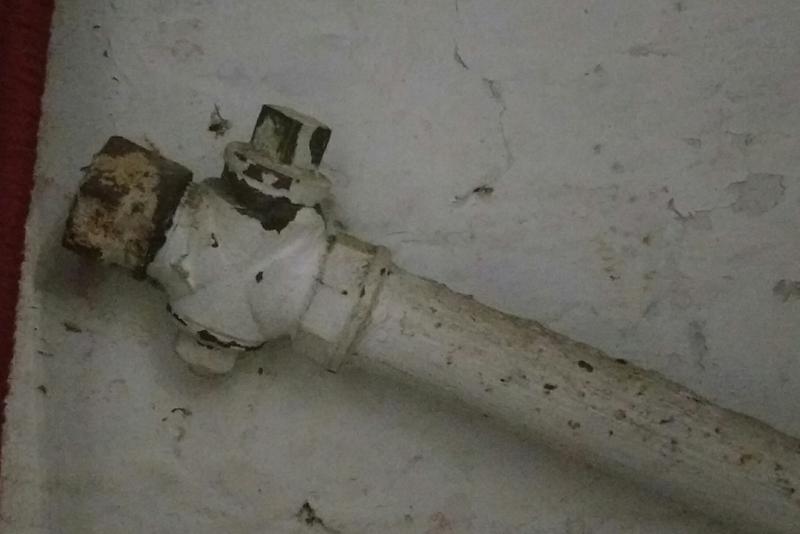
As the title asks - anyone know from this picture of pipe and end cap what is in this pipe? Water/ gas?
-
appreciate all the replies - ducting in now coming up the inside with a drawstring
-
I am laying some ducting for water/electric/BT for barn conversion to dwelling. I will at first run some Cat 5 cable from my house next door to the barn to provide internet access on the same line as mine but would like to future proof so in the future I can get BT in to provide new line. Do BT insist on the grey ducting coming up outside the new dwelling (and then drill through the wall for main box inside) or can I run the ducting up to the inside wall of the barn? cheers john
-
Multi finish is fine for joints. I would do them first just before you hit the whole wall and before they go off. Corner trowels are pretty useful I would say if you are doing two adjoining walls. But better to do opposite walls first and then you will have a hard corner to work off when you come to do the remaining walls later in the day or the day after - much easier.
-
Its a small 2 bed barn conversion and a smaller office/spare bedroom barn. 2 bed barn is 40m from 3 phase board. Smaller outbuilding is another 15m on from that. 2 bed barn: 5kw ASHP, induction cooker (unspecified yet), sockets, lights Outbuilding: sockets. lights, electric heater and ideally with potential for 7.5kw shower down the road All well insulated, airtight.
-
thanks -got it now. it was the multiple drop down arrows that confused me
-
Quick question - will a 25mm2 SWA cable pull through a 50/63mm twin wall duct (assuming no outrageous bends) with relative ease? What diameter is a 25mm2 SWA cable? And as a sub note anyone know why I couldn't post this in the electric section (only certain options are not greyed out)?
-
good to know Ian - do you know what they did to alter the design to further improve use for intermittent use?
-
good to know about sensible pumping strategies. anyone with any advice/knowledge on the pitfalls of intermittent use for sewage treatment plants?
-
thanks I have already got cement and ballast on my order list as I am in a high water table area!



