jfb
-
Posts
668 -
Joined
-
Last visited
Everything posted by jfb
-
Have you done a search on this forum for acoustic insulation or soundproofing? I would have thought that would be the place to start.
-
Water pipe … dig-it-deep or through-the-roof?
jfb replied to Dreadnaught's topic in General Self Build & DIY Discussion
I suspect it will still be warm. Think how quickly a lagged hot water pipe cools down (surprisingly quick I think). Also, what happens in summer if the pipe is near the top of the insulation? -
Water pipe … dig-it-deep or through-the-roof?
jfb replied to Dreadnaught's topic in General Self Build & DIY Discussion
you'll have warmer water from the cold tap? -
If it was mine I would use membrane around the whole French drain if the ground is sandy. If clay I wouldn't bother with the membrane as it will clog up. Line up the perforated pipe so that there is a smooth (no perforations) channel right at the bottom. What size pipe are you thinking of using?
-
Just noticed it is a retrofit so that may constrain you.
-
200mm minimum of EPS (polystyrene) under slab. Why not attach UFH pipes to mesh in slab then no need for screed on top? This seems very little insulation. Does it even meet building regs? Also 50mm screed with pipes in it seems very thin but I don't know quite what liquid screeds are capable of. I would have thought 70mm minimum screed.
-
do you have a plan for the ducting? are you using radial/manifolds? have you allowed room for a silencer on the supply side? easy access to filters? I think you might be underestimating how much space a typical MVHR setup takes.
-
I'm planning on running some of my ducting in my barn conversion at the apex like prodave has suggested and then between the rafters and to the edges of the room. I have a extra insulation on top of the rafters making it easier to use the rafters for ducting (still within insulation envelope). What is happening at rafter level for you?
-
I believe from looking at other threads on this that some have been happy with multipanel. I was planning on using them.
-
I got BC approval as well for mine.
-
As I understand it if you get a passport through grandparents then your children won't get one.
-
Does the chimney have a liner?
-
True. But what is the value of a whole brick/block/stone compared with a crushed brick/block?
-
Every day is a good day to use lime! Well maybe not if it is really freezing, but then not so good for cement either. How about for starters - at the end of the building's life cycle you will be able to reuse materials you couldn't with cement.
-
Stiff brush - basically a broom in a hand held brush!
-
On a hot summer day you would use hessian dunked in water to cover lime pointing as you want the lime to dry out slowly - too fast and it won't set properly. Protection from rain is maybe more important in these months so hessian or some sheeting can help with that. I have found it surprising how much you can get away with lime pointing in the cold and have rarely had it blow because of frost damage. Just make sure the mix is pretty dry. Even cover up a wall you will be working on for a few days before to stop it getting soaked before you point it. Also - if it has set a bit too much before you try to finish up the pointing a wire brush can help - I don't like the lines you sometimes get with them so you can bash away at the pointing with a churn brush afterwards and that can get it where you want it.
-
Reclaimed brick – removing mortar effectively
jfb replied to JackOrion's topic in Bricklaying, Blockwork & Mortar
i don't think most brickies would be happy with bricks that still have old mortar on it - obviously depends how much. Like Brickie says, if the bricks are really valuable you could grind off the mortar - but it will take a while! -
Reclaimed brick – removing mortar effectively
jfb replied to JackOrion's topic in Bricklaying, Blockwork & Mortar
If the mortar is lime as you would expect it should come off pretty easy without damage. If cement much harder not to damage the bricks. -
Insulating the perimeter of an existing opening?
jfb replied to shbrooks's topic in Environmental Products
if you use expanding foam around doors make sure you brace the frame or use some low expanding foam. -
I am happy to help when the answer might not be obvious (see your question about concrete slab/insulation positioning) - I just feel that you should be prepared to do some of the legwork. You clearly have internet access as you are posting on here so just look up insulation prices on sites that advertise the prices.
-
A 2 minute look at a few websites or a call to a builders yard would give you the answer. Please do so.
-
B is most common. Slab under insulation, screed on top. A might be more common for builders on this forum though since there are some advantages to well insulated slabs with under floor heating in the slab.
-
If it might be a bedroom in the future you should consider fewer but larger windows that confirm to fire regs. The window manufacturers will know which of their sizes are suitable as fire exits.
-
cant beat a good blue one - nice and sturdy, if a bit heavy! i think i might have become a pallet snob
-
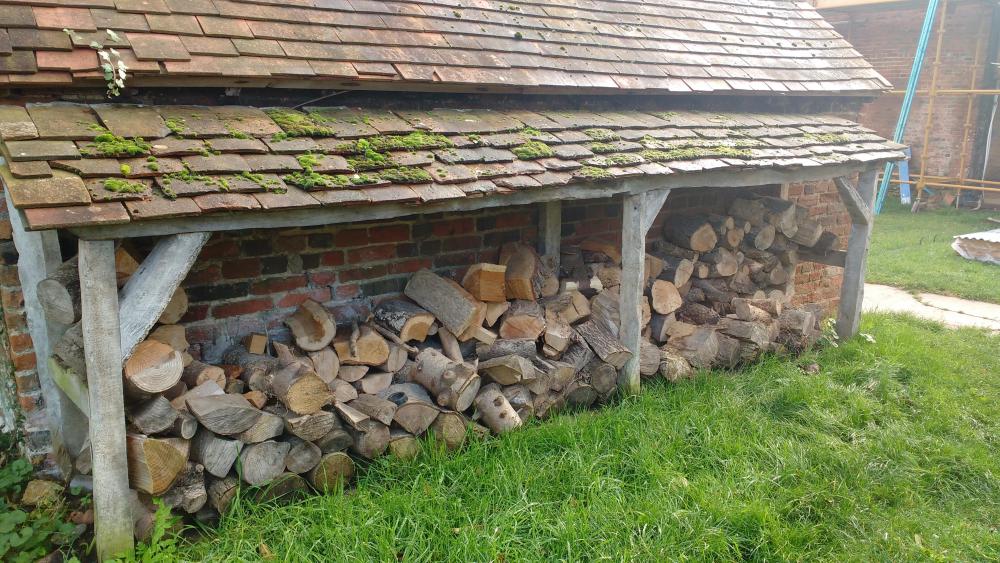
I made mine out of old joists I had pulled out on the house and some left over tiles that didn't quite make the grade for the main roof.