


jfb
-
Posts
668 -
Joined
-
Last visited
Everything posted by jfb
-
a slightly damp sponge can smooth off a lot of the ridges - just have to catch it when there is still some movement in the render but not too soft.
-
i think you aren't going to get the simple answer you want from us. Given that you have planning for an extension it is very likely that the planners would be happy with your new plan. But given it is different to the approved plans and it doesn't seem like you can do the new plan B under permitted development (because it is so close to the road) in theory you need to go back to the planners.
-
Yes you can build within 2m of boundary though I think building control comes up and if building in timber needs to be 1m (2?) from boundary whereas block/brick can go right up to boundary. I missed looking at your map - there are further complications when boundaries are near roads: I think you can't build any extension or outbuilding within 3.5m of a boundary if the boundary backs onto a road (under permitted development). I assume the definition of boundary is the edge of your property not the road itself.
-
max height is 4m for dual pitched roof (and max 2.5m at eaves) if more than 2m from boundary and max 3m for mono pitch roof. Max height is 2.5m within 2m of boundary.
-
Internal wall insulation 600mm masonry wall - condensation risk
jfb replied to Robbie's topic in Heat Insulation
If it has a cement render why can you not use EWI over the whole building? Would have a similar finish to how it is now, much better for long-term condition of the wall and if the existing render is mostly ok you can just apply the EWI straight in to it. -
Plasterboarding on yer lonesome ....
jfb replied to ToughButterCup's topic in Plastering & Rendering
can you not just lean the boards upright against the tower and then pull them up from the tower? -
Tata Steel v Marley Eternity Profile 6
jfb replied to canalsiderenovation's topic in Roofing, Tiling & Slating
I used Tata colourcoat for two simple flat roofs, no penetrations/veluxes. Very happy with end result. Was one of the few things on my build that i outsourced (despite the DIY possibilities) and was very happy with the installers. They travel fair distances doing it. Can pass on a contact if you want. -
ok ok! i submit. i'll leave it all level
-
Thinking of a single small step up from entrance hall into main living area in barn conversion. There will be a door as well, ideally opening into the main space , so at the top of the rise. Can the rise be 100mm, 75mm, 50mm? Or is there a minimum rise allowed by building regs?
-
I offered to have a look at a friend's plans for a single storey timber frame extension with a beam and block floor. I was thinking there should be a better way of dealing with the thermal bridge from floor to wall. From the drawings - is it possible to do away with the final trench block so the the sole plate sits at the same level as the floor insulation giving more overlap between wall insulation and up stand/floor insulation? Presumably the periscope vents would need to drop down a bit. Other factors?
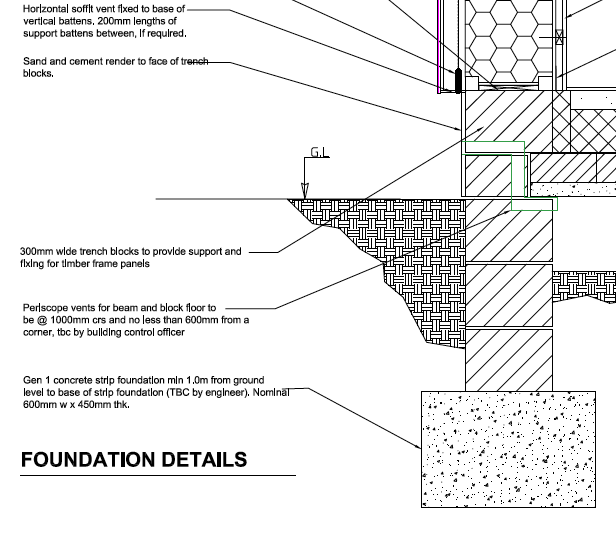
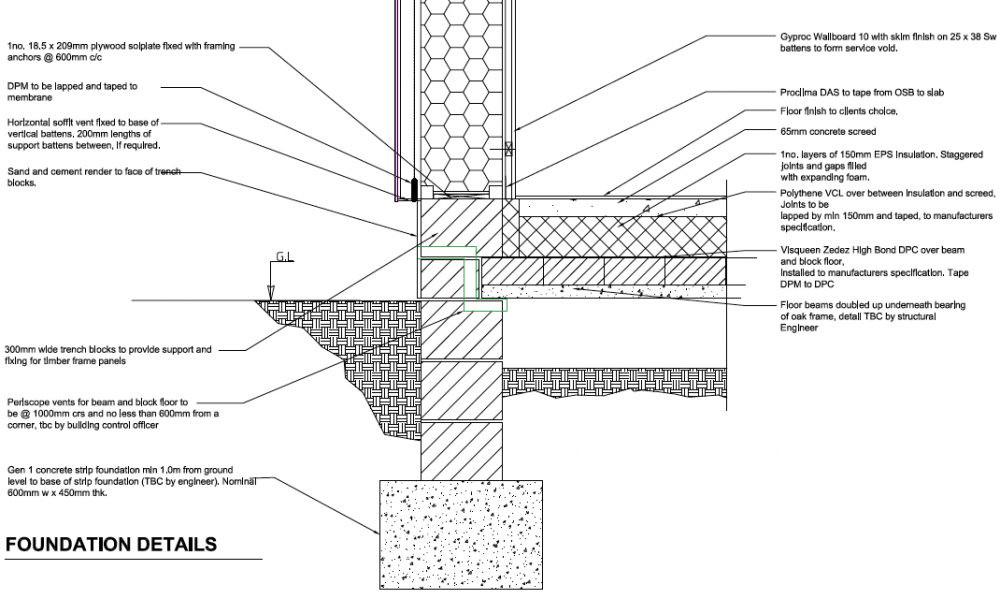
-
Think it depends from council to council. I was able to raise the roofline for extra insulation under non material amendment so it can be broader.
-
I'd suggest getting a few different pcs over and benefitting from about of their time for free. The more prepared yo u are with some ideas the better.
-
Sounds like a good project. Is it a solid stone walled building, timber frame, or something else? Where in Oxfordshire? I'm converting an old stone barn just outside Oxford in Garsington.
-
Should I fit solar panels
jfb replied to Russell griffiths's topic in General Self Build & DIY Discussion
Quick question for the unenlightened - I'm sure I have seen stuff about it before but can't remember where - what is the maximum size of install in KW allowed before it becomes difficult to DIY (is there a threshold at which it needs greater cooperation with electric companies)? -
Actually the living room window isnt going to be there as there is a building against that wall now. The Rooflight above the kitchen could be of a size to escape from though access would have to be from the worktops.
-
i can see that is a way to go - I'd rather not do that if I don't have to and would like to comply with fire regs in case I ever rented the house out.
-
Does anyone know off hand regarding fire regs - is it possible to have one external door downstairs only (no other opening doors/windows downstairs). There will be 2 fire compliant windows upstairs in the bedrooms. It is just two storey. Looking at the attached plan I am considering making the door opposite the stairs a non opener and so the only external door would be the one by the downstairs toilet. cheers
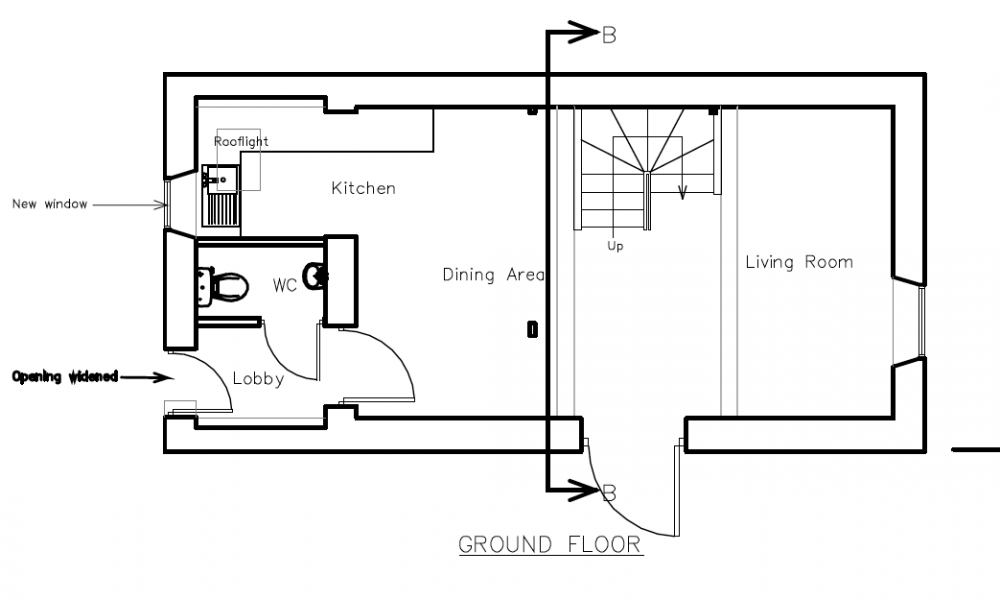
-
i second the resilience of the OSB to withstand the outdoors - especially for a temporary solution. But I can't say exactly what type of OSB it was - some was from some SIP panel leftovers and other bits of board. I'm surprised yours seems to be falling apart so quick
-
I have to make a new opening for the front door of a small barn conversion. This has to be done now before I actually have a door/frame because I am insulating below slab. I don't know yet whether I will buy a new door, get one from ebay or get one made by a friend locally but think I should make it a generic size so I can most likely avoid problems later. Looking at some websites it appears 838mm is a pretty standard size and the one I rang up said that their external door frames add an extra 70mm. Should I add on another 15mm so set the opening at 923mm? Less, more? Is 35mm for a frame edge pretty standard? I am planning on making a temporary frame to build around. Any other advice appreciated.
-
Why would you use thermalite for anything other than external walls for insulation value? Medium density better for fixing to, sound absorption and fine to go off slab. I suppose they are lighter for the poor Brickie!
-
How thick can your walls be? How much insulation are you hoping to have under your floor? Thinnest bang for your u value buck in masonry build is probably single skin blocks and ewi. Cavity wall is possible but to get a decent level of insulation to you are looking at 200mm cavity and so a wider wall
- 19 replies
-
- 1
-

-
- new build
- brick block
- (and 2 more)
-
ASHP- struggling to warm house in the cold weather
jfb replied to Jude1234's topic in Air Source Heat Pumps (ASHP)
Jude, I would second what Dave has been saying. Find out and give us details of what results you got for your air tightness test and what the specification for insulation values was. Without these figures it is hard to offer advice. The air tightness test result should be in the form of X m3/m2h @ 50 Pa. X being anywhere from 10 (terrible) to 0.6 (very air tight). -
MVHR for single room studio
jfb replied to Andrew's topic in Mechanical Ventilation with Heat Recovery (MVHR)
I'm in the market for something similar and am worried about noise levels - Crofter are you using it in continuous trickle mode or full blast? Looking at the spec it suggest a noise level of 21db on trickle mode and 45 db on boost. Is it only when it goes into boost that you hear it? -
+1 for not putting a membrane around the French drain if it is clay. If it were sandy better to have a membrane.
-
thats true of normal EPS with a conductivity of 0.037 but graphite EPS is 0.030 compared with 0.024 for celotex. But I take the point.


