


jfb
-
Posts
668 -
Joined
-
Last visited
Everything posted by jfb
-
thanks botus - a lot of help. i will try and get my plumbing head on! i have heard you are meant to pressure test first to 2 bar first and then 10 bar. depending on local supply would 2 bar be typical water pressure? and for more you would need a compressor?
-
I have found that no boost is needed in shower/bath rooms. I just leave the flow rate at the same low rate and there are no condensation problems.
-
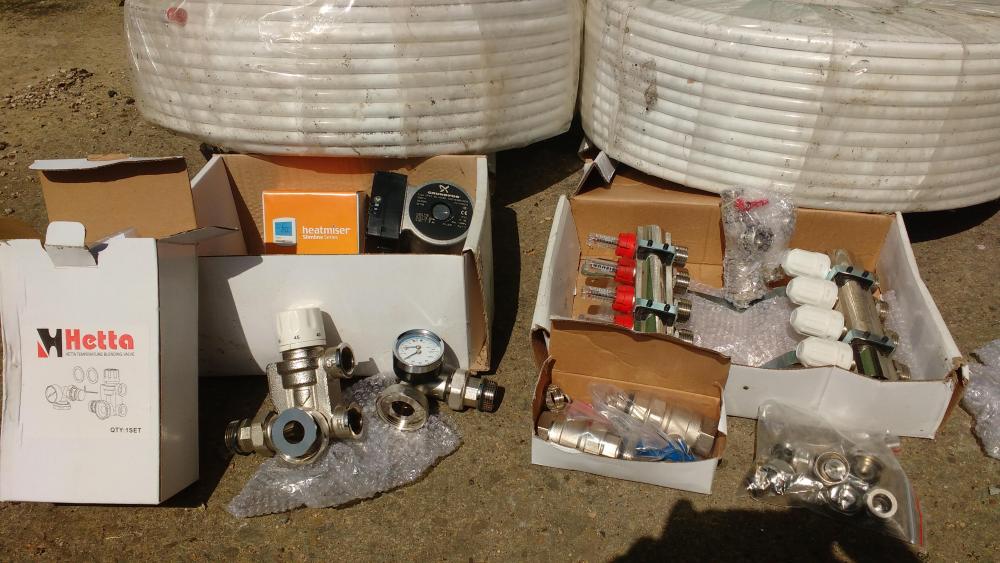
I am getting set to pour my concrete slab with A142 mesh and UFH pipes attached and have a couple of questions. I bought a Hetta 4 way manifold kit with 2 x 200m 16mm pert-al-pert pipe second hand (unused) on Gumtree a while back so hopefully it works and has all the relevant bits! 1. I notice that the kit doesn't include any 90 degree conduit for near the manifold - should i get some like this? https://www.toolstation.com/jg-speedfit-conduit-elbow/p74951?utm_source=googleshopping&utm_medium=feed&utm_campaign=googleshoppingfeed&gclid=EAIaIQobChMIx_qppoKM4wIV4b3tCh3k_QOcEAQYASABEgKTl_D_BwE 2. i have a couple of expansion joints where the pipe will go through - should I use conduit for those sections as well? 3. I was not planning on pressure testing before the pour (mostly because plumbing isn't my strength, don't have a compressor, having looked at some advice on here suggesting it isn't absolutely necessary, also will be running at low temperature (100mm spacing) so pipe expansion issues not so relevant) - do I have to fit the pipe to the manifold before the pour? I was thinking I could leave the pipes sticking up in line and fit manifold later. I think I need someone to tell me to stop being stupid/lazy and just fit it now as I can see it can't be as easy to fit later - it is just that the wall isn't quite ready to fix to yet. 4. Can I use a vibrating poker when I am pouring the concrete or could that damage the pipe? 5. It is an open plan space of 25m2 - at 100mm spacing I make that 10m per m2 so 250m pipe in total is needed. It will all be run as one zone. I am planning to use 2 loops of 125m each in a spiral pattern. Is there any reason why I should do 4 shorter loops instead?
-
I bought a cheap co2 monitor from Alibaba - it stopped working within a month. I was also in touch with Mr. Vair and that is disappointing to hear he isn't still doing them.
-
I would have thought it more common if brick to oak to use a brown sealant like: https://www.toolstation.com/window-door-external-frame-sealant-300ml/p76921?store=O2&utm_source=googleshopping&utm_medium=feed&utm_campaign=googleshoppingfeed&gclid=EAIaIQobChMI-7iy8v6G4wIVBp7VCh0i3goPEAYYASABEgIC1_D_BwE problem is the colour rarely matches exactly. But not sure how clear would look - maybe try it and see if it looks ok. For my windows (green windows and stone walls) I just jointed the gaps with mortar and this has been fine with just occasional cracking from differential movement.
-
90 degree angles just fold, 270 degree angles are trickier and you do have to cut and splice in extra dpm taped. make sure all corners are nice and square before putting dpm down or else tricky to get dpm in nice and cleanly.
-
It might be worth seeing if there is space to fit a sound attenuator near the ventilation unit. Is it just extract? normally more sound issues come from the supply side of MVHR units. Or is the sound coming mostly from the actual ventilation unit? If so you could look at ways of minimizing the sound from the unit itself.
-
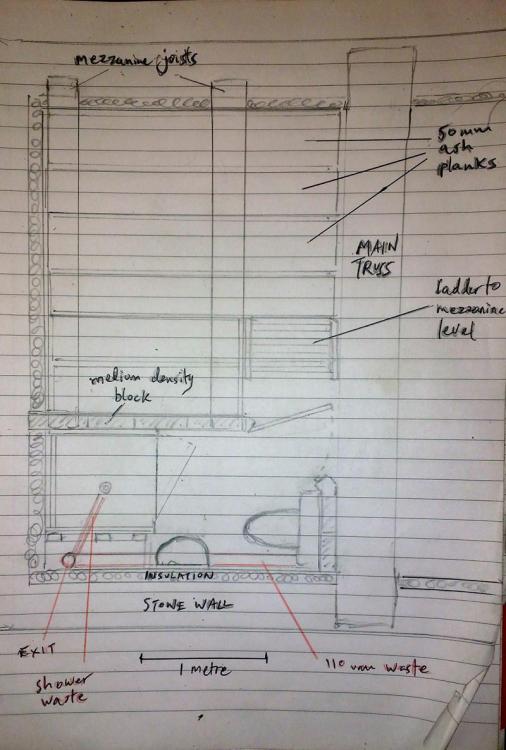
I have been wrestling with how to fit in a small shower room into a small barn (3.5m x 4.5m) with a mezzanine level/bunk bed. The plan I have come up with is attached (apologies for the lined paper). It includes a steep ladder up to the bunk bed and an angled door to the shower room that includes a 800mm x 800mm shower. Any thoughts on layout? Originally it was going to be just a toilet and the soil pipe come up in the corner of the building. With the toilet now 2m from the exit pipe I presume this should still work considering the pipe layout/sink position/toilet pipe outlet height? One last thing - is there a good way of making a thermal break where the medium density block joins onto the main stone wall? I plan to use a wall starter kit as normal but is there a better way that provides a thermal break to match the IWI?
-
You can also get graphite EPS which has a better lamda value of 0.030. it costs about 30% more than the normal white EPS. I normally get mine from Ecclestons.
-
Is this the party wall? If so then I would have thought you have plenty of bearing on a good padstone.
-
I bought a small electronic device which failed after a few weeks. No redress to be had - returns policy non existent effectively as far as I can tell.
-
Do you know where on buildhub you found this? Does the Multipanel have the same issue regarding the bottom seal?
-
I've only just watched this video and I have to say he is fantastic!
-
this is all great info. i was doing a bit more digging around and came across a heat pump site that was giving reasons against using the heat pump to cool: https://www.freedomhp.co.uk/2018/10/08/why-cooling-is-so-hard-to-achieve-in-a-conventional-heating-system/ it claims it is very inefficient (8x compared to heating) and also that it can lead to problems of condensation. has anyone using a slab to cool experienced this (a cool damp floor)? or is it likely to be less relevant if the pipes are spaced close together so you are not asking for a big differential between outside temp and slab temp (in same way as heating can be done at lower temps if pipes are closely spaced)
-
sounds very sensible and i have some trunking spare so will use that. thanks
-
Does anyone know what you have to do when making sure cable doesn't come into contact with EPS? Does there need to be a gap of minimum 20mm, 50mm,? Or if I tape some membrane (say like intello) to the eps can the cable rest against the membrane?
-
by what method can the cold water produced by the ASHP cool the air supply of the MVHR?
-
Hi from Abingdon, Oxfordshire - Self Build Extension
jfb replied to Northcourt Couple's topic in Introduce Yourself
Good luck with the project. If you do know exactly what you want then have you considered using an architectural technician rather than an architect. Maybe this might be less straight forward if you are using a non standard form of building but it could certainly be a lot cheaper! -
resurrecting an old thread - can someone enlighten the unenlightened? in summer when you are asking for slab cooling how does it provide hot water? is it as simple as switching over from heating to cooling at different times (presumably with dhw taking precedent)?
-
it either is or isn't the case - as others have said have a good look at your planning decision and there is a good chance all PD rights will be removed.
-
Silencer in metal ducting
jfb replied to Thedreamer's topic in Mechanical Ventilation with Heat Recovery (MVHR)
yes go as big as you can - I also ended up making my own and it has reduced the noise on the supply side to inaudible -
Exactly what I did and it worked very well. Only my electrician was annoyed as he had to make sure his wiring didn't come into contact with the EPS.
-
That makes sense Dave. I thought i wouldn't need an AAV as the longer branch that goes to the upstairs bathroom will vent through the roof (off mains, have STP installed). The two branches join at a y junction about 2 metres from downstairs toilet. I'll have to look into anti syphon traps.
-
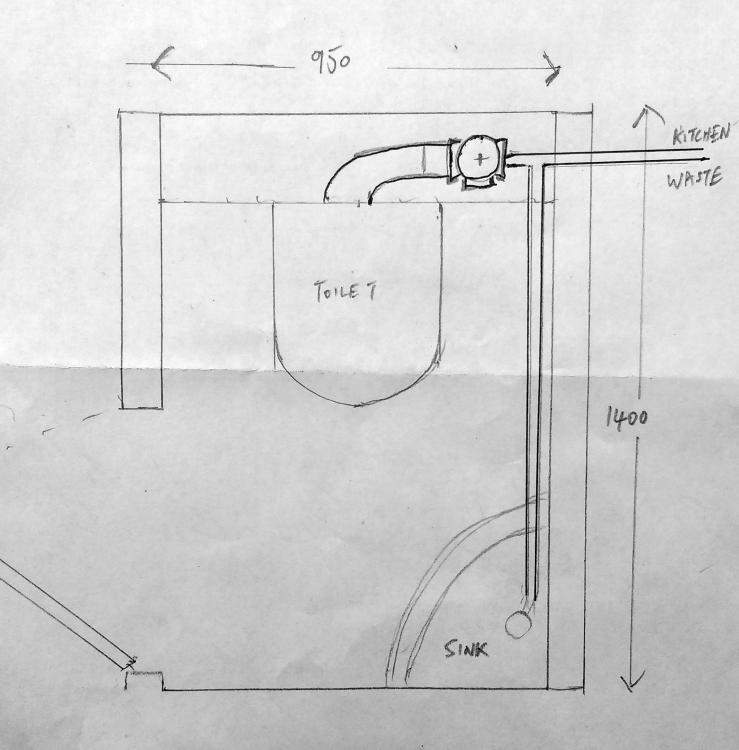
I have a downstairs toilet where the 110mm waste pipe comes up in the corner of the attached plan. I am looking to get an access branch that allows me to take the toilet waste and the kitchen and toilet sink waste as well. I was thinking of getting this : https://www.toolstation.com/access-branch-110mm-9250/p26539 Access placed on top. Toilet waste would go into one side branch and 40mm waste into the other 110mm branch via a 110mm to 40mm reducer. Does that sound sensible?
-
i second what Punter says - if it is a barn wall of a certain age it is very likely to have been built with hydraulic lime mortar (not hydrated lime) and should be repointed in similar, not cement. The sand used also tends to be a bit sharper (not as fine particles as in a cement mortar) and the mix stiffer so pointing guns not so effective. A 'small tool' is useful, just make sure the square end is slightly narrower than the typical joint size - something like this: https://www.oxtools.co.uk/hand-tools/masonry-tools/small-tools/pro-small-tool.html




