pdf27
-
Posts
387 -
Joined
-
Last visited
-
Days Won
1
Everything posted by pdf27
-
Actually, I think the big lesson from that is the potential value of weather forecasts to improving COP. Most of the hot water will be used in the morning in an average household, and not further required until the evening. Putting an inhibit on the unit until 10am and then working at max power would be a very effective strategy on that day - whereas if it was cold all day then the best strategy would be to run at lowish power rates intermittently throughout the day and leave the unit to defrost naturally in between. The whole Internet Of Things will actually make this quite easy to implement.
-
Only if the roof itself is a vacuum chamber - otherwise it's the surface of the inside of the panels you need to worry about. There is also conduction through the silica foam used to provide the structure of the panel. So essentially you have a very small number divided by virtually zero, which means what response there is will be very rapid - but the insulation should be good enough that the actual power transmitted will be quite low. This means that the relevant thermal mass is more that of the whole building than of the roof insulation itself. In a well insulated, high decrement factor wall the heat transmission across it will be low and it will take a long time to measure any change in external temperature. For a well insulated, low decrement factor wall the heat transmission across it will be low but it will take very little time to measure changes in external temperature. If heat transmission is low, however, this isn't such a big deal - the roof temperature might for example drop by half a degree over the course of 20 minutes rather than 12 hours. Provided there is a reasonable amount of thermal inertia elsewhere in the system (a concrete floor for instance) it should be no big deal - if the concrete is at close to equilibrium with the air, even small changes are self-correcting as the rate of heat transfer will rapidly increase as the air temperature drops. The key is keeping power demand small - temperature swing will be directly proportional to power. Personally, I wouldn't ever have an unpumped/unpumpable vacuum system at home - I spent the first 10 years of my career as a vacuum engineer, much of which was finding new ways to find obscure leaks. The idea of the insulation relying on nobody puncturing a foil bag on a building site just causes my mind to boggle a bit - I'm used to systems being assembled in clean rooms and a single scratch or fingerprint being enough to trash the system. Admittedly I was working on ultra-high vacuum systems, but still...
- 10 replies
-
- 2
-

-
- roof lights
- roof
- (and 3 more)
-
Probably a question for @AndyT - the "Smart Heat Batteries" presentation temperature range chart shows an actual/potential temperature point at 43°C: do you know if this is either commercially available or planned to be so in the near/intermediate term? The reason I'm interested is that 43°C is a good match to the maximum scald-safe hot water temperatures without being out of the efficient range for a heat pump, so a Stack unit with this material looks like it would be an excellent way to provide hot water from a heat pump, something I'm likely to be interested in doing in ~12-18 months time.
-
See http://www.autoexpress.co.uk/car-news/103256/ovo-launches-vehicle-to-grid-charger-for-nissan-leaf - even without smart meters it's possible to make a profit selling electricity from cars back to the grid.
-
How do you think they're all getting in my house in the first place?
-
Before you get mains gas, work out how long a 47kg bottle of LPG would last you and at what cost. Hobs use very little gas in real life - even a 47kg bottle is probably too big.
-
One thing to pay attention to is the gas standing charge - been doing a few fag-packet calculations recently and for a 150 m2 Passivhaus the standing charge means that the running costs of an ASHP and gas boiler are essentially the same. That’s going to make a hybrid system very unlikely to be viable unless you’re going to have a gas connection anyway. In that case, heat pumps make sense if you want cooling, but not otherwise.
-

Conceptual and detail design software
pdf27 replied to LouiseSJPP's topic in New House & Self Build Design
Problem is any 2D CAD package is only doing what you can do by hand pretty easily once you learn to do technical drawing - 3D CAD packages are way more expensive. I’ve used Catia v5 and NX at work: both are hugely capable - you could model individual wires in a whole house model - but that power comes at a huge price (5 figure license costs). -
Drying Towels in an MVHR fitted bathroom
pdf27 replied to TerryE's topic in Mechanical Ventilation with Heat Recovery (MVHR)
Yeah, I deliberately didn’t consider anything outside the bathroom - I was thinking as to whether it would work at all, not the whole house balance. Essentially the problem is that it doesn’t work without a heat dump, not that it’s inefficient. I would expect in an MVHR for the exhaust temperature to be pretty constant (set by nominal efficiency at typical humidity). Increasing the humidity in the extract air will increase the condensation rate once the outdoor air is cool enough - pretty much 100% of the additional water being condensed and the energy used to warm the supply air. You can’t be warmer than the supply air, but should be able to get pretty close. -
Drying Towels in an MVHR fitted bathroom
pdf27 replied to TerryE's topic in Mechanical Ventilation with Heat Recovery (MVHR)
Reading this and got thinking: 70g of water seems to be a reasonable estimate for the amount of water on a towel - so it would need to evaporate off 150-300g of water per day without any other drying mechanism at work. Latent heat of evaporation is 2,260 kJ/kg - so between 340 and 680 kJ per day is required. That works out at between 4-8W of additonal heating - it's the being warm rather than the heat energy which makes the difference. All else being equal the drying rate will roughly scale with the vapour pressure of water at the towel temperature. Problem is, that doesn't start rising rapidly until the radiator gets fairly warm - at 30°C it's only ~1.5 higher than at 20°C while at 70°C it's 13 times higher. Looks to me like a heated towel rail will work well in a conventional build where the bathroom needs a significant amount of heating anyway. With smaller heat requirements, unless you want your bathroom a lot warmer than the rest of the house then you're going to struggle to run it warm enough to have any significant drying effect. Given that towel radiators tend to inhibit airflow over the towels compared to a simple towel rail, you may well get dryer towels without it. -
Wife has moved in and he's hiding in AirBNB for his own safety?
-
Do low energy houses really need heating controls?
pdf27 replied to pdf27's topic in Boffin's Corner
The obvious answer there is that either your duct pressure loss is relatively high (it'll do 300 m3/hr at 150 Pa but only 200 m3/hr at 300 Pa) of your cooling demand is significantly greater than 500W. Unless you've paid a lot of attention to avoiding direct sunlight except in winter, my money would be on the latter. Another potential benefit of a duct heat exchanger is that it gives you a guarantee that you won't get condensation on the floor - the heat exchanger will be at the water temperature, cooling the air flowing over it and guaranteeing that the dew point of the air in the house is warmer than the floor temperature. In reality it won't be an issue anyway unless you have a huge amount of solar gain to deal with - the heat exchanger in the MVHR will do the same thing since the air leaving will be pretty cool - but it does avoid an extra heating/cooling device. -
Do low energy houses really need heating controls?
pdf27 replied to pdf27's topic in Boffin's Corner
I think looking at it in hour terms is a bit unhelpful - 500W and 1210 J/m3K means that you need to exchange 5/12 of a m3K per second - at a 10°C temperature difference that's only 40 litres/second, which isn't ridiculous for a whole house. Can I just check your numbers actually - something doesn't make sense. I agree with the 0.3361 Wh/m3K value, but to remove 500 Wh that means to me you need 500/0.3361 = 1487 m3K per hour to provide the cooling (same as I've got below). Your figure only works at 0.5K, i.e. the outside temperature is the same as the target temperature and the inside temperature is 0.5°C warmer than the outside - the 1487 m3K figure is air flow rate multiplied by temperature difference between the room temperature and that of the supply air. 500W x 3600 seconds is 1.8 MJ, dividing this by 1210 J/m3K means you need 1483 m3K per hour to provide that much cooling. A Paul Novus 300 can provide up to 300 m3/hr, so provided the outside temperature is more than 5°C below your target temperature you should be able to provide sufficient cooling that way. That's a small enough difference that you're unlikely to be in heating mode - at which point a water to air heat exchanger plumbed into the same circuit as the floor slab would give you precooled air in the same way your Genvex does. -
Do low energy houses really need heating controls?
pdf27 replied to pdf27's topic in Boffin's Corner
In other words the only practicable way to deal with sudden temperature spikes in a low-energy house is to directly cool the air, either through a recirculating unit (air conditioner or similar) or through the ventilation system (MVHR bypass or opening a window), unless a replacement plasterboard-type material with much better thermal conductivity is available. Fermacell is 50% better than gypsum but still pretty rubbish. I'm assuming sudden reductions in temperature aren't a significant problem - essentially that means opening a door or window, which is under the control of the inhabitants and so more likely to be accepted. Using air as the main heating/cooling system of the house would work nicely with this, but tends not to be very popular. It's possible to come up with a partially recycled air heating system to break the link between heating and ventilation, or to go down the route suggested in the Passivhaus spec of using the ventilation air for heating and cooling. This is feasible (the 10W/m2 spec comes from ensuring that duct temperatures at standard ventilation rates do not need to exceed 50°C) but doesn't seem to be particularly liked. Cooling at standard ventilation rates is much harder - to get the 10W/m2 you need to be providing air at -10°C which certainly won't be comfortable. My understanding (theory only - please correct if I'm missing something) is that there are three scenarios in which you would need to dump excess heat: Lots of visitors come over at once. Realistically in this scenario you'd need to increase the ventilation rate anyway to keep the air quality high, so using the ventilation system for cooling is the obvious answer. When the house is in heating mode then the summer bypass should kick in and extract hot air, replacing it with cool air. In cooling mode that won't work, but if there is a water-to-air heat exchanger tied in to the heating system (which would be in cooling mode anyway) and between the outlet of the heat exchanger and the point where the summer bypass is teed in then this should work acceptably well. This may need a buffer tank to work well though, although you could I suppose use the thermal inertia in the slab to provide initial cooling until the flow temperature rises and the heat pump kicks in. Cooking. This splits two ways - for ovens, the best answer is a well insulated oven which will also reduce energy consumption anyway. For cooking on a hob, local extract-only ventilation would appear to be the correct answer - a cooker hood would conventionally be positioned to pick up the hottest air, essentially isolating it from the rest of the house. This goes against normal practice however, and I'm not sure why - the MVHR system would have to be able to run with unbalanced supply and extract flows, and you'll need an airtight (servo-operated?) valve on the cooker hood extract pipe to ensure you don't suffer from backdrafting. This is a potential problem if you have a combustion appliance in the house, but I'm not sure this is a showstopper - the low heat demand makes wood burning awkward, gas boilers tend to be room sealed and induction seems to be slowly taking over from gas, so in the long run these are going anyway. Solar gain. I think the answer to this is probably a combination of design (i.e. remove by design the risk of having to deal with 10kW of solar heating on a spring day), boosting the ventilation and always running the UFH circulation pump in daylight hours (as per @JSHarris) to increase the heat capacity of the area warmed by the sun. -
Do low energy houses really need heating controls?
pdf27 replied to pdf27's topic in Boffin's Corner
Umm... are those temperatures measured ones? The temperature differences look rather too large to me. Room temperature 21°C at 10 W/m2 - this means floor surface temperature is 22.1°C 18mm or so of engineered wood has a US R-value of ~0.75 (U=7.6 W/m2K in SI units) - at 10 W/m2 that's 23.4°C at the bottom of the engineered flooring or a 1.3°C delta T. Thermal conductivity for pumped screed seems to be about 2.2 W/mK, assume the pipes are on 200mm centres 30mm deep so the heat will have between 30mm and 105mm to travel. That gives U-values between 73 and 21 W/m2K and thus at 10 W/m2 temperature differences of between 0.13 and 0.48°C - trivially small. That means the pipe surface temperature will be 23.7°C. Assuming 200mm centres, there will be 5m of PEX-Al-PEX pipe per square metre of floor space - so a heat transfer of 2W/m of pipe. Thermal conductivity appears to be about 0.43 W/mK. I can't be bothered to do the integral so taking the pipe to be a 4mm thick plate which is 43mm wide (circumference at 14mm diameter) gives a temperature difference of 107 W/m2K and thus a temperature difference across the pipe of 0.4K. That means the mean water temperature will be 24.1°C. So in a scenario where the slab is supplying 750W and the pump is providing 150 l/hr (0.04 kg/sec) - 175 W/°C temperature difference in the water. That means a flow temperature of 26°C and a return temperature of 22°C. Now assume a sudden increase in provided heat of 2kW for a net surplus of 1250W. Initially the flow temperature won't change and if that continued then you'd be very warm indeed - 31°C. However, that's very unlikely to happen - an increase in the return temperature from 22 to 24°C for instance would indicate a halving of the demand for heat. That would imply a reduction in the mean water temperature target from 24°C to 22°C, and thus a flow temperature of 23°C - at which point the heat pump is already providing cooling to the slab. There are going to be two time constants in operation here - that for the flow of water around the circuit and that for the slab to heat up. A 100m loop would apparently need a flow rate of 2.5 l/min for a conventional installation - that would have a fluid content of ~11 litres, so time constant for the water temperature to react would be less than 5 minutes. A 30mm thick by 1m2 concrete slab will have a mass of ~70kg - that means 60 kJ of heat needs to be added to warm it up by 1°C. With a sudden increase in heating load of 25W/m2 that's going to take 2250 seconds (37 minutes) per °C temperature rise, and realistically rather longer than this since there will be a significant contribution from the volume of concrete below the slab. Treating the whole slab as a unit increases this time constant to 2 hours/°C. This does give you a significant impact on the rate of rise of air temperatures however - So in any such scenario the slab cooling simply isn't going to react - it'll continue providing the same background level of heat for at least a couple of hours. That would apply to pretty much any control scheme however, unless there is a very big source of heat or cooling available - a 75m2 slab 100mm thick would weigh 17 tonnes and so have a heat capacity of ~4kWh/°C - providing rapid cooling would need something like a 100kW heat pump and you'd end up chasing your tail all day long trying to keep the room temperature constant. Specifically with solar gain, however, I do wonder if the time constant wouldn't be somewhat different. In the majority of cases the sun will presumably be hitting the floor, which then warms up and so heats the rest of the house. There the sequence works for rather than against you - the room won't warm up significantly until after the slab has, and the slab warming up gives any heat pump the chance to switch over into active cooling mode. This then raises a question - what sort of temperature swing are people comfortable with in the short term, e.g. when cooking? Slab cooling isn't going to cut it, nor are normal MVHR ventilation rates. -
Do low energy houses really need heating controls?
pdf27 replied to pdf27's topic in Boffin's Corner
This is where I'm not so sure - for say a 75m2 slab then you only need the room to be 1.4°C warmer than the slab for it to be absorbing 1kW of heat. Realistically that means you can absorb several kW of heat before any temperature rise becomes significant. The question then is whether the slab surface temperature really is remaining constant and the issue is a lack of heat transfer between slab and air, or whether (as I suspect the case may be with Jeremy's system) the pipes are buried deep in the slab and this means that the limiting factor is the large amount of concrete which must be warmed up before any additional heat transfer to a heating/cooling system can take place. Your heating pipes are buried deep in your slab, correct? I've got to wonder if that has an impact - the deeper your control element is in the slab the longer the time constant involved, while the thermal buffering ("thermal mass" ) of the slab will be a function of the depth and thus heat capacity of the slab rather than the position of the heating pipes in it. When you're running the circulation pump to distribute heat around the house with the heating off, do you get the same sort of time lag - i.e. if the pump had been off for a while and you turned it back on would you expect it to take a day or so for the heat to settle down around the house? -
Do low energy houses really need heating controls?
pdf27 replied to pdf27's topic in Boffin's Corner
I have been reading up on what you did, and this is to a large extent inspired by it. The idea is that if you have the flow & return temperatures plus the flow rate this will give you both the average slab temperature plus the net heat loss from it - providing the missing bit of information you needed. The difference is that instead of making assumptions about losses based on the inside and outside temperatures (as in a standard weather compensation circuit), you measure heat demand directly. -
Do low energy houses really need heating controls?
pdf27 replied to pdf27's topic in Boffin's Corner
If 50 people suddenly turn up, then the heat transfer should shift from floor -> rooms to the other way around, and the return temperature should exceed the flow temperature. Response times may be an issue though - you'll get an initial rapid response as the floor slab will be close to the target temperature and the air temperature will be a long way off leading to a lot of heat transfer from the slab, but I'm not sure how quickly the water circuit would pick this up - or even if a slow response would matter. -
I've been musing a bit about how best to control the air temperature in a low energy house over the past couple of weeks as a bit of an escape from reality, and started to wonder about something. As per @JSHarris's formula, underfloor heating will provide a power of = 8.92 * (floor surface temperature - room temperature)^1.1 W/m2 - assuming a low energy house will never need more than 20 W/m2 and very rarely more than 10W/m2, that means the surface temperature will never need to be more than 1-2°C above ambient. Perhaps more interestingly we can use this to calculate the average house temperature from the flow and return temperatures. Liquid screeds seem to be in the region of 2-3 W/mK, with the pipes being between 25 and 150mm from the surface - so at 1m thickness you're looking at 3-5°C temperature drop per metre at 10W, realistically for 1/8m maximum conduction distance through the screed you're at <1°C. Importantly, this means that the temperature difference between the flowing water and the rooms will be small (2-3°C) and a pretty much linear function of power since at low levels of heat the ^1.1 term can be pretty much neglected. Very roughly, you're going to be looking at something like: power ≈ 5 x (average water flow temperature - room temperature) For a wet underfloor system, this means that everything needed to calculate room temperature is already known, provided the insulation constant of the floor can be measured: power = (flow temperature - return temperature) x specific heat capacity of water x flow rate ≈ 5 x (average water flow temperature - room temperature) And measuring the insulation constant of the floor should be straightforward - you need a room temperature thermometer to make the initial measurements, but doing so should be simple to automate and when completed should give very consistent temperature control. The downside is that you need to be able to measure flow rate and flow/return temperatures very accurately - this would potentially all be within a heat pump using existing parts (the P/Q/Power curve for the pump should be well known for instance), but would presumably be rather hard to DIY. So what am I missing?
-
Best thermal insulation under bamboo flooring.
pdf27 replied to TheMitchells's topic in General Flooring
Ummm... what are you trying to achieve? If you're using underfloor heating you want minimum insulation (and how much is a problem depends on how well insulated the rest of the house is), if you aren't then more insulation is better -
I think it's 042 as well. Nothing is correct in 738, one is correct but wrongly placed in 780 - therefore the first or second digit is zero. 206 has two digits correct but wrongly placed. We already know that the first or second digit is zero, so the first digit must be zero. One of 2 or 6 makes up one of the remaining digits, with the other not being present. 682 has one digit correct and correctly placed. Since the first digit must be a zero, the correct digit must be a 2 as the third digit. 614 has one digit correct but wrongly placed. The missing digit must be a 6 or a 4, and we know from (2) that there is no 6 present.
-
Umm... that it probably breaks the laws of physics? I think the indoor temperatures look like they're the wrong way around - that seems to be saying that the heat exchanger is taking indoor air at 11°C and sending fresh, warmed air out again at 15°C. Much more likely is the other way around - that gives outgoing dT of 11°C and incoming of 9°C. If flow rates are equal in and out (as they should be) then that's about 82% efficiency.
-
Doesn't help - you'll get about a litre of water for every litre of diesel burned too, and bottled gas is slightly worse for the same amount of heat delivered. Essentially all the oil and gas derivatives are made of a mixture of hydrogen and carbon (natural gas has 4 hydrogen molecules and 1 carbon, while diesel has about 32 hydrogen molecules and 15 carbon molecules). The heat is given off by combining the carbon and hydrogen atoms with oxygen from the air, forming carbon dioxide and water. Pretty much the only thing you can burn without a lot of water in the exhaust is coal and similar smokeless fuels. The actual calculation is: LPG gives about 46 MJ/kg (12.8 kWh/kg) - that's lower calorific value so assumes the water from the combustion process will stay as vapour. That means 78kg of gas is needed per 1,000 kWh. They're either C3H8 (propane) or C4H10 (butane) - 10% or 8% hydrogen by weight respectively. That means the 78kg of gas will contain about 7kg of hydrogen gas. Water is H2O - so 2kg of hydrogen gives 18kg of water. So 1,000 kWh will mean about 60kg of water being released into the house. Unless well ventilated, it will all end up condensing out on cold surfaces.
-
A Robust Non-Gas Heating / Water System for Rentals
pdf27 replied to Ferdinand's topic in Boffin's Corner
I agree with the loss calculation, what I'm not so convinced by is the significance of it. What you're showing is that underfloor heating is a bit less efficient than radiators, when the radiators use water at the same temperature as the underfloor heating. That seems entirely reasonable to me, but it also doesn't seem like a very real-world situation - unless you're using fan coil type radiators then using the entire surface area of the floor as a heating surface is going to be pretty hard to equal. That isn't really a problem in a very well insulated house since the heating requirement is very low and "normal" sized radiators are now drastically oversized and will work just fine. It's a bit different in a less well insulated house, say at the 50W/m2 point. A smallish 10m2 room would need 500W - that puts the floor temperature 5C above ambient and the water temperature no more than 30C. A heat pump is operating at peak efficiency and a boiler will be fully condensing at this point - perfect. The correction factor seems to be about (air-water temperature difference/50)^1.344 - so to match the underfloor the radiator would have to be 8.7 times larger than the book value - i.e. sized for 4.3kW. That means specifying a triple panel 600 x 1800 radiator for a room 3m x 3m! Now realistically you don't need to match the low temperature of the underfloor heating to get all of the efficiency gains from the rest of the heating system, and that gets you away from ridiculously big radiators (at 40C you're down to a 1.7kW radiator for instance) - but there is clearly a risk that by optimising to reduce total heat losses from the building you're increasing rather than decreasing total energy demand, depending on how your heating system of choice reacts to varying output temperatures. -
A Robust Non-Gas Heating / Water System for Rentals
pdf27 replied to Ferdinand's topic in Boffin's Corner
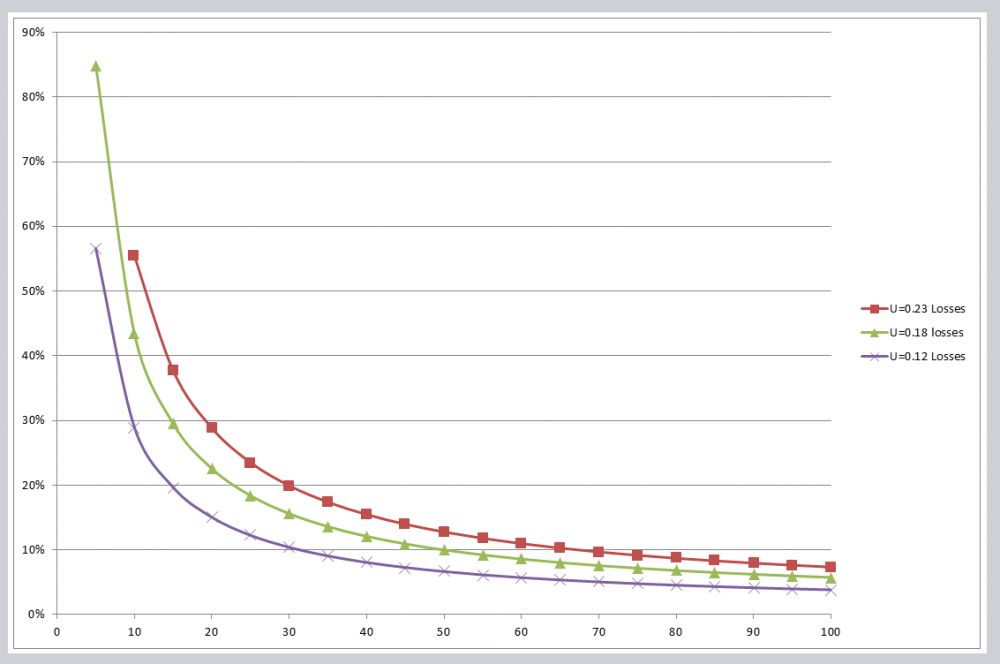
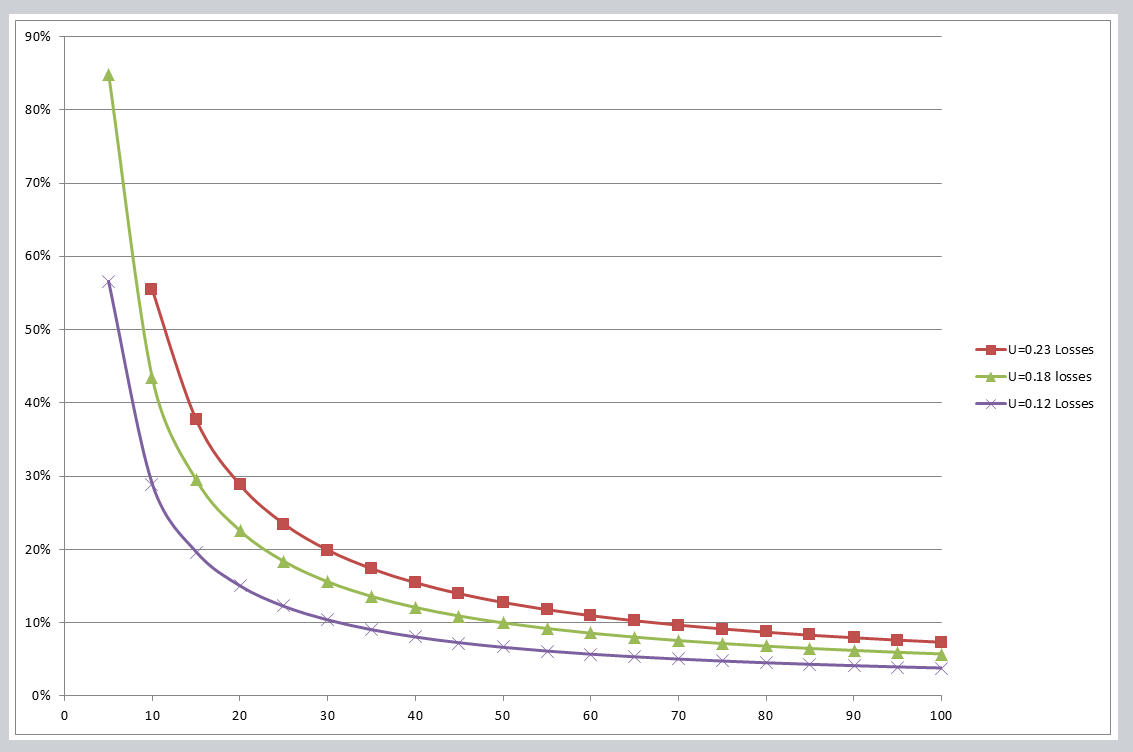
Err... not convinced by that. Very crude spreadsheet model. X-axis is the heat provided to the whole house in W/m2. That is then used to work out floor surface temperatures and hence losses through the floor for three insulation levels, given as a percentage of the total heat loss for the house. For a well-insulated house, floor heat losses form a significant proportion of the total. As heat losses elsewhere become more important, however, the quality of the floor insulation becomes much less important as a fraction of the whole, and the heat loss impact of using underfloor heating becomes less significant. For a gas boiler you're probably better off using radiators still (just - the impact is small enough that you **might** get it back from improved condensing), but with a heat pump I think it's pretty clear that the lower flow temperatures and hence improved COP from the bigger emitter area would make underfloor heating helpful - although in a retrofit case I suspect it's unlikely to be economic.