


pdf27
-
Posts
387 -
Joined
-
Last visited
-
Days Won
1
Everything posted by pdf27
-
Oxis Energy have been about to launch these for over a decade now, and a few others are available but cost £££££. In theory they're a good fit for domestic boiler replacement, but in practice they seem to be very difficult to build at a price people can afford.
-

SAP10, 0.233kgCO2e/kWh for electricity
pdf27 replied to Dreadnaught's topic in Energy Efficient & Sustainable Design Concepts
If it was just a cost thing then electric resistance makes some sense - same for very small houses or ones you're thinking of letting out. If it was somewhere I was going to live I'd want a heat pump though - mostly for summer cooling. Getting a decent rating on fuel cost might be quite hard though, and that might put developers off. -
SAP10, 0.233kgCO2e/kWh for electricity
pdf27 replied to Dreadnaught's topic in Energy Efficient & Sustainable Design Concepts
I think it looks like the cost penalty of electric heating is coming down a bit too: I think heat pumps at <35°C are assumed to be 230% efficient, with a fuel price of 16.55 p/kWh (standing charge should be paid for anyway) = 7.19 p/kWh of heat Assuming a top of the line (90%) gas boiler with a fuel price of 3.94 p/kWh = 4.38 p/kWh of heat plus a standing charge of £87 Break even is at 2676 kWh/year of heating - 25 kWh/m2/year for a typical 100m2 house. Hot water demand will shift this a bit, but I think it means the predicted fuel costs will be much the same for both options too. Full document is available at https://bregroup.com/sap/sap10/ BTW. -
I vote Bonkers. Norway is 98% hydro anyway with fairly limited interconnection potential, so trying to design a house that generates a lot of power (probably from PV - in Norway) really doesn't get you much. Minimising heat demand makes a lot of sense, as does trying to use timber framing rather than concrete as much as possible to ensure that embedded energy is held down. I get the feeling that a lot of this is about drumming up work for architects and associated certification professionals, rather than trying to reduce net emissions - for the same investment you'd get a lot more net generation from large scale hydro.
-
We have a low-level external vent on our current (1920s) house, and the architects have previously stated that it's OK to continue using that for venting sewer gases - indeed strongly preferable to do so. From memory the statement was that on another project they'd modelled the high level vent to cost 1 kWh/m2/year of losses - not massive in heating bill terms, but a big deal if you're trying to hit a standard like Passivhaus which they were on that project.
-
Cwoor look at the insulation on those.
pdf27 replied to MikeSharp01's topic in General Self Build & DIY Discussion
Fuel is cheap, and most people won't pay extra for better insulation. Most of those that will probably think that with a new house they already are - which is even technically true as the building regs are much tighter now than they were historically. This being the case, why spend the money on more insulation when they could take it as profit? -
There are no patents listed on Espacenet owned by Halcyan - https://worldwide.espacenet.com/searchResults?ST=singleline&locale=en_EP&submitted=true&DB=&query=halcyan This doesn't exclude the possibility of them licensing the IP from someone else.
-
Full patent below, downloaded from Espacenet. Number doesn't match but inventors, title and date do. Having read the patent I'm none the wiser as to how it is supposed to work. AU580474B2.pdf Edit: for clarity, this is the expired Australian patent mentioned by @Alphonsox
- 199 replies
-
- 1
-

-
- hard water
- water softener
- (and 1 more)
-
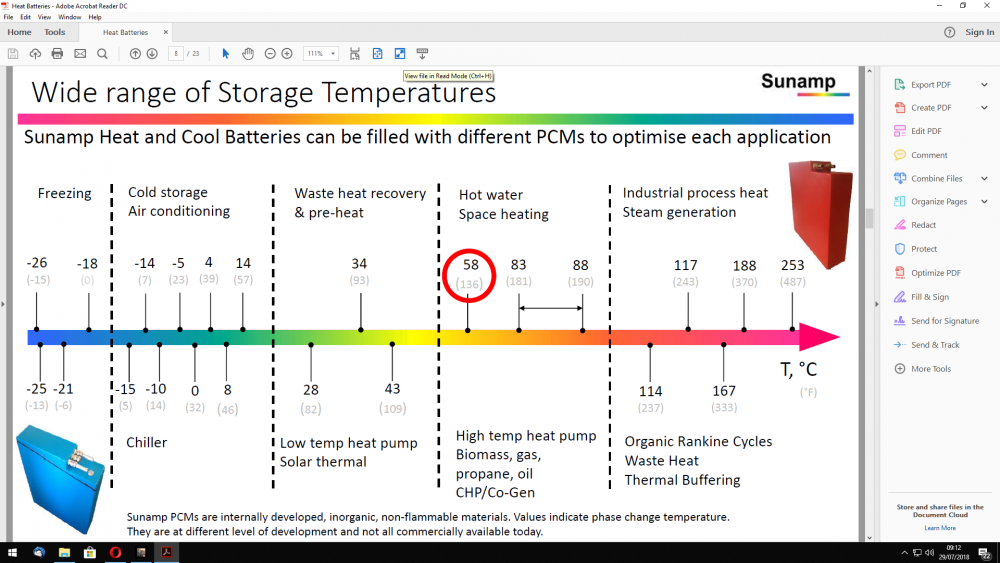
If you look at their promotional material they say that a number of different PCM operating temperatures are possible, with PCM34 and 58 currently being the focus. PCM43 is particularly interesting to me because it looks like it might be in the sweet spot for providing DHW from a heat pump - the output temperature should match nicely to the temperature downstream of a scald protection TMV, while the charging temperature should be within the temperature output capability of most heat pumps. I have a suspicion that they may be aiming it at the UniQ rHW device (integrated into a heat pump, with the refrigerant circuit being used directly to charge it). Unfortunately that will be an OEM-only option, and nothing has yet been released about when or if this will become available.
-
You can still do much the same sort of thing - you presumably know the basics of the process (washing, drying, ironing, etc.) and the sequencing. That should give you some ideas of resources used (water and heat) and from that you can start looking at ways to reduce them. Water recycling is an obvious route (e.g. https://www.waterworld.com/articles/iww/2016/09/water-recycling-system-for-commercial-laundry-users-benfits-from-pertnership-between-concurrent-technologies-corporation-water-energy-technologies.html) - particularly if you can keep the recycled water hot before feeding it back into the system, as are heat pump driers like http://www.primuslaundry.com/_media/primus-aacebe969ab4c553bb29cdc38daee2ad/primus_evo4_drying_technology_eng.pdf. However, without looking at the requirements of the process you might be missing something obvious.
-
I assume you've already got something like this? https://www.barriquand.com/en/heat-exchangers-industrial-laundry I'd start by tracing where all the energy goes, identifying where it enters and leaves the system and at what temperatures. Picking technologies before you have a very good idea of the problem you're trying to solve is usually a bad idea.
-
I think £9k is very optimistic for a 16kW ASHP - you're looking at £5k just for a monobloc unit from someone like Samsung, maybe a little less on eBay. Installation should be pretty easy, but will still cost a bit. Having said that, if you're on an electric boiler at the moment then shifting over to an ASHP is pretty much a no-brainer financially whether or not you get RHI.
-
How big? Monobloc or bi-block? A Chinese ASHP can be had as a 10kW monobloc for less than £2k, which only needs a small amount of plumbing and electrical to install. If you're getting £1,300 per year in RHI then you might want to look at insulation levels and the like first since that works out at something like 15 MWh of heat provided.
-
Unlikely. Do you have a special reason for wanting to claim RHI? The vast majority of MCS-registered installers essentially tack on the value of the payments to their bill so the financial benefit of going down that route is very minimal unless you're in some fairly unusual circumstances.
-
Try looking up local air conditioning companies - most of the ones around me say on their websites that they install ASHPs, but never turn up in google searches for ASHP installers for some reason.
-
So much depends on how big your heat demand is, how it varies throughout the year, how you're producing the heat at the moment, etc. To give an example for my current thinking in my case: We're thinking of building a passivhaus or similar - that means low demand for heat, possibly some requirement for cooling and of the heat a large fraction will be for water heating. the use of solar gain to provide a significant chunk of the heating means that there is little opportunity to use ST for additional heat - the windows will be doing the same thing at the same time anyway. This being the case, it becomes quite hard to justify keeping the existing gas connection - the desire to have active cooling pushes you towards a heat pump solution, and in any case given the low demand gas becomes quite an expensive form of heat due to the standing charge and servicing requirements. Solar thermal can't guarantee heat year-round, so a back-up hot water system is also required. If a heat pump is fitted anyway, this is the obvious source of that heat. COP for an air source heat pump providing hot water in summer (when solar thermal works best) is surprisingly good - very roughly the amount of heat delivered to hot water from solar thermal and solar PV per square metre of roof is the same in both cases. We'd ideally like solar PV anyway to tackle plug loads - so the cost comparison is for a standalone ST system about 2m x 2m, or adding the same amount of area to a PV system - the latter being much cheaper in both initial and ongoing costs. We would have a large south or south-east facing roof (TBC) so both are practicable. There are any number of points in there where ST starts to look viable again - for instance, if we decided that we didn't need cooling then resistance heat starts to look very attractive. That being the case, ST would give much more heat per unit area of roof and would probably help a little more than PV were we to make getting certified a priority.
-
Looks like a bog standard evacuated tube solar thermal system, with a huge number of very questionable buzzwords thrown in and a lot of what look like apples-to-oranges comparisons to me (e.g. metered data against a SAP model - the difference between the two proves that they had unusually sunny weather, not that their system was wonderful). Solar thermal is also one of those technologies that look like they ought to be a great idea, but when you start studying them in detail it all falls over. PV tends to give more usable energy in winter (no losses, making up for the higher efficiency of ST) while not suffering from the overheating problems of ST in summer and needing far less maintenance. If designing a system for new build, PV + heat pump works much better than ST + heating system.
-
Both FIT AND export payments to be cancelled next year
pdf27 replied to Jeremy Harris's topic in Photovoltaics (PV)
I'll share what I can when I get an answer, but since the project has only just been made public (https://www.safran-electrical-power.com/media/safran-lance-ses-nouvelles-gammes-de-generateurs-et-moteurs-electriques-geneus-et-engineus-20180716) there will be quite a lot I won't be able to discuss yet. -
Both FIT AND export payments to be cancelled next year
pdf27 replied to Jeremy Harris's topic in Photovoltaics (PV)
That's something for me to check on Monday then - I'm working on an extremely lightweight megawatt-scale hybrid power system with a DC link. The working assumption at the moment is that the generator will be working at unity power factor thanks to the rectifier, but if that isn't true on some systems then it may not be on others - and that could have a huge impact on the design. Thanks. -
Both FIT AND export payments to be cancelled next year
pdf27 replied to Jeremy Harris's topic in Photovoltaics (PV)
Have you got any inverter-driven devices you can check? These should in theory have a DC-link between motor and mains which ought to eliminate the phase shift, but I'm very curious how well they work out in practice. -
Disc loading is about 100kg/m2, while a Huey is about 26kg/m2. The problem isn't so much the speed (you can deal with that by changing the pitch of the propellers to an extent) but the fact that you need one hell of a lot of rotor area to carry a lot of weight, and tilt-rotors can't get by with a single rotor but need multiples of two rotors. Problem is, two 10m diameter rotors have about the same area as a single 14m diameter rotor, so packaging them into a tilt-rotor gets very hard. There are some awesome things being worked on at the moment that get around this problem, but unfortunately they aren't in the public domain yet ?. I'm hoping some of them get revealed this week at Farnborough, but don't hold your breath.
-
LG Therma V mono block Air Source Heat Pump
pdf27 replied to ProDave's topic in Air Source Heat Pumps (ASHP)
If you're trying to maximise PV, the better route would presumably be to turn up the tank setpoint when the electricity is available (say by shorting another resistor across it so that the heat pump stops trying at 55°C rather than 45°C normally). That way it will run whenever PV is available and the tank can take any more heat, and if PV isn't available it will still ensure that you have hot water. -
LG Therma V mono block Air Source Heat Pump
pdf27 replied to ProDave's topic in Air Source Heat Pumps (ASHP)
It's a bit hard to tell without the manual to hand, but I **think** that unit is classed as "SG Ready" (although the only link I can find is in Polish - https://www.klimatizace-topeni.cz/_data/Files/LG-Therma-V-Split.pdf). That means you've got a couple of contactors somewhere in it that essentially turn the thermostat up when they're closed - pretty easy to do with any number of PV systems when a given export level is reached. This has the added advantage that you're splitting the problem of "is electricity cheap/free right now" from "am I cold", and with a low energy house even an increase of internal temperature of a degree or so will mean you don't need more heating for quite a long time. -
Except in this case the theory matches what you've found, and explains why you need a buffer and Jack doesn't. Because you have a circulating pump on your manifold set to a higher flow rate than the heat pump, you will start to see a small increase in the return water temperature on the UFH circuit (and thus the return temperature to the heat pump) very rapidly. The heat pump will have a minimum dT it can run at - turning down the heat pump flow temperature will cause this to be hit earlier leading to far worse short cycling, while turning the UFH flow temperature up while maintaining the circulator flow rate will both increase the return temperature to the heat pump (not helping at all) and increase the slab temperature leading to major temperature overshoots and comfort issues. Essentially the effective volume of water in your system is between the heat pump and manifold, which is why you need a buffer tank - the effect of the slab is very minimal. In Jack's case, the heat pump is connected directly to the UFH circuit without a circulating pump. Water is circulated at a low temperature eliminating the overshoot issue, and the low flow rate of the circulating pump compared to the volume of water in the pipes means that the time constant before the return water can possibly warm up is 2-3 times longer. This means that the slab actually has an impact on the system, and eliminates the short cycling problem - which as I understand it is his experience. From Samsung data at 7°C air temperature - W30 has a COP of 5.59, W35 has a COP of 4.72 and W40 has a COP of 4.01. I don't have any W25 data, but that looks a pretty significant improvement to me. The improvement seems to hold good across the air temperature range, and as Jeremy has noted reducing the water temperature has a major impact on defrosting problems. I agree that for a low energy consumption house a Willis heater or similar (air heater in the MVHR?) would work just fine and provide a very cheap solution. I'm less convinced it's an optimised solution however - in most cases it will be cheaper to meet say a given energy budget by using a heat pump and insulating to building regulations standard than by superinsulating and using resistance heat. It only really makes sense to go down that route as either a low capital cost route with an upgrade path, or if you have very specific comfort requirements - in which case the cooling capacity of an ASHP starts to become very attractive.
-
http://heatpumps.co.uk/2014/03/06/getting-the-best-from-underfloor-heating/ is worth a read - it's clear that provided the heat pump will regulate low enough then blending valves make things worse rather than better.

