pdf27
-
Posts
387 -
Joined
-
Last visited
-
Days Won
1
Everything posted by pdf27
-
We originally tried to go down something like this route (currently a bungalow, wanted to put a new floor on top of part of the house and insulate properly), and eventually abandoned it purely for cost reasons: Downstairs is already in need of major refurbishment, so we would essentially be keeping the existing walls and foundations. Unfortunately the cost of EWI to a good standard is not far off that of building new walls from scratch, and to sort the layout we even had to get rid of most of the internal walls. Keeping anything above the foundations means that the whole build attracts VAT at 20%. For us this would have been significantly more than the value of what we could have kept. Very few of the package companies would quote because of the risk to them that the walls would be slightly mismatched to the plans when we got the roof off. The only one that would quote still said it would be cheaper to knock down. If we wanted to go for EnerPHit we would need to dig out the slabbed parts of the ground floor by hand, and possibly dig out under the suspended floor area too before insulating and re-laying. We would also have been left with a very annoying step (the existing rear extension was built on top of the earth excavated from the original foundations, as far as we can work out), and around half of the losses would have been through the floor. Existing layout isn't great, and we'd be locking that in. In particular, to leave by car we have to reverse out into a fairly busy road, albeit one with a 30mph limit. I've since found out that one thing I knew was a bit of a risk hit some people over the road very badly - they were planning to do much the same as us, albeit probably to a slightly lower insulation standard. However, when they got the floorboards up to start work they found the place had essentially no foundations and it got condemned as unsafe so they were forced to demolish and rebuild after already starting work on refurbishing. Our house is from the same era and on the same ground (gault clay) so we would have been at severe risk of the same thing happening. Looking at what you're thinking of, it looks a lot like our initial thinking - "we need to fix items X, Y, Z, that's it, it'll be much cheaper than knocking down and starting again". The problem is that those items didn't form a clearly defined section of the existing structure, they were scattered all over the place. That then had knock-on consequences, which snowballed. Essentially if you can get what you want with extending the existing loft conversion (e.g. hip to gable conversion for another room) then it's likely to be viable. If not you're probably worse off than knocking down and starting again.
-
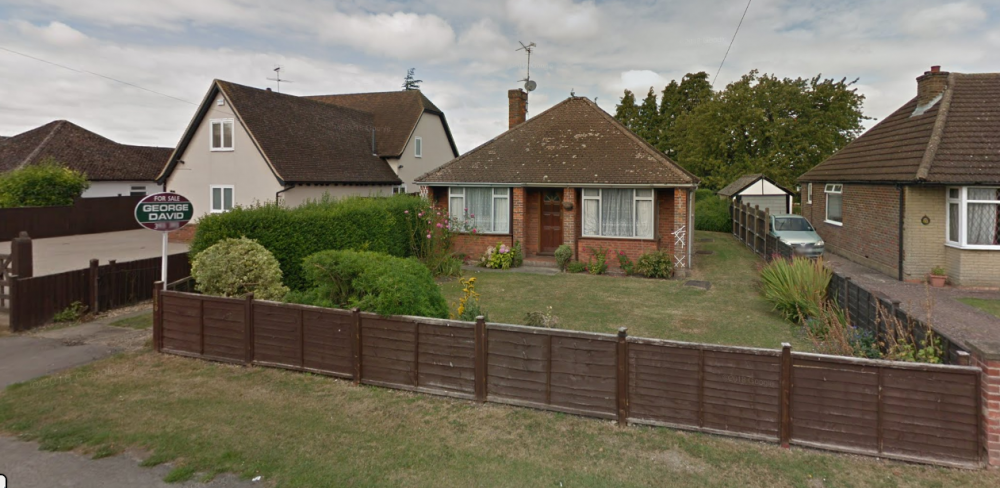
The one in the picture is the neighbours - it's a 15 year old Potton kit. We're hoping to do this one, budget permitting: Fairly small house, huge plot (1/4 acre) right on the edge of the London green belt, awful 1970s extension on the back and pretty much everything inside (kitchen, bathroom, plumbing, heating, etc.) is a bit elderly and needing work. Could easily spend £50k just getting everything working properly! The original plan was to refurbish and extend upwards, but we had to drop that when the prices came back as more than new build, and at the time we didn't have the budget to rebuild. We may have had a lucky escape on that - a very similar house across the road had to be demolished and rebuild when they tried to do it and found it essentially didn't have any foundations - bit of a problem on clay with a high water table! I **think** we probably have the budget to do this now, but having been quite badly burned last time I'm planning everything I want to do (up to and including designing/specifying what I want to do) and costing it out before we start getting professionals involved and actually spending money on it.
-
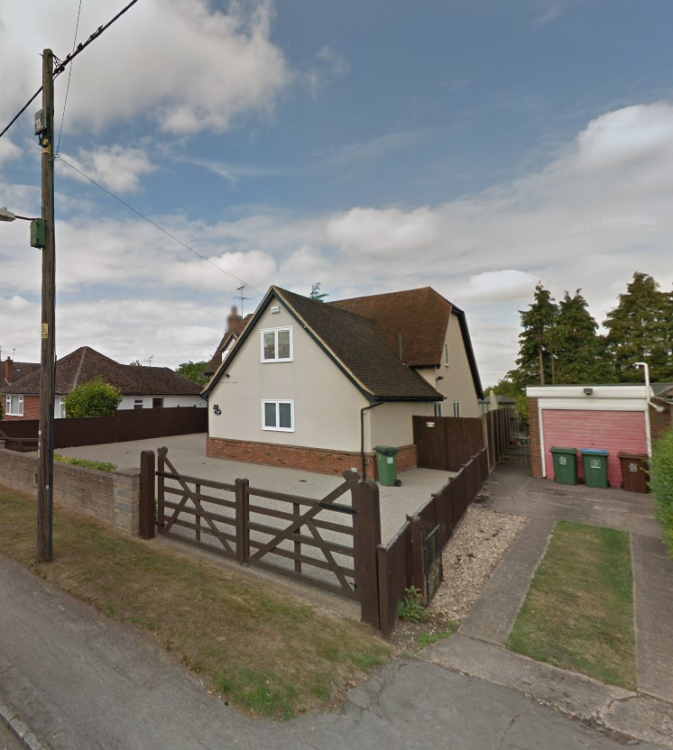
Likely to be a year or two, but it's hard not to see 3 phase making sense given it's all of 4m from the edge of my driveway. 3 phase inverter would pay for itself in no time - Sunny Design reckons it would be a couple of MWh extra exported per year without the 3.9kW limit, and the export limiting kit is something else to wire up and go wrong. There really isn't a lot of price difference between inverter brands, so it makes sense to get a decent one. The other side of things is that we're definitely going to be a 2-car family for a long time to come, and that means we'll have 2 electric cars to charge. 3-phase gives us one phase for each car and another for the house, which should help a lot when time-of-use tariffs become much more common in future. Edit: pink garage on the right is where my electricity meter is at the moment.
-
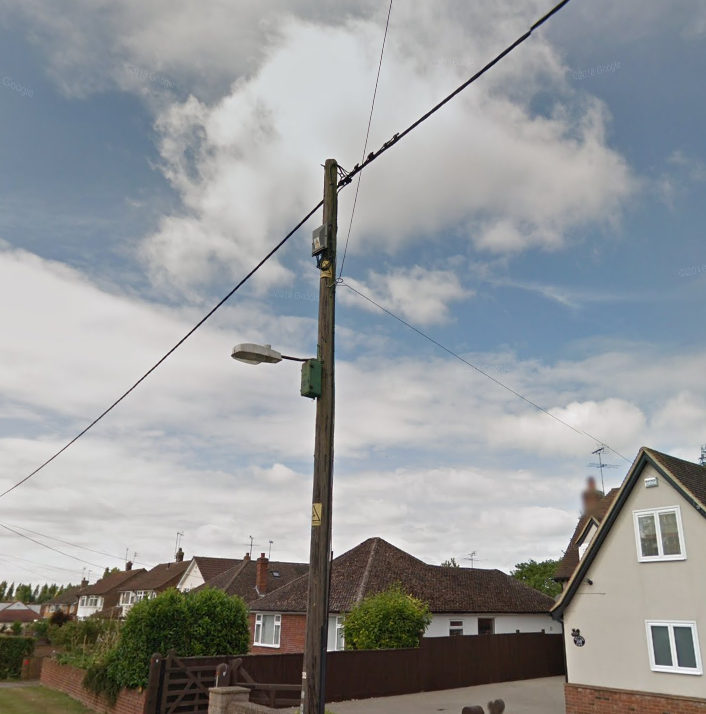
Street view image of the pole in question...
-
I **think** it's twisted (will take a detailed look tomorrow), but I don't know if they wrap single phase (L+N) around a steel supporting wire at all. Helpfully the pole only says "this is an electricity pole"! There is certainly only one wire or bundle of wires on it.
-
LV line running down the street providing power to the ~120 or so houses on the street. I'll take some photos tomorrow morning when there's a bit more light.
-
My electricity supply comes in via an overhead wire, with the pole in verge in front of the house next door where it goes underground for the final few meters. Is there any way of telling whether the overhead wires themselves are 3 phase or single phase without asking the DNO? I've been mocking up the house we want and working out how big a PV array I could potentially fit, and how cheap it would be (Midsummer are quoting £4200 for the bits for a 10kw in-roof system), and am suddenly coveting a 3-phase connection. Since I'd have to move the connection anyway (it comes up through the current floor slab), I'm suddenly very curious.
-
I've suddenly realised where you are. I used to head up the back to Chanctonbury Ring all the time when I lived down there, and there always seemed to be a Piper Cub in WW2 markings hanging about when I went past.
-
My understanding is that the floor/wall junction is the main problem area, and putting on a parge coat would presumably be tricky around there. That, and my understanding is the parge coat needs to go on before the services or they'll be the source of even more leaks. It clearly works, it just seems really complicated and I'm trying to understand why they don't do it differently.
-
Well yeah. The point is that there appears to be nothing wrong with putting a render airtightness barrier on the outside of the blockwork but inside the insulation. Thermally, that's the same as what I'm suggesting above, with the difference being the outer leaf which is effectively a very thick render layer (even the wall ties are replicated with the EWI fixing bolts).
-
From what I've read, it appears that the normal way of doing airtightness in a cavity wall Passivhaus is to use wet plaster on the inside of the inner leaf. This makes sense (you want the airtightness barrier to be on the warm side of the insulation, so it needs to be part of the inner leaf), but one thing that is really bugging me is why they don't do it on the outside of the inner leaf as is done with externally insulated solid walls. It means an additional process, but that should be outweighed by the fact that the airtightness layer is much less exposed to damage and there are far fewer details to worry about (wall/floor junctions, etc.). What am I missing? Is it just that 100mm blocks aren't stable enough to support the roof, etc. sufficient to air seal everything without the outer leaf in place?
-
Even the big, high quality ones are getting cheaper - was recently quoted £300k for a SLA unit capable of printing parts up to almost 1m3. Prices are going down by ~10% per year at the moment.
-
Apologies for the delay in replying - I got hit with a combination of a dead motherboard, crazy busy-ness at work and my eldest starting school all at the same time. I have, and am not at all convinced that it's a significantly better way to go - costs seem to scale fairly linearly with the amount of work involved. PH requires a lot of detailed design and quality assurance, and that puts up the price - but from bitter experience I know it doesn't necessarily save anything in the long run. We're in a nasty corner of circumstances which make all of the alternatives that bit harder: We're on a plot ~15m x 50m, with the south facing side being the short one facing the road at the front and houses right up against the boundary on either side. The current building is L-shaped, but anything not on the front or the back tends to get awfully dark for much of the year. That means the final building really needs to be a rectangle across the width of the plot - so any side extensions would need planning not PD as I understand it. Prices appear to have gone up significantly (~10%) in the past year, most likely Brexit-related. Housing associations are apparently talking about bringing in projects at no less than £1,800/m2 - so less than £2,000/m2 is feasible for a bigger house but the 10% price increase translates to a smaller house on a fixed budget. We're right on the point of very nearly but not quite working - and that budget includes everything, with no contingency. Kitchens, bathrooms, etc. we can certainly save a bit on, beyond that we're very time limited. We've got two young kids (2 and 4), both work - I'm in a fairly high pressure job and likely to go up a grade soon, my wife is less so but I know from experience on the renovation we did to our last house that she'll offer to do something and it won't happen. We're in a nice part of the world on the outer edge of the London commuter zone - which will push the cost of everything up a bit. Nope, fees are broken out separately. This is actually the architect saying "I don't think you can afford to do what you want, so I don't think you should pay me to start working on the design". It's mostly based on the total spend for a number of similar projects that they've run locally - all of them came in quite a bit over this, and they've shared with me the rough cost breakdown and reasons why. I think he's being as open as he can with me about likely costs given what we want to do.
-
It's turning into a bit of a headache: Plan A was to extent and refurbish. It's possible to do, but by the time we did everything we wanted there was very little left of the original structure. Worse, any refurbishment attracts VAT at 20% while a knock down and rebuild doesn't. Essentially if you're trying to refit to a high standard there is a strong possibility that it will be cheaper to knock down and rebuild than to refurbish. Plan B was to knock down and refurbish. That's the current problem - the architects (who have build a number of Passivhauses locally) are of the view that we should be budgeting at £2,000/m2 of internal floor area given that we aren't able to do much of the work or project manage ourselves. That's a mix of things - prices going up 10% in the past year, the fact that we're in easy commuting distance from London, there is an existing structure to demolish, etc. We can afford a reasonably sized house that meets our needs OK, but which is really a bit on the small size for the plot which will hurt the resale value - if we were going to stay there forever that wouldn't be a concern, but there is a strong possibility we will want to move. That means we need to maximise the ratio of cost to resale value - and so need to push for a bigger house than we can really afford right now. Plan C doesn't exist yet!
-
It’ll take a minor hit - glycol is a bit more viscous so the circulating pump has to work harder, and the heat capacity is a little lower which will push the flow temperature up marginally and so the COP down. The impact will be very small though - a couple of percent I’d guess.
-
This thread has got me thinking about a problem of my own. Some way before the bottom of our garden we have a selection of rather large and somewhat ugly Leylandii, courtesy of the previous owners. There are some smaller trees beyond them (2 very mature apple trees, one that I think is probably hazel, a plum tree and some mixed shrubs), but realistically if we take them down we'll want replace them with something else to largely block out the sight of the houses at the back. Essentially I'd like to thicken up the existing block of deciduous trees at the back rather than just create a screen from scratch. I don't think we need evergreens as the garden isn't likely to be used much in winter and the plot is fairly large (200ft x 50ft) with the house towards the other end of it, so the overlooking isn't serious. We're also likely to be here for a while so can afford to plant smaller trees that will take a few years to become established. Ideal ultimate height would be about 5-6m - enough to fully block out the view of the houses but no more: that view is almost directly north and the fruit trees are currently suffering quite badly from shading. Ideas so far are: Half-standard cherry tree (flowers, wildlife and eating) Half standard pear tree (flowers and eating) Magnolia (flowers) Mountain Laurel (flowers) Lilac (flowers) Rowan (berries, leaves, height without overshading fruit trees behind) Any other suggestions? I figure we probably want 3-4 trees to fill up the gap.
-
Provided that the rate of change in slab temperature is slow enough, all the time constants are known and you can accurately measure average slab temperature, that should have worked fine. As TerryE notes, however, the building time constants are really long and the temperature you need isn't the current one but the average over the past 18-24 hours or so - if the flow temperatures are relatively high giving a fast responding slab coupled to a control system responding to current outside temperatures, you're going to end up with the thermal equivalent of a pilot-induced oscillation. My belief is that the critical change was in reducing the flow temperature - a shift from say 35°C to 25°C flow should cut the overshoot for a thermostat set to 20°C by a factor of 3. Realistically going much lower than 24-25°C will be quite difficult in that the pipes might not be able to deliver enough heat on a very cold day. The next improvement would probably be in reducing pipe spacings a bit - this should help reduce the average difference between concrete and water temperature, and so mean that room temperature rises slightly earlier. That would potentially let the thermostat catch things before as much energy had gone into the slab, reducing overshoot (I think - that one needs a bit more thought). It almost self-regulates: the heat moving from slab to room is a function of the difference in temperature between the two. Going by @TerryE's experience, at 1 degree temperature difference this is 7W/m2. A 50% increase in losses would only cause a shift in temperature of 0.5°C. In a well-insulated house that's mostly acceptable - I'd be fine with it, others (including my wife) probably would not. The one problem to be aware of (as @JSHarris found) is that measuring the slab temperature directly and then controlling it is quite hard. Because the slab temperature has such a strong influence on the air temperature in a well insulated house, however, you can get the same effect by just using a conventional thermostat. In both cases you're effectively controlling the slab temperature because that's what you're putting heat into - it's just that measuring air temperature is a lot easier and makes it less work to calibrate the comfort level you want as it can be set directly rather than via a couple of heat transfer coefficients.
-
Apologies, it's been a long week and I have a head full of cotton wool at the moment so I'm not expressing myself clearly. As I understand it, heat pump driven systems have constraints that your Willis Heater system does not - notably a minimum flow temperature (typically 25°C) below which they cannot add heat. For efficiency (Carnot) reasons, I want to operate any system at this minimum flow temperature for as much time as possible - ideally designing it such that the design 10 W/m2 heat load can be provided by a unit running full time at 25°C. Most heat pumps have their own circulating pump built in - using this rather than an external pump, combined with the use of the heat pump for flow temperature control will give the simplest plumbing design available with a heat pump. As a matter of policy, I want to use absolutely standard OEM control systems only to provide heating and hot water - I appreciate that a homebrew system would probably be quite a bit better, but I simply don't have the time or energy to implement one nor do I want to deal with having to try to fix it remotely if there is a problem while I'm away from home. I'm happy to be more creative with Smart Grid controls, but with those the only impact would be a small increase in the electricity bill rather than any comfort effects, so no time constraints apply. Because I have a mechanical engineering background, I want to use parameters like pipe spacing and flow temperature to provide the majority of the control, with the residual being provided by a simple temperature switch (thermostat). When designing a mechanical system you typically aim to minimise the amount of control it requires, and to simplify the control system as far as possible - mostly because control systems are horrifically unreliable compared to purely mechanical systems. While this isn't a genuine problem in most domestic cases, I'm going to be seriously uncomfortable taking any other approach. I didn't realise your house time constant exceeds 24 hours - that makes using actual data a lot more feasible. You're still vulnerable to changes in internal heat generation however - your predictions are based on standard internal gains plus predicted external losses based on the temperature seen the day before. OK, it's overwhelmingly likely to be a "too hot" problem which the MVHR can handle, but it's too heavily driven by the requirement for E7 for me to be happy with.
-
I'm not that good at fiddling with the mesh, so I'd be constrained to an (r, θ, x, t) space anyway. Absolutely it could be done (and certainly would be if you were doing it yourself), but I'm not sure how well supported it is in commercial packages where it wouldn't be something they would look at a lot. At which point you really come back to not controlling anything - if you're fixed to 100m loops and a given floor area, then the only control you have is from picking the centres. Realistically that's going to be from a fairly limited menu anyway as you want to try to keep the loop length fairly close to 100m in order to ensure the time constant isn't too short. Instinctively the timescales should be fine and nothing should fight, but I'm always a lot happier when I have a realistic model, and only ever comfortable when I have proper, validated test data (not the same as experience or playing around with something for a few days to test it, unfortunately).
-
https://www.vcharge-energy.com It's a tool that lets them turn on loads remotely in order to shift demand around in time, balancing loads on the grid a bit better.
-
http://www.c60design.co.uk/many-cats-take-heat-passive-house/ "In summary then, cats are expensive and wasteful"
-
A seated or sleeping person is worth about 100W. That many people is probably a third of the heating you would require on a design low temperature day!
-
Because they're cheap and it isn't my main job, I've only got a fairly slow laptop to run Ansys on so anything normally requiring 10 hours will run out of memory and crash long before it gets to a solution. The model I've run previously - basically a 150mm by 150mm section of floor using symmetry between pipes and a zero heat transfer condition at all edges except the top - would probably be quite amenable to looking at over time, and runs pretty fast. Because it's meshed anyway, there really isn't a lot of benefit to assuming radial symmetry - the software would just create a circular rather than rectangular mesh. One thing this might be useful for is working out what the minimum and maximum pipe spacing is - if you put too much pipe in, then depending on the flow rate of the circulating pump you might have short cycling issues, while with too little you won't be able to provide sufficient heat at a low flow temperature. Absolutely. In any case, the buffer tank in most cases is there to smooth out oscillations/short cycling from the TMV, rather than the tank - and the TMV is there mostly because combustion systems can't regulate water temperatures down low enough not to get chronic temperature overshoot in most normal houses, let alone a properly insulated one. Fit an appropriately sized ASHP with the flow temperature turned all the way down, however, and all those problems go away. The amount of heat it can put in is limited so the reaction time will be quite slow, but because the slab itself has such a high inertia that will happen whatever you do. More importantly, you can't get the air in the house above the flow temperature without breaking the zeroth law - and the T4 relationship in radiative heat transfer will keep average slab temperature and perceived air temperature (itself heavily influenced by radiative heat transfer) very close together. That's the one area I dislike your system - in the 3-4 month time section essentially it relies on guessing about right what the weather will be like tomorrow, over-warming the slab slightly and dumping any excess heat through the ventilation system. It clearly works well - unsurprising given the long time constant of the structure and slab plus the ability of the ventilation system to dump heat from the air - but it's fundamentally inelegant to my mind. I would far rather use a standard air thermostat to call for heat, and the fact that an inverter-driven pump will have a maximum return temperature above which it can't maintain minimum output power to turn it off again. By the time it is allowed to run again, the room temperature should have risen and the system stabilised. The one weakness in this system is that there are two or three interlocking time constants - that of the slab warming up and warming the air, that of the return water warming up and tripping the heat pump, and the anti-short-cycling mode in the pump. Provided that the air warms faster than the water plus short-cycling requirement, it should work very nicely. Kids are currently 2 & 4 plus hate bathtime, so at the moment hot water demand is very low. That'll change when they become teenagers, however - assuming we're still here. I'm not interested in using a buffer tank for preheating however - far simpler just to have a big hot water tank like @Stones used plus a shower heat exchanger. Mark/Space ratio would be driven by the thermostat, assuming the time constants match up which I think is probable but I'm not quite sure how to model. Essentially this is staying in your December/January/February mode all year round. Given how fast PV prices are dropping, we're almost certain to have a lot of it. That makes using the smart grid functionality in most heat pumps a no brainer - when PV is available, heat water first and when the tank is full turn the thermostat up by a degree. That's unlikely to be a comfort problem, and the long time constant means that no further (paid for) heating will be needed for quite a while afterwards. My current thinking is to use whatever thermostat is packaged with the heat pump I end up with - I don't have a problem with temperature varying by a degree or so, so don't feel the need to go for super-accurate or low hysteresis temperature measurement. Agreed. The Passivhaus evangelicals talk about night venting being the solution to everything, but every year for a few days you'll have a period where it's 30°C inside and out for days on end. Treating it as a system an ASHP appears to me to be the most cost-effective way of providing this cooling since it can also provide heating and hot water very cheaply too. Yes. As you will have noticed I'm not at all a big fan of lots of glass (driven by the 15 kWh/m2/year requirement, largely). In our particular case the SE elevation at the front faces onto a busy road, while the NW elevation at the back faces onto a rather nice large garden. That means I want the house biased towards the garden, and don't want too much south facing glass. That supports my instinct that the 10 W/m2 condition is a more appropriate one anyway in most cases - I get the feeling the use of lots of glass for heating in the shoulder seasons is a hangover from before heat pumps were readily available and people had to use gas or electric resistance for heat, in which case hitting the primary energy targets was almost impossible without a lot of glass for additional heating. It isn't needed any more, but when you start thinking in terms of a particular design solution it's very hard to shift out of it to another one.
-
Yeah, it's pretty non-linear - fortunately I have an ANSYS license at work (quite a lot of what I do is thermdynamics and heat transfer, albeit at very high power densities), which is pretty much designed for exactly this problem so modelling it is actually pretty easy, at least in a steady-state condition which is what you care about for the design worst-case sizing condition. That isn't important with a Willis heater since you're power limited only and want to run on E7, but with an ASHP it's rather more important. If I'm understanding things correctly, you essentially control your heating by putting a fixed power in and turning it off when the return temperature rises to a value you've empirically found to be a good match for your desired comfort levels. What I'm contemplating is very similar indeed - running a small ASHP with the flow temperature turned down as low as I can, turning it on when the room temperature drops and relying on the return water thermostat to turn it off when the dT starts to drop off as the concrete starts warming up. That isn't going to lead to short-cycling - in your case the ASHP would be running for at least 2 hours at a time - and allows me to make use of the fact that the floor temperature will be very close to the desired air temperature to control overshoot extremely well, particularly if it is nearly purely radiative at which point the T4 term will really have a huge impact on power .vs. temperature. That, and running at very low flow temperatures has a major positive impact on power consumption - throw in the use of the SG Ready terminals to turn up the thermostat when PV is available and I think I could get the imported power values very low indeed.
-
Hang on a second, is that floor temperature or flow temperature? Floor temperature would make sense, flow temperature disagrees rather violently with several sources (e.g. this one from John Guest). That has a 40/30°C tiled/screeded floor (i.e. 15°C dT between water average and air) providing 60 W/m2, i.e. just over 4 W/m2.K: switching to carpet gives you about 50% of that heat output.