

ProDave
-
Posts
30862 -
Joined
-
Last visited
-
Days Won
427
Everything posted by ProDave
-

3-Phase - Connecting to Caravan...
ProDave replied to Mulberry View's topic in General Self Build & DIY Discussion
You will need a switch fuse to connect to the caravan, you need one with a metal enclosure to take the gland of the SWA cable. Terminate the SWA at the supply end but at the caravan end, insulate and do not connect the SWA (use a large plastic stuffing gland) and connect the caravan to a TT earth. Get a door on that cubicle, the meter and it's connections are not waterproof and it would not surprise me if BG refuse to connect a meter without a door on the cubicle. -
The "plug" next to the tap is not blocking the pipe, it's the thing you would unscrew if you (or the water company) was fitting a water meter. Turn the blue handle 90 degrees from it's present position and water should flow. If not it is not a live connection yet.
-
The issue with the ac side is volt RISE. Because the inverter is feeding in to the house loads, the voltage at the garage CU will RISE as generation increases. If it gets as high as 253V most inverters will shut off. It all depends what your mains voltage is normally. It will probably be okay but you won't know until you try it.
-
Which is why most people that bother about making a house air tight, also fit MVHR to give controlled air in and out with heat recovery. In fact if the air test is under a certain number, building control here insist on mvhr.
-
Re "sticky tape" Where I could, e,g, where the tape was just joining adjacent strips or air tight membrane, I screwed ripped strips of OSB over the taped joint, to mechanically hold it together in the vain hope of preventing the taped joints opening over time. Also I use the Barriar air tight membrane which comes with a tape built in which is supposed to seal overlaps, but because I did not board straight away, I fortunately found the built in tape was useless and started to open up so I gave it a layer of Tescon tape as well. Had I fitted the Barriar using it's own tape and boarded straight away I would not have know the tape was failing until the air tight test and then it would be a bit late. I am surprised the air tight test blew the water out of a shower trap. It is only supposed to pump up to 50Pa which is only a few mm, way lower than even the shallowest shower trap. But that is a well known problem when doing a drain pressure test, I could not get above 75mm before it just blew bubbles though the traps. I did however have to make some temporary wedges to keep the lift out buckets in the 2 shower trays down in place for the drain pressure test.
-
Straight bond v staggered Bond on roof
ProDave replied to richie9648's topic in Roofing, Tiling & Slating
They will look shite straight, they need to be staggered to look correct. -
Don't you normally fit a cooker hood without the glass, and the very last thing you do is lift the glass into place?
-
How to keep a toilet roll dry in a wet room?
ProDave replied to Adsibob's topic in Bathrooms, Ensuites & Wetrooms
We have folding glass screens to keep most of the water in the shower area. They don't need to be full height and don't need to go all the way to and seal to the floor, so we bought off the shelf folding screens intended to go on a bath, and set them about 100mm above the floor. Very little water escapes past them. In our case it was to keep a wooden unit where the towels are stored from getting wet. -
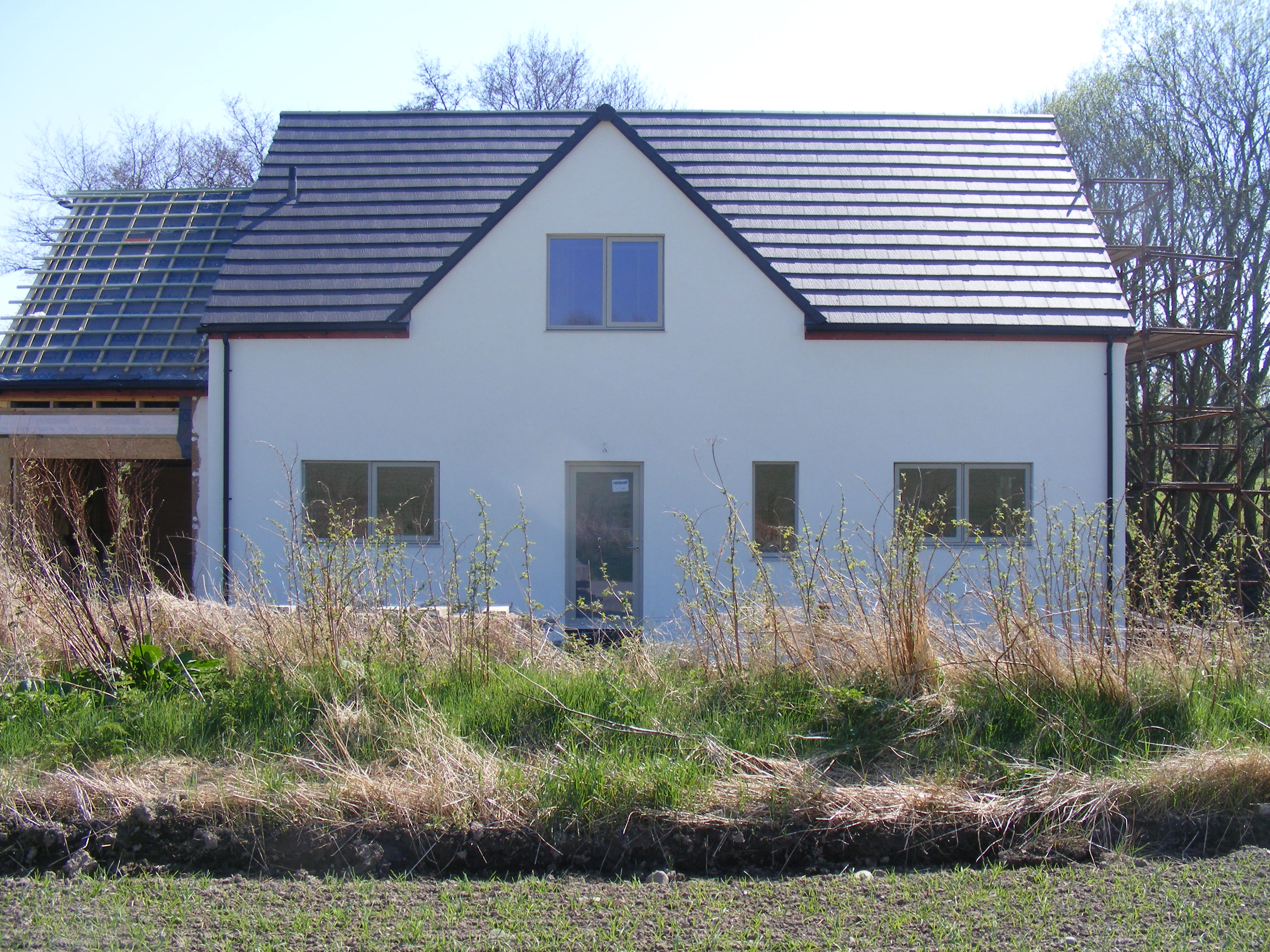
The decrement delay of our house is over 13 hours and it provides a very stable internal temperature, it does not heat up or cool down quickly. To some extent, our layout is modelled on the traditional highland "croft house" being quite wide but not very deep front door in the middle, stairs in the middle and rooms either side of the stairs on both floors. It suited the site, wide but not very deep, and was in character with it's surroundings. None of the rooms have massive windows, again in keeping with the style, except for our sun room that is the glass box.
-
The Highlands is a good choice of location, it is also a very large area so plenty to choose from. And it has the advantage over other parts of the UK that building plots are usually for sale and at sensible prices. As to choosing the layout, that is often led by the plot, i.e. shape, orientation, views, neighbours, etc etc so I would not get too far down the line of designing a house before the plot, but it is certainly worth getting some ideas. Do lots of reading on here, thicken up your skin (you will need it) and get working on your sense of humour.
-
It is usually a function of the ASHP that it sets the temperature of hot water or heating separately. Unlike a system boiler, they usually only heat one at a time. The detail of exactly how they work varies from one make to another. But mine for instance you set the on and off times of heating and hot water and the water temperature for each. The heat pump decides what to do when both are demanding heat at the same time, in my case I have it set for hot water priority, so when the tank needs some heat, it stops heating the house. In a well insulated house you won't notice that pause in space heating while it heats the hot water tank. Don't over think it. Buy an ASHP and read the manual or if you have specific requirements we can help you choose, i am pretty sure just about every make of heat pump is in use by someone on the forum.
-
That bit got my eye. WHY would you put the DHW tank so far away? You are going to have stupidly long hot water runs, you will need a hot water circulating system which will have heat losses or it will be unworkable. You want the HW tank in the house as close to the points of use as possible. Distance to HP is not as bad but you will still have losses in the pipes. Is the system actually working properly? Are you thinking of a buffer because someone on the internet says you need one? Or to solve an issue you are having?
-
Problems with Baumit.com thin coat render system - part 3.
ProDave replied to ProDave's topic in Plastering & Rendering
The top coat comes pre mixed in tubs. you just give it a mix up and spread it on. On the original application, the quantity was bought based on advised coverage by the manufacturer, and I think we had 1 tub left over, so pretty close to the mark. -
Might be worth getting a plumber to pressure test the drains to find problems like that. I wonder how many houses actually get a proper drain pressure test?
-
Eaves Storage Drawers - Structural Question
ProDave replied to Ramaya's topic in Lofts, Dormers & Loft Conversions
The upright timbers forming the dwarf wall are non structural. All the other angled timbers are part of the roof trusses and must not be touched. You could make drawers that slide into each section between the trusses without disturbing those. BUT before you embark upon this, you are talking of incorporating what is presently a cold area, into the room. So you must first move your insulated envelope outwards to ensure the new storage space is now part of the insulated room space.- 2 replies
-
- 1
-

-
- eaves
- eaves storage
- (and 4 more)
-
So it is not working. Call your installer to come and fix it.
-
Belfast sink - joining old waste to new 40mm trap and pipe
ProDave replied to Oxbow16's topic in General Plumbing
Thanks for posting that. The old saying "every day is a school day" is so true, I had not seen that fitting before and it seems to have solved your issue, so duly filed away in memory for future use. (no guarantee I will be able to recall the memory when I need to though) -
Turn the thermal mixing valve (on the right below the pump) down, until the thermometer reads the temperature you want. The thermometer is much more accurate than the dial on the mixing valve.
-
Problems with Baumit.com thin coat render system - part 3.
ProDave replied to ProDave's topic in Plastering & Rendering
Yes I am becoming resigned to at some point having to re think the cladding, but that is going to be a painful and expensive decision. And just what is different with a thin coat render system applied to a render board? How will that be totally waterproof so rain cannot get in and freeze and blow it? If such a render applied to a render board can be resilient to wind driven rain and freezing, why can't a render applied to wood fibre be so as well? Just one little more to this trying to understand it. My opening post showed how the front wall after being lashed with a lot of wind driven rain followed by freezing temperatures appeared to bulge in a few places suggesting water had got in, frozen and expanded. Well following that it thawed, we had a few mild and dry days and now we are into the second day of sub zero temperatures, it's not been above 0 today, the wall is covered in a nice layer of frost but there are no sign of bulges. So further speculation: Water got in with the wind driven rain and when it froze it expanded. A few mild days has dried it out and there is no longer significant moisture there to expand when frozen. If, and again it is if my speculation is true, then it would tend to favour rain ingress as the problem rather than moisture from within? -
Problems with Baumit.com thin coat render system - part 3.
ProDave replied to ProDave's topic in Plastering & Rendering
Yes that's the whole point, the BBA certificate described this particular render applied directly to wood fibre EWI. I believe this was the only render product approved for this so it's not as though we could try K rend as an alternative. -
Well done, always nice to leave the 'van behind.
-
Problems with Baumit.com thin coat render system - part 3.
ProDave replied to ProDave's topic in Plastering & Rendering
We are not West Scotland, we are 20miles north of Inverness, closer to the East coast / Black Isle. I did see an exposure rating written down somewhere I will see if I can find it. -
I would definitely say fit MVHR. Apart from the energy saving aspect by ventiliating your house with little heat loss, it's other big advantage is the air is always fresh and stale smelly air constantly removed from kitchens and bathrooms. the house never smells or feels stuffy and never has problems with condensation. I would say in your case it is a must have.
-
Semi-final plans --- feedback/critique welcome!
ProDave replied to RK6's topic in New House & Self Build Design
What's the reason for the driveway going up a hill, round the top and back down again? It would be a lot easier to turn right and straight round the bottom where it is nearly all level to the garage before excavations? -
Well done. Advise the owner to give them a good scrub before use.

