


ProDave
-
Posts
30862 -
Joined
-
Last visited
-
Days Won
427
Everything posted by ProDave
-
This has got me thinking. Our ASHP uses 1500kWh of electricity each year heating the house. so guess a COP of 3 that's 4500kWh of heat. With Kerosene at 10.35kWh per litre, that's 434 litres per year. Round that up to 500 litres for boiler efficiency. Our old house had a 2500L tank. So I would only have to buy fuel every 5 years and that would give a LOT of scope for watching the price and buying when it's cheap.
-
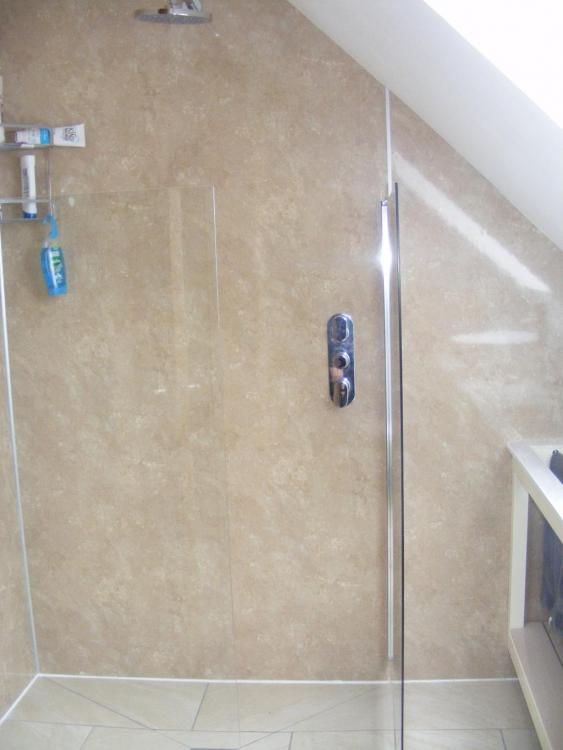
We wanted hinged shower screens so when not in use they can fold flat against the wall so leave the space open. They are really only there to stop water splashing on the wall unit that is used for towel storage. the only options seemed to be buy some made to measure glass and some hinges and make your own, or we chose cheap off the shelf shower screens intended to go over a bath. So they are not very tall. I set them 100mm above the floor and the top is head height. So some water will go over and some will go under, but that does not matter, the whole room is a tanked wet room. What goes under or over does not go very far and there is not very much of it, and you just sweep it down the drain with a squeegee when done.
-

Inspection chamber at change of direction of drain
ProDave replied to Helen2's topic in Waste & Sewerage
You definitely need a chamber at change of direction for foul drains, but this is rainwater? Our BC was completely disinterested in rainwater drains and we have multiple joints and branches without chambers. -
I have the same tray and have glass screens at the edges of the shower tray that do NOT touch the ground. A small amount of water will splash under or over the screen and just sit there in the flat bit until you have finished. A quick sweep around with a squeegee on a pole sweeps all the water away. Don't over think it.
-
I have a typical 4kWp / 3.68kW PV system and I can self use most of it without batteries. It offsets roughly 1/3 of our electricity usage. It might not help much with the heating in winter but it certainly helps a lot with DHW heating in the summer. Without the ASHP it would be harder to self use all our PV generation. What about standing charges / maintenance / rental costs of a bulk LPG tank?
-
The figures are close enough that I would choose ASHP just to save having to have a great big bulk LPG tank to accommodate somewhere in the garden. Anything you can do to improve insulation to bring that heat requirement down? Unless it is a big house, that seems high.
-
And most makes energise the motor to open, then switch a resistor or something similar to keep the motor energised at a lower power and stalled to keep it open. The mid position valves insert a diode in line and stall the motor with DC to hold the mid position. If the valve is inside the house that 3.6kWh per year of energy is not "wasted" but used to heat the house just a little.
-
What saw is it, where are you and how much would you want for it? If you have a lot of woodland is it not worth keeping it and installing a WBS?
-
You can remove the Honeywell, Tower and Danfoss actuators from the valve body without draining down. You can even buy new motors and many other parts for them. It is the microswitches that seem to be the weak link on Danfoss heads and they are not easy to change. A minor irritation is a while back Honeywell changed the physical interface between actuator and valve body. I found out embarrassingly when I tried to replace a failed actuator head to find it did not fit the old valve body.
-
From experience, Honeywell has been the most reliable, Danfoss the least. But regardless of which make you choose, 2 port valves and S plan are ALL infinitely more reliable than that utter bodge of the 3 port mid position valve and Y plan. THAT is what you want to avoid.
-
Yes standard fittings at each end of the pump. If you want quiet, first choice is Wilo, second choice is Grundfoss.
-
That looks just like the generic no name manifolds that I bought from ebay (for a lot less than that price). In what way has it gone wrong? Probably the pump failed? I changed the pumps on mine as those cheap ones were noisy, I now have the little Wilo pumps on mine.
-
Where is it leaking? A replacement does not need to be identical so the fact it is obsolete now does not matter.
-
I installed mine myself in the new build and all BC wanted to check was clearances to combustible materials and what the instruction manual said.
-
The only difference between Bruce (yes that really is his name) and Jock, is they tend to get all their rain in big storms in the wet season, and allow some to run off the roof to wash the bird s&!t off before allowing it to go into the tanks. Here we get a lot more light rain and more likely to get more roof muck in the water. I don't think they treat it, and it tastes good as far as I could tell and no ill effects. They collect from the house roof and several outbuildings and have 4 or 5 tanks.
-
I think the 5 minutes was a separate milestone at a different time. Even from near the start 20 second runs were normal. At some point they maintained containment for 5 minutes.
-
Each time I read this, I wonder how our relatives in Australia survive with Rainwater as their only source of water for everything * and how when we visit and drink the foul polluted liquid we don't even get a dodgy tummy * If the dry season goes on too long they can buy in a tanker of water to keep them going
-
I believe Jeremy hacked learned the communication protocol and set up his car charger to charge at a rate matching surplus PV generation.
-
I look forward to seeing your as built SAP derived EPC.
-
Working on different zones of an S-Plan
ProDave replied to CotswoldDoItUpper's topic in General Plumbing
NO, they will share a common connection to the return. If radiators are upstairs only a partial drain down will do. -
What's the issue? Help Please ?
ProDave replied to canalsiderenovation's topic in Air Source Heat Pumps (ASHP)
My PV diverter is home made based on an Arduino and programmed by me. The heater is controlled by a 934Mhz transmitter module in the diverter and a 934Mhz receiver and relay mounted at the heater. Both cheap Chinese modules from ebay. It is currently programmed to turn the 700W heater on when immersion divert reaches about 90% and to turn the heater off when immersion divert goes under about 10% so quite a big overlap, that those are figures I can experiment with, e.g. if I thought more space heating was beneficial I could make it turn the heater on sooner. A few other points. If I ever venture into battery storage, that will probably be via an addition to the Arduino system so the same processor with some additions to the software will determine when to charge and when to discharge the batteries. I don't turn on my ASHP DHW heating until 11AM on the basis by then there should be reasonable PV generation so more likely to help with productive self use of PV energy. As long as the HW tank is heated up the previous evening, there is still enough hot water for one morning shower and only one of us showers in the morning. On a general point, the ASHP uses about 2/3 the amount of electricity heating DHW as it does heating the house. My own PV diverter failed after about 2 years, the solid state relay failed. I suspect not enough heat sink compound so it may have overheated. I have also repaired a couple of commercial PV diverters, one in particular (I forget which make) I thought was very poorly made, it was in fact an interconnecting cable from the PCB to the SSR that had burned out. -
It will need a clear fireproof coating. I have seen it done before. I even saw one house with OSB as the finished wall surface and that passed BR with a coating.
-
The ones I know that have been used by people on this forum are BioPure, Conder, Graff and Vortex
-
My only suggestion is before you commit to this, look at the alternatives. I have witnessed one fail twice, once due to a failed motor and once due to a seized gearbox. On both occasions I firmly declined the job of fixing them. Absolutely horrible job in a horrible location to fix a mechanical fault like that. Instead take a good look at the treatment plants that work with a air blower to agitate the effluent. About all that can go wrong is the air blower can fail, and it is well away from the smelly stuff so simple to replace or service.
-
At a very minimum go around with a can of squirty foam and fill the gap between the blocks and the top of the insulation ALL the way around the building. It is this sort of detail that most builders seem completely oblivious to.


