Roundtuit
-
Posts
1280 -
Joined
-
Last visited
-
Days Won
2
Everything posted by Roundtuit
-
Yep, knocked one of those out in our first house. Then chased out the wall and rewired the plug socket to get it down to a sensible height...
-
Any chance it could be mud? I think masonry bees sometimes plug-up nest holes.
-
I sent a covering note with my vat reclaim explaining the different addresses on the invoices (old home, followed by rented place, followed by plot address). It wasn't queried, so I assume it's not an unusual occurrence. Re: best terms. I know I got some good discounts from my BM, because I was able to check them against what a small developer was paying, but I was still able to get better prices shopping around on many occasions. Don't assume that best terms means best market price 😉
-
I may be wrong, but I don't think that's going to help the smell issue is it? Might actually make it worse if you're ducting smell in to more rooms?
-
Probably best to get an accurate idea of the height difference in the first instance. I think I'd be allowing 10-12mm minimum for tiles and adhesive, plus whatever insulation board you use. As above; the way electricity prices are heading, I'd be looking for more bang for my buck.
-
Hmm... installed by HETAS installer, and signed off by BC. I think it's OK.
-
Straight on to tiles here, as per thr photo. BC never queried it.
-
I hope so, internally it's very similar to ours: brick outer skin, 50mm gap, beather membrane, 11mm osb, 140mm frame with 120mm pir, then VCL (airtight membrane), with 40mm of pir over the top, 25mm mm battens then plasterboard.
-
As above, how cool is the incoming air? If your mvhr is 80% efficient, at your current internal temperature (20c), incoming air should be around 16C.
-
Advice needed on PD and summerhouse build
Roundtuit replied to China21's topic in Introduce Yourself
I guess that depends on how you feel about the suggestion that you may be on the wrong side of planning law, and how comfortable you are with it being unresolved. Ignoring it wouldn't really work for me, but I can understand why some might take that route. -
Advice needed on PD and summerhouse build
Roundtuit replied to China21's topic in Introduce Yourself
It's worth checking the height of your raised decking is OK too. I think 300mm is the PD limit. If you're over that, you might want to think about building your ground level up a bit before you send a photo 😉 -
Advice needed on PD and summerhouse build
Roundtuit replied to China21's topic in Introduce Yourself
To me, it sounds like you're within permitted development. I assume no one from the planning department has been out to have a look? If not, I'd politely push back until they come out and prove otherwise. -
Building a Block Workshop - ADVICE NEEDED!
Roundtuit replied to stunotch's topic in General Self Build & DIY Discussion
I wouldn't worry too much about the joints tbh, but I'd put a slip membrane over the top of the insulation before the concrete. Isn't there some debate about a potential reaction between the foil and concrete if they're in direct contact? -
My guess would be that maybe some historical localised water ingress or leak has caused an area of rot and water staining. The 'rot' looks long gone and if everything is dry now, as above, patch it up and don't worry!
-
Looks like the kitchen needs twice the extract that the small bathroom needs, but I'm sure you'll be doing the maths!
-
I can only speak with reference to my install, but one size of ducting is used throughout. Most rooms have a single run of duct from the manifold to either a supply or extract vent but in bigger (or wetter) rooms with a greater feed or extract requirement, two runs of ducting are used to get enough air flow. Adjustable vents are then used to throttle-back the flow at each outlet to balance the system.
-
I'm no plumber, but I think your rising main is best coming up into the plant room, then run everything else internally in the ceiling, dropping down the wall to sinks etc as required.
-
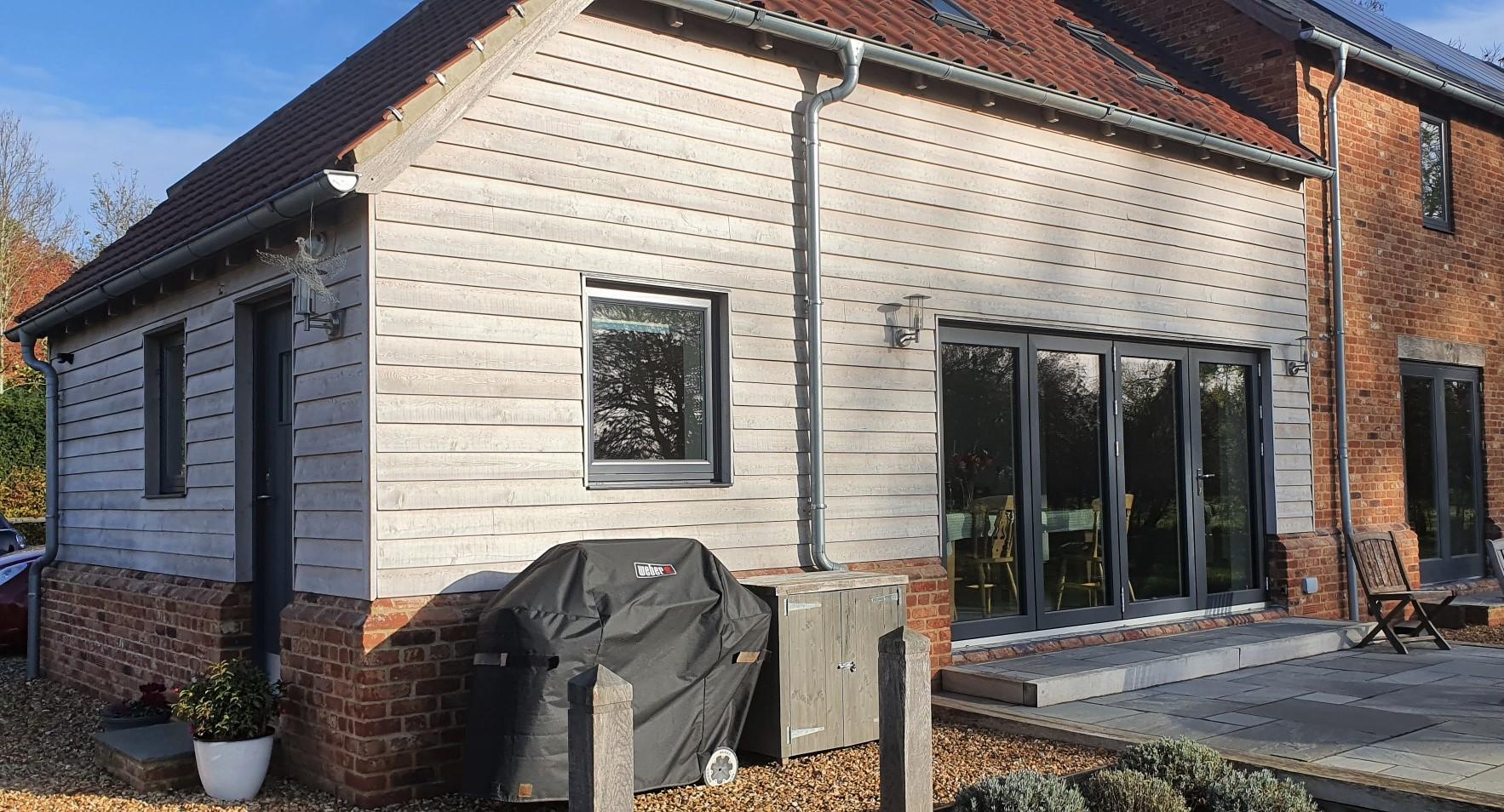
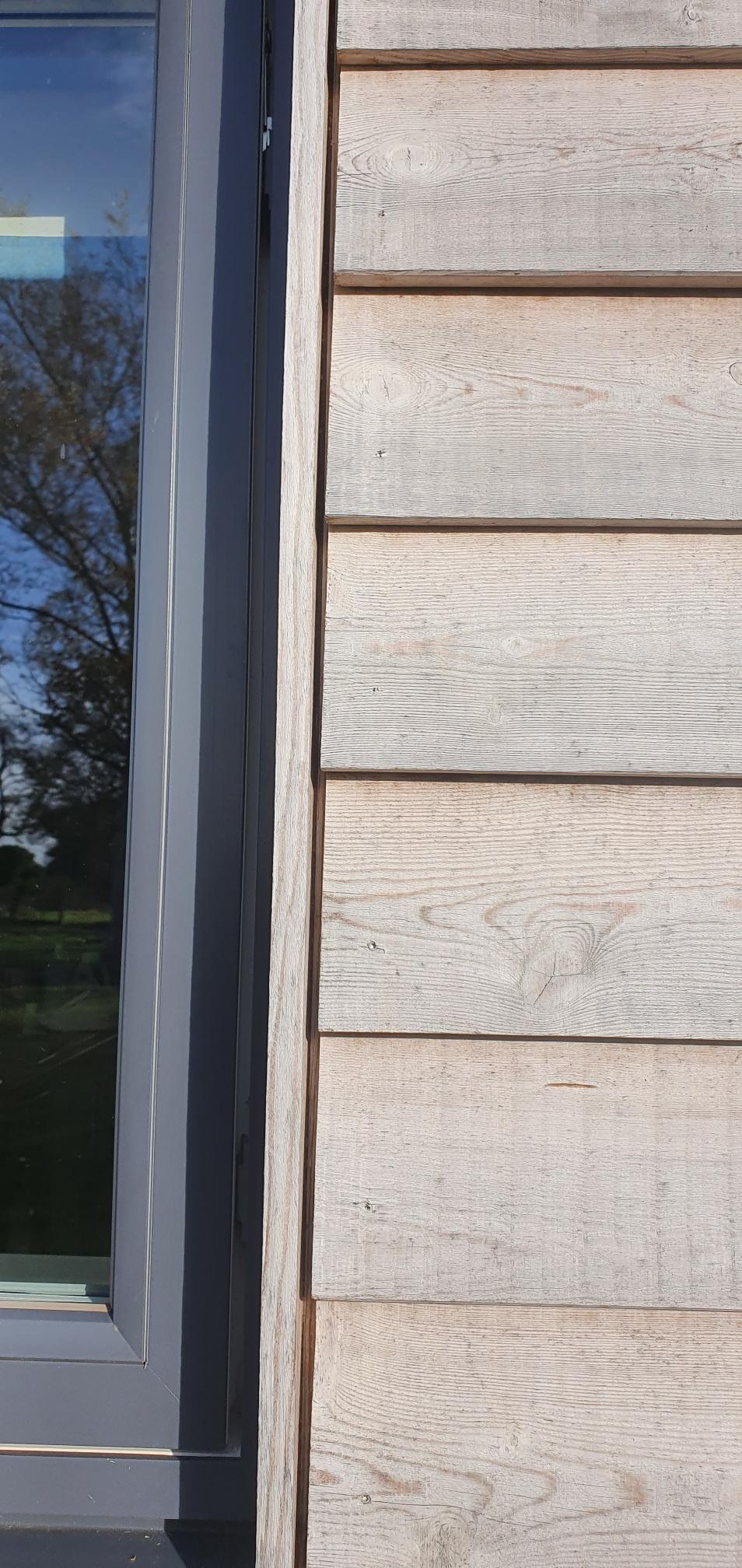
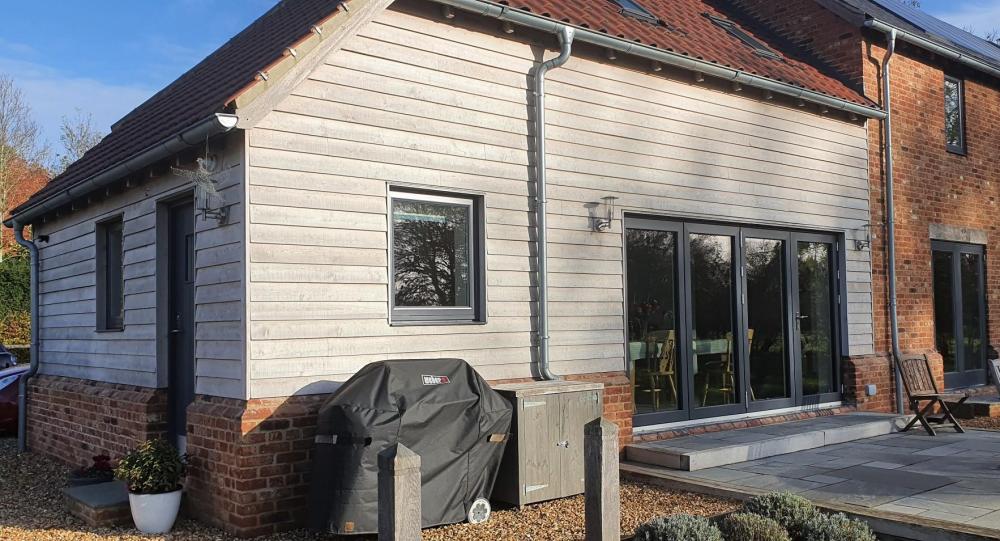
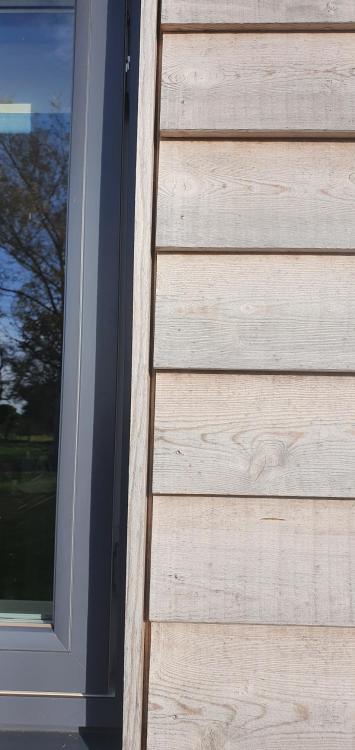
Siberian larch treated with Sioo-X sprayed and brushed in. There's a couple of details I'd do differently if doing it again. I've used lead flashing over the top of the windows, lapped up onder the cladding; a proper aluminium pressing would be better, like the ones you linked to. I did the cladding a couple of years before I got round to fitting cills, so fitted the cills between the cladding reveals. I should really have taken the reveals off and fitted over the top of the cill.
-
If you haven't already, spend some time on the websites of mvhr suppliers (eg BPC) and see what kit is commercially easily available; there's a lot of useful info out there. Ducting comes in standard sizes, so you only need to establish whether you need 1 run or 2 to each vent.
-
Yes. I'd definitely do it to stop moisture getting trapped. I thought 8mm looked too much, so compromised with 5mm.
-
To be honest, I don't think there's any point worrying about it now. Sounds like a few months isn't going to make a difference to the condition; I'd wait until the roof is sorted.
-
Top pic is a nice roof with bonnet hip tiles. Bottom pic is concrete tiles; a cheaper replacement perhaps. Why do you need a new roof? Looks in reasonable order from the outside.
-
Front door patio building regs
Roundtuit replied to Gerhardt's topic in Landscaping, Decking & Patios
You need a level threshold and disabled access at one door, but it doesn't have to be this one. I can't see BC objecting to your plan; it's effectively a big doorstep, under cover. -
I'm sure you can estimate ACH based on an airtightness strategy, but what you actually end up with depends on how well the strategy is implemented. It's all about attention to detail, and most trades struggle to get their heads round it. If you're on site every day and able to check every penetration and interface in your airtightness layer, spec good doors and windows and don't even consider open fire places/letter boxes/cat flaps, you'll be fine.
-
External air ventilation for log burner
Roundtuit replied to SBMS's topic in Energy Efficient & Sustainable Design Concepts
We've got a 'room sealed' wood burner for supplementary heating. The air supply is ducted in under the floor insulation. Cold bridge? In theory, yes, when it's not lit, there will be cold air passing through it, but nothing that is noticeable. Stuffy air? Nope. Mvhr does its thing, stove sucks what it needs from outdoors.