JohnMo
-
Posts
13292 -
Joined
-
Last visited
-
Days Won
200
Everything posted by JohnMo
-
Joy of England, we can't get the warrant until structural engineering is completed.
-
Isn't it defined in your structural calculations what you should be doing?
-
We are not in the Highlands, but have an IV postcode, and still supplier want to rip us off. eBay is as bad. But if they don't give me a good deal on delivery, I just look elsewhere.
-

Quote for plumbing supplies without itemised prices
JohnMo replied to faby's topic in Building Materials
Screwfix supply everything, check pricing with them. BM will be giving the plumber a discount, which they won't want to disclose to you. -
Long pipe runs mean, bigger pressure drops, which mean for a given flow rate the MVHR unit needs to work harder, so makes more noise. Consider 90mm if going semi flexible. You haven't mentioned what the piping is. There are several options. Semi flexible, comes with a plenum, this reduced cross talk between rooms, is easy to install. Other systems will require multiple attenuators/ silencers between rooms. If any quotes specify flexible duct, don't use them. High pressure drops, so not good.
-
Rega Vent MVHR Reviews
JohnMo replied to bob the builder 2's topic in Mechanical Ventilation with Heat Recovery (MVHR)
Triton HRV, made in UK, good range of sizes and specs, good technical support, spares readily available, passivhaus certified if you need it. -
Or use coanda effect supply valves to throw the air across the room. The air follows the ceiling for about 4 to 6m, then descends and comes back across the room and out the door.
-
Or use double sided tape to hold in place.
-
Wouldn't you just end up chasing your tail for ever, as things will change on a minute by minute basis. And still leak heat to atmosphere at its temperature? The better insulated the building the closer the OWT, will be to OAT and vise versa for poorly insulated. All confused if the sun is out.
-
The membrane is to stop the chemical reaction between the cement within the screed and the aluminium covering the insulation. The reaction produces hydrogen gas, which leads to bubbles in the finished floor.
-
Think you need a plume kit. https://www.screwfix.com/p/worcester-bosch-plume-management-kit/90277?tc=TA5&ds_kid=92700055281954502&ds_rl=1249404&gclid=CjwKCAiAgvKQBhBbEiwAaPQw3KCC9yBmYfLy6tsbGO7b6w2iKD9sluZDsnUZtVRKX-k3gFFPMnDiMRoCeYcQAvD_BwE&gclsrc=aw.ds
-
Timber cladding 145mm vs 120mm boards, why's it so hard to choose?
JohnMo replied to Thorfun's topic in General Joinery
Photo taken just now, no sun, as just about to disappear, it is always red.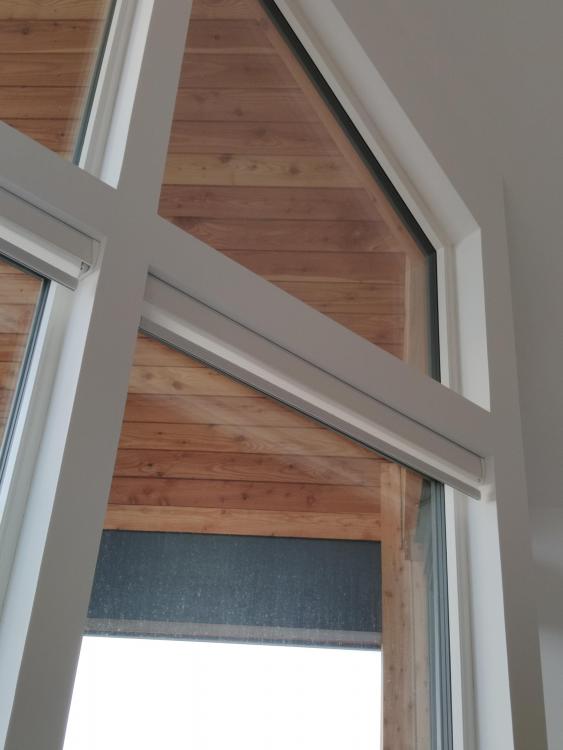
-
Timber cladding 145mm vs 120mm boards, why's it so hard to choose?
JohnMo replied to Thorfun's topic in General Joinery
You may be over thinking it, I doubt you will really notice the difference in width once finished. Wester red cedar? Scottish Larch on ours - will be treating with cedar oil.
-
I would have thought the basics are 1. Simple manifold so you can flow balance, actuator of each loop, all wired to act as one, from single thermostat. A simple UFH wiring centre, that would manage the thermostat, actuators and pump, possibly a relay to manage the heater, using the wiring center CH signal. 2. Single simple thermostat, I'm using a Salus wq610rf, set to 0.25 hysteresis. £60. You can move it around the house to find the best location, before committing to holes in wall. 3. A mixing valve upstream of pump, to give you protection if the thermostat in the Willis heater fails. 4. Pre installed (spare) second heater, valved to be put online should the first unit fail.
-
Solar powered?
-
Airtight walls & fixing stuff to them
JohnMo replied to WWilts's topic in New House & Self Build Design
We parged before the wall plate went on. We used hybrid sealant on the the fixing that went through the wall plate, and a good fillet around the plate against the wall. We used blower proof liquid around the whole perimeter at floor/ wall interface. We screwed battens to the wall (ICF Woodcrete) and added hybrid sealant to the screws threads. Do you need vapour barrier on concrete blocks? We have it on the roof/ceiling, this is bonded to the parge coat at the top of the wall. -
I did wonder how they complied with any sort of building regs, but didn't like to ask.
-
Just notice diesel and petrol prices have gone up about 8p litre over the last week. Gas and electric prices are sure to go up, even more than they have. Things to do Insulation get it ordered and put in as much as possible. Add a deep basement to your build, install your own water supply, and pre wire for your own generator. "Anything be cheaper because of war" - unfortunately people's lives will be, for cheap political motivation.
-
UFH will be costly to run as as much or more heat will go downwards. Could you do plinth heater's below the kitchen units and do you have space for any tall thin radiators?
-
The one in PV mag (link) was buried in the garden, which is best place for it in a domestic situation
-
Our glulams came from plasqual not sure of the right spelling, but in Inverness. Ours are a similar size.
-
Centrifugal gas compressors routinely run at that or greater speeds without issue
-
Battery storage may have an alternative technology on its way - the flywheel. https://www.pv-magazine.com/2022/02/24/french-flywheel-storage-system-specialist-secures-e10-million-investment/ Funny thing I did a a project paper on this subject 30 years ago. There was even a Le Mans race car with one installed in the early 90s and trams have had them installed for energy recovery and storage. Run a flywheel on magnetic bearings and in a vacuum, nearly no standing losses. Use a magnetic clutch to engage a motor/generator for power output and power input. It's not rocket science as they say, just some kenetic energy.
-
I would explore if you really need to up the size of the heat pump, as the heat downstairs will go a long way to fulfill the heating requirements of that space. Simplify the glazing design or don't install any, will help with the heat losses. Do you need a spandrel panel, could it stick built on site?
-
Good places for info are the German passivhaus website, lots of good info freely available. You can build a good building using any build method, the important bit is the contractor being good, because many will not read detailed notes and just do what they have always done, which may not be what you want. The other thing is constructibility, so PIR in cavity may not be the way to go as it's too unforgiving. A lower performance u value, may be better than a high performance u value badly installed. So Rockwool or bonded beads etc. Form factor makes a difference, but only in respect to how much insulation you have to add to meet the 10W/m2 criteria. We followed the principles, getting rid of thermal bridges, continuity of insulation, high performance triple glazed, airtightness etc. Our form factor is at the wrong end of the scale, long thin and single storey, all insulation at roof line. But so far this heating season our gas input has equated to 13W/m2 (NE Scotland), that includes, a prolonged period of the boiler short cycling, drying the building out etc. All in all pleased with the result. Get the architect drawings and a highlighter. Get each cross section and starting at a piece of insulation, follow its path around the building, up the walls, roof, back down the wall and through the floor, your highlighted light should have no gaps. Any gaps rectify. Ask yourself could I install easily, example, our architect haf mineral wood and PIR insulation in the roof, I changed it, to counter battens (to increase fill depth) and full fill spray foam. Good luck