


JohnMo
-
Posts
13292 -
Joined
-
Last visited
-
Days Won
200
Everything posted by JohnMo
-
Our architect did the permeability tests and designed the soakaway to suit. However these calculations had to be signed off by an "expert" that had the right computer program. Ultimately the whole treatment system had to be approved by SEPA, including the soakaway and they insisted on a pumped system for the outflow to soakaway. Beware SEPA approval took an age.
-
Same thing being advertised here. https://www.airconditioningcentre.com/product/ahp-60/ Say Panasonic compressor, no mention of swimming pools
-
You can spend a lot on a kitchen, if that is money well spent depends. A fantastic ultra high quality kitchen and poor fitter and poor design, will never be as good as a medium quality kitchen with a great fitter and good design, design is important and so is how it's installed. We spent £25k on a kitchen in 1998, the designer, took our design, chucked it in the bin and designed us a fantastic kitchen, had no issue paying for the Italian kitchen with contoured granite and stainless steel tops. We saw the kitchen a couple of years ago and still looked great. 22 years later, we paid £16k, again great design, great fitter, no Italian cabinets, but who would know. Shop around, get opinions of different companies, don't pay upfront, use a company you feel comfortable with.
-

UVC prep for ASHP recommendations
JohnMo replied to SuperPav's topic in Air Source Heat Pumps (ASHP)
Can you not run the boiler output through a cylinder coil designed for a heat pump. Even run the boiler at the same supply temps as an ASHP? -
If the contractor has done it, tell him he needs to do it again, as it's rubbish. Why should you pay twice? If you contracted it yourself tell the company to come back. Looks like everyone is wiping up the mess left by a shoddy plasterer.
-
Unless you knew what you were looking at aluminium and uPVC soffit and fascia look the same, because the aluminium is generally powder coated; so is plastic coated. I saved the money and spent elsewhere. Also the uPVC is much easier to work with.
-
Airtight walls & fixing stuff to them
JohnMo replied to WWilts's topic in New House & Self Build Design
Anything better than 3 ach may require MVHR are you prepared for that. Q1. Parge coat, two of us (never done it before) approx 210m2 in two days with brushes and on ladders as some walls are 4m tall; that was for Durisol blocks, normal cement blocks will be much easier. -
Slightly different approach. Parge coat, service battons screwed to Durisol through parge coat, used a hybrid sealant at all screws. Made plates at top of wall for electrician to run wiring, same for where plumbing was running so all clips were secured to OSB, instead of direct to the wall. Below bottom horizontal battons, foam filled and airtight paint. 50mm battons everywhere.
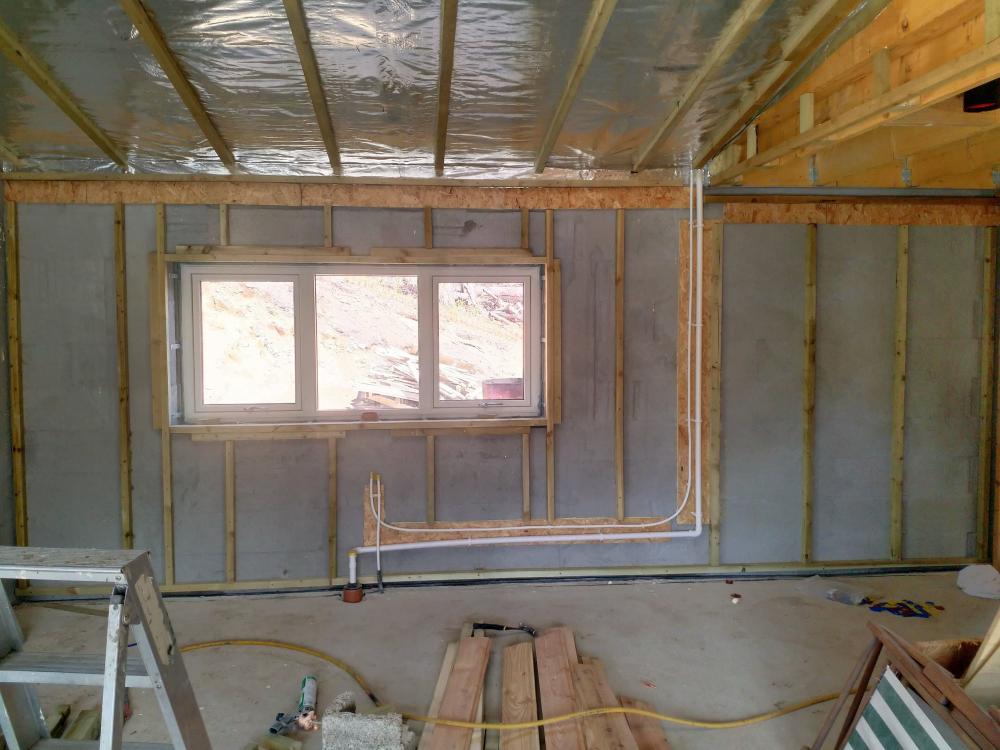
-
Construction Floor, 200mm, reinforced concrete, 200mm PIR, 100mm concrete floor with UFH in all rooms. Walls Durisol, with cement, lime parge coat, service battons and plasterboard. Roof all vaulted ceilings, with 300 to 350mm spray foam insulation. Aluminium foil vapour control, airtightness layer on ceiling, draping down 200mm on to wall and glued to wall, service battons and plasterboard. Floor to wall perimeter at dpc, airtightness paint. Triple glazed windows. One thermostat in the hall. Gas combi boiler, but thermal store as buffer for central heating, and pre heat for DHW and solar PV immersion diverter.
-
Great
-
Decentralised MVHR
JohnMo replied to HelenS's topic in Mechanical Ventilation with Heat Recovery (MVHR)
This is worth a read Atamate_SDAR+Paper+2019+(1).pdf -
I had a similar problem on a gas boiler. My buffer was set for 40 deg, but the boiler which was set at 45 deg and would never fire up, until the temp dropped in buffer to quite a bit below 40. What was happening, the boiler pump would start, and the boiler was not seeing a big enough difference between the return flow and the boiler temperature set point, to allow the logic to give a firing permissive. Once I had increased the firing temperature, it work fine. So as said you will need to find the sweet spot by increasing the boiler set point
-
What ever. I really wouldn't bother, there are better products mentioned above. Never really had much success with hamerite, new or old.
-
That's a confusing response. You disagree that hamerite in isn't as good as it was, then go on to say the new stuff is pants. The old stuff will be good - its not the new stuff. You can't buy it any more unless it's old stock.
-
General comments, if you are really well insulated, 0.15. U value or better and airtight, your heating demands are very low, so the heat loss is slow. I have my heating set for 19 degs, 24/7, the boiler comes on once a day to keep that temperature. My average heat input by gas has been 2.2kW since September for 190m2 single storey. "If you can shut off the heat but can't call for it, is this just by using standard TRV's? What's the benefit to having electric towel rails over water heated." Answer, we have UFH in the bedrooms, but like cool bedrooms, when the house is warm in the winter, we can open the bedroom door and within an hour the room is the same temperature as the rest of the house. But with doors closed we can have the bedrooms a few degrees cooler. We just wanted to be able to switch the UFH of in the bedrooms sooner than the rest of the house. We are using a standard Salus head on the UFH manifold. We have electric towel rails for two reasons. First is for summer towel drying, so there is no requirement to use the CH. Second our house is super insulated and the UFH only needs to come once per day, the electrical towel rail allows flexibility for towel drying in winter also. "What are you referring to as linking to an area, do you mean don't extract from the ensuite, or do you mean to make sure the ensuite radiator is always linked to an area that will be calling for heat throughout the day?" Answer, I am talking about the heating not ventilation. Have the ensuite/bathroom radiators on their own zone for heating. One of the reasons for electric towel rails, so I heat these rooms even with the rest of the heating off. If I was doing it again I would have electric UFH instead of water, for complete flexibility.
-
If you don't extract you would also end up with lots of damp issues also. Yes it would end up cool. So don't link to an are area that wouldn't be calling for heat. We have electric rads in ensuite and bathroom for that reason. You say you are well insulated per regs. Do you mean you have building regs insulation only?
-
I think it is the min insulation required to meet passivhaus levels of insulation with u value of 0.15. Could be well wrong in the assumption.
-
Comments as above plus Basics. MVHR, does not move heat about very effectively. Remember you will only be moving 0.3 to 0.5 air volumes an hour. Air will flow through rooms with a supply and then into and across a room with an extract. So all rooms are having air exchanged. Having an en-suite part of the bedroom loop isn't a good idea as the temperature requirements are very different. Ensuite warm, bedroom cool. I would look at the MVHR in its own right and the heating in own right. You have to extract in wet rooms and supply in dry rooms. If you are very well insulated, having loads of zones isn't a real benefit, as the heat loads are so low. We have bedrooms that can shut off heat, but cannot call for heat. Everything else is s single zone. We have electric towel rads in bathrooms and en-suites.
-
All I could find was. https://salus-controls.eu/2021/03/07/learn-about-heating-control-algorithms/
-
Does this do everything you need out the box? A Salus SQ610 has ITLC algorithm for UFH and you can connect external sensors or switches
-
Passive House, storms and power cuts
JohnMo replied to Russdl's topic in Energy Efficient & Sustainable Design Concepts
You can buy a petrol from chainsaw supplier that does not go off. Intend to have some ready to go. -
Don't you just need a thermostat with ITLC control?
-
Just read this. https://www.solarreviews.com/blog/generators-for-solar-panels
-
Found this. https://gustohomes.co.uk/media-coverage/housebuilder-property-developer/
-
We'll find out when the next person jumps in!



