JohnMo
-
Posts
13292 -
Joined
-
Last visited
-
Days Won
200
Everything posted by JohnMo
-

Which heating system to use on our new build?
JohnMo replied to Johnny Jekyll's topic in Underfloor Heating
With the floor installation you have, I would go UFH in screed. Small system boiler, not sure if you get them but one where you can run the heating circuit at a lower temp than the DHW. Unvented cylinder. Your UFH will come on once per day for a few hours and shut off until the next day, irrespective of what you want it to via thermostats. Run the whole ground floor as a single zone from a single timer thermostat. No need for anything fancy, as they will not work as required in a high performance house. I took my thermostat out except one in the living space and one in each bedroom, as we are in a bungalow. Put electric towel rails in bathrooms. Ask yourself do I need heating in the bedrooms as the heat will move upwards and they will be heated anyway. I went slightly different route. Combi with thermal store upstream, to collect PV immersion heat; to offset gas costs in the summer, the boiler takes the preheated water up to 55 degs (via mixing valve) it adds heat if it needs to only. Will also be adding solar thermal in a couple of months also, to help displace heating costs in the shoulder months. Boiler works with no short cycling as the UFH manifold (temp set at 30) is fed from the thermal store. Boiler heating circuit is used to heat thermal store to 34 deg (no real losses from the cylinder) with a 4 deg hysteresis. Boiler heating flow set to 40. When running the boiler runs for about 15 to 20 mins and slowly creeps up to a max allowable temp of 55. Then spends about 10 to 15 mins resting. (Still making changes to setting to get it to run most efficiently). -
You never know, they may also look at council tax records and completion sign off. Anything to trip you up.
-
Your test worked
- 1 reply
-
- 1
-

-
Site worth a read. Lots of info on getting best from your system https://www.heatgeek.com/category/knowledge/balancing/
-
"Oh no, the rooms look so small"
JohnMo replied to Selfbuildsarah's topic in General Self Build & DIY Discussion
Our house Tradesmen, seeing our slab, that house is huge. Wife, it's tiny Walls up, it tiny, internal walls up it's tiny, plasterboard up it's tiny. First coat of whit paint, it's huge, did we need room that big! -
Do you need anti legionella in the UK? The supply water coming in to your house is chlorine treated to kill everything. About previous comments ref weather compensation, this cannot be done with this boiler, as far as I can see.
-
You want your CH return temp below 54 degrees. The lower from there the better. It is worth something like a 10 to 20% cut in your heating bill. We are assuming your boiler isn't as old as the hills and is condensing? Your flue should burn clean with very little or no white smoke coming out, if you are in condensing mode. As mentioned low and slow. Your heating system is designed for the coldest day, so any day or time warmer than that, it should be having an easy time. You would be better turning you CH temp down to 60 (supply temp) and running the upstairs rads for longer. Does you boiler have weather compensation? You may be better moving to that if you have it or can add it. This changes the CH flow temp based on outside temp. It runs all the time and uses the low and slow principle. Also do you need the heating at 21, 1 degree less will save a big chunk as well.
-
Do extractor fans always need to be near ceiling?
JohnMo replied to WWilts's topic in Electrics - Kitchen & Bathroom
Basically not doing what they are designed to do, would be my opinion. Piss poor performance? If you have trickle ventilation it will just suck the air from the trickle vent instead of the room, it also needs to be away from the doorway. Can you duct to a remote fan -
Do extractor fans always need to be near ceiling?
JohnMo replied to WWilts's topic in Electrics - Kitchen & Bathroom
Have a read of the manufacturer instructions, they will give you clear guidance on where and where not to install. You really want to extract at a high level where the steam is, not as it's condensing and coming down. You also should either extract above shower/bath or close by -
I used 70mm, you don't want it to touch the plasterboard, as it will transfer sound
-
Hi, bit if a cut and paste, as this is not an organisation, but a forum.
-
Paying tips to delivery drivers
JohnMo replied to Omnibuswoman's topic in General Self Build & DIY Discussion
Never tipped a driver, never even thought to so. Possibly never will. -
System is 10x 310W panels in series, Growatt 3000s inverter
-
Hi being asked for a schematic showing the PV system showing inverter model and rating, for G98 approval. Anyone got a copy of something that has been accepted, that I could use, modify or copy. Many thanks
-
Single zone, if you are well insulated a single zone for the whole floor. The whole system is likely to come on once per day and unlikely to cause any short cycling of the heat source.
-
My last ones came from Toolstation, mainly because they give you a life expectancy. Small difference in cost between 40/50k hr life bulb and one that lasts 15k hrs.
-
Kitchen: Wife's whims vs static design requirements
JohnMo replied to MortarThePoint's topic in Kitchen Units & Worktops
Go and visit a couple of kitchen places get designs done, they will give 3D images of their planned kitchen layout, so you can see what does or doesn't work for you. Go tomorrow you'll have designs next week. There will likely be changes you need to do. If have different ideas use a third party (kitchen designer) to sort your ideas. Our best kitchen, we had a clear idea of what we wanted, the designer told us it was rubbish and he could do better, and he did. -
Have you had a price and delivery schedule? What level of insulation are going for? Things to add to price. All ground work, erection, depending external finish, external block work, render etc.
-
To give you an idea of a normal (ish) foundation on sand (although is really an old sand dune, which is now 10 miles from the sea). First photo strip foundations, the front wide ones are all reinforced. Second photo has insulated retaining walls up to DPC and stub walls where structural walls are going. Everything is thermally broken using thermolite blocks Following this ground leveled, then DPC, two layers of rebar, 160mm concrete. Then 200mm of PIR, then DPC and UFH pipes then another 100mm of fibre reinforced concrete. A passive slab would have been way less work.
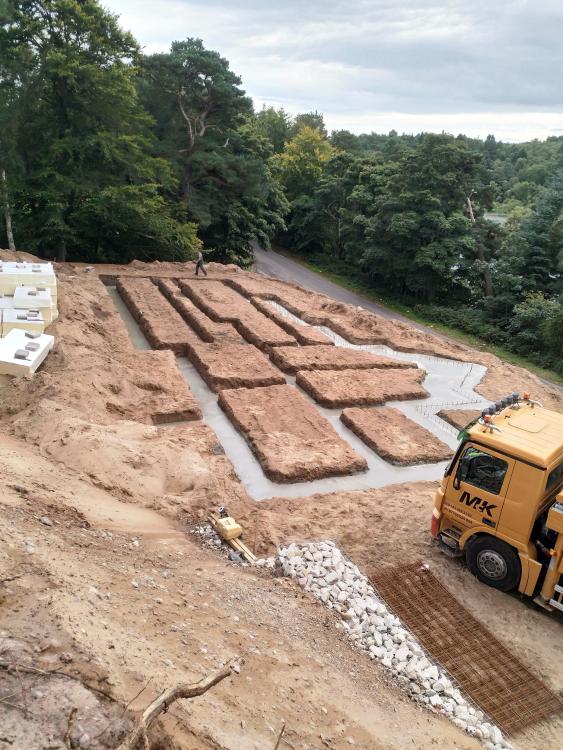
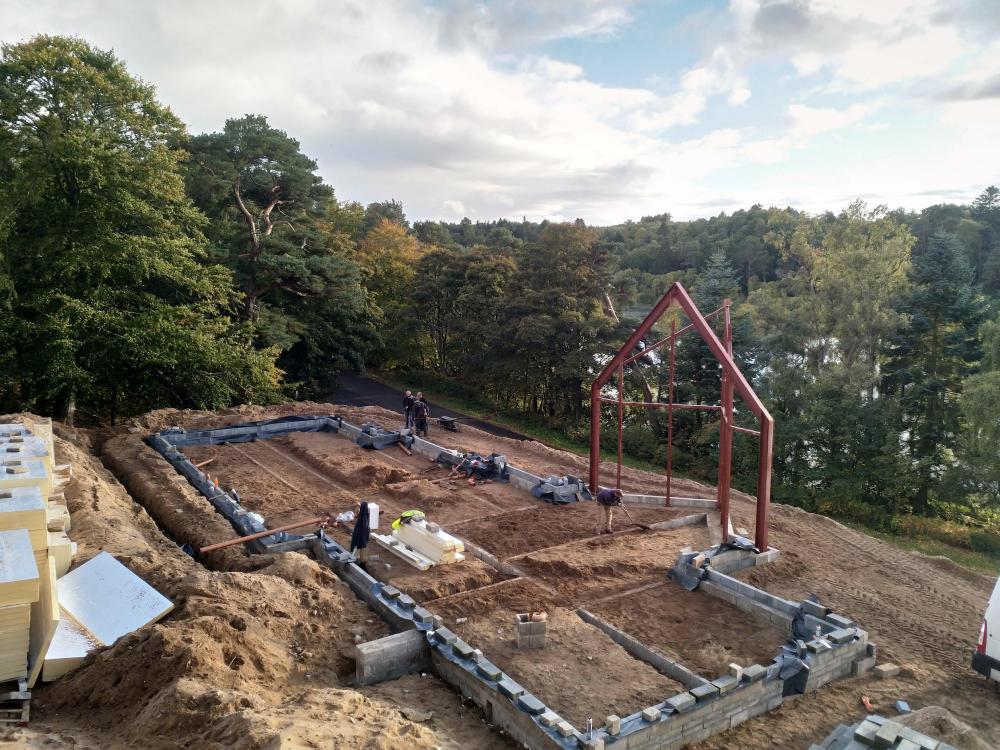
-
That's good to hear
-
ICF or Sips for new house in Scotland
JohnMo replied to Meabh's topic in General Construction Issues
Siberian, that won't be in sale for quite a while, as it come from Russia. Keep your money in the UK, plenty of good woods from here. -
Completely different units. But part of a u value calc. W/m.k, that how much heat is lost per metre thickness of that material per degree. U value is W/m2.k that is what building control looks at, it is the build up of all materials in say a wall in area
-
ICF or Sips for new house in Scotland
JohnMo replied to Meabh's topic in General Construction Issues
I would say it depends on how much of the build you are doing your self. I did a lot myself, so selected methods I could do and where required I could get support locally, based on normal practice. We are in NE Scotland, on a sand hill. We did strip foundation, insulated stub walls, 160mm reinforced concrete slab, infilled with 200mm PIR, 70mm PIR upstands, UFH pipes another 100mm concrete. Then Durisol ICF walls, as no specialist equipment needed to support during concrete pours. -
Would not buy second unless they can demonstrate only a couple of years old. Double check all prices against new, some try to charge over the top. But that said there are some really good bargains. Just be careful.
-
Further to my previous post. If you can afford it and have storage or can get supplier to store, buy well ahead of when you think you will need it. I had a garage full of bits, I purchased as the first lockdown was looking like starting. Full PV system, full ventilation system, full heating system including UFH. Slate roof and wood stove was purchased just before brexit and stored at suppliers for six months. Floor insulation was stored at site for around 3 months before being used (allowed to degas). Durisol blocks, stone cladding were on site around three months before ready to use. Delays, wood cladding (3 months), kitchen (1 month) extractor (3 months, it was damaged on delivery and then another 2 months), internal doors (6 weeks). Most things didn't slow the build down as there was always plenty to do. We moved in without the extractor and a couple of internal doors, just had no fried food for a couple of months. Things finished off while in house, stone cladding, 30% of the wood cladding, plenty of internal painting.