


A_L
-
Posts
652 -
Joined
-
Last visited
-
Days Won
1
Everything posted by A_L
-
Paul Camilli, who lives off grid on Raasay might be able to point you in the right direction https://lifeattheendoftheroad.wordpress.com/
-
If there is a path from a heated area through the vertical timbers to the cold outside without passing through insulation then yes, otherwise no
-
Yes it is. 12 x 260W = 3120Watts or 3.12kWp. At about 900kWh/kWp you should get about 2808kWh/year so you need to re-calculate!
-
60mm of PIR and 100mm of lightweight aerated concrete will meet building regs for U-values, wether or not this is enough is another matter.
-
not necessarily in a block/cavity/block construction, but I agree it will not flow out of holes. At best make sure you get a contractor who can provide a CIGA guarantee (Cavity Insulation Guarantee Agency). If trouble after the event voids can be identified by thermal imaging. Try the NI branch of the Energy Saving Trust for CIGA companies, you might even get a grant - 0800 142 2865
-
Calculating radiator output at different Temps
A_L replied to Miek's topic in Central Heating (Radiators)
@Miek , Relative to 70°C outputs at 30°C/13.5%, 40°C/32.1%, 50°C/53.0%, 60°C/75.8% for rooms at 20°C and 'ordinary' radiators -
In Central England the 100mm option will save around 1kWh/m2/yr of heat loss. You already have some decrement delay so I doubt it would be significant.
-
Xtratherm? https://www.xtratherm.com/products/xt-tf/
-
Hello and welcome, @Ed Davies on here is the person to talk to. https://edavies.me.uk/
-
IIRC it is only a requirement in rented property?
-
1) Locate the flashing neon on the meter, or if possible both meters. (If necessary switch a large load on and off) 2) Switch off any heating by electricity so that the neon only flashes every 10 seconds or so. 3) Switch on a kettle 4) The neon will now flash every 1 to 2 seconds 5) This will identify which meter is measuring the kettle (and flat) power 6) Check a bill with actual (even a self read) not an estimated reading corresponds with the meter you believe to be hers
-
Looking for advice: Log Cabin "Caravan" build Scotland
A_L replied to morkus's topic in Planning Permission
@morkus As far as I understand it is necessary to get PP but you can avoid building regulations for 'portable buildings'. have a look at the Caravans Act, under the latest update it is possible in England, Wales (N.I.?) to build a mobile home of up to 136 sq metres with only planning permission for a 'Caravan'. In Scotland it is about 107 sq metres Here is a Scottish link but the others are very similar https://www.highland.gov.uk/downloads/file/1346/bst_018_caravans_and_mobile_homes and here is a more commercial link http://www.newforestlogcabins.co.uk/page45.html just to emphasise, mobile home definition is basically a building which can be split into two parts which (in theory) can then be put on the back of two lorries, it does not even have to be possible for the lorries to get to the specific site or to have originally delivered the building.- 44 replies
-
- 1
-

-
- planning permission
- log cabin
- (and 5 more)
-
Yes a reflective VCL should have its shiny surface facing into a cavity of at least 25mm. It can be on either side of the service cavity but is usually on the outside. Yes a cheaper non-reflective VCL would be O.K. if no cavity. The best place for the VCL is on the warm side of all the insulation but it could be between the PIR and the Frametherm but do not increase the thickness of the PIR. It would decrease the temperature of the frametherm too much and give potential problems from interstitial condensation at warm side of VCL
-
Assuming a brick/50mm cavity/brick construction then 50mm of mineral wool batt will save about 40% and 50mm of PIR/PUR about 50%
- 1 reply
-
- 2
-
-
Corrugated Metal Roof - how did you ventilate your panels
A_L replied to Tom's Barn's topic in Roofing, Tiling & Slating
Not according to the BBA cert for possibly the leading brand BBA Certificate for Colorcoat Urban Roof panel.pdf -
How far are current Building Regs from Zero Energy House?
A_L replied to Ferdinand's topic in Boffin's Corner
Neither, EPC100 (or SAP100) means zero energy cost The Environmental Impact Rating (or EI rating) measures net carbon emissions and EI100 is net zero. -
Temporary heat source for UFH: Willis heaters
A_L commented on oranjeboom's blog entry in Kentish RenoExtension
possibly not, immersion heater elements usually have 'cold zones' at each end (usually about 50mm apparently) http://www.tpfay.co.uk/information/glossary-descriptions-heating-elements/#ColdEndDef http://www.tpfay.co.uk/our-products/straight-elements/#.Xiw24IV2vIU -
hello and welcome, Your U-values are fine, though I would try and reduce the wall value if possible. The reason to keep U-values similar is principally to prevent condensation on the higher value areas but this is on a much higher difference, e.g. the latest Scottish regs ask for walls averaging 0.22 but allow local areas of 0.7.
-
mineral wool batts will typically have a thermal conductivity of 0.035 W/m.K and PIR 0.022W/m.K. Thus 22mm of PIR will have the same insulating effect as 35mm of batt steico wood fibre batts, IIRC with a thermal conductivity of 0.048W/m.K will have the same insulating effect at 48mm thickness
- 26 replies
-
- 1
-

-
- hemp
- insulation
- (and 1 more)
-
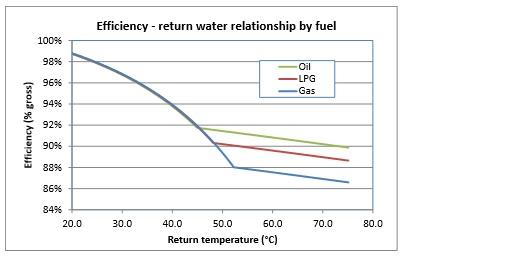
I think your thinking about solid fuel stoves where this can be necessary. New condensing oil boilers will have corrosion resistant heat exchangers as condensation on them is obviously desirable. Heat output from a given amount of fuel rises as return temperatures fall. from https://assets.publishing.service.gov.uk/government/uploads/system/uploads/attachment_data/file/648337/heating-controls-compensation-tpi-bre.pdf page 11
-
no, twice the price for the same insulating effect
-
@Thorfun , for the same thermal resistance PIR/PUR is typically twice the price of mineral wool batts
-
Two-thirds down the tonyshouse page the diagram is repeated and there are two photographs to the left of it with a wall with an opening consistent with the sketch
-
Still there, via us:- https://forum.buildhub.org.uk/topic/10669-frameless-glazing-units/?tab=comments#comment-180111
-
MVHR in large volume New Build
A_L replied to Triassic's topic in Mechanical Ventilation with Heat Recovery (MVHR)
To minimise noise from airflow aim to keep the air velocity below 2m/s
