


A_L
-
Posts
652 -
Joined
-
Last visited
-
Days Won
1
Everything posted by A_L
-
Sizing up 6k Solar PV, am I on the right track?
A_L replied to magutosh's topic in Photovoltaics (PV)
@Nickfromwales Agreed!!!!!! - To early in the morning for me! I meant 4.5kWh/kWp per month (of December) -
Sizing up 6k Solar PV, am I on the right track?
A_L replied to magutosh's topic in Photovoltaics (PV)
Assuming you are referring to a 6kWp system, occupying about 40m2 of roof, it will generate an average of about 4.5kWh/day in December with many zero days. Total over year will be around 5100kWh. Why do you want a MCS installer? It is only useful for paying you for export which you may have very little of and will come at a significant premium. Edit:- Production will be about 4.5kWh per kWp per month in December! -
1) May be possible to get PP for a caravan but not a house. 2) As said above, exemption from building regs for 'caravan'. @Crofter, perhaps you could detail your planning process? TIA
-
I believe the Sottish dimensions have been 'harmonised' with the English ones, i.e. 136m² https://www.gov.scot/publications/business-regulatory-impact-assessment-caravan-sites-act-1968-amendment-definition-caravan-scotland-order-2019/pages/1/ https://www.legislation.gov.uk/ssi/2019/295/made
-
His last post (09/05) on here may provide a clue. - https://forum.buildhub.org.uk/topic/11657-kill-grass-and-weeds-permanently/page/3/?tab=comments#comment-243796 His last actual visit was 26/05
-
@Bryera, If you intend more than one layer of insulation then you need to just fill the remaining depth of the timbers first, so you probably need a 100mm roll. The same site/warehouse has at about 1/3 the price for the same total amount of insulation. I do recommend a pre-split roll as it make life in a loft easier, e.g. https://www.insulationsuperstore.co.uk/product/loft-insulation-multi-roll-44-by-superglass-100mm-1212m2-pack.html it is incidentally marginally cheaper again. Multiple layers of loft roll (300mm) will be sufficiently insulating would make this unnecessary and uneconomic. If there is any ventilation in the loft it would also be ineffective.
-
perhaps try this one time buildhubber https://forum.buildhub.org.uk/topic/16414-caravan-act-compliant-home-eligible-for-vat-claim-back/?tab=comments#comment-266730 https://forum.buildhub.org.uk/topic/13305-looking-for-advice-log-cabin-caravan-build-scotland/page/2/?tab=comments#comment-222442
-
you want a battery hybrid inverter with export limitation, something like this - https://www.ginlong.com/rhi_inverter1/1952.html the dno gives permission for the maximum permitted output, the actual size of the array should be irrelevant
-
@Bryera It looks like your timbers are at 400mm centres, the most important thing is to find insulation rolls which are already partially pre-cut into 3 x 380mm sections, then find a thickness compatible with the remaining timber depth. The question then is do you use 'cheap as chips' loft roll with a thermal conductivity of 0.044 or premium Frametherm32, thermal conductivity 0.032 at about three times the price. If you intend to add more insulation above this I would not bother with the premium stuff, just use (150-200mm) more loft roll. There will be no problem with condensation on the underside of the Celotex if it has silver foil there, it acts as a vapour barrier layer. The additional insulation will keep it warm and there will be no problem with interstitial condensation
-
Experience of all the 'Passiv slab' houses on here and plenty more elsewhere suggests otherwise.
-
Agreed, but the original question was 'Is it necessary to remove the existing CWI', and pay £1500 for the privilege?. Answer - No. The table just illustrates that the original CWI has a significant contribution to the overall thermal resistance Incidentally a change of 0.05W/m2/K is about 2.5kWh/m2/yr difference in energy saved/lost during heating season.
-
That does not quite fit, two rows of brick are 225mm, but there is little effect on the ultimate thermal resistance. Assuming no foil on the phenolic and breathable render there do not seem to be any problems with interstitial condensation U-values With CWI Without CWI 90mm EPS 0.21 0.28 140mm EPS 0.16 0.19 80mm Phenolic 0.17 0.21
-
hello and welcome, The principal problem with putting EWI on a filled cavity wall is that the cavity filling can reduce the temperature of the outer leaf to below the point at which water vapour from inside the house condenses out. The more EWI insulation the warmer the outside leaf is and the less likely for this to occur. Can you provide specific details of the original wall construction, it is probably brick/cavity/brick, does your 300mm include external and internal decorative finishes? Also what is the EWI material and thickness? The cavity must be unventilated or the EWI would be ineffective, leaving the mineral wool in place would add significantly to the overall insulating effect. This sort of condensation occurs inside the structure and MVHR will not have any effect.
-
Here is a more readable version of the data sheet http://www.firstsolar.com/en-Emea/-/media/First-Solar/Project-Documents/PD-5-401-03_Series3Black-4_NA.ashx Things to note 1) None of the variants produce 97Watts, 85 to 95 Watts. 2) They have no bypass diodes, they will be very sensitive to shading 3) With an open circuit voltage of 60.5V it will limit the number in series for a given inverter, rather than about 30V for silicon 4) Will occupy around 8m2 /kWp as opposed to 5-6m2 /kWp for silicon panels 5) Should produce 5% more per kWp than silicon 6) Production in low light conditions should be greater than silicon (10%?) 7) Will not suffer as much output degradation at high temperatures as Silicon, 0.25%/°C rather than 0.37%/°C
-
These are heavily optimised for output per unit frontal area, designer radiators are inevitably larger for the same output, You will need to go to a level of 'doubling' to get a smaller frontage. Output is generally quoted at a mean radiator temperature of 70°C. This is a bit high to ensure the boiler is in an economical condensing mode and you are probably not running your system at this temperature level (boiler flow of 75°C) currently. Running radiators at a mean temperature of 60°C will reduce output by 20%. So you may find it difficult to source a designer radiator to suit.
-
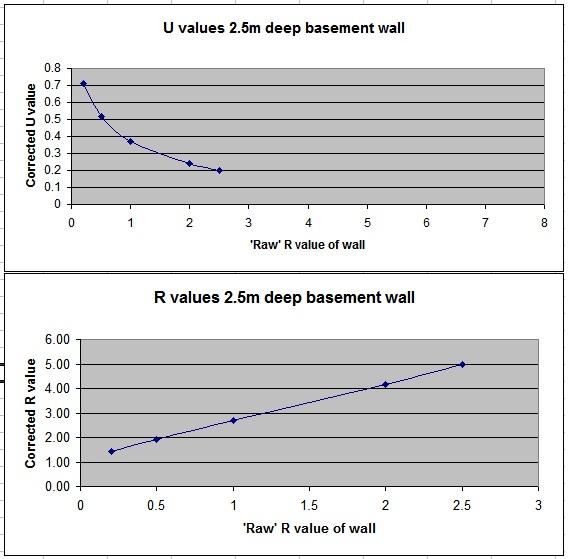
@Thorfun , as it says in the document - I have given it a go - I should add that I never had to do a basement when I was actively doing SAP! If we look at the table we can see that the change in U-values is rapidly declining with depth, particularly at higher R values, therefore I think you can ignore not having values for your depth and use those for 2.5m The first plot shows the U values in the 2.5m column plotted against 'raw' R values in the 1st column. I think it would be difficult to give an accurate U value for a 'raw' R value of 7 from this In the second plot I have calculated R values from the U values in the 2.5m column and plotted these against the 'raw' R values in the first column. Assuming this is a straight line (y=mx + c) then a 'raw' R of seven converts to about 11.61 or a corrected U value of about 0.09
-
@Thorfun , Here is a slightly out=of-date document which describes the methods for calculation of U-values for below ground walls and floors. Replace the Building Regs U-values and ignore the references to Elemental and Carbon Index methods Basement U-values.pdf
-
Each tape manufacturer generally has their own 'airtight primer' e.g. https://proclima.com/products/bonding-agents/primer/tescon-primer-rp
-
@SuperJohnG, @Thorfun , my memory may be faulty but I thought the forum owns a plaster board lifter which is held by the last user? maybe mods ( @jack ?) can help.
-
Rehaus's own metal diffuser plates are 0.8mm thick. The heat conduction along the foil covering of an insulation board will be insignificant by comparison. Cooking foil is 1/50th as thick as a metal diffuser plate and I am sure thicker than insulating board foil. Consider surface mounting the pipes on insulation board and use a sand/cement 'pug' mix between the pipes to spread the heat
-
EPC for RHI and Electricity Tarrif
A_L replied to canalsiderenovation's topic in Air Source Heat Pumps (ASHP)
Since it is not a new build it can be done 'as is' at any time. Appliances are irrelevant. There are some minimum insulation requirements but EWI is not one of them. PV panels do not affect the CH and DHW loads in an EPC. -
what is the reason for digging below the frost line
A_L replied to brickierob1's topic in Bricklaying, Blockwork & Mortar
Soil expands when the water in it freezes, potentially causing uplift, but even NHBC do not require that much, and that's for load bearing, not decorative features. https://nhbc-standards.co.uk/4-foundations/4-3-strip-and-trench-fill-foundations/4-3-3-ground-conditions/ -
If we can assume a floor area in the region of 317m2 then 60mm of PIR (0.022W/mK) or 100mm of EPS (0.035W/mK) will give U values of 0.19 for PIR or 0.18 for EPS. U values will tend lower for larger areas.
-
you can fix UFH pipe to clip/mount rails which use adhesive patches to fix. https://underfloorparts.co.uk/product/underfloor-heating-clip-rail-track-1mtr-adhesive but would less than 25mm cover above pipe be O.K. 1)mechanically? and 2)heat spreading?
-
The higher flow temperature means that the rate at which the floor can accept energy is higher so assuming you do not turn it up to far, to significantly reduce condensing, there will be little loss of efficiency. There will also be a beneficial effect on boiler cycling, the burner will stay on longer and the inefficiencies associated with burner start-up/shutdown will be reduced. The boiler will probably have an output greater than the ability of the floor to accept energy so you will be unlikely to eliminate cycling entirely. Therefore in conclusion you want the lowest flow temperature which does not cause rapid burner cycling. Is the 47°C for condensing a manufacturer recommendation? I ask as for gas boilers 57°C is usually considered the maximum return temp to cause condensing?



