


Russell griffiths
-
Posts
7790 -
Joined
-
Last visited
-
Days Won
60
Everything posted by Russell griffiths
-
Many ways to skin this cat. If going with a hanger, no notch needed, just a saw cut for hanger to slot into. If going with a batten I would add a 150-175?? Construction screw through each rafter into the ridge. Restraint strap does not need to be thick. The thinner the better as it can play havoc with your roof tiling. Its in tension so doesn’t need to be thick, I think mine are only 1.5 —2mm.
-
Those screws are fine. But I would go 18mm, 9 is just floppy and will fall to bits if fixing close to the edge.
-
 They don’t have a bulb, it’s all built in led, when it fails you chuck it and fit a new one.
 -
Can you get the structural engineer to stick a couple of 80mm holes in the steel.
-
Everything Simpson is over priced. Can you just replace these with a simple wind post. 75mm box section. I bet the reason they specifically said Simpson is they have the calculations readily available and don’t need to do their own.
-
Have you seen his site ?? i can fully understand the need.
-
Do it Australian style. I had multiple groups of this as I built in a semi cyclonic area, wind load was horrendous. Ive never seen anything built like it over here. So so basically they make a racking wall using threaded rod and plywood. Bottom plate is fixed to concrete raft with an anchor bolt that has a female thread facing upwards. This bolt has a length of 12mm threaded rod that goes up through any noggins and up through the top two head plates. Theses are fitted every 1200 mm along the wall, directly inline with the size of plywood sheets. The ply is fitted with full head nails, nailed every 150mmm. In effect it creates a 1200 x 2.4 box. Start at the corners and work up to reveals. Full sheets on all corners and reveals. If your interested i will will do a little sketch. All materials readily available of the shelf.
-
Best Subfloor for UFH with Suspended Timber Floor?
Russell griffiths replied to hammerandnails's topic in Underfloor Heating
How about more insulation, loose the screed and fit a board that takes the pipes on top in grooves and tile directly onto it. -
Best Subfloor for UFH with Suspended Timber Floor?
Russell griffiths replied to hammerandnails's topic in Underfloor Heating
What is stopping the heat going downwards out of the bottom of the screed. -
No hangers needed for uplift or downward movement IMHO fit a 25x 50 batten the full length of your ridge, do a plumb cut on the rafter end including a notch for the batten. Fit rafter and secure with a 125-150x8 timber fixing. All you need then is restraint straps, these will go over the top of the ridge and fit to the top or side of the opposite rafter.
-
I’ve just driven past a very similar building, it’s got a rail system being fitted and external insulation then metal sheets on top.
-
Water supply is easy that’s a 15mm pipe. Waste water removal is far harder as you will need a 40mm pipe. Harder to hide and it needs to fall away from the machine to drain correctly.
-
Conditions on material for new driveway for new build
Russell griffiths replied to Bullseye's topic in Driveways
The first section of drive I believe has to be non movable. IE a solid surface not stone, not gravel. I believe it is to stop loose stones being spread onto the road surface, dangerous for motorbikes and stuff. I don’t believe it has to be to any specific spec, just a sealed surface. -
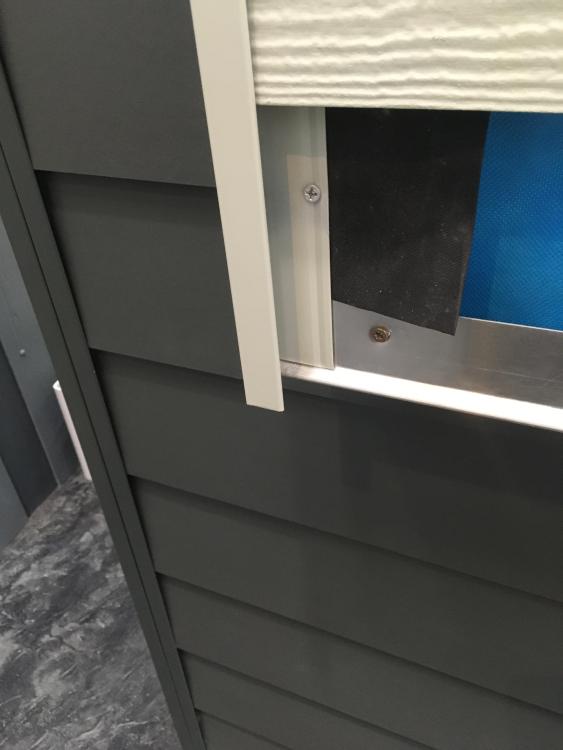
Why 20mm thick, the weight will be incredible, the strength of some of the composites means they can be 7-9 mm and still be strong. Pick up a length of composite decking and see how heavy it is. James hardy do a smooth panel that is fixed featheredge style.
-
Well you have started with a more or less free plot, so winner winner chicken dinner.
-
You will want 1-4-5. depending on what you are doing. 1 for fixing osb to wall if you are adding racking boards or just a stiffening for plasterboard. 4 for nailing 38 to 38 and 5 for most stud to sole plate, top plate stuff.
-
Timber Cladding over render detail
Russell griffiths replied to Kernow's topic in General Construction Issues
I would go aluminium trim, with a little kicker at the front, the cladding should sit 3mm off the trim so water doesn’t wick up the cladding. -
Durisol - in administration
Russell griffiths replied to PeterW's topic in Insulated Concrete Formwork (ICF)
All the videos @FM2015talks about are readily available on YouTube, if people do the hunting. Anybody picking an icf product should have a good hunt on YouTube, if you cannot find it on there chances are not many people are using that product. -
Durisol - in administration
Russell griffiths replied to PeterW's topic in Insulated Concrete Formwork (ICF)
@MakoIm trying to find a reason why not to build using concrete with external insulation. a fairly big reason would be getting somebody to do it. You would need a very competent concrete contractor, probably found in the civil engineering world rather than house builders. A friend has a 90% concrete house and they really had to go to an industrial scale to get the appropriate contractors. If you have the budget then then that’s fine but for a standard size house it would be hard to get a contractor interested. Million pound build not so much of a problem. -
-
Cubic metres or square metres. Would all depend on access. If it’s within grabbing distance of the truck or if it’s in a back garden and the only access is a 1m wide gate. Too many variables.
-
something to remove cement from granite
Russell griffiths replied to scottishjohn's topic in Bricklaying, Blockwork & Mortar
Sand blaster. -
Your icf house should be airtight without any internal finish. I tested mine before plasterboard and got a good score, big mirrors, cupboards, flatscreen telly, fix a chunk of 5/8 ply behind the plasterboard, then just board over. Externally, mine sat outside with no external protection for 3 years, you can stand there with a hose on it if you want, you won’t get any water penetration if you pick a good icf and if you detail the window and floor junction correctly. The only thing that hurts it is UV.
-
That concrete is probably what is known as ( oversite) just a thin layer to stop weeds and stuff, they used to build the dwarf walls on top of it that carries the floor joists. Its normally very rough and can differ in thickness massively. Depends how wild you want to go, I would probably take it all up. What do you want to achieve and how long are you going to live there.
-
I would turn the ceiling joists the other way, I would then build in as much strength as possible on that front edge, back to back joists with a steel flitch beam sandwiched in between. When you size doors you need to allow a 20mm gap at the top that is filled with a compressible insulation with a trim covering this gap, if you don’t any deflection will press on the top of the door and stop it working correctly.



