


Russell griffiths
-
Posts
7971 -
Joined
-
Last visited
-
Days Won
65
Everything posted by Russell griffiths
-

Kingspan green guard GG500 threshold
Russell griffiths replied to gravelrash's topic in General Construction Issues
No fixings in my base track at all, just lots of pu sealant applied as door track went in, then another tube inside and out, you would need to rip it out with an excavator if you wanted to take it out. -
Kingspan green guard GG500 threshold
Russell griffiths replied to gravelrash's topic in General Construction Issues
i used it under my sliders, 400kg on it, it won’t hold a screw though. Do you really need screws in the cill area.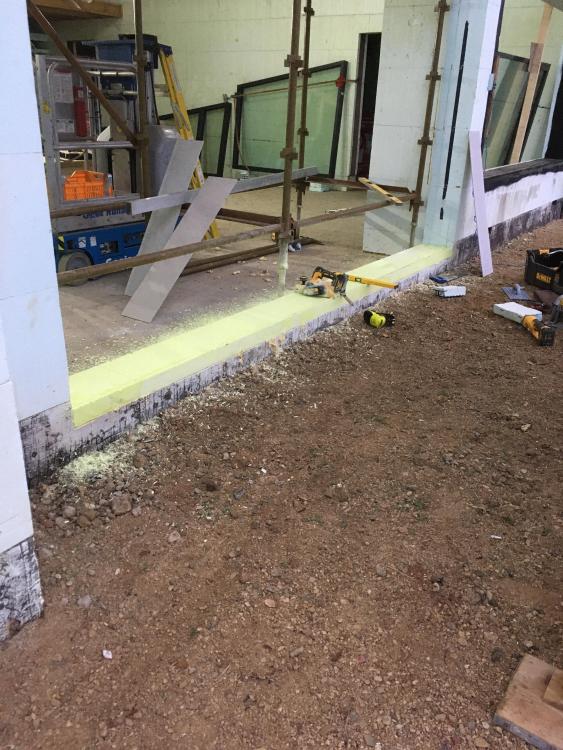
-
That’s u value, not airtightness.
-
If you are considering passive standards then I thought bi folds where something to avoid, I was under the impression that they have poor air sealing that gets worse as they get older.
-
Waste pipework diameters and connections
Russell griffiths replied to Olf's topic in Waste & Sewerage
You need a trap for the washing machine, sealing the waste pipe on just let’s the smells out of the drum. -
Quick response. Scrape off the blinding down to just a bit to fill in voids 25mm eps to squish down to protect dpm dpm 100mm pir concrete floor with mesh with ufh tied to mesh. Grind and polish concrete. Increase insulation if you have the height. If you don’t want polished concrete then finish the concrete well, thin coat of self levelling compound and LVT floor.
-
If you have a leak that needle will drop like a stone, it will literally flop straight around to zero. To give yourself a reality check, crack a valve open the tiniest bit, you will see an instant drop.
-
Do I need a Structural Engineer ?
Russell griffiths replied to Mano's topic in New House & Self Build Design
Don’t be bloody ridiculous -
Remember to drop the pressure when the screed is in, the heat from the curing process increases the pressure. Mine hit 12 bar before I spotted it. ??♂️?
-
Fermacell, Verspaanel, Magply for sheathing
Russell griffiths replied to molynoox's topic in Garages & Workshops
Why not change the outside cladding to non combustible. -
1500x 1000 is a small window in my book, when they get to 3000x 1600 then they get a bit heavy, window fitting must be the most overcharged job going.
-
I had a design like yours so I spaced flow and return at 150 like the rest of the house so if you shorten the pink purple loop and space them evenly across that area. Lose all runs in hall and just cover with flow return.
-
Yep brilliant I have 4 of them.
-
As above, fat bloke knows what he’s talking about.
-
Trench pipe layout verses slinky trench design
Russell griffiths replied to Marvin's topic in Air Source Heat Pumps (ASHP)
No idea, it was just suggested to me to have a bore hole instead of 800m of pipe. -
Trench pipe layout verses slinky trench design
Russell griffiths replied to Marvin's topic in Air Source Heat Pumps (ASHP)
Bore hole, takes up 150mm square. -
Screed on the edge of landing
Russell griffiths replied to MortarThePoint's topic in Floor Structures
Is that all you’ve got, I’m disappointed with the poor come back. ? -
@willbish did his pipes in the slab, he set up a system with scaffolding boards laid on the finished slab to take the screws for the props. He has probably got some pics if you if you ask him nicely.
-
Don’t bother shaping the wings, form your roll on the ground and lift it up, the weight of the lead will lay itself onto the slate, then finish forming and trim wings when all in place, trying to make it tooooo accurate on the ground won’t work. Rough form then fit and tidy in place.
-
Screed on the edge of landing
Russell griffiths replied to MortarThePoint's topic in Floor Structures
If it cracks then the bit of screed on top of the steel will just float and rattle about. I would mesh it and fix the mesh to the steel with tex screws and washers. Leaving a gap for screed to go under the mesh, so pack it up off the steel. -
Screed on the edge of landing
Russell griffiths replied to MortarThePoint's topic in Floor Structures
@Nickfromwales grafting. ????????????????????????????????????????????????????????????????????????????????????????????????????????????????? -
Screed on the edge of landing
Russell griffiths replied to MortarThePoint's topic in Floor Structures
Looking at that stud they supply you could adapt that to have a threaded end that screws into a captive nut in the steel web. Cut out the screed in the post location, drill through steel, insert stud and tighten in web of steel. Or if your a bit clever install the stud in the steel now and screed around them. -
Screed on the edge of landing
Russell griffiths replied to MortarThePoint's topic in Floor Structures
Are you going to bridge the gap between steel and concrete with some form of mesh, I have used chicken wire in the past or a fine stainless mesh embedded in the screed. -
So when your floor flexes what happens to the screed on top.?? its not a method I would want, has your architect done this before?
-
You don’t normally list anything under 75mm in diameter.



