
Conor
-
Posts
4165 -
Joined
-
Last visited
-
Days Won
12
Everything posted by Conor
-
I bet the pipe was kinked / pinched at some point before install and the water pressure has gradually pushed through the weakened points.
-
Get the nonsense leveller from Screwfix, comes in two version, get the one that matches your buildup. Used it loads of times.
-
So, full strip, replacement of some timbers, refelt, batten and redo the tiles. And probably soffit, fascia and gutters while you're at it. £££
-
I wouldn't use OSB, it'll flake apart with wear. I'd use 18mm ply.
-
What condition are the timbers in? Is there water ingress? Looks like it's been patched up a fair bit over the years already. Id assume a potential £10-£15k job at some point in near future.
-
It's condensation. It takes months for a house to dry out. Keep windows open 24x7.
-
Can't go much higher without planning permission / annoying your neighbours. I'd plant a stand of fast growing trees tight against the wall. 6 l, 3m high trees will cost you about £1k, depending on species. Natives are cheapest, e.g. birch or rowan.
-
We have that in our basement. Matt black taps and shower. No issues.
-
I cast a 900x900mm concrete platform for our cylinder directly on top of the PIR insualtion. It needed to go in before we did the floor screed. Worked out well. Sits about 40mm higher than the finished floor and is only slightly bigger than the tank. The buffer is wall mounted.
-

Face mask advice/recommendation for loft insulation work
Conor replied to Rob99's topic in Lofts, Dormers & Loft Conversions
As Gaz says, leave the old insualtion in place and lay the new stuff over. It's not worth the mess, and you're saving on materials -
100mm cavity with 90mm insualtion is from the 1990s, it's not enough. Also some poor cold bridging details that will be a concern. Strange as they've got a decent 150mm.im.the floor and 400mm mineral wool in the loft. Get a full heatloss model done now before you start. You certainly don't want to scrape through the assessment, you want to fly through.
-
After building control signoff.
-
Ceiling diffusers for MVHR
Conor replied to renternolonger's topic in Mechanical Ventilation with Heat Recovery (MVHR)
Yep, kind have to if you want the air to get out!!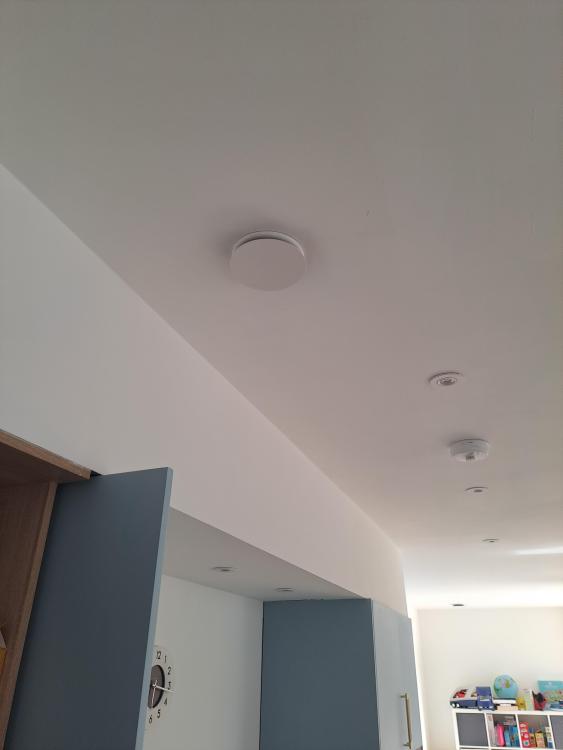
-
It's easy, not much more challenging than wiring a plug. I did my own.
-
Ceiling diffusers for MVHR
Conor replied to renternolonger's topic in Mechanical Ventilation with Heat Recovery (MVHR)
@Nickfromwales I'm assuming he means the diameter of the plenum outlet. I used lindab airy valves with flat plates in white. work well and don't notice them. All you need them to do. -
Stick a dpc and coping stone on the top and it'll bere here in a hundred years. If you don't, you'll get a decade, tops
-
Welcome I knew nothing when I started on this site three years ago. Now, I regularly dispense answers to questions on a daily basis. I still don't know much tho...
-
Get rid of the chimney entirely. Brother had similar issues, spent about £2k on various attempts. Still has issues, and always will.
-
Are they recommending 35mm plastic or 35mm copper? If the former then pretty much the same as 28mm copper. 28mm copper should be more than enough. Are you having flow rate issues?
-
Paving - reduce chance of accidental damage to the roof covering. Will also reduce sound transmission. Assume you think planning will be ok with an overlooking balcony? Some LAs despise them.
-
I checked and never earthed mine. Asked here as well. Not sure if it was the right or wrong thing, but too late to worry about it.
-
If the assessor has assumed a worst case airtightness, and you get a much better result, you may well pass. There are lots of people to blame for this, but none fully responsible. It's the embedded culture of "that'll do", "not my problem" and a system that is rigged by developers . PV is a no-brainer regardless of the air test.
-
75mm or 100mm Kingsland Thermafloor TF70 PIR insulation board
Conor replied to Alex Carr's topic in Heat Insulation
Can you dig deeper? I'd be aiming for 150mm. We put in 200mm (new build tho). I'm not sure 75mm would pass BC. -
UFH with flow problem - how can I confirm flow rates
Conor replied to DeanAlan's topic in Underfloor Heating
Sounds like you've a blockage / restriction in your flow/return pipework to the manifold. Could be any range off issues from faulty / incorrect spec pump, blocked filter etc.