
Conor
-
Posts
4165 -
Joined
-
Last visited
-
Days Won
12
Everything posted by Conor
-
Where is the water currently discharging to?
-
Worked on various projects in the middle east where TSE (treated sewage effulant) is used for municipal irrigation. It's common and perfectly safe for non-crop irrigation. But it all depends on your treatment system and what standard of effulant comes out. Storage, distribution and handling needs to be thought out and designed. To be honest, I'd just get a couple large rainwater storage tanks (e.g IBCs) instead. Two IBCs will irrigate a medium sized garden for a minimum 20 days with no top-up. Tanks, connectors, pump etc will come in at less than £300.
-
A few insights from my ICF build. The planks can only partially bear as you have vertical rebar coming up from the wall below that needs to tie into the next wall. You don't need to seal up the end of the slabs - a combination of the small diameter of the holes, interference from rebar, and by not working the concrete at that point (poker will vibrate the concrete at the bottom of the formwork), it simply won't flow in more than a short lenght if the consistency of the concrete is correct. You won't have an issue unless you are using an overly low slump / high flowing mix. Also, you normally need to bend over a certain number of the vertical bars and break into the planks. Then get grouted in, in order to tie the floor to the wall.
-

Small wall at top of staircase
Conor replied to crispy_wafer's topic in General Self Build & DIY Discussion
I'd just bring out a stud wall to the top step to ~1m height. -
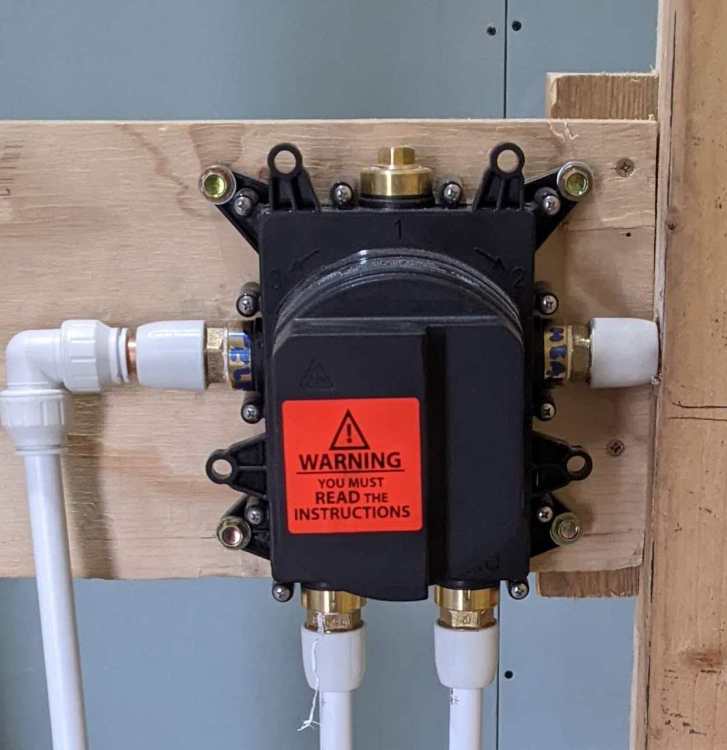
I used the HEP20 3/4 - 15mm push fit directly into my cross water mixer. A bit of PTFE on the threads. No issues 5 years in.
-
Ours were all screwed directly to the icf (amvic). Just need to chase out the cable runs in advance with a hot wire cutter. Battening out is not required, more money, time, no performance gain, and less space in your rooms.
-
Phone Scottish water and they will send somebody out to sort it.
-
Protecting Kitchen cabinet cut edges
Conor replied to crispy_wafer's topic in General Self Build & DIY Discussion
Waterproof PVA 🤣 A smear of silicone Lick of varnish Used all three from time to time and all good options. Waterproof PVA would be my choice if it's MDF, silicone if it's chipboard. -
Concrete washout facilities
Conor replied to flanagaj's topic in General Self Build & DIY Discussion
I made sure the washout area was a spot that would be later paved / concreted over. Each time there was a dump of concrete or cement, I'd rake it out flat and level. Ended up covering a good 20m²+ and 100mm+ thick by the time we were done. Concrete pumps produce a lot of waste! -
Don't do any filling now, give it a year to let any drying/ movement/expansion/contraction finish off. And when you do, rake out any narrow cracks with edge of a paint scraper before filling.
-
Maybe. Pro: longer PRV life Con: likely to get clogged and reduce flow over time. Regular cleaning needed. In water networks, strainers cause more issues and cost than they save. Primarily because once they are fitted, they are forgotten about. Hidden. Don't provide a day to day function, and no telemetry giving any idea of condition or functional performance. If you do fit one, set a reminder on your calender to clean it every 6 months.
-
Garden Wall / Fence Height question
Conor replied to HandyAndyTheAmateur's topic in Party Wall & Property Legal Issues
1.8m from local ground level. no limits on hedges.... Get some 6ft Griselda/laurel/box for fast growing screening. Wouldn't plant this time of year tho, we're struggling to keep our new beech hedge alive in this weather -
Overlapping rebar mesh sheets
Conor replied to flanagaj's topic in General Self Build & DIY Discussion
Key thing is the steel to concrete ratio along with spacing between the mesh. See if you can use this to do a quick check. https://wutools.com/calc/engineering/rebar-calculator -
Welcome. First thing will be to get a drawing from Severn Trent showing the location and details of the sewer. If there are any discrepancies, request they come out and survey it to confirm. Check your property deeds for a way leave. There may not be one depending on the age of the sewer Whether you get permission to build over or not, that's a complete lottery I'm afraid. same for planning. Precedence a couple miles away doesn't really apply, it's what's been done on your street. Best of luck. Ask as many questions here as you like.
-
Does an island need to be fixed to the floor?
Conor replied to saveasteading's topic in Kitchen Units & Worktops
No need to fix down once you get worktops on and fill the cupboards. -
Moving an incorrectly placed soil vent pipe
Conor replied to Bancroft's topic in General Construction Issues
Is it just a vent pipe or is it a function stack? If it's just for venting, bury over it, fit another one somewhere else, or use a combo of air admittance cables instead. -
200mm is a bit out of what you could call a margin of error. we did similar, ended up 250mm too high by the time we got up to the ridge. I made the call to drop the wall plate by 100mm and the ridge by 150mm. So we edend up about 100mm too tall. Could not got away with any more as we set the ridge height to be mid way between the houses either side of us. It depends on your design and construction method, but trimming 100mm off your ridge and wall plate might help you sleep at night. we were building ICF and a panel roof system, sownqs dead easy to make the change.
-
Sticking Aerogel to steel
Conor replied to Great_scot_selfbuild's topic in General Construction Issues
Internal on painted steels. Not a clue where I got it from, was five years ago. -
Sticking Aerogel to steel
Conor replied to Great_scot_selfbuild's topic in General Construction Issues
I used foil faced aerogel, easier to work with and stick down. I think I used double sided tape. -
How do ecology BS value each stage of the build
Conor replied to PSC88's topic in Self Build Mortgages
We (un)subtlety told the surveyor the valuation we needed. He did this on all bar one occasion. -
My architect always said anything within the dimensions of a concrete block would probably be ok with planning.
-
Is there an inexpensive MVHR diy option?
Conor replied to Wadrian's topic in Mechanical Ventilation with Heat Recovery (MVHR)
It's easy. You can certify it yourself with an anerometer and a spreadsheet. I think there is an MVHR design sheet floating around the forum somewhere. Tl;Dr, make sure your duct runs are as short as possible and your diameters are as big as possible. -
How do ecology BS value each stage of the build
Conor replied to PSC88's topic in Self Build Mortgages
Depends on the valuation. The getting out of the ground stage is the most expensive part, but also adds the least value. You really want some walls built before you get the valuer out. Get as much money as you can at each stage. Our biggest regret is not drawing down more!!! -
Bancroft had it well covered, my view as a self builder and as a project manager as a day job. Avoiding a main contractor and managing the build yourself will save you upto 30% of project cost. BUT... Getting trades will be tough. You take more responsibility and risk. It takes a LOT of time as you have to learn and do at the same time. It's much more satisfying. The key thing is to make sure roles, responsibilities etc are clearly defined. "However, a close friend, who I trust, is a self-employed carpenter and runs a carpentry/renovation business with his business partner. They do not normally operate in my area and they do not have the experience/capacity to take on the whole project, but they do have good experience working on renovation projects. My idea would be for him to take on the elements he is comfortable with and help me coordinate some other packages." I would absolutely not do this. Recipe for disaster. Grey lines. No cost control, you take all the risk. You'll fall out when something goes wrong. Much more to it than this but I've no time to say more right now. Something that you'll soon be familiar with 🤣
-
Ohhh don't even think about picking up that phone.