joth
-
Posts
2918 -
Joined
-
Last visited
-
Days Won
5
Everything posted by joth
-
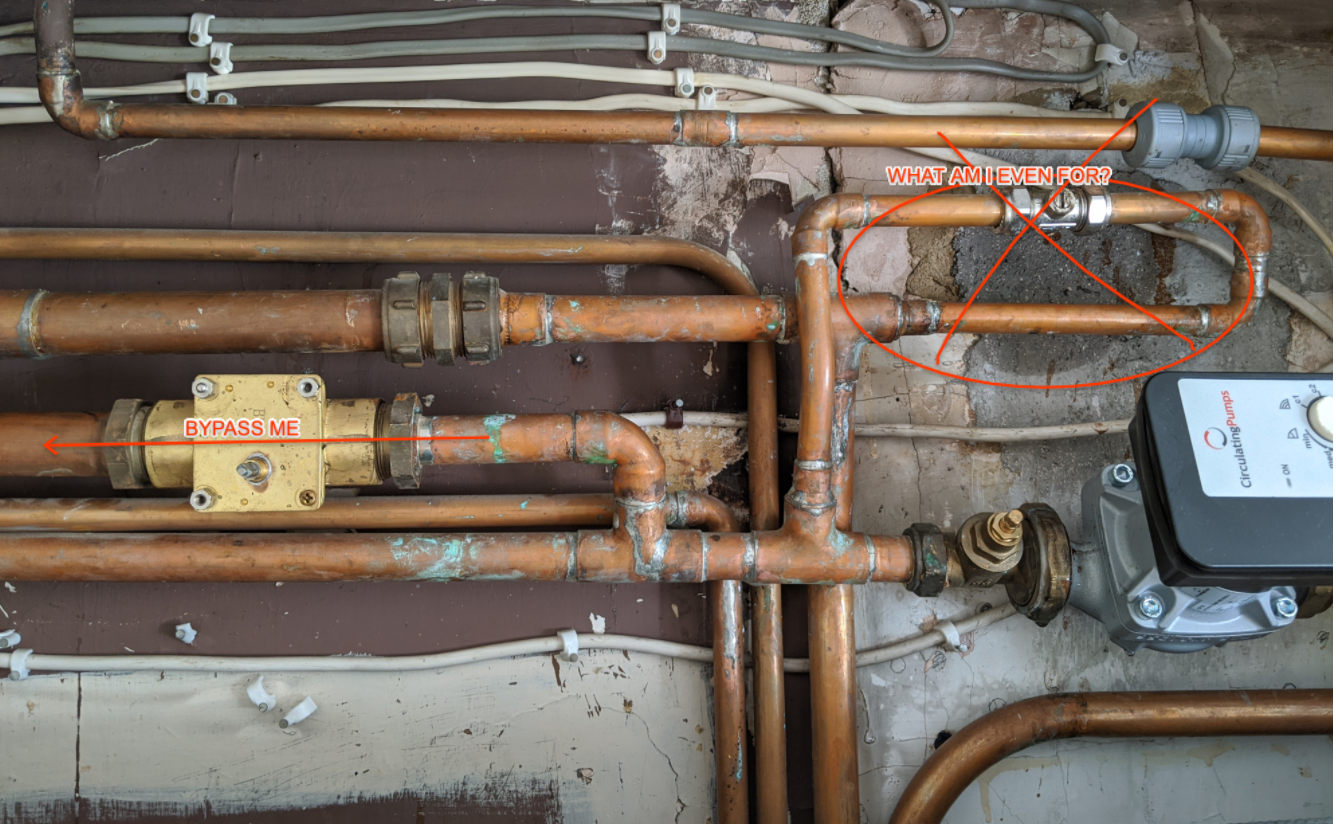
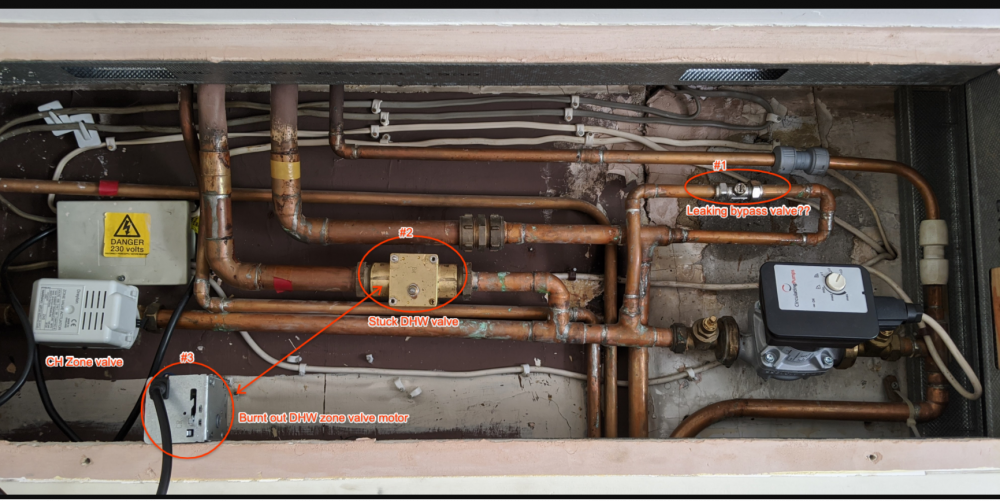
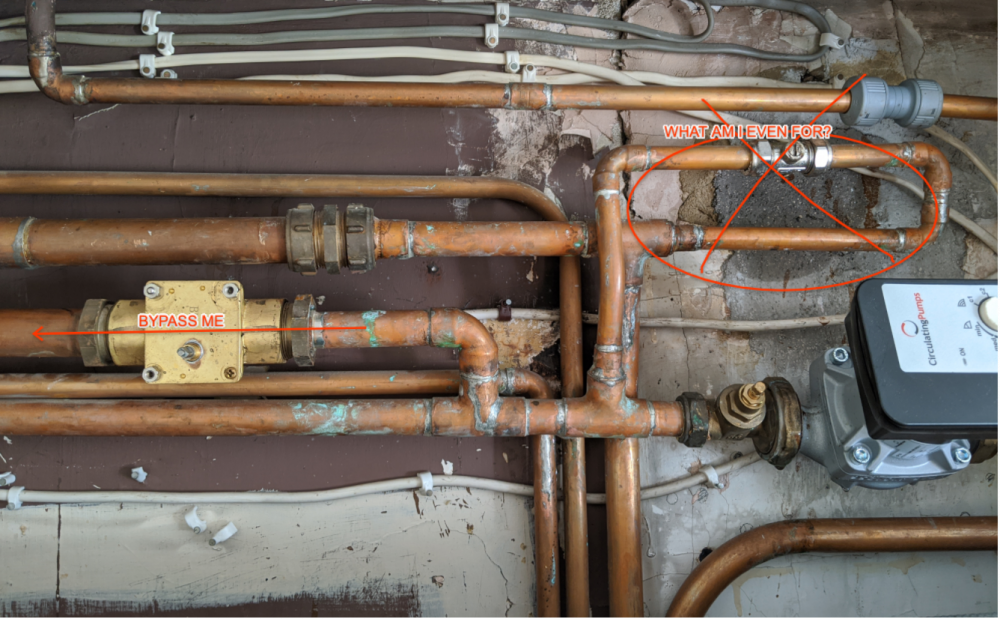
Backstory: I'm renting a friend [and fellow self Builder!]'s house while ours is renovated. Due to COVID delay now looks like we'll be here through to the next heating season so thought it worth getting a gas service, and see if I can get the DHW working again. There's been a long standing issue that the DHW zone valve gets stuck due to an airlock (presumably because of some unknown slow leak somewhere) so we've been using immersion heater for 2 months. The gas man wanted £300 to drain the system so I said stuff that I'll do it myself. The whole house is in line for demolition, so not worth spending much on, this is all Acme Bodgit & Scarper land. However, in my eagerness to investigate I touched a bypass/isolation valve of unknown purpose, that started to leak (video) and dripped all night, so I've now drained the system and am enthused to learn how to solve this, as it is good prep for when our own install happens later this summer. Here's the mess (closer up). And here's my attempt to label what's going on: Plan of attack/ question: 1/ Remove the leaking bypass valve and cap off the pipes. I believe this valve is closed (?) and I don't know what it's for (it seems to connect flow directly to return, bypassing both zones?). For a minimal working system, I don't think we need it. Q: what's best way to cap it off? It's connecting 15mm pipe either side. 2/ Replace the stuck DHW zone valve with straight pipe. What's the best way to do this? It's 22mm on the right feeding into 28mm on the left side. (I *think* I've just about forced the valve into the open position, but hard to be sure it will stay there?) Obviously this will mean we can't run heating without DHW also running, but that's a fair trade off for "just a few months" usage. 3/ Electrically disconnect the (now burnt out) DHW valve head. This seems to have a microswitch in it that needs to be press if (and only if) the timer is allowing for DHW to be on. I think this is S-plan wiring, so I think I can just use the "motor open" signal to trigger the call for heat directly. i.e. connect the Brown wire to the orange wire, if it is following this diagram? In summary: 4/ Bonus question: how to test all my replacement connections, other than fill it all up and wait? Cheeers!
-
It's intended for an australian market, but this article is quite interesting. Aside from learning the fact Australia has the exact same 230 VAC +10% -6% requirement as the UK (wonder how that came about...) they have a few more options for recourse- it seem the rules over there are that if the grid is just at 252V but your local observed voltage is rising above it due to the inverter (and a long cable run from the grid), you can seek permission to set the inverter's trip points slightly higher. This is called Volt-VAR mode, perhaps named after California "Rule 21 Volt-VAR requirements" Another option (both there and here) that some people have been sold up to is installing a so-called voltage optimizer (examples: PV+, EdgeIQ) which reduces the local voltage as seen by the inverter. I truly can't understand how this is morally any better than going and fudging the voltage trip-points in the inverter to be +10% higher, but still these things seem widely recommended upsell by PV companies so I presume they're at least legal and maybe even effective. (They're only good for 4kW though so no use for our planned install.) Finally, perhaps the most practical suggestion is to go for a 3 phase supply from the grid to reduce the local voltage increase per phase. Damn- wish I'd thought of that 4 months ago :-(
-
Many folks on here get by without any heating upstairs (including some that installed it but find they never need to use it). This is what we're planning too, but with some future proofing so we can easily add panel heaters or blown hot/cold air if needed in future. It depends on exactly how much insulation and airtightness the building has as a whole. Are you planning to install MVHR, and have you had any thermal modelling/heat load estimate made? If not then @Jeremy Harris had a helpful spreadsheet that can be used to get a pretty good estimate.
-
A few more unorganized thoughts on this: - the key point of a buffer tank is to simplify commissioning, making differing flow rates compatible. Do anything clever and you've added rather than removed complexity. (Tripley so is using SA as buffer tank) - I've understood the uvc is in the loft, but does the buffer tank need to be there too? Putting it nearer the place that needs heating would be more intuitive to avoid heatloss. This will probably payback much faster (I'm reduced heatloss) than incremental gains on COP for the DHW) - if ubc cold-start reheat times are critical, what are you going to do in summer when the buffer tank is not in use? Maybe consider a larger uvc and don't let it get empty? - with uvc in the cold loft, insulation on it will be important. This maybe of interest: https://www.osohotwater.com/en/domestic/optima-geocoil A rated with "tank in tank" integrated buffer tank. - will you be using a monobloc heat pump? We're putting in a warm loft, but went off putting the UVC there because of the pipe run length to get to it.
-
Why do you want the UVC to benefit from the stored energy in the buffer tank - for speed of heating the UVC, or feeling it will be 'wasted' energy if not used? To the former, the buffer tank is lower temperature so not sure it will make much of a dent in heating the UVC unless it has been totally drained and is stone cold. To the latter, so long as the buffer tank is inside the thermal envelope of the building, the energy in it should not go to waste: this escaping energy is usefully heating the house. This is how I'm reasoning about it anyway ?
-

Thermostat for Electric UFH: recommendations please
joth replied to ToughButterCup's topic in Underfloor Heating
Yes, basically a big relay. Allows a smart home system to control heavy loads. Same for towel radiator control. Fairly easy to drive it with a basic timer switch or something smarter as desired. And you can get them with a manual override switch so still usable when the smart controller inevitably crashes... ? -
Thermostat for Electric UFH: recommendations please
joth replied to ToughButterCup's topic in Underfloor Heating
I'd say 'no' to that. I'm going pretty far with smart home nonsense (or at least, future proofing wiring ready to do so) and the most I'd want for the UFH spurs is a contactor to allow me to automate shutting them off when the house is empty, which also doubles as everything I'd need to automate timing or weather based usage or whatever. Nice thing is the contactor goes at the CU and can be a retrofit when actually needed. The less electronics - smart or otherwise - in the wet area the better. -
Microcontroller & single board computer technology suggestions
joth replied to dnb's topic in Boffin's Corner
It's not that clear cut. If every application had to, say, roll it's on SSL/TLS implementation you'd have several orders of magnitude more zero day exploits. Sure, shared libraries can often be infuriating to work with, and doubly so when it turns out to be the cause of a vulnerability, but some things should not be rewritten lightly. All depends on the libraries in question of course; due diligence certainly pays off. -
Microcontroller & single board computer technology suggestions
joth replied to dnb's topic in Boffin's Corner
My impression is that the "load of libraries" is exactly what it brings to the party - after all it's not just this 'general population' that benefits from reusing already working code. Admittedly I don't have much experience with Arduino per-se, but I also thought it is fairly chip-agnostic these days? e.g. ESP32 seems is also supported as an optional 'core' in arduino https://github.com/espressif/arduino-esp32 I'm becoming quite a fan of ESP32 - I've used them more with tasmota, platformio and mostly esphome. Even if you don't need wifi for a given current project, they're nice and very cheap little boards, and they're so pervasive I feel they're going to be about for a good while, and I was surprised how handy the wifi interface can be useful for maintenance & debugging tasks even if not needed in the core application. -
Sounds like you got further in a morning than I've managed in several weeks with BlueIris so that's very promising (not that I've put a lot of focused effort in yet..) I forgot a nice thing with Synology is it will get a cert from let's encrypt for you, and then it should be good to go for various remote accesses you want to do with it. Certainly should be much simpler than setting this up for remote access to windows which I'm not looking forward to at all.
-
@JamesP thanks that's helpful! It has helped me find their "databook" which has more deatils too. I now also realize they have two active product variants at the moment: PUHZ-W85VAA and PUZ-WM85VAA (note the missing H). The former is MCS listed, but using R410, the latter is not MCS but uses R-32 (and has sligthly better COP for space heating). So another case where RHI is stearing consumers towards the more environmentally harmful choice! (I presume this is temporary, until they get the MCS listing, but that could be delayed in the current circumstances)
-
@JamesP sounds like this is sorted, can I ask is it working well? Do you use it for space cooling and DHW heating ln the same day without trouble? I'd be interested to know is there some documentation or how you knew to use SW2-4? I can't see it in the (UK) manual. (I'm still in the proces of selecting ASHP, the Ecodan looks to have very good COP for our needs, so interested if it has cooling capability too)
-
Here: https://www.ispreview.co.uk/index.php/2020/05/openreach-to-stop-selling-copper-phone-in-118-areas-go-fttp.html Mostly town centers so not going to impact self builders for a while, but, has anyone seen any openreach technical guidance on how to prewire a new build to future proof it to be FTTP ready? There's the obvious"flood wire it with cat6" but curious what their recommendations are for locating the entry and distribution, places where mains would be needed, where does the fiber ideally get terminated, is there even any call for running copper internal phone extensions anymore (I personally haven't for 2 decades, but still) etc. I'm now considering with going with only a Virgin install until FTTP is down our street (supposedly 18 months from now, so could be within a year of build finishing). But wondering how to prepare the external wall for the eventual fiber ingress without ruining airtightness.
-
Is that based on any inside info, or just expression of hope? Not sure when it was first published but the SMETS2 spec was had its last round of revisions in 2014, yet in 2020 still no-one is making/installing polyphase meters to that spec, and with the backlash against smart meters in general I don't hold much hope for them focusing on 3ph anytime soon...
-
Yeah - I went for Raid 10 across 4 drives mostly because my NAS is on Linux and I'm using btrfs which I love, but I don't fully trust its RAID 5 support (and probably never will as it looks like the winds are blowing towards zfs these days). Also I had some bad experience with Raid 5 on my old Infrant ReadyNAS that got slower over time but was a real pickle to convert back from. With the 1019+ my inclination would be same -- even start out with 4 or even three drives in Raid 5, put the NVR on it too, see how that goes and consider how to use the remaining 2 bays as space and speed demands evolve. I'll watch how you get on with interest! I'm sure 8GB RAM is plenty, but having seen the table above the lack of future expansion on this is the only hesitation I'd now have on it. (Full disclosure, I installed Home assistant on a Virtual Box VM (on ubuntu) yesterday , as they're deprecating the docker install I was using, and while it runs absolutely fine the act of carving out 2GB dedicated to the VM did make me twinge rather).
-
Thinking about these Pros and Cons in light of the current situation : - Pro: National bagged plaster shortage means Fermacell has distinct benefit in avoiding wet plastering - Con: Heavy two person lift makes it impossible to work with full sized boards while following social distancing Using half-sized Fermacell boards maybe a popular choice for upcoming projects. (Assuming there isn't a national shortage of these too)
-
It seems to be on permanent discount on https://store.ipcamtalk.com/shop/blue-iris-software/ $57.99 About £46. It's developed by a single person so can't be sure of its longevity, and unfortunate it's windows only.
-
Ah yes, I now recall the online reviews typically rate the Synology Surveillance station as more feature rich and easy to use than the QNAP built in software (e.g. per https://nascompares.com/2020/05/09/synology-ds920-vs-qnap-ts-453d-nas-drive-compare/) but the QNAP works out more economic. But a colleague had used both extensively and didn't rate either that much compared to Blue Iris, which is what pushed me down that route.
-
Well as you say, depends entirely what you're doing with it. 8GB should be plenty to host a Home Assistant installation, for example (the prime thing I'd likely want to do in an always-on NAS).
-
For pure storage, maybe, but the 1019+ has more RAM and beefier CPU so probably better if doing a lot of CCTV or media transcoding or VMs (or combinations thereof) https://nascompares.com/2019/02/15/synology-ds1019-vs-ds918-nas-which-should-you-buy/ has a table half way down that compares a lot of the range:

-
Yes I think if I was starting out from scratch now I'd go for that 1019+. The CCTV licenses have sticker shock, compared to the BlueIris one-off cost for unlimited cameras, but over the lifetime Synology is probably far better choice than keeping a Windows box alive.
-
It's often recommended not using RAID for the CCTV. You'd have to be very unlucky to have the drive go just as someone is breaking in. Another benefit of the segregated volumes is you can use something like WD Purple drive(s) for the CCTV which are designed for continuous write duty cycle. I very nearly went for a Synology 1019+ with 5 bays, so I'd have 4 for RAID10 and one for CCTV. In the end I realized my existing linux box RAID was just fine and not worth the cost of replacing. (Also CCTV licenses for Synology are pricy). I tried an Amthal dedicated NVR but the UI is super clumky and poor remote access so gave up on that. Now settled on a Windows 10 NUC running BlueIris. I'm not yet entirely at home with it, but it's widely supported for HA integrations and extensive power user options so I reckon I'll grow into it.
-
The Luxpower units look very interesting alternative, they even have a hybrid inverter that could take our 8kW array as direct input, although we'd loose out on 3kw of generation when the batteries are full as it only has a 5kw inverter. On balance I think I'll keep the batteries AC coupled just to keep the systems independent. Although the cost savings are substantial; at £950 their hybrid inverter charger is less than the solaredge PV inverter on its own. And having a single app for monitoring both is systems would be convenient Speaking of which, the one potential downside of the Luxpower is it almost certainly has a bunch of built in "phone home" code connecting to a server in Shenzhen I have no control over, for firmware updates and for their monitoring &control app service, which makes me a little uneasy. Not sure what local interface it supports for control, e.g. if it is blocked it off from public internet access.
-
It would be impractical and perhaps impossible to get a Tesla-battery qualified electrician to rewire my home if I'm not actually planning to install a Tesla battery at this point. I was hoping they'd say something more like "it depends whether you want to plan for a partial or a whole-house backup? Take a look at the UK version of this guide, and here's some additional information to help you figure what sort of backup you might eventually need". Answering my own question, I found the comprehensive Installation manual (generic, not UK targeted) here: https://www.tesla.com/sites/default/files/pdfs/powerwall/Powerwall_2_AC_BU_NA-EN_Installation_Manual.pdf Pages 40-48 have detailed diagrams of how it should be wired. Key thing (obvious really) is in a partial-backup scenario you need the powerwall and any solar PV inverter connected into the sub-main board that is feeding the backed up loads (downstream of the backup Gateway). Important to think about the relative locations of these things. As our supply meter, PV inverter and (eventual) battery will all be in the garage I need the sub-main there and have 2 feeds into the house (for grid and battery-backed resp.) Thinking out loud - it'd be nice if I could send both those feeds from garage to house down a single run of 5-core SWA, but it maybe a bit dodgy as they're coming from different boards. ... Unless one can use in effect a split load consumer unit, inserting the Tesla backup Gateway (cutout switch) between the 2 sides such that one half is direct grid supply and the other side is the battery backed circuits, and then send the feed to house from that single CU with a L/N pair coming from both sides. Hmmmm.