


joth
-
Posts
2918 -
Joined
-
Last visited
-
Days Won
5
Everything posted by joth
-
The 17 pages here with no clear answer provided the clear "no" answer for me, as after the thrill of researching and installing the system, I honestly never want to have to think hard about it again, and the risk of unscheduled maintenance seems too high. Likewise I eliminated the Mixergy tank for over-complexity. Getting a reliable knowledgable ASHP installer in our area is damn hard, without making an extra stick for my back. Instead, for better or worse, I've settled on an OSO geocoil: https://www.osohotwater.com/en/domestic/delta-geocoil 300L with claimed 49W heat loss is just over 1.1kWh per day, so not entirely out of the SA domain. But with massive benefit that every single heating engineer in the country will know how to hook it up or work on it, and even if OSO go bust I've got a very good chance of long term maintenance on it, as there's virtually no active components in it. (Much less any cloud dependency, no thank you Mixergy). It's also actually cheaper than the Ecodan matched UVC my installer originally quoted for, so if all goes well it's exceptionally good VFM. Biggest downsides vs any other UVC are it's only available with one immersion heater slot (so I am reliant on ASHP for reliable reheat times, unless I can retrofit a 6kW+ element?), and there's always a risk about longevity and unrepairable nature of VIPs (OSO say it's no more likely to fail that the tank itself leak, and they have 25yr warranty).
-

What electric heating and DHW for small new build flat?
joth replied to Mr Punter's topic in Other Heating Systems
I'll say it once more: put any spare £ you want for hugs from planet earth into insulation. That stuff is hard to retrofit, especially underfloor. This will reduce heating (and cooling) requirements at zero incremental cost over time. Systems changes, PV or ASHP or whatever, can be retrofitted far more easily as/when that becomes economic. But if you've already reduced the total energy demand, it matters far far less where that energy is coming from. To reappropriate the physical wastage slogan for energy efficiency, the priority order should be 1/ Reduce energy requirements (i.e. add insulation), 2/ reuse energy (i.e. increase airtightness and use heat-recovery ventilation), 3/ recycle energy (more accurately upcycle energy: convert low grade energy to higher value, e.g. via PV or ASHP). SAP seems to encourage everyone to think about #3 without doing #1 and #2 first. -
meta comments - you mention "vents etc?" and that got me thinking about MVHR placement and air duct routing, but to confirm the question here is actually solely about ASHP? (co-locating them maybe necessary anyway if going for a fancy integrated heat pump ventilation system, or would like to have flexibility to retrofit one in future e.g. if that tech becomes more commonplace by the time the system eventually needs replacing) - having a North arrow on the diagram could be handy (it's towards the bottom left corner). Some assorted thoughts: - even if using a split system, my gut feel would be to put it beside or as close to the house if possible, all else equal, to reduce amount of refrigerant pipework both for efficiency and avoid stupid mistakes with a future landscaping project damaging the pipework - for aesthetics, the main places I'd avoid putting it are on the "main" access path from street to front door, and anywhere in sight of the prime outdoor seating location(s). As a rule they look a bit ugly, so putting it approximately in the same place you'd keep the wheelie bins isn't a bad line of thinking [assuming you're planning to keep the wheelie bins outdoors, but out of sight] - assuming it's not a massive (dual fan) unit, then it could slot under either the "sitting room" windows in the area you mention, or nestle between them, - another possibility to at least work through to consciously eliminate is putting it on the side passage wall , mounted up above head height. It's not a conservation area so I think this is an option, but could have consequences for neighbourly relations. (hypothetically, if were the sort of folks that make a lot of noise out in that area themselves emptying the bins and emptying the yappy dog each night, you'd probably find the sound of a heat pump would be gentle soothing white noise in comparison, but this is a hard point to make). - wherever it is, you'll really not hear it yourself indoors due to triple glazing and having MVHR meaning the windows don't always have to be wide open. (Likewise the noise of any hypothetical yappy dog will also be greatly diminished) And if all else fails, "own it" -unapologetically sling one of these in the middle of the garden:
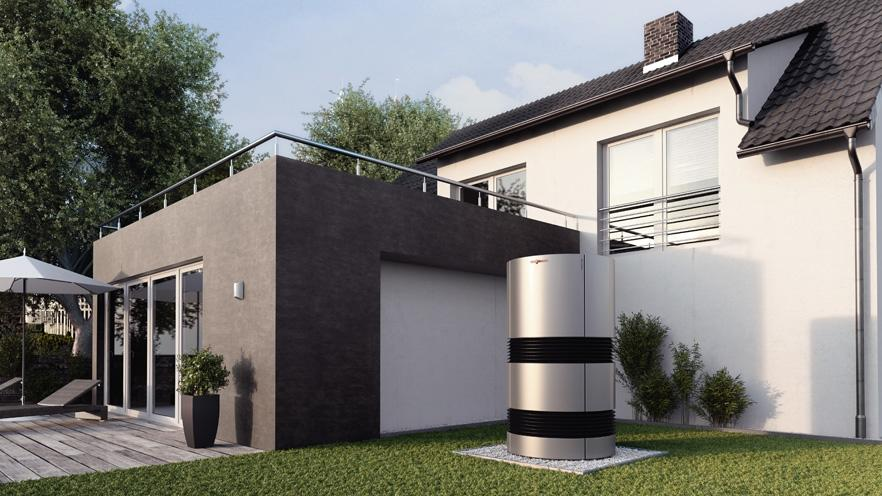
-
What electric heating and DHW for small new build flat?
joth replied to Mr Punter's topic in Other Heating Systems
Just to check this point, is your concern that qualified engineers, parts/replacements or even the delivery of gas itself will become difficult over time? I personally can't see that happening for many decades, as a nation we're so hooked on it, and it'll need a very very significant change in pricing to really retrofit folks off it. If they're paying people to move off it, you might as well go with it now and take the cash incentive when it's offered. (Plus, there is still the slim possibility we'll see CO2 near-neutral gas someday and there'll be no need to do any of this) Obviously if you preference is driven by deeper ideological basis around this point then fair enough (and I'm with you). For low maintenance at a fixed (low) capital investment, and with an eye to minimizing emissions, I'd say put all the £ you can into upgrading insulation, airtightness, reducing the need for heating of any sort, and then go with the very best value for money combi boiler deal you can find. (As a landlord I found a system boiler a nightmare as our tenants couldn't understand a timer switch and had repeated emergency call outs to adjust it. We fitted a combi boiler and never had another issue) Just my 2p worth. -
This is good news! I was planning to use trimless plaster-in downlighters and worrying about the grumbling this would cause, but if the grumbling is expected even for normal downlighters I think we should be fine https://www.mr-resistor.co.uk/item.aspx?i=15768
-
GU10 RGB simple (WiFi?) mood lighting controllable from Raspberry Pi
joth replied to DamonHD's topic in Boffin's Corner
I've done this quite a bit with B22 bulbs, in principle GU10 should be very similar Tips: - I flash all mine with custom firmware that connects to Home Assistant locally rather than use the stock images that have depend on a Chinese server - unless you enjoy a lot of disassembly and look for devices that are known to work with tuya-convert so they can be reprogrammed over WiFi E.g. this review (different bulb) looks promising https://www.amazon.co.uk/gp/aw/review/B078XD699G/R3T8W4VM4IVU62/ref=ask_dp_lswr_rp_hza I've had good success with Teckin https://www.amazon.co.uk/Dimmable-Multicolor-Required-TECKIN-Equivalent/dp/B07K1J1RDS - if you already have Home Assistant, ESPhome has a really easy learning curve and is frankly brilliant. Having originally set out to connect everything via MQTT I've now switched to avoiding if at all possible! - the quality of light from the bulbs themselves is so-so. I find it fine for "accent" or secondary lighting, table lamps etc in portable fixtures where wireless control makes a lot of sense, but for my primary wired lighting I'd avoid them both for quality of the light emitted and general dislike of over reliance on wireless - just yesterday I wrote an ESPhome extension that allows me to control them directly from loxone too, no other bridge or server needed. I'm very pleased about this as if means I can have one system control all my lighting (wired and wireless) from one interface. -
Side comment: during the current pandemic the recommendation is to turn off recirculating ventilation systems and any using rotary heat exchangers, due to a minute risk of a virus being transferred from the extract to the inlet feed via the rotor. Normal heat exchangers (including enthalpy exchangers) are fine. These rules are all for large commercial buildings, fairly irrelevant for a single home but I found it interesting anyway.
- 14 replies
-
- 1
-

-
- komfovent
- rotary heat exchanger
- (and 1 more)
-
I presume you mean barely enough volume, but there's also the limit on flow rate. If you have more than 2 showers in the house, it's advisable to have >1 Sunamp paralleled up I believe.
-
My bad - I'd forgotten or never realised the flush drain and overflow were on different outlets (but it makes sense now I think about it). In this case we only want the drain going to the butt and the overflow can just spill out of the box onto the patio somewhere obvious :-) [I'm assuming the overflow should only flow in very rare cases, i.e. if malfunctioning ] The drain can run 9m and climb 2.4m so that's no problem. interestingly going with this plan, ours will be sited next to the ASHP... I'll keep it out of the 'blast line' of the fan as that could be very cold in depths of winter! I actually wondered if the ASHP feed/return pipes can be fed through & boxed in with the water-softener, as even though well-lagged any heat escaping from them will give a little natural frost protection for the softener. got it. I checked again today and the main has already been fairly well buried in anyway, so I think the decision is pretty simple to just have the stop-cock under the sink and a feed-return loop out to the softener+ outdoor tap Thanks all!
-
Speaking to local Kinetico supplier, their normal approach (i.e. normally it's a retrofit) is to leave the supply and stop cock inside and tee off a loop to the external softener. They typically recommend this for a new build instal too, just because it's easy for people to understand and can easily decommission the softener leaving a very normal "indoor only" setup if desired. Downside is 3 penetrations (mains into house, then 2 for the loop out to the softener and back in) but we save on having penetrations for the outdoor tap and the overflow drain to the outdoor water butt, so it's no worse than indoor.
-
Yes, I preferrer softened for drinking, but we will also have unsoftened tap for those that prefer it (as I mentioned in cons: "we do need an additional penetration to bring unsoftened water into the house")
-
Sounds like the shortages are still quite bad - we've got a few more months to go so hopefully things will improve before it pushes us to make a rash decision like this!
-
Speaking with the Harvey's rep, it's perfectly possible to install their water-softener outdoors, so long as its in an insulated box of some sort. I think Kinetico are the same (as a prebuilt box is available) Has anyone done this, and got feedback? I can see a lot of benefits, especially given the alternative for us is putting it under the kitchen sink - easy to plumb the flush pipe/overflow directly to a water butt, no airtightness penetration needed. - outdoor tap can be connected direct from the softener, again no wall penetration - easy to put the salt in: no need to bring salt into the house or install it in cramped under-sink location - more room under the sink - drinking water coming through the softener will be at a cooler (nicer to drink) temperature - stop-cock etc would then be outside the house, so 100% sure we can cutoff the supply into the house in case of a leak There's only a few downside: we do need an additional penetration to bring unsoftened water into the house, and of course being outdoors could perhaps have a detrimental effect on longevity - although if the manufacturer encourages this config it doesn't seem it could be terrible. Interested in other pros/cons/thoughts.
-
Yes this was it FTC5 Section 4.9 Smart grid ready This is perfect - with a pair of digital inputs I can force it on, force off, or "recommend" on. I don't feel like I need more that that.
-
Thanks @Stones this is also super useful assurance. Sounds good. I think like solar PV inverter and redirect, the real/only interest for me in cloud services is passing interest in the monitoring and performance reporting it might provide. It'd be nice to log this data by time of day, but really not crucial . This is very interesting. The thing that led me to investigation home-autoation integration was another installer was pushing to integrate with Heatmiser controls with zone and thermostat per room. I pushed back saying I'm doing Loxone system with its own thermostat per room, so really no point having the cost of doubling that up, and besides I only wanted one heating zone anyway. They replied that the domestic heating compliance guide requires that separate rooms should have their own temperature control (page 55 of http://www.ukwta.org/pdfs/DomHeatingComplGuide.pdf) I don't think that applies to us anyway, as we're a renovation not a new build, but if it did it never occurred to me that if we did need to comply I could very easily have Loxone control zone actuators at the manifold, completely independent of the whole-house thermostat controlling ASHP on/off. I like it. One other thing I might want to do is give the ASHP a 'boost' signal when we're at high PV generation. The simplest way like you say is to statically programme this into it as "energy is cheap around midday (except in winter)", but I think I saw a simple dry-contact on FTC-5 I can use to enable a boost mode, which is about all the integration I really want anyway. Thanks again!
-
UK Power Networks survey visit; what questions do I need to ask?
joth replied to Thorfun's topic in Electrics - Other
One more tip: UKPN will only provide you one firm/written quote per site visit, however they will give you pretty good cost illustrations while with onsite (at least they did with me). So have in mind all the different scenarios you might realistically want, outline high level needs and you ideas, then work through your scenarios (and any other they suggest) one by one getting example costings for each, then finally decide on your favourite to get a firm written quote written up and sent. There's no commit, You can always change your mind, they'll just have to come out again to make the new quote. Have some paper, pencil, camera etc on hand to take copious notes of what they say as I think they gave 'verbal' example quotes only. (If you're cheeky you might ask them to get a photo of their laptop screen as they bring up each quote). -
Not at all, you've actually been very helpful The fact you have good experience of "bedding it in" without the wifi module tells me I don't need it, despite my natural inclination to go for All The Gadgets. (My hunch is others on here will concur with your choice too, but any counter opinion of it being very useful would be welcome) Cheers
-
Just to confirm, this was "yes it will meet the needs" not "yes I have one of these ASHPs". ? (After this thread, I've made it a minor goal not to ever have whatever the ASHP was that you had ?)
-
Hi @JamesP - as a strong enthusiast of this model, can I check do you have the Wifi module and MELCloud online service for it, and would you strongly recommend it? I'm pretty (OK very) reluctant to my heating system control have have a hard dependency on a cloud service that could be blocked/shutdown at any time, but it's been included in the quote I've got and doesn't seem to cost too much, and if it's handy for the short term (initial setup monitoring) etc then maybe I leave it in anyway even if I plan to replace it longer term. But question then is how one can integrate the Econdan / FTC5 into a local (not cloud) home management/automation system. Presumably having a very simple "call for heat" dry contact is achievable, but would loose most the benefits of having the complex FTC5 controller. Deeper integration (e.g. to relay each room/zone temperatures etc into it) seems very hard (undocumented) with the ecodan products, unlike the German ones that tend to have a range of modbus/KNX/TCP interfaces available.
-
Porcelain prices - are we being taken for a ride?
joth replied to sw879's topic in Wall Tiles & Tiling
There's probably a truism here: the biggest discounts will be offered by the places with the biggest markups to start with :-) -
Oh my, my real ancestral home (although never lived there myself) got relations going back for generations there on all sides of the family. Although of course mostly moved out to make way for all the holiday/second homes. Reminds me, Hockings just restarted trading so I must make a pilgrimage to acquire a 4L tub for the summer as soon as I can :-) Ah good stuff. Only after we moved into our house (invalidating the 'empty clause) did we discover it had been empty for several years, not the 12 months we were told when buying. Couple quick things to be aware of: - you need evidence of continuous unoccupied status. e.g. council tax exception letters are pretty good. - you mustn't do anything to invalidate that unoccupied status, right through until the day your contractor(s) start. - IIRC the VAT discount only applies to the bills (materials + labour) from contactors, not for any materials you buy to install yourself. But if you can make all that work, it will be well worth it.
-
Porcelain prices - are we being taken for a ride?
joth replied to sw879's topic in Wall Tiles & Tiling
Go on then I'll bite What make are they, and where can I get them that price? -
Porcelain prices - are we being taken for a ride?
joth replied to sw879's topic in Wall Tiles & Tiling
you're not paying them a % of the total contract value, per chance? Always have to question the incentives in those situations. We're getting wood-effect porcelain from the random shop at the end of our road that imports direct from Spain, £40/m2 -
Welcome! I'm interested to hear about your project, firstly becuae we're currently mid-build on an EnerPHit renovation (in Herts) but second, my wife and I are from N. Devon and lots of family still there. On the off chance you're in Barnstaple, I think I can make a good guess whereabouts! There's a whole street of NE-facing upside houses that I know quite well. Impressed to hear you have an architect with PHPP knowledge! (Assume it was the architect that did the modeling?). In our project we're also going for ground-floor only UFH, largely based on what I learnt here. A large part of this is that we prefer slightly cooler bedroom than living rooms, so that works itself out naturally. The key thing of a well insulated and airtight house is, unless it's a really odd shape, it naturally converges to all rooms within the envolpe being similar temperature, as it's much easier for heat to move between rooms than escape the house, vs a traditional build. (Hence latest building regs requiring separate zone controls per room is rather misguided in a near-zero energy home; fabric first design often allows for less dependency on technical "work arounds" like this). The first thing I'd think about in an upside down house is what the ground floor is currently constructed of, and how much you're already planning to do to remove and replace it regardless of doing the UFH. For us, the desire to do UFH there drove the decision to replace and insulate the concrete slab, which in turn enabled the decision to go for EnerPhit. If the house was the otherway up we might have made some different value choices which could have led to a very different projects. (BTW we also considered demolish and rebuild, largely because the VAT savings that brings would pretty much pay for the additional work, and if we had done that we'd have been very tempted to propose and upside down design. The main reason we went with renovation was expediency in getting the project underway).
-
in a few instances I can see it being a good way from an existing back box. e.g. a couple places I think I might want to put an alarm PIR in future, but the current alarm co. don't want to put one, initially. Putting in a blanking plate is obvious option, but UK single-gang blanking plates are kinda ugly to put up at ceiling height in full view. Interested if there's a more discreet option. Thinking about it, alarm PIRs don't normally involve cutting big holes into the plasterboard at all, so I'm not even sure yet what sort of outlet/grommet would normally be used for these. I can see I might just end up putting extra PIRs in everywhere I think I could want one, purely to hide the holes with what would otherwise be spare cables hanging out of them!

