


joth
-
Posts
2918 -
Joined
-
Last visited
-
Days Won
5
Everything posted by joth
-
Very useful link. Do you have the Tesla equivelent? "This will only work when the customer has a three-phase meter capable of Net metering. This can be checked with the customer electricity supply company." if only it were possible in practice! But it does seem to suport the general assumption. For more motivation: Germany has a lot of domestic 3ph, and all the German PV and battery manufacturers seem to assume domestic installs have net metering and the SMETS2 spec is based on some EU conventions which Germany surely had a hand in writing, hence why I feel this is the longer term trend even if it will take a decade or 3 for UK to converge towards it.
-
Our PV installer told us to ask an electrician. I asked a few, and the DNO and three different suppliers (ovo, BG, Bulb) and none of them knew. Ovo was perhaps most enlightening as the customer services guy said he had no idea how 3ph export metering was supposed to work, but that they must be complicated as he fields a lot of calls getting an engineer out to put it right. The DNO confirmed that for residential installs they have no expectation or requirement of the usage being balanced a across phases, and billing (inc penalties for unbalanced use) is not in their control. If you go 3ph, one mitigation would be to sign up to the Octopus Tesla energy plan, as that charges the same for import and export so the metering is then moot. Definitely would make sense if the suppliers vaguely supported it! We're having 8kW PV and originally thought a 3ph inverter would be marginally cheaper vs 2 single ph (but not by enough to offset having the new supply installed), but we're having solaredge optimisers anyway and their new optimizer-optimized inverters will go up to 10kW on a single phase in a single box and actually works out cheaper than the 3ph one. On the plus side: inverters only last a decade or so, so you should have plenty of opportunity to change your mind over the lifetime of the house.
-
I wouldn't read too much into that manual, it's for one particular (albeit popular) manufacturers meter that is used in many countries and for commercial as well as domestic installs, hence supports many different metering modes. I found the SMETSv2 polyphase spec easier and more trustworthy, as described here (Tip: search for polyphase for more discussion on it) Snag is no-one makes / supplies those meters yet, and looks like they may never do so, but AIUI existing non-smart domestic installs are expected to work the same way. Personally for a new install I'd plan to install 3ph to the cut out but plan to put a single phase meter on it, unless something truly demanded 3ph from day 1.
-
Thanks all! My architect also pointed me to page 9 of https://www.passivhaustrust.org.uk/UserFiles/File/Technical Papers/BRE_Passivhaus_Airtightness_Guide.pdf which has some good info on this too. It seems like there is plenty of track record on taping OSB3 out there, but you need to know you're getting good quality material and [even more] attention to the detail in taping it. A good part of the attraction of Smartply Propassiv to specifiers and installers is giving a clear brand name and quality assurance around what you're getting and how to work it. Good luck and let us know how you get on :-) Did you have any trouble with getting the tape to adhere, vs any other surfaces? As ours if a retrofit, I'm already concerned about the effort needed in taping around existing joists, so anything that potentially adds additional points of weakness to the joint is my concern.
-
We're using OSB lining for the internal airtight layer on our renovation & extension. I had thought Smartply Propassiv OSB3 would be the obvious choice but just discovered the spec only called for OSB3 and contractor has quoted a basic price, not for Propassiv. They have good experience getting great airtightness results taping on the Propassiv but never done it with standard OSB3 before. I'm getting prices for upgrade to Propassiv, which is my gut instinct to go with, but I'm trying to figure out how much risk we're taking on if we did keep with taping standard OSB? Has anyone here taken that route (or got references to anyone that has) and achieved good results? (Or horror stories!?) Thanks
-
... except their (£450) DALI extension - presumably if only works via that, not KNX. I see they updated the DALI extension data sheet last month (but doesn't mention DT8), do you know if it's a new HW version? (just asking out of curiosity so not urgent)
-
I'm drawn by this rationale too. "Fabric first" philosophy of hw cylinders, focus on high insulation rather than smart tech add ons. (And vitally, no dependence on cloud connection to any server not under my control) Looks like the "geocoil" is their heatpump ready cylinder, but can't find any pricing for it https://www.osohotwater.com/en/domestic/delta-geocoil They do list a UK direct sales info so I might shoot them an email/call https://www.osohotwater.com/en/contact
-
I wondered about this, but when I looked through the WRAS and Building regs requirements it had requirements that if you do this, the DHW secondary return must operate at 60+ deg C or so, and must run "continuously" (or wording around that effect). I could not tell if N hours a day would satisfy this "continuous" requirement, and of course would add another requirement to have the secondary return operate all year even if away on holidays (ah, those were the days when being out the house for a week at a time didn't seem ludicrous). Combined with the excellent points @Jeremy Harris makes on here of the simplicity of direct electrical heating (for towel rads and bathroom UFH) we decided to go that way. To the second part of the question, I'm curious what could stop any heating element work with loxone? Hook them on a 16A relay extension and away you go? I guess a very high end element could have built in smarts that need a manual prodding if the power is removed? So just go for a good value, dumb element.
-
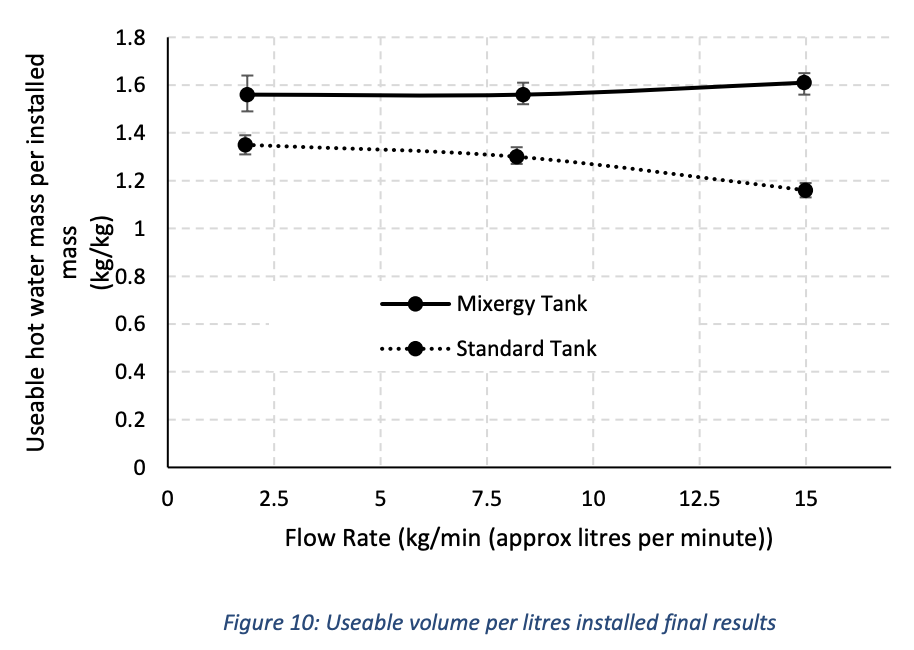
That report is interesting, as it shows that a standard tank's usable volume decreases as the flow rate increases (as expected, more turbulance results in loss of the thermocline), whereas the Mixergy actually has a slight increase in usable volume as the flow rate increases. Any idea why? Couple interesting points on this from the report: - It states: "The Mixergy Tank is a hot water tank that makes use of a novel inlet diffuser and angled heating element scheme to increase the utilisation of stored water within a domestic hot water tank" - It seems they used a Newark tank as the reference "standard" tank (going on Table 7 & 8) so does make a direct comparison of the two - The tests were carried out by Newark on their premises (but under instruction of NPL), so not entire independent, but sure what more to read into that if anything.
-
I've got the older Loxone miniserver with KNX interface built in, so only need the one gateway I was 95% decided on Loxone, but the recent (predictable) change in their online shop, locking it down for partner companies only, no retail sales, has given me cold feet. I already have most of what I need, basically everything except a couple more Touch tree switches, so might keep with them. The alternative is MDT KNX switches, and either use the Loxone purely as KNX->DMX gateway or buy a dedicated gateway. I have 30 channels of DMX triac dimmers from AliExpress, which is a very straight forward solution and seems to work with all the mains dimmable LEDs (GU10 etc) I've thrown at it.
-
Do you have any tunable white DALI LED modules? I have a Merten KNX->DALI gateway which works OK with Loxone, after a fashion, and AIAUI in theory supports DT8 but I don't have any drivers/modules that support it to actually test out. btw I've mostly decided against the DALI because of the costs and additional wiring complexity, so will post up the bits I have for sale at some point.
-
 Just noticed 2 of the biggest passive house certified suppliers have merged: https://www.enhabit.uk.com/enhabit-joins-forces-with-green-building-store/ https://www.greenbuildingstore.co.uk/green-building-store-joins-forces-with-enhabit/ Obviously they both do more than just MVHR, but these seems to be their biggest area of overlap
-
- 1
-

-
KS430 Sliders and Safety Glass Internorm
joth replied to canalsiderenovation's topic in Windows & Glazing
It'll depend on the insurance company, ours absolutely requires all windows have locks, but they specifically say they'll honour claims if we forget to use them. -
To the original question (can I DIY Loxone), the answer now appears to be a clear "No". sigh. At some point since I last looked at their webshop, they've locked it down so now only their Installer Partner network can order direct, and the rest of us have to purchase everything through a partner. At least they still have component prices listed on the website, but that surely can't last very long: next thing will be a hidden pricelist, installers refusing to supply kit unless they're also installing it, and being able to charge whatever markup they fill the local market or your specific project can bear. And then once installed, you're completely locked in with no way to DIY upgrades or maintenance etc. I'd already been paring back the functionality I was looking to use Loxone for, to just the most critical building services like lighting and heating, and was getting familiar with Home Asssitant for less mission critical stuff. But now they've pushed me away completely. Given the current situation, when work resumes I anticipate we'll just want to get the electrics done ASAP so I'll probably scale right back my ambition: make a future proofed wiring plan and come back to it another year with some kind of retrofit.
-
Some recent thoughts on the very subject here:
-
Appeal to keep builder's merchents open: https://www.insightdiy.co.uk/news/leaders-of-builders-merchants-offer-to-meet-with-government-over-potential-uk-support/8226.htm Which implicitly somewhat suggests they're closer to be closed down than I realized. This would be real hit for us; our renovation is currently back to the shell and open to the elements on 2 sides, we'd have to do some emergency boarding & shuttering if we should have to mothball the project due to lack of materials. (The building crew are keen to keep going as long as they possibly can)
-
Sorry I can't directly answer that but I definitely have read on here that there's different categories of permitted development, and even if your PP has a clause to remove PD for extending/improving the dwelling this doesn't remove the other classes of PD. I can neither find that thread nor remember the name of the author, but IIRC it was one of those helpful professional architect types that often help out on this board ? Just to clarify: I have no idea if ASHP falls into which class of PD. That's the crux of the question AIUI
-
I don't quitefollow this, ASHP are still permitted development even in a conservation area, just a couple more restrictions (must not be on or in front of a wall facing a highway)
-
What’s the best and simplest security system
joth replied to recoveringbuilder's topic in Networks, AV, Security & Automation
They will do, but it must be a graded alarm with an annual maintenance contract (recurring fee) from a registered installer that provides an "URN" reference number (one time fee) for the system. Any trigger must be confirmed (two different sensors activate) and is routed via an alarm receiving center (recurring fee) to triage. They have a three strikes policy for false alarms and such like. If you don't want to pay recurring fees, the best you can do is self monitoring with some sort of system that notifies you on your phone -
It would be impractical and perhaps impossible to get a Tesla-battery qualified electrician to rewire my home if I'm not actually planning to install a Tesla battery at this point. I was hoping they'd say something more like "it depends whether you want to plan for a partial or a whole-house backup? Take a look at the UK version of this guide, and here's some additional information to help you figure what sort of backup you might eventually need".
-
Yeahbut my electrician's first question is "what is the Tesla MIs and their technical recommendations"....
-
@Dan Feist when I spoke with Sunamp they were adamant their own testing would be needed due to control systems (in)compatibility catching them out repeatedly with so many other ASHPs. I think I mentioned at the time they could just as well test with an existing Vaillant aroTherm ASHP as surely the control logic would be pretty similar. Agree with the other points. I personally don't care tooo much about the cost implicartions of a legionalla cycle. Between PV eliminating it in summer and an occasional blast in winter (or not, per other views on here) we're talking about pennies really. The hassle of getting formal G3 maintenance once a year is more of a motivation to go Sunamp, plus space saving, but offset by the lack of long-term reliability evidence. I'll probably continue to prevaricate and make a panic decision in a few months based on which suppliers actually want to talk to me at that point.
-
In daytime you need more primary lighting (direct, overhead e.g. downlighters) but in evening secondary/indirect lighting comes more into its own, so +1 to @PeterW's approach of using different temperatures in different lights. Another option we're looking into is dimmable LED bulbs that change temperature as they dim. There was a recent thread on this suggesting IKEA bulbs. Worth a look, very price effective and no extra control complexity needed. Last resort is bulbs that use Bluetooth app to adjust temperature or dedicated Dali fittings that have fully adjustable temperature. They're all are too fiddly or expensive (or both) for me to consider, but a colleague recently redid their whole house with temperature adjustable DALI fittings (controlled from Gira server and KNX) and love it.
-
Similar. For me internorm, GBS and Gaulhoffer were all similar sort of prices, but weru sufficiently more we didn't even write them down in the comparison spreadsheet. (Unlike OP we were specifically after timber+alu so YMMV)
-
Securing PV panels to shipping container
joth replied to NWGEAR's topic in General Self Build & DIY Discussion
Do something with the corner castings? No idea what, but my starting point is to design a grid/platform that bolts to all four corners and install on that, then see how to simplify that idea.
