joth
-
Posts
2918 -
Joined
-
Last visited
-
Days Won
5
Everything posted by joth
-
Wunda seems to be the most frequent choice here https://forum.buildhub.org.uk/search/?&q=Wunda
-

Air-to-water & Air-to-Air from the same unit?
joth replied to HaloThree's topic in Air Source Heat Pumps (ASHP)
It's more common to use air-to-water, and then route the (cold) water through a fan-coil unit or fan-assisted radiator to effect the same. Some folks here also put the cold water through UFH circuit to achieve some degree of cooling, but - going on how many snags and bumps people seem to get with UFH controllers at the best of times - I'd think only an enthusiast would go down this route. -
Welcome! from a fellow Herts-based self builder (well, customer renovator). I can't help with your question, but when you do have an answer I expect @puntloos will be interested. ?
-
Powerline WiFi options?
joth replied to Jeremy Harris's topic in Networks, AV, Security & Automation
Wireless bandwidth is already a finite resource. The demands on wireless bandwidth are already growing much faster than the available allocations are so using that finite bandwidth so everything is focused on getting the best efficiency out of this finite resource. Re-transmitting every packet for each 'hop' of a mesh uses up that bandwidth approximately N factors faster for an N hop route. On top of that, efficient network route discovery protocols perform very poorly (i.e. re-transmit more often; see previous point for why that's a problem) in the face of a constantly changing topology, which is why existing 'mesh' technology only really works for statically located APs. -
Measuring RH and CO2
joth replied to MarkyP's topic in Mechanical Ventilation with Heat Recovery (MVHR)
I just noticed Home Assistant has an action to trigger a calibration cycle: mhz19.calibrate_zero Action My idea is to hook this up to the MVHR so it does a (weekly? monthly?) 20min highest level boost and run the calibration then. It might also work to do it opportunistically when other events trigger boost, but they tend to involve humidity changes so may not be the best time to do it (per @SteamyTea above) and also needs interlocking to ensure the boost remains on for 20+ mins. In the meantime (i.e. before we have MVHR) it's a case of open all the windows up on a windy day, and press the calibrate button. btw most these sensors seems to have accuracy in the 50+ ppm range, so the gradual rise of global CO2 levels is not going to seriously impact their performance until we have much bigger things to worry about. -
Measuring RH and CO2
joth replied to MarkyP's topic in Mechanical Ventilation with Heat Recovery (MVHR)
Quite. I do indeed have that auto-calibration disabled and so also pretty skeptical about the absolute figures on it. I'll try leaving it for a few days and see. https://www.circuits.dk/testing-mh-z19-ndir-co2-sensor-module/ suggests it does include a reference gas chamber (nitrogen) but knowing quality control on these things it could be quite hit and miss anyway. For data logging it's still useful to see variation through the day and from one day to the next even if the absolute numbers aren't correct, and certainly could be enough for triggering an MVHR boost. -
I think one of these would look the part in a wine cellar, and has cloud based Wifi built in https://getawair.co.uk/products/awair-2nd-edition Specifications Dimensions Sensors Temperature -40 to 125° C +/- 0.2° C (+/- 0.36° F) Humidity 0 to 95% +/- 2%p CO2 0 to 4000 ppm +/- 75ppm Chemicals (VOCs) 0 to 2014 ppb Dust 0 to 500 μg/m3 System Requirements Wi-Fi Connection Smartphone or tablet with support for Bluetooth 4.0, running iOS (8 or later) and Android (Jelly Bean 4.3 or later) Free Awair account Wireless Working Wi-Fi connection: 802.11 b/g/n @ 2.4GHz Bluetooth 4.0 Power 100~240V AC, 50/60Hz
-
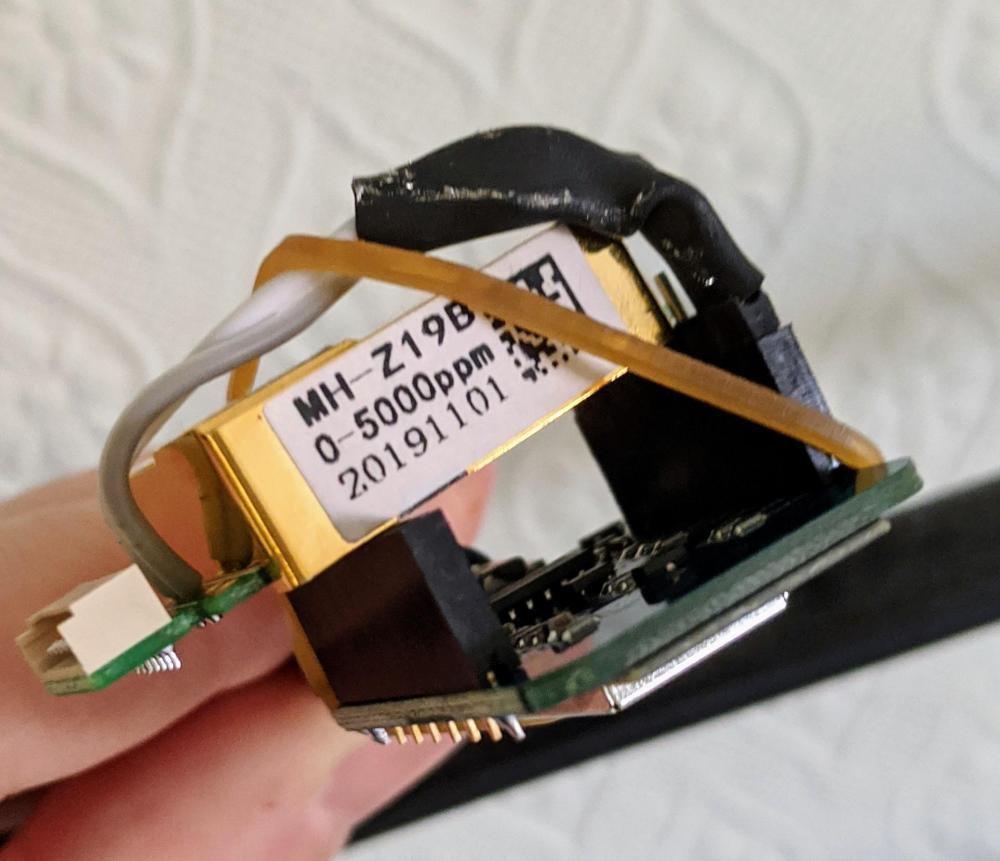
Cross post from the other thread, I built my own using the £17 MH-Z19 : But I just noticed both OPs were after off-the-shelf options ? is there a "DIY CO2" topic somewhere?
-
Measuring RH and CO2
joth replied to MarkyP's topic in Mechanical Ventilation with Heat Recovery (MVHR)
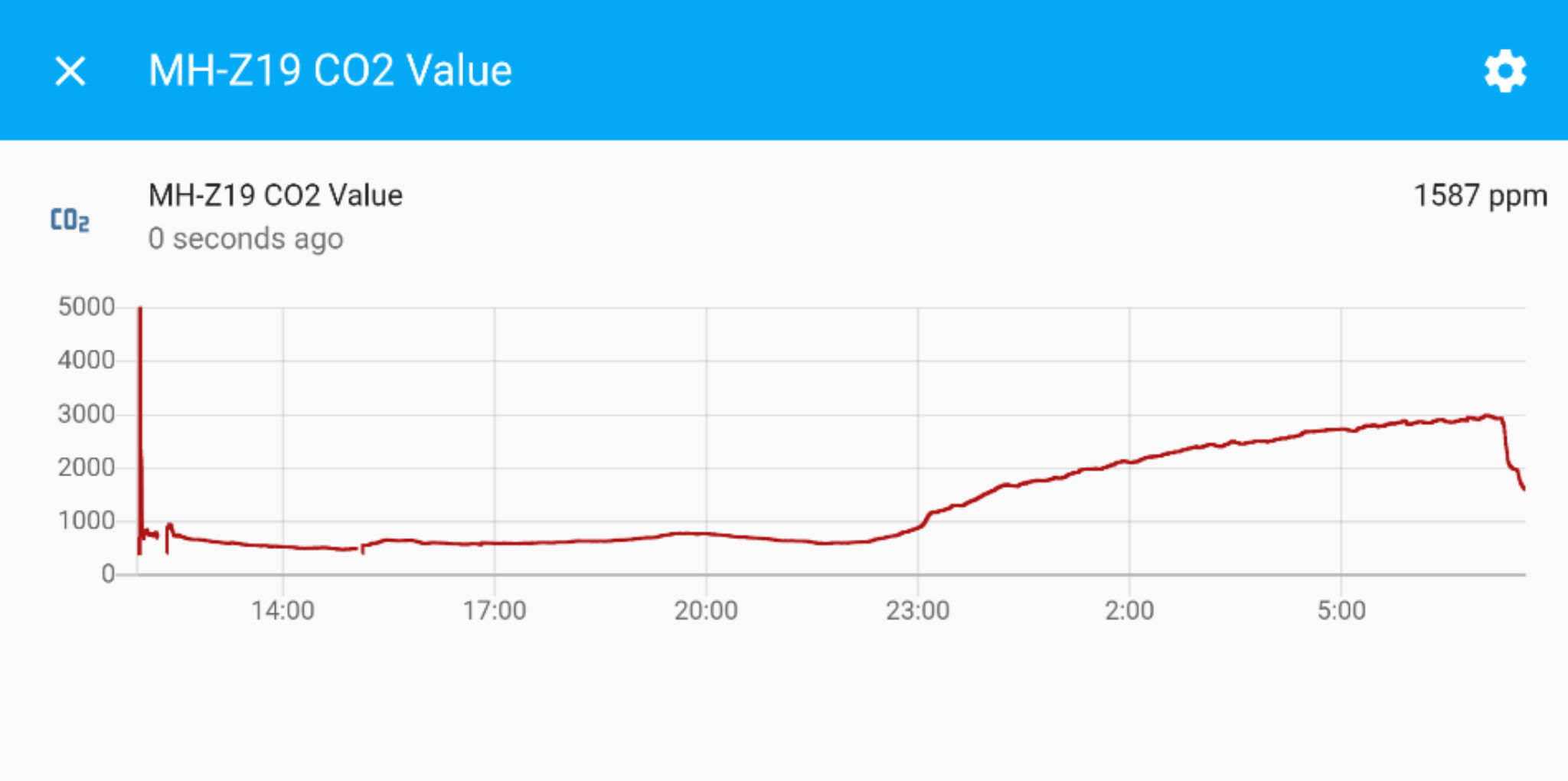
Well that turned out to be a fun Sunday project. I hooked the MH-Z19 up to an ESP2866 (D1 mini) just about within my soldering ability, flashed ESPHome which has a bundled driver for this sensor and the readings appeared in Home Assistant first time. £20 not including the machine that's running HA. As an aside, I did a clean install of home assistant too, using the Hassio docker distribution this time, and goodness it's come along a long way even since May when it looks like I last tried it.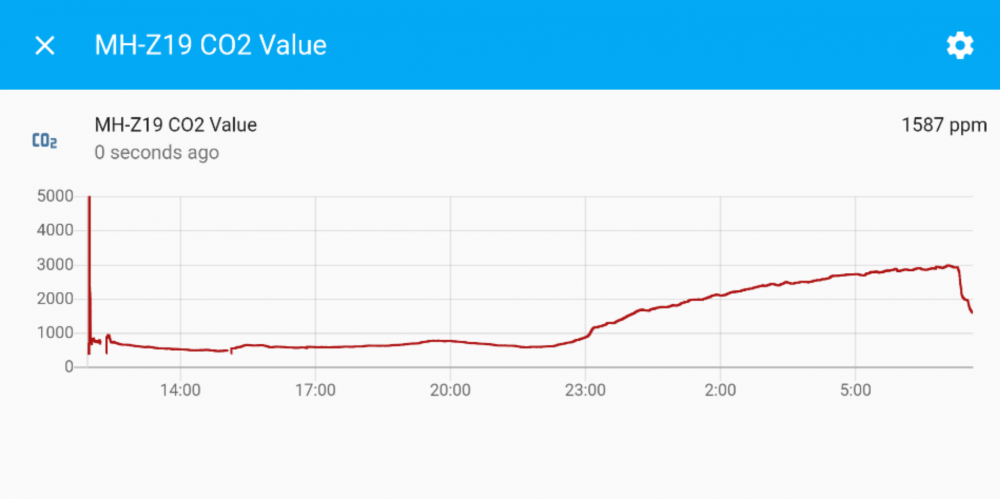
-
Powerline WiFi options?
joth replied to Jeremy Harris's topic in Networks, AV, Security & Automation
I put Google WiFi in my in-laws farmhouse (doomsday era thick walls, need an AP per room virtually!). I prefer wired ethernet for the back haul but used one with mesh and one with a tplink powerline adapter that seemed to work ok after a fashion. (I thought it was failing to bridge between their two consumer units, but actually it was just that it was plugged into a surge protector extension that actually did a good job of filtering out the signal. Straight into a socket was okay) Google WiFi is very easy to setup but you'd hate it as it's all cloud managed. The access points were all hand me downs from my own home as we just upgraded to Unifi Ubiquity which I've been very impressed by. This has very nice SME features like load balancing & fail over of WAN connection, VLAN and multiple SSIDs*, and turns out their nanoHD APs have extremely good range too. It can use WiFi mesh for backhaul but they really are much better with wired PoE to each node. Definitely works out more £ than your average DSL router. Their new "Dream Machine" is a bit more like a conventional consumer router I guess, but with a clear upgrade path to e.g. add the long range or building to building APs to it as needed, all managed as a single installation * - I wanted this so I can put CCTV cameras and dodgy IoT stuff on their own vlan without internet access -
Yeah I'll be putting a bunch of ducting in, but for the main run into the wiring cupboard I wanted to know I had the actual cable in place already. Likewise we're tearing up the front garden for a new soak away so seemed a sensible time to drop the cable into an open trench. The openreach cable also got chewed up so had to put additional duct in for that to be rerun too, after all.
-
Kitchen firm that can accept CAD drawings?
joth replied to Carrerahill's topic in Kitchen & Household Appliances
My architect uses Revit 3D but she can make 2D DWG exports, my kitchen designer is an ex architect and said she can work with DWG. After a few rounds of "what scale is it" and "no measurements are showing" and other import errors I gave up and requested the architect make a PDF with absolutely every possible internal dimension marked on it. That seems to have been more successful. Without access to all the packages used it's near impossible to debug what was going wrong from my position -
How far are current Building Regs from Zero Energy House?
joth replied to Ferdinand's topic in Boffin's Corner
That's quite a read. The plan for zero carbon is to remove building fabric metrics and just estimate primary energy use. It's a "Fabric last" approach; build it cheap then cover it in solar panels until the CO2 metric passes. -
Like most things, I only know what I learnt about them on here The horizontal main drain needs separate venting somewhere. Ours is planned to be in the attached garage, which I'm now a bit concerned will make that stink. Etc https://forum.buildhub.org.uk/search/?&q=Aav
-
Soil pipes don't tend to require open venting these days? Use a Durgo/AAV instead https://www.designingbuildings.co.uk/wiki/Air admittance valve
-
Answering my own question in case it's helpful to others. 1. Sign up to a virgin broadband 30 day rolling contract, select the earliest available install date during sign-up 2. Wait a couple days and hopefully they'll pull the external cable from the pavement up to the boundary (or throw through the hedge in our case) along with some green ducting 3. Phone up the cancellation line and click through all the menus saying you want to cancel until you get to a human that is motivated not to lose a would be customer 4. You could just cancel now, or Explain your house isn't built / has no electricity, you need to defer the instal for 5 months but you'd like a pre-install survey and have them bring a roll of internal cable for internal prewire 5. If they drop off the internal cable within 14 days you can then call up can cancel under remote selling terms for full refund, Or just leave it with deferred full install for 6+ months time. During the visit they also confirmed that while they normally put the splitter outside for multiroom install, they can bring a single cable into one location and do an internal splitter there which is better for a 1st fix prewire and reducing airtightness penetrations
-
Also when did you buy them? Maybe also have a look at this thread? And https://forum.buildhub.org.uk/search/?q=Salus
-
The Salus installation manual says if you power on the actuator for 20-60secs then power it off and wait for LED to light then power it back on, it will enter re-calibration mode. That could make it behave weird. Is the Heatmiser more likely to trigger that sequence for some reason? Does it try and do its own actuator modulation maybe?
-
Indeed. nothing specific was spotted in the ground to suggest it, but just cited the theoretical risk of drift. The compounding factor is the original SE that signed off the design has since retired (ill health) and the next SE consulted agreed with the inspector, which left us rather high and dry. Interesting idea. The previous plan was 0.127W/m2K everywhere which is already good enough for EnerPHit+ anyway...
-
Well it was actually very opportune timing for this thread to pop up this morning! Just after reading this I attended a site meeting to discuss issues with the ground works for the extension - digging was completed once for a 200mm raft foundation for timber frame, but building inspector had a change of mind and has now decided it must be done as strip founds to match the existing house (Easy to be fickle when it's someone else's money eh? Best bit is we even get to pay VAT on all the wasted work too. But I digress) Anyway, long shot is we need to raise the level back up by 100mm as it's no longer a structural raft slab, and having paid to excavate it I was reluctant to pay more on MOT to fill it back in. Having just read this posting this morning I thought why not put more insulation instead. Architect and contractor all agree that's a goer. So now the plan is (top to bottom): 75mm cement screed extension 260mm Celotex / main house retrofitted with 160mm Celotex 100mm slab From what I can tell Celotex is no more expensive that MOT anyway - maybe it's actually cheaper, lets see.
-
Another idea: look what burglar alarm system the house has (normally printed on the external bell) and contact them. Often door entry systems are part of an alarm/CCTV package.
-
Yeah my guess was DoorBird, also German, kind of a nest/security intercom cross over (as the name suggests), but I can't see they do them in black. There's plenty of other possibilities, Hikvision make several door intercoms too. What I really can't tell is what's going on with the pedestal it's set in. Is that a parcel drop box too? Maybe integrated with the camera and enabling remote open when the delivery driver calls? If so, neat idea, surprised they're not more readily googleable.
-
Not sure I follow why this is a major issue? If the buffer tank is only used on the UFH circuit then it will only be hot when the system is calling for heat, which is exactly when you want to be adding heat into the building....
-
Also following as it's likely I'm going to end up in this situation too. (And thanks you @Jeremy Harris for the useful info as always!) Just to clarify, is this "shouldn't" because it is unsafe or against regs to do so, or just a shouldn't because it will be frustrating and inconvenient to the user for the double-trip reasons given? Also, if you put RCD or RCBOs on all the downstream / sub-main circuits is it then OK to remove the upstream earth leak protection? Or does this then trigger potentially more upgrades need to the cable between the two? (i.e. upgrade to double protection/armoured? Or should that always be there anyway for the feed to a sub-main distribution board) [also to clarify I'll be having a certified person do all the work, just find the conversations go so much easier if I already know what I'm asking for is within regs]
-
I've had a recommendation to look at Amcrest products for a good value alternative to Hikvision (the latter being caught up in some of the ongoing USA Vs Huawei conspiracy too) Like Hikvision, you can use Amcrest cameras with BlueIris (Windows), Synology Nas servers (surveillance station), or with their own NVR. I see Amcrest have recently released a nice looking doorbell too, looks one the the best received camera doorbells that are local only / don't require a cloud service Caveat: I've not tried any of the above yet. Just building my own shopping list.