Dudda
-
Posts
487 -
Joined
-
Last visited
-
Days Won
1
Everything posted by Dudda
-

3G glass supplier for fixed rooflight
Dudda replied to divorcingjack's topic in Skylights & Roof Windows
You could look at velux commercial rooflights. Not the rooflights for houses but their modular skylights system. They have single fixed rooflights up to 1000 x 3000mm. The advantage is you get all the flashings, glazings, curbs, upstands, everything from one company so you get a full guarantee for everything. https://www.velux.ie/professional/products/rooflights-roof-glazing -
I'd be cautious any claiming lifetime or similar. I've used them in a few public buildings, halls, churches, etc which have exposed timber ceilings. These products need to be reapplied after a few years and the issue I see is how do you repaint the back of them? You're leaving gaps between them so the fire will go up between the gaps and light the back of these boards. To be fair it's probably find for a small single storey residential property but no way I'd use that detail in a public building I'd have to sign off on.
-
I think the best option is to make the timber fire rated rather than a layer behind the timber. This will stop the spread of flames across the ceiling and can be done in two ways. Paint the timber with intumescent fire paint. You can get this in a limited number of standard colours and clear varnish. Custom colours are available but costly. You need to repaint this every few years to keep the fire rating. The other way is to get the timber pressure treated with a fire retardant. This is a much better solution as it doesn't require maintenance and you get a certificate from the manufacture that it's fire rated for your building control officer. From an aesthetic point remember the timber will make the ceiling look a lot lower than the traditional white plaster and it will make the room appear darker.
-
Wow you have done your research. Saying all the right stuff and little I can disagree with there. Welcome.
-
Slide something thin like a piece steel or aluminium sheet, MDF or if you've a hobby cutting mat that would be ideal between the VCL and insulation.
-
Cut back the foil to 200x200mm but leave the VCL 185x185 or smaller if you can. You should have 15mm now of exposed VCL. Use an airtight mastic like Orcon-f to fix the hood to the VCL. Don't use silicone or foam and don't fix the hood to the foil. It should be fixed to the VCL.
-
Welcome Andy. I made contact with you a few months back during detailed design on a house I'm designing. All going to plan I should have my first of many Sunamps in about 3-4 months. The building regulations here in Ireland require you to have renewable energy with most opting for PV. Ireland doesn't have any FIT so a lot of generated energy is wasted from the owners perspective during the day. Sunamp is a simple way to utilise more generated energy and I think the market here is therefore very large but nobody has heard of Sunamp.
-
I one I got either a year or two ago (not sure) but it doesn't have a forward / reverse. The knob also has three options; chisel, hammer drill and drill. That newer version looks to have four? It's brilliant for the price I paid for it. I've really pushed it over a variety of tasks and it's held up very well. Will get it for my Dad as he keeps borrowing mine.
-
I think you need 5 minimum for some jobs. eg when I was recently fixing battens as part of internal drylining. Laser Level Impact Driver Drill for masonry holes Circular saw / jigsaw One charging I have a radio which also uses the same DeWalt batteries but don't count this as critical. If a radio is critical or if the batteries don't charge that fast or you're very fast and go through batteries faster then you need 6 batteries. So I'd say 5 batteries or 6 if they're low capacity. edit: My rechargeable lights have an inbuilt battery so didn't think of them.
-
Internally the 15mm OSB wouldn't be as airtight as the 12mm VapourBlock OSB. I wouldn't go changing that considering this is your airtight layer.
-
Over time the straight edge would chip and become unsightly. The bead gives a minor bit of protection.
-
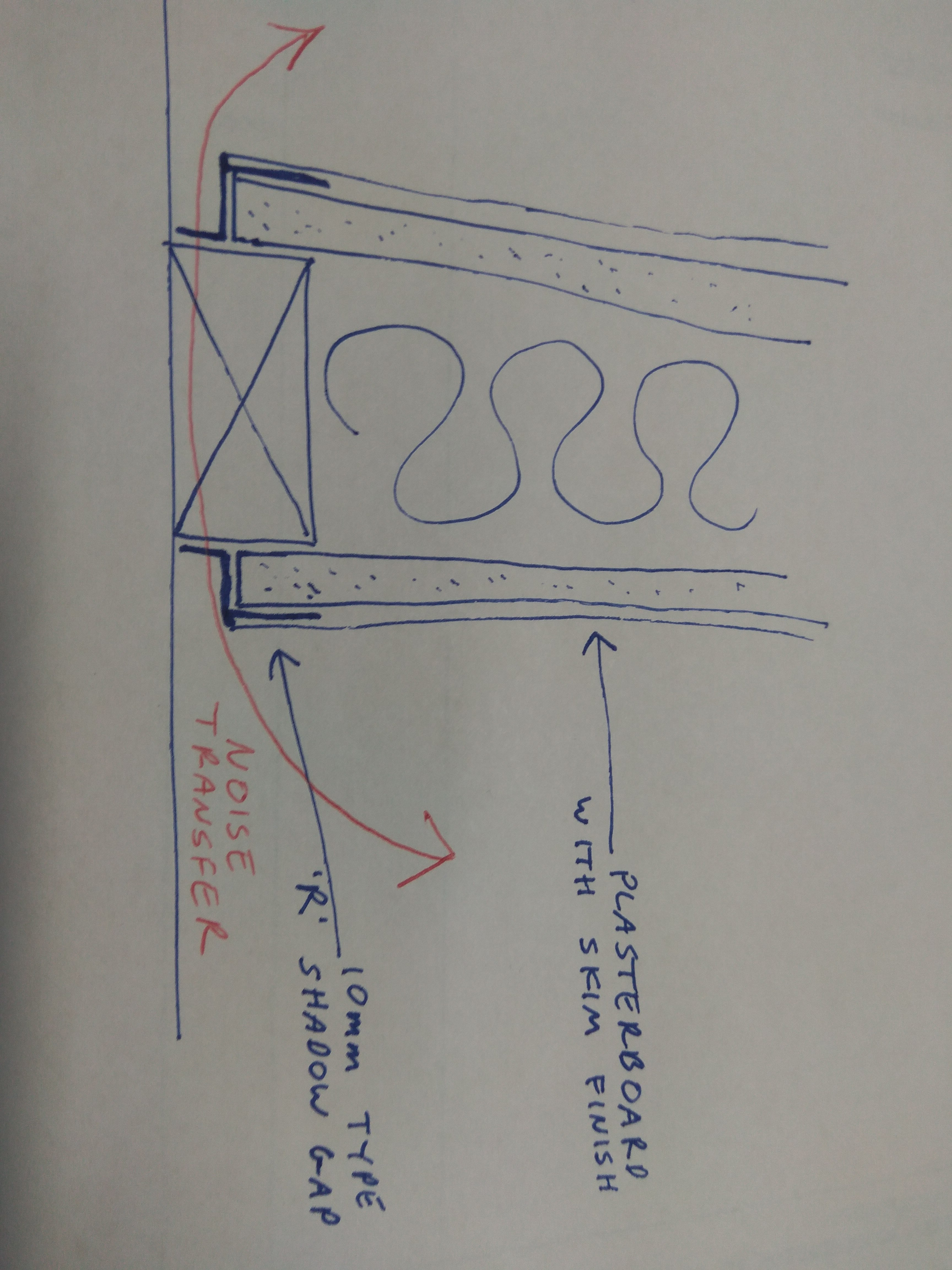
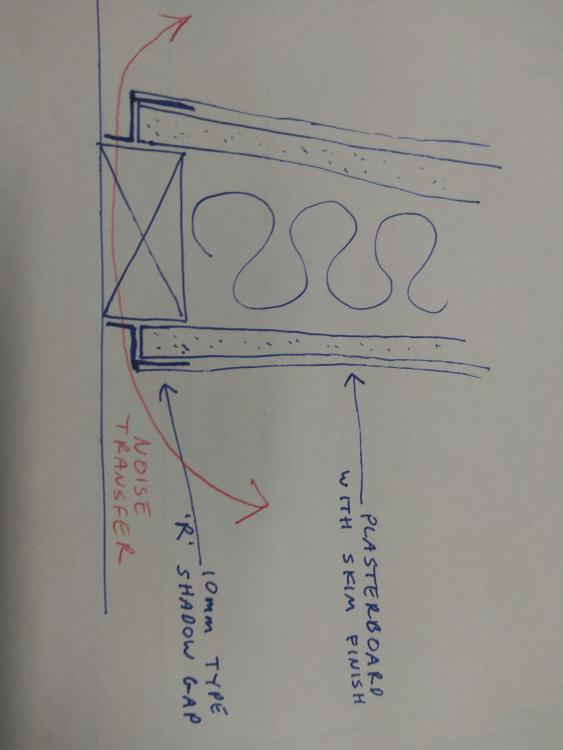
I’ve specified shadow gaps in a lot of projects and like IanR above for aesthetic reasons. They look so crisp and sharp. They’re more expensive than skirting and architraves if you use painted MDF. If you’re looking at shadow gaps v’s some oiled oak skirting and architraves or similar then they work out cheaper. You also need a good plasterer. I’ve seen a lot of crap shadow gaps as if they’re out by a few mm it really shows up. You don’t notice a good shadow gap but you can’t avoid a bad one. Always use aluminium trim. Don’t use plastic and check on delivery if you’re buying them for kinks and bends and they’re easily damaged in transit. I always use Type R instead of Type D and don’t use the 6mm as it’s too small to get accurate. On internal stud walls you’ll have to think about acoustics if you’re only using one layer of plasterboard. The trim can be an acoustic weak point and may need to be bedded to the frame with an acoustic mastic to help noise control. See below sketch. Not sure if you can rotate images after you attach them so sorry.
- 39 replies
-
- 2
-

-
- shadow
- shadow gap
- (and 1 more)
-
I wouldn't bother and I'm struggling to see the gap in the photos. It's a continuous sheet of OSB behind I presume so no room for any wasps or bees to make a nest IF they can even get in. In a vented cold roof the vents and grills are circa 3mm wide and you don't get wasps or bees making nests behind them. I'm sure you've a million and one other jobs so I'd skip this and move onto the next.
-
I think you’d be mad to go messing with it. Aren’t you thinking external insulation long term? I presume that will cover this room you’re on about so I’d wait until that’s done and then see what’s required heat wise. Would you not finish the bathroom first?
-
Welcome to BuildHub Simon. I didn't realise there was a trend for 2017? I don't think doors are like Kitchens or Bathrooms where you have a trend. I suppose you could argue thermal performance was a factor?
-
Steels: paint, galvanise, avoid?
Dudda replied to ToughButterCup's topic in RSJs, Lintels & Steelwork
If you can taste salt in the air any time of the year you need to galvanise it. We tried to save money on a university building for exposed steel columns and got the best paint available which was factory applied and its showing signs of rust now which is 5 years later. Project is 3km from the sheltered bay, about 4km from the sea. Last year on another building on the same university campus we galvanised everything, even some steel immediately inside the front door as the door might be open a lot with all the student traffic. -
Have never dealt with Karndean as it’s not as popular a brand in Ireland but Forbo and Polyfloor do almost identical products and I’m very impressed with them. All these wood effect vinyls have come a long way in the last 5 years. Used them in a high end fashion flagship store which has heavy use and also in a Hospital. The area in the hospital was a family room so wanted to create a comfortable relaxing environment away from the clinical hospital environment. It had to pass a load of infection control, maintenance and heavy duty traffic standards that timber and tiles (due to the dirt building up in grout) couldn’t meet. Planning to use it on two more hospital projects next year and possibly some student housing. Very impressed with how realistic the wood looked and obviously all the above uses are heavy traffic areas. When looking for a house or site it's location, location, location but then it's samples, samples, samples...
-
The heat loss from a window is the u-value. The heat you get into the room from the sun is the g-value and a low g-value reduces the amount of solar gain. You want something with a low u-value (to reduce heat loss) and a higher g-value (to increase solar gain). The third figure is the Tv value which is the amount of light (think bright room) that gets in. With a lot of glazing this isn't an issue. It's a balancing act. Here are some examples (they will vary from company to company so using them as a guide only): Glass type and designation Structure G Ƭv U (mm) [mm] [-] [W/m2 K)] Single glazing 4 0,87 0,90 5,8 Double glazing 4/ZR/4 0,78 0,82 2,7 Triple glazing 4/ZR/4/ZR/4 0,67 0,72 1,9 Double heat protection glass, coated 4/ZR-AR/b4 0,63 0,80 1,1 Triple heat protection glass, coated 4/ZR-AR/4/ZR-AR/b4 0,50 0,71 0,5 SOLAR + triple protection glass coating 4/ZR-AR/4/ZR-AR/b4 0,62 0,73 0,6 Looking at the above if you had standard double glazing you'd have a g-value of 0.78 which would be good for solar gain but that u-value is terrible. It would almost loose heat as fast as it gets it. For standard triple glazing you've a g-value of 0.67 but a poor u-value of only 1.9. The top spec triple glazing with a SOLAR layer has a g-value almost as close at 0.62 which will let almost as much heat enter via solar gain but a very low u-value of 0.6 reducing heat loss considerably. In short I think you're far better off sticking with triple glazing but getting a high g-value (circa 0.6), low u-value (circa 0.6) and using the internal doors in summer to stop the house overheating.
-
People usually put the first layer between the ceiling joists / trusses which prevent compression of that layer. The next layer rests on the timber as it's laid at 90 degrees. You therefore don't really have it crushing itself providing the first layer is between timber.
-
If money isn't an issue then I'd go with cellulose. It won't cause any issues. While cellulose is superior than earthwool and a hell of a lot quicker as someone does it for you in a day it's one of the decisions where the additional cost to additional benefit ratio isn't great. I put in 500mm of earthwool instead of 400mm of cellulose which gave a better u-value and still worked out a lot cheaper. It wasn't hard but did take me a while though (three layers). It's a decision that doesn't have a wrong answer if you ask me.
-
Is it block or timber frame? If timber then cellulose would be better due to the decrement delay but if it's block earthwool or similar is good enough if you're looking to make savings.
-
It's in between the UFH manifold and the black plate heat exchanger on the other photo. It has a white circular cap and two white stickers on it. You can just about make out 'Willis Jacket' on the top sticker.
-
What does First Fix really mean?
Dudda replied to ToughButterCup's topic in General Self Build & DIY Discussion
I’ve tried to put them in order: Soil Pipes, Waste pipes, Copper pipes, MVHR Ducts and cable trays together or at least coordinated, Hep2O pipes, backing / support pieces (eg for TV’s or WC cistern in stud walls), electrical back boxes, cables, door frames (if going for shadow gaps only otherwise later). -
Did they ask to bring a model to the meeting? I’m not sure I’d bring any and definitely wouldn’t give them any model to keep. I’d only really present models to the client and try not to present them to planners. Remember nobody except the local flying club will ever view the house from the angle you’ve shown above but it’s the view everyone will have at a meeting. You’d be better off taking a photo from some view and then if you could do a Sketchup model (or a more advanced 3D rendering program if available) and insert that into the image with Photoshop you’d have before and after photos. This is the way we present to planners always as you get to decide the view and pick an angle which would be favorable to the design and scale. Print these up large enough, eg A3 or bigger, and mount them on stiff card so they look professional and are easy to handle. You also get to flick through them like flip cards and control the presentation explaining the concept and challenges rather than them jumping ahead. They can see how it will look in the landscape from eye level where it will be seen when finished. You can find people online who can create these photomontages for you cheaply and quickly if you want or if you’re architect is to costly.
-
I converted a church which finished about 3 years ago for a client. Planning took about a year, detailed design about 5 months and construction was about 10 months. It was a big job (over 2 million) as it was a big stone church and over 100 years old but I’m sure some of the same principles will apply. You’ll need a good architect and possibly a conservation architect. These points are in no order and just as they come to me: Meet the local priest We met with two of the local priests during the design stage. The church was closed about 6 years but still had some religious items stored in it. It was critical to get an inventory of these done up and see exactly what the church wanted to keep. eg some timber pews, old damaged organ (dump), statues, altar, etc. It was also important to get their ‘blessing’ as we didn’t want any objections from locals who could claim we destroyed their former place of worship. The planners should also want this recorded and a photographic record of the building submitted with planning so it can be kept on file. Meet the planners We met the planners, local authority conservation architect, heritage, etc several times before lodging our planning application. They were reluctant on some of the more modern interventions so planning and design took a while. We also had trouble with fire (a huge exposed timber roof, timber wall paneling, original doors we were retaining which we'd restore but which wouldn't be certified as fire doors, etc). We just had to sit down and work through the items with them. Opening up/investigation works On a building this old you’ll never know what you’ll find. Get a local builder in for a few days to carry opening up works in about 10 places, floor, walls, roof, etc. You’ll get to see the build up, condition, etc. eg what state the roof timber is and what’s the build up. We found lovely original red brick and glazed tiles which were hidden behind some modern chipboard installed in the 60’s. This allowed us to include drawings and restoration specification into the tender package for builders. Another item we did during the upening up works was a drilling core test to check the load bearing capactiy of the existing floor. We knew we wanted a mezenine or second floor but wanted to know if the existing floor could support it (it couldn’t). Knowing the bearing conditions meant we knew before going to tender how much of the existing floor would have to be removed and how deep we’d have to dig. Light & Ventilation A key problem for us was getting light and ventilation into the church as it had original stained glass windows we couldn’t touch and didn’t want to go knocking giant holes and MVHR grills into the walls. We carried underground ducts under the floor and outside about 4-5 meters from the church where they took in fresh air hidden in a sloped bank. We then used rooflights on the non visible side of the church which was by chance south to let natural light in. Services We were close to electricity, mains water, gas, fiber internet, etc. but did have to coordinate these. As it was a protected building we got permission to build a concrete pillar a few meters from the church (close to where the ventilation ducts terminated around the back) where we installed the electricity and gas meter. We didn't want an electricity or gas meter fixed to the side of the church. This coordination did take a while and almost delayed the project. Bats & Birds Old churches are well known for having bats and birds resting in their eaves. We had some really rare bird which only nests in historic buildings. Ensure you've done a bat survey prior to tender and try and cordinate roof works outside the mating season or whatever season you're not allowed. We ended up having to phase the roof to ensure it was finished in time to allow the birds build their nests again in early spring and then had to move hoarding as it obstructed the flight path. Some things you have to do to please the local conservation and heritage officer. I've loads of other info but this post is already getting long. The project ended up winning an architecture award so if you want more info I can PM you.