mvincentd
-
Posts
495 -
Joined
-
Last visited
-
Days Won
1
Everything posted by mvincentd
-
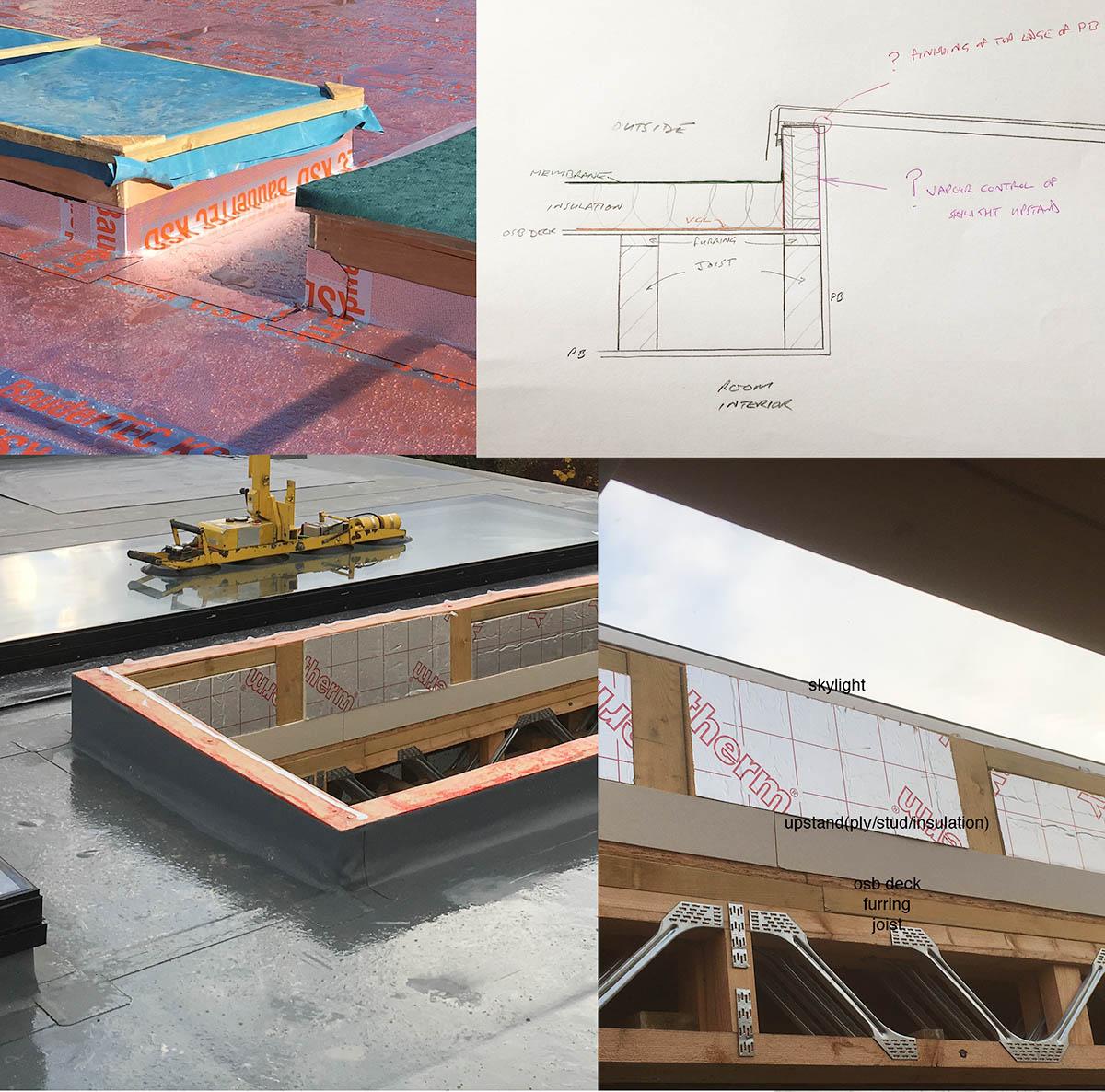
I have a warm flat roof which from outside in goes as follows; membrane insulation vcl osb deck furrings metal web joists & associated void plasterboard (& eventual skim) I created upstands for skylights after the deck went on, before vcl etc(as per every and any picture i can find on google). These are 25mm ply sided boxes on 75mm timber framework which are insulated in between. The vcl crosses the deck and climbs the external face of the ply upstand, not to the top but just enough to ensure the membrane joins it to encapsulate the insulation. The membrane does climb to the top. The width of deck underneath the upstand therefore does not have vcl and nor does the internal vertical face which will get plasterboarded. I now think I need vcl lining the skylight void before plaster boarding....but where to terminate this....as I cant seamlessly join to the deck vcl? I dont feel i've created anything unusual and yet cant find any illustration of a comprehensive vcl in this scenario. Minor additional question; at the top edge of the plasterboard which stops just shy of the skylight glass, what should be the approach to finishing this?....i'm imagining it could be the recipient of any condensation that drips off the glass?
-
i'm actually going to experiment next week with rendering a wall with Thistle Onecoat then stamping it with board. I know from prior experiments that the board can create suction and drag the wet muck off with it, and also that if too dried it won't take the stamp, so the working time window of receptive surface is quite short. I wouldn't want too much wall rendered and drying at once. It shouldn't be any great problem to do it in small sections anyway. I did one boardform wall with poured concrete. You need a product called Adowax to smear on the wood as a release agent. I just used rough sawn 4 x 1 and 6 x1 from Travis. Typically for a poured wall the concrete will be a pump mix, so not stiff, and it will get pokered a lot to remove air. I fear without these in your mould system you will get voids in the surface that will really spoil the aesthetic.
-
Plasterboarding on yer lonesome ....
mvincentd replied to ToughButterCup's topic in Plastering & Rendering
I'm currently on this task myself and have purchase a board lifter, which will get its first use tomorrow. I have relatively simple low flat ceilings but it's still brutal work. My 15mm boards are 33kg each and if I can just once lift them over my head then step onto a hop-up, use my head to hold the board against the ceiling in the correct position and tack it on....I certainly cant do it multiple times, and then turn up to do it again the next day. A deadman or two are helpful, but are also more to juggle when single-handed. The board lifter (based on an initial play) will make the task 'viable' solo..but painfully slow. I'm imagining two people working together can do 6 times the pace of a solo. I cant really grasp the idea of putting a lift on a tower and trying to operate it safely solo...like others i'm a bit concerned. -
All looking great and tantalisingly close to habitable. Ian is plastering for me in April so great to see your photos of his nice work.
-
Pleased & relieved
mvincentd replied to Moira Niedzwiecka's topic in General Self Build & DIY Discussion
Sorry to hear such sad news, especially when there is so much to be proud of, not least of which yourself. Great respect to you and indeed your husband. -
2 years ago I paid £21k for the combined excavation and muck away of 3000 tons of largely chalk. This was pretty much the price of most of the other muckaway quotes without the dig. The exceptional advantage of my chosen contractor was his yard being only 3 miles/8 minutes away versus the next closest at 20 minutes. ..... so geography will likely be a big factor in your price. Go make friends with your local farmer or anyone else with land where they could lose your muck.
-
Comical EPC thingy
mvincentd replied to Russell griffiths's topic in General Self Build & DIY Discussion
My plumber told me he knows a farmer with a biomass boiler which he runs 365 24/7 and opens the doors/windows in the summer....because govt incentives effectively pay him to do so. -
My untreated western red cedar is silvering........or at least I hope it is! I don't know how to differentiate natural silvering from fungal decay. After rain its quite grey and blotchy, and if I rub the surface with my finger it pills like wet paper and reveals the original colour beneath. Paranoia is creeping in....do I have a problem?
-
Paid £12 per panel set (fence, foot, connector) and £50 delivery, used good condition from eventscrew.com who tend to have loads available after festival season ends, don't know about right now. How much you need, where are you?
-
Best way to hang posi joists into different materials
mvincentd replied to Vijay's topic in Floor Structures
You can spec trimmable ends, and to varying amounts...i was able to take up to 100mm off each end of mine. -
Sedum will be in growing medium and the growing medium will either be in trays or it will be on a route protection membrane/barrier, and this lot will be on your waterproof membrane (of single ply/GRP/felt/rubber/whatever ). It is possible to have a waterproof membrane that incorporates its own root protection into it, but that’s not the most typical situation. It is also possible that you might choose to incorporate other layers between the growing medium and the root protection... such as water retention/ drainage mat( possibly sandwiched between the fleece). If you don’t want to just follow the rules big roof membrane co’s lay down in order to maintain their guarantees, Charles Fentiman might be a good one to consult: http://www.greenroofsubstrates.co.uk/
-
Not sure that Bauder product really helps you as it raises the panels 300 mm.... for what... so green stuff can grow under the panels where nobody can really see it anyway. Might it be better to argue the benefit of the flat roof is that it is low and makes your building less conspicuous, and panels mounted at a low angle can be virtually unseen. Why won’t Greenbelt planners like a flat roof?
-
The storm style rain we seem to get these days and will likely get even more in future, strikes me as rendering irrelevant the notion that a green roof halves run off ...... when it’s saturated it will shed water as usual so I’d gutter it as usual. ignore the tray providers opinion...ask the membrane manufacturer what’s acceptable. Well, you surely want normal+ ....I don’t see having a green surface provides any opportunity to cut corners versus a standard flat roof.
-
well, this is from IdealCombi's glass guide; "Solar reflective glass Solar reflective glass reduces the amount of thermal energy and/or light which is admitted through the unit. This type of glass is often used for large surfaces where the aim is to make full use of the sun- light while at the same time keeping out the solar heat. In other cases both the sun and the heat is kept out." It's on this basis that I specced it in some of my windows...which when I stand in front of I can appreciate a distinct difference so i'd say it works. To my recollection it added approx £300 to one of my typical 1.5 x 2.3 units(but my memory is a sieve).
-
I have 3 frr break plates where balcony steelwork adjoins the crossbar of the goalposts that contain my sliding doors. From memory they’re 12mm thick. It’s somewhat impossible to comment as to their effectiveness I think.
-
Google Farrat plate...SE should spec them anyway i’d Imagine.
-
MVHR Duct Design
mvincentd replied to Triassic's topic in Mechanical Ventilation with Heat Recovery (MVHR)
It is what it is now, but I don't think so....I have 122mm wide posijoists at 400mm centres either side of the steels and they're not aligned webs due to the house being curved. heyho! -
MVHR Duct Design
mvincentd replied to Triassic's topic in Mechanical Ventilation with Heat Recovery (MVHR)
I wouldn't disagree...it's a pain. However on a point to point system I would have had to get 12 runs of flexible ducting through steelwork, 4 times...the last of which is only a 2 metre long steel. -
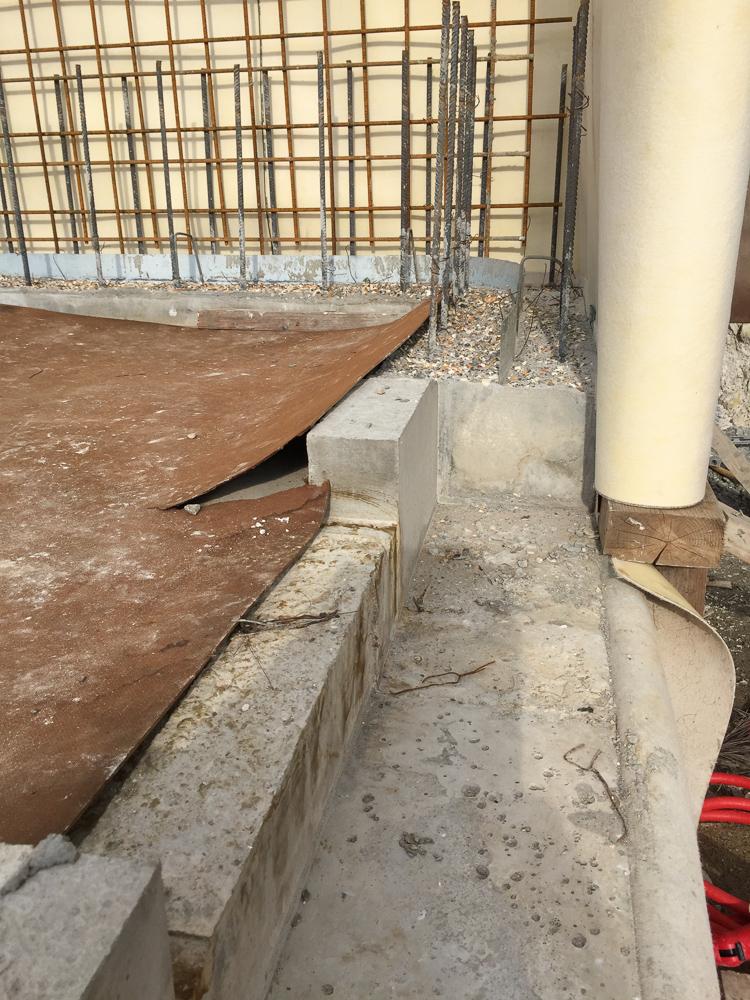
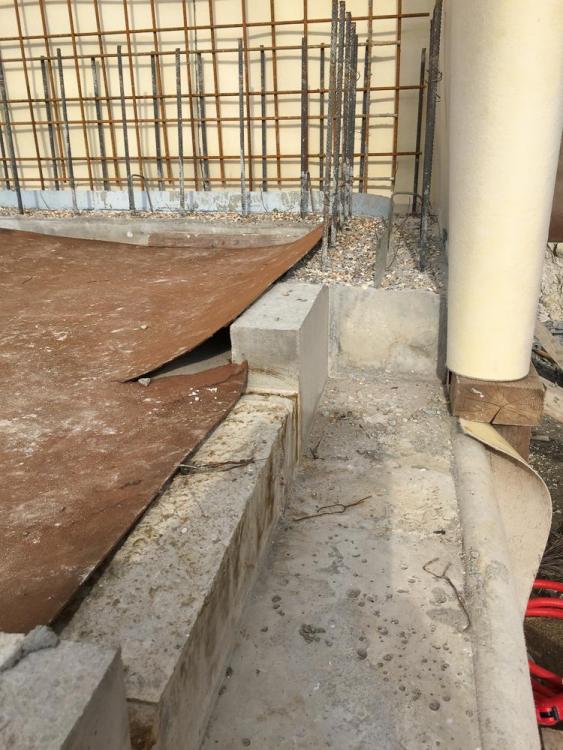
Look beyond swellable water bar and there should be something viable. Attached is a pic of my slab with rebar rising out of it ready to tie into the concrete walls. There just so happens to be an upstand in my design but thats neither here nor there for the purpose of this conversation. The top of the upstand has aggregate exposed as a result of retarder being applied to that surface at the end of the pour (to me it makes sense to do this to the area you'd pour your icf walls onto but i've not seen it mentioned much amongst 'ICFers'). Rising out of the centre of that surface is a flat metal strip, as much of which is buried in the concrete. This was placed before the slab pour along with the rebar. It's a Sika product but right now I cant find it's name. I have the Sikaswell red bars at vertical joints so maybe it's because of the pre-wetting risk that they don't use it on the longer exposed slab. While mine wasn't icf I see no reason it wouldn't work, except if the plastic icf webs might crush it.
-
You're not alone. At the end of last winter I bought algae remover and used on a large section of wall that was unpointed flint blocks, largely shaded over winter and looking green. The algae remover (from TP I think ??) wasn't sufficiently expensive for me to engage with home-brew ideas, and it worked well enough.
-
MVHR Duct Design
mvincentd replied to Triassic's topic in Mechanical Ventilation with Heat Recovery (MVHR)
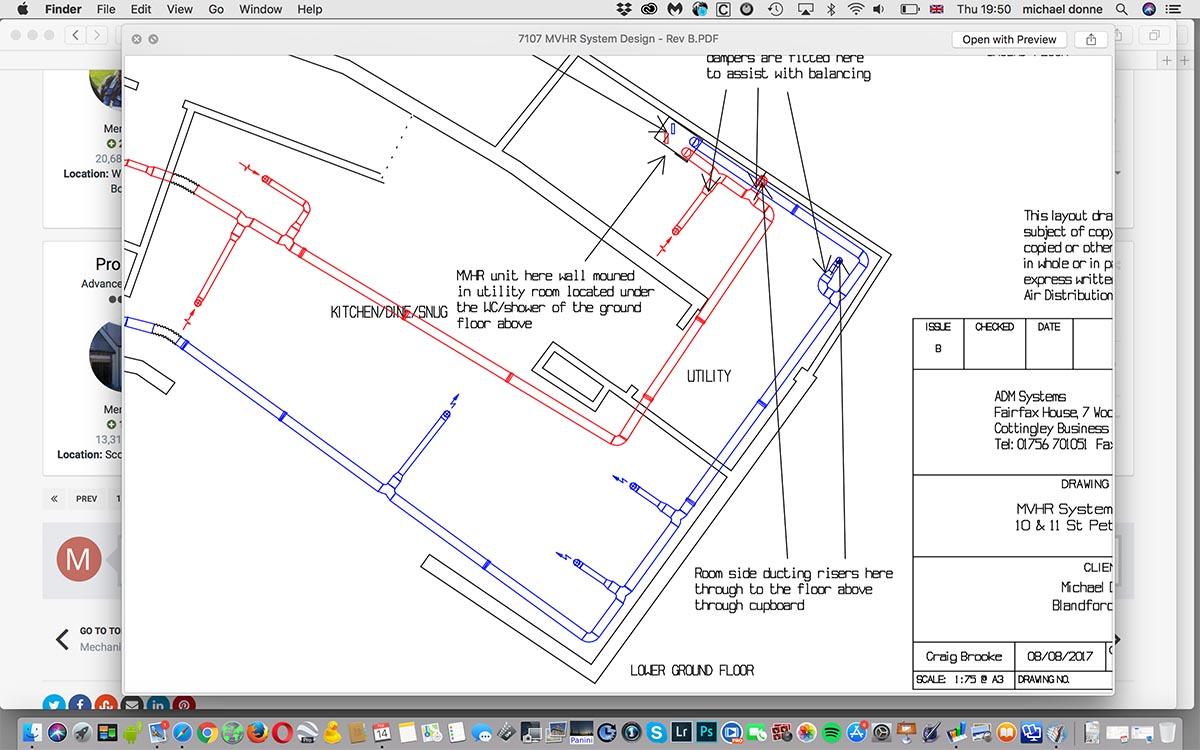
I've a kitchen/living/dining area in the 170m3 ballpark....3x 125mm inlets and 2x 125mm outlets which expand into 150mm diameter ducting back to unit. I'm on a branched system with rigid duct so not sure if this is a helpful comparison or not...see attached.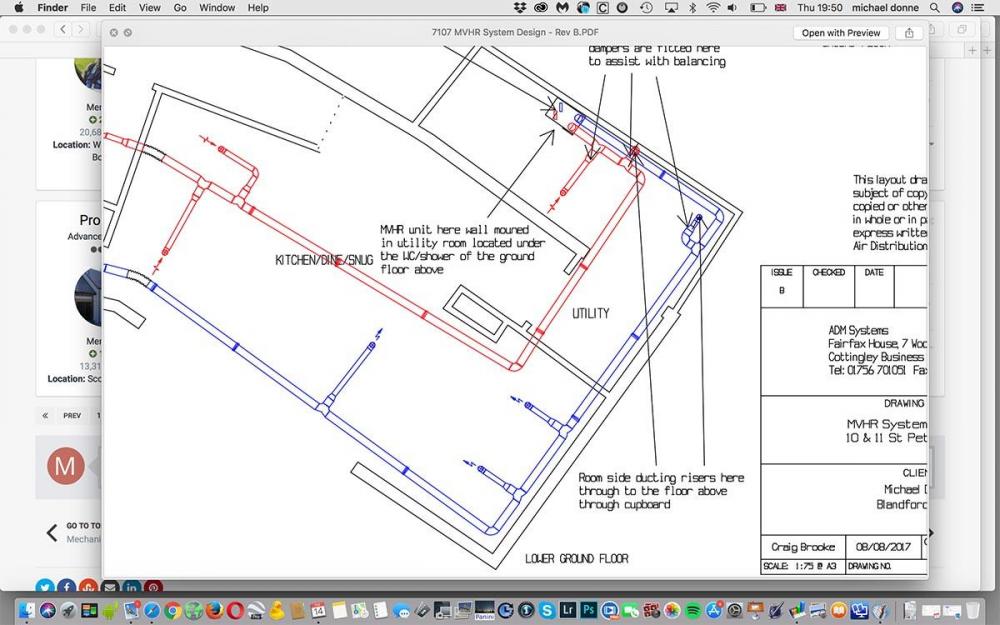
-
I doubt the chap @vivienz and I have in common had more than 4k off me for a 2 team labour, to level and blind approx 180 Sqm, and lay approx 70m of drainage inc 2 IC’s and 5cu of crates. I’m guessing at materials here, around 2k, I paid for direct. @vivienz at £11k I can see why you are questioning!
-
With me he even got me a deal on ‘surplus to requirements’ pipe and bends from a n other Groundworker so I think he’s unlikely to be trying to stiff you on materials. Admittedly he’s not ‘cheap’ but he’s effective. That £415 for 3 team IS cheap, I’d expect £515 from him. I’d honestly be more inclined to cross check his time estimate than his materials. You mentioned in an earlier thread he was pushing to use Hepworth stuff......this might just be his perception that you only want the best rather than his insistence...he just automatically got me polypipe and I didn’t think to question it. At this stage he knows your site and job so should be able to identify to you where the problem/expensive/slow bits are better than anyone....push him for a comprehensive walk-through.
-
I have circa 155sqm of rc walls containing 47.5cu, and 212sqm of slab containing 63.5cu Sika waterproof concrete. All shuttering was bespoke timber and fair faced ply. Sikaproof-A membrane was placed in the shuttering and is therefore bonded to the rc (external face) by the pour. There's near 1200sqm of A393 mesh and 170sqm of A142 in that lot. 172sqm of slab was powerfloated, concrete was pumped 35 metres, 8 separate days of 40 ton crane hire. Contractor was a respected specialist. £117k Independent quotes to waterproof the structure using external membranes and internal cavity drains (so replacing Sikaproof-A and Sika waterproof additive) were circa £27k...or if I chose to build icf they went up by £15k, for little better reason than them not wanting to have to waterproof subterranean icf. Are you considering a concrete 'top' because the wall/top junction is underground? If you have such a detail then ensure it is impeccably detailed and stick to a single manufacturer system of waterproofing solution...have them detail it. This will force you into a very early commitment which you might not fancy, ...but suck it up, if you value peace of mind.
-
If you want your sarnafil guarantee to hold up you’d be best to compose your green build up in accordance with Sika’s notion of how such things should be done. Also be aware sarnafil needs a root protection layer and i’d Personally suggest you use the sarnafil product (again for guarantee reasons). Look at the Bauder system equivalent to sarnafil......I think cheaper and better, I have both. The Bauder has a compatible thin build sedum system that’s real easy and light.