Jump to content

Nickfromwales

Members
  • Posts

    30977
  • Joined

  • Last visited

  • Days Won

    327

Everything posted by Nickfromwales

  1. It was all going so well, then I spotted the obvious building control infringement which could jeopardise the whole project............... Yup, that Justin Bieber poster . I'm trying to bring out new legislation banning such items. "Is it too late to say sorry?", yes Justin, it is
  2. I wish the floor I was tiling today was as flat as that ! Looks very good considering they can't really see how level it is until it has a shine to it. Hows it feel underfoot?
  3. That's 100% a common method of fixing down pans, yesteryear. I've seen hundreds like that. One of the main reasons was the porcelain / China was ever cast very well and changed shape a fair bit when fired. That meant that when you sat the pan on the floor it was either not level or rocked on the high points. The solution was to make a tower out of compo and twist the pan down into it before it actually made contact with the floor, and leave it to set. You can't argue that it worked a treat, and would have still been there in 20 years time. That colour may put you of mushy peas for life
  4. Never use it where it's on show basically. It's a foundation, so you'll still need a coloured silicone / other to finish off. The good thing about that discipline is that the bead do silicone can easily be removed and redone when it gets tatty.
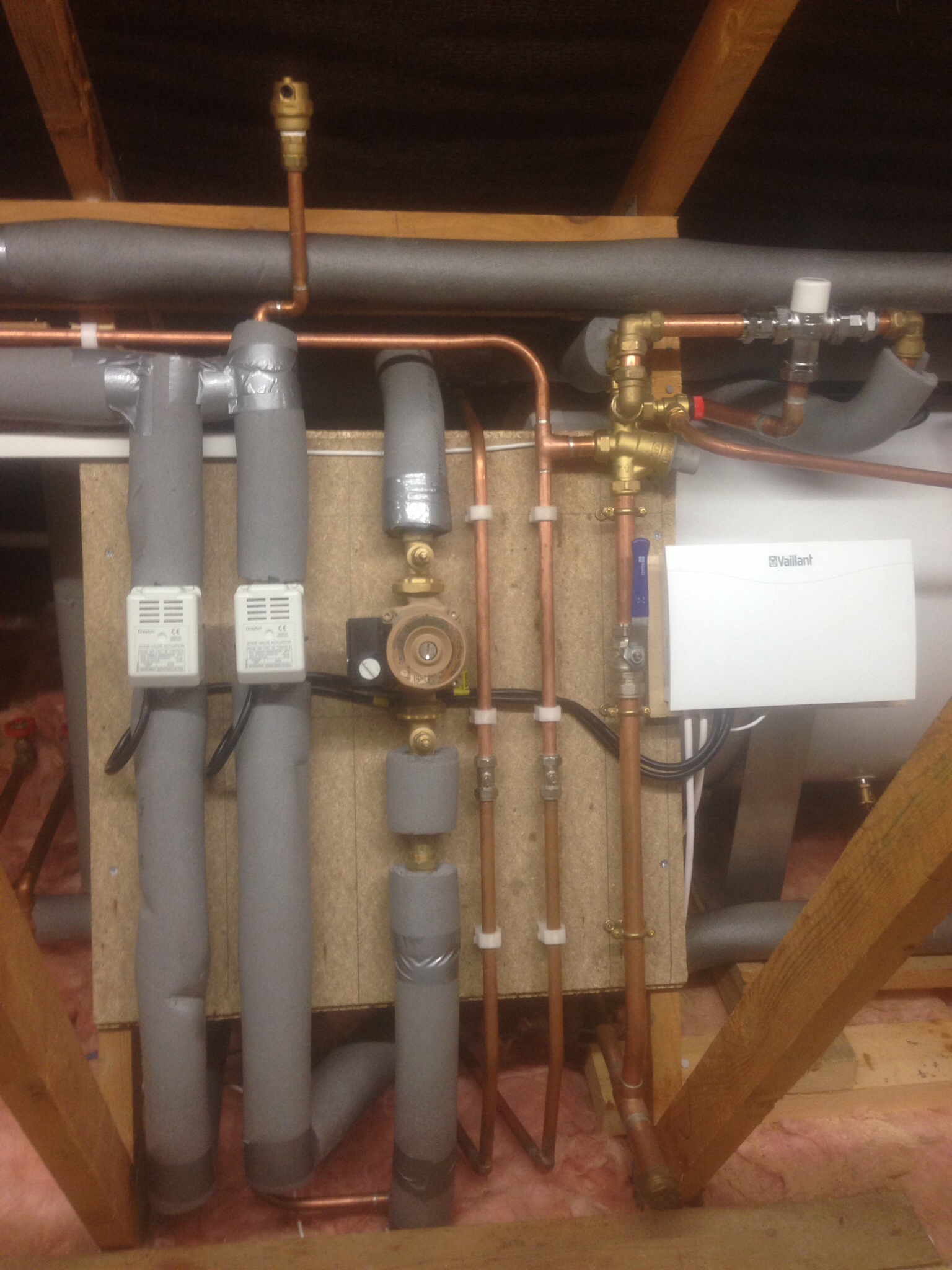
  5. What peter said. Ok...... A TS is basically a huge round radiator, full of primary central heating water, and stores zero dhw. Dhw is produced instantaneously via a coil which sits at the top of the TS which is simply heated by the surrounding water. The heated primary water can be drawn off via dedicated tappings, the same way heated primary water enters the TS from the boiler, and your Ufh would simply be drawn from those points. There is no 'pressure' other than the static primary pressure which would show on the gauge of your system boiler, which is simply showing that the system is sealed and full of water, aka pressurised. There is no force available to 'push' water to the manifolds, that circulation would be provided solely by the manifold pumps. For eg, if you connected the manifold flow and return to the TS, then unless it was by convection, no water would flow through the pipes as the body of water would be unified and therefore be at the same potential. Even though the boiler pump is pushing water to the TS, it's also pulling back at almost the same potential so that creates a circuit of flow to and from the TS to the boiler, only. To create external ( beyond the TS ) circulation you need to fit a pump, hence the ones on the manifold. @Temp spoke in detail ( on EB ) about this need for a second pump still remaining with certain manifolds / manufacturers, but tbh I still am unsure as to why the manifold pump wouldn't draw through regardless. Maybe Temp can reiterate that so we can identify the type of manifold which may need the secondary circulation pump. An UVC is the opposite of a TS. It has a coil, fed by the heat source eg boiler, which heats the tank full of clean drinking quality 'potable' water, the water that actually comes out of the tap. UVC's don't have additional tappings for removing heat as the coil which heats it simply couldn't deal with the additional demand, eg a bath being drawn plus all the Ufh calling for hot water to heat the house from cold etc. The TS gets heated directly via the open body of water so is far far better at getting the heat from the boiler into the primary water, plus it circulates it too, spreading the heat out evenly. The flow from the boiler also hits the top of the TS, which is where the dhw coil sits, so in essence provides a kind of hot water priority. This is why your second plumber is one is not consider using. He should have clearly stated all this to you as a reason for his suggestion, but I doubt if he knows what a TS is, let alone how it should be utilised. My bottom dollar is on him failing to explain that he intended to run your Ufh directly from the boiler, using 2-port zone valves, and a third zone valve for the UVC, as opposed to leaving you think that the Ufh could be fed from the UVC. If you were having Pv I'd have probably said upsize to maybe 400ltrs, but if you feed the TS directly with that size boiler you'll get instant, constant ( as in 24/7 constant running dhw ) from the 300. As it'll never be used as a heat battery from a Pv POV, pointless in upsizing and increasing the losses, BUT, if you do upsize it, drumroll please, you'll be able to run at a lower target temp and reduce the losses a fair bit so if overheating would ever be a problem that's one way to mitigate it ( say upsizing to 500L and running at 55oC, or 65oC at 400L ), Setting up for a lower flow temperature can allow you to ensure you hit the best condensing flow return temps and maximise boiler efficiency too, so this is a multi-faceted question which needs a bit more thought / input . With a fully modulating boiler you could probably get away with running the Ufh directly from the boiler and fitting an UVC for dhw, as long as the minimum heat load for the house ( when the house is up to temperature and the boiler is only offsetting the heat losses from the house itself ) doesn't fall below the lowest modulating point. The only problem would be sizing the UVC exactly to your anticipated consumption. This situation would see the boiler running all sorts of different flow temps though, and would reduce it's efficiency quite a bit, so my recommendation would be.... 400L TS fed from a 32kw boiler. Ufh fed from the TS. Have the 2 circuits of Ufh flow and return pipework split immediately after the TS so the ground floor pipework can be isolated from the upstairs via dedicated two 2-port valves. These are required more to stave off convection circulation ( a killer with TS's ) than to offer control for the heating. You will also require an additional 2-port ZV between the boiler and the TS (i) to have control of the TS temp and (ii) to stop backflow of heat from the TS to the boiler. Set the cylinder stat to control that ZV and that ZV will then fire the boiler. That can be set to get the boiler to fire for bursts at a temp suited to get the best efficiency, rather than constantly idling to maintain temp. Written on the move so hopefully makes some sense.
  6. Quick question, do you have a lip with those flush ones or is the tile cut edge on display with only the grouting / sealing for a finish?
  7. I've not yet seen the flush ones tbh, and I like the look, a LOT. I'd say take the tiles off in a heartbeat, but the only problem will be if you've stuck them to plasterboard the tiles will take it with them and open a hell of a can of worms up. Whats the score with the tiles? PB / other? Type of adhesive ?
  8. It doesn't look like you'll get much filler material into the crack tbh, so I'd say plate as well. Looks like a major stress point too.
  9. Don't tell me you finished the Capri before the bathroom ?!?
  10. Excellent news. Some of the bloggers had the links / mention of this place removed so glad a few got left behind. If your in contact with any ex members please spread the word.
  11. Hello, again ! miss us ?
  12. The comp ( his first year there ) are very slow responding to why he came home with bruises up his arm, but when his mobile phone was out in classroom time they were on it like a tramp on a kebab. Punished him, confiscated the phone, detention the full monty. Hes got ADHD and him having a phone at the end of each day is critical. They won't take it off him again after my 2 cents went in. Waiting on a phone call today from the head of year, but if I dont get it today I'm going up in the morning to kick some arses. That'll be the 5 time in a year where I've asked for a witnessed, minutes drawn meeting with the heads ( school and year ) for them to generate an official response. Give them enough rope etc.
  13. I took apart the one in my boys primary school. As much use as a kickstart on a helicopter. Wait for ages for forms, then wonder why there is no response. Then find out she hasn't sent them.......again. Just given the head of the comp a deadline to respond to bullying. I knew they'd done nothing when he started stuttering. Ofsted next stop. ?
  14. My makita collated driver is a great tool, but I've seen better ones, such as Hilti. Very little in the way of moving parts, so less to go wrong. If you ever want to get rid of the BC let me know. . I use the router at the mo, but it's a pita to set up, and it's a heavy bugger too.
  15. Ah, maintenance. Im one of those stubborn ( or maybe just too busy ) people who drive the tool until it decides that's the end of the road. Most if my makita stuff isn't worth the effort or down time. Impact drivers can be bought new ( naked ) for change of £60, 2-speed drills for change of £40, and so on. The only place I draw the line is with things like my Dewalt DWS 780 XPS chopsaw. That's going in next week for tires, oil, filter, and an a full MOT. Nothing worse than wondering if that savage 12" blade is going to come loose and slice you clean in half.
  16. Cheers for the thought, but just another thing to charge, have a lead for etc, when I already own a phone . Saw one on the bay for around £60, and another seller selling the same thing for £120. Gave up at that point and I'll just keep my eyes and ears open until a cheap 'I' flavoured one pops up until then I'll use my current inspection device.
  17. Anyone know of a cheap one for Apple / iPhone / ipad?
  18. Ian. I just wrote something heart felt, then the auto save on this forum decided to erase it for me. Ill retype in the morning so please don't order any 'hits' until then, ok?
  19. I'd have knocked his fackin teeth out. What a complete prick.
  20. If it's an outside wall, definitely a good opportunity to add some insulated plasterboards, but you may have a new wall / old wall look then. If your not re-plastering the whole room then prob better to stick with the old school methods, ( for one wall ).
  21. I think I'd be equally concerned about the condition of the battens and felt tbh. You may be better taking the lot off, buying some reclaimed to make up the quantity, and doing the felt and battens first as last. If your rendering to them then it will be almost impossible to do the roof later down the line. It will also be a near impossible task to carry out remedial work to the bottom courses of slates as they're nailed then overlaid 3-fold. Pointless looking at remedial work for the edges and bottom when the whole thing really needs assessing. Re-laying the roof will allow the battens to be set out accordingly for the overhangs, bottom and sides. You can use 'dry verge' and 'dry ridge' if you want, which alleviates cementing anywhere, but isn't as nice looking a job IMO unless you choose a nice colour for all the plastics. Im not sure you'll have many other options here tbh, and the roof is number one on the 'get right' list.
  22. 10mm Pipe For Hot Water Taps? (Content copied from EB) Started by Eagerbeaver , 24 Jan 2016 07:56 AM 10 replies to this topic Eagerbeaver Posted 24 January 2016 - 07:56 AM All the water pipe installs I've seen use 15mm pipe but the flow capacity of 15mm is far more than is needed for most hand basins and sinks. The down side of using 15mm for hot water is that you end up with a lot more cold water to shift in the pipe before it runs hot. Is there any problem with using 10mm for hand basins and sinks for the hot water? tonyshouse Posted 24 January 2016 - 09:13 AM For very long runs pressure drop could result in too slow flow, avoiding using elbows will help Would be fine with combi or pressurised system or three storey situation. Nickfromwales Posted 24 January 2016 - 10:21 AM What lengths are the runs? Also, are we talking about a radial plumbing setup ( critical if considering using 10mm runs ). 10mm is perfect for wash hand basins, but kitchen and utility would probably be better with 15mm for short, higher volume draw offs where 10mm may struggle. If there's not a good / very good cold mains pressure / flow rate at the incoming supply then excessively long runs may suffer, Regards, Nick ProDave Posted 24 January 2016 - 10:38 AM I'm considering this. In my new house, the kitchen will have the longest run, about 6 metres. I'm planning to try a 10mm pipe for the kitchen hot water tap to minimise the volume of cold that has to be drawn off before the hot arrives. We have good water pressure and food flow at the source so I think it's worth a try. jsharris Posted 24 January 2016 - 10:38 AM It's commonplace on the continent to see narrow pipe runs to basin taps, not sure if it's usually 10mm or 12mm but it looks a lot smaller than our normal pipe of 15mm. With a decent head 10mm pipe will flow a fair bit of water, more than is usually needed for wash basins or even sink taps, dishwashers etc. For guidance, a 10m long length of 10mm OD copper pipe causes a pressure drop of about 1.7 bar at a flow rate of 10 litres/minute. Sink taps rarely flow at more than 6 litres/minute, 10 litres /minute is about an average mains pressure shower flow rate. What this means is that if you have a head at the start of the pipe of at least 1.7 bar then you can get a flow rate of 10 litres/minute from the open end of a 10 metre length of 10mm OD copper pipe. We have an available head of around 4.5 bar, so I could have used 10mm pipe pretty much everywhere and still had good enough flow rates. The downsides with using small bore pipe is that you pretty much have to use a radial plumbing arrangement, with the pipe from each outlet fed back to a common manifold, you can't really run two or more outlets from a single pipe, as they will interfere with each other to a greater extent than with larger bore pipe with a lower flow resistance. Another downside is that if you try and flow 10 litres/minute through a 10mm OD pipe then it will make a noise, especially if you have a fairly high head of pressure at the manifold. The noise is acceptable at up to around 6 litres/minute, but any more and you need to increase the pipe diameter to quieten it down. For comparison, the pressure drop across 10m of 15mm OD copper pipe is a great deal lower, at around 0.2 bar for 10 litres/minute flow rate. Plastic pipe flow rates are lower, or the pressure drop higher for a given flow rate, because they usually have a smaller bore for the same OD as copper pipes. cjard Posted 24 January 2016 - 10:46 AM I looked a using a range of different pipe sizes but in the end just used 15 mm throughout for the following reasons I'm using plastic, and the bore is a little smaller than copper 15ml so there's a little less volume of wasted water A metre of 15mm plastic holds about 70ml more water than a metre of 10mm, given my longest pipe run from manifold to sink is 5 metres, that's less than a teacup. The longest shower run is 10m but, for the duration a shower runs, the excess is a drop in the ocean Plastic doesn't suck the heat out of the water the same The manifolds are 15mm, and I'd have to adapt down to 10. Plastic fittings at pretty bulky and ugly at the best of times and it adds cost and points of failure Flow capacity isn't the be all and end all. If you rush water through a pipe you can create areas of low pressure where it will boil temporarily and make a horrendous noise. A bigger pipe flows more slowly isn't as prone to this cavitation cjard Posted 24 January 2016 - 10:53 AM ProDave, on 24 January 2016 - 10:38 AM, said: I'm considering this. In my new house, the kitchen will have the longest run, about 6 metres. I'm planning to try a 10mm pipe for the kitchen hot water tap to minimise the volume of cold that has to be drawn off before the hot arrives. We have good water pressure and food flow at the source so I think it's worth a try. Consider an instantaneous heater that will use a little electricity to heat the initial water and then dial back on its output as he hotter water starts arriving. Saves water, maybe saves the planet if you have renewable electricity. Such instant heaters can be good for occasional use households as it beats having a large standing volume of hot water losing heat constantly jsharr Posted 24 January 2016 - 10:57 AM cjard, on 24 January 2016 - 10:46 AM, said: I looked a using a range of different pipe sizes but in the end just used 15 mm throughout for the following reasons I'm using plastic, and the bore is a little smaller than copper 15ml so there's a little less volume of wasted water A metre of 15mm plastic holds about 70ml more water than a metre of 10mm, given my longest pipe run from manifold to sink is 5 metres, that's less than a teacup. The longest shower run is 10m but, for the duration a shower runs, the excess is a drop in the ocean Plastic doesn't suck the heat out of the water the same The manifolds are 15mm, and I'd have to adapt down to 10. Plastic fittings at pretty bulky and ugly at the best of times and it adds cost and points of failure Flow capacity isn't the be all and end all. If you rush water through a pipe you can create areas of low pressure where it will boil temporarily and make a horrendous noise. A bigger pipe flows more slowly isn't as prone to this cavitation I did the same, used 15mm plastic everywhere, for much the same reasons. I did initially try running 10mm copper, but it was far too difficult for me to pull through posijoists on my own and I scrapped two lengths and then gave up and switched to 15mm plastic. Plastic is a hell of a lot cheaper and one roll did the whole house. I'd definitely NOT use 10mm plastic, as the bore is a lot smaller than 10mm copper, and restricted further by the inserts. Nickfromwales Posted 24 January 2016 - 01:10 PM I've ( on a previous job ) used 10mm Hepworth with the slimline stainless steel inserts and the flow rates were more than adequate. Longest run was prob about 13-14m. I used 10mm to each WC purposely to reduce water velocity and stop the WC from over monopolising on the available water pressure ( quite a significant short turn effect on showering when not reinforced with an accumulator ) which gave the desired results, and also reduced the noise of the cisterns filling too. The basin hot and colds were all in 10mm and performed well. Manifold 15mm outlet with a 15x10mm reducer. Hepworth 10mm direct to outlet with zero joints. 10mm exposed behind basin ( out of sight ) terminating into fitting reducers ( female each side ) and then a piece of 15mm copper made off to a male 15mm x 1/2" fitting which the tap connector fits into. Everything else in 15mm, for simplicity ( one size fits all ) more than anything Regards, Nick. ProDave Posted 24 January 2016 - 05:49 PM Sounds like in my case 10mm to the kitchen sink will be okay. It's the only pipe run in this direction and the longest run from the hw tank. All the rest (bathrooms and utility) are the opposite direction and will be more conventional. the bulk of the run will run parallel to one of the posi joists so I will try and run it in a coil of 10mm copper. VIPMan Posted 24 January 2016 - 06:20 PM I've used a 15mm manifold system with 10mm copper to basins. 15mm plastic to bath and shower. Maximum runs around 17metre. Still a work in progress but flows seem reasonable with around 4.5 bar mains pressure.
      • 2
      • Like
  23. ebuild.co.uk → Building Trades → Heating Systems → Heating Systems: Other ebuild is sad to announce its closure - it has become too time and resource intensive to develop, manage and maintain. However, ebuild will remain on-line in archive mode (ie no posting facilties) for several weeks so that users can use it as an information resource. 1Follow this topic Hot Water System Idea Started by vijay , 28 Jan 2016 05:56 PM PREV Page 2 of 2 1 2 Register (at top of page) to post reply 28 replies to this topic #21stones Advanced Member Member Blogger 1,012 posts LocationOrkney Posted 29 January 2016 - 01:13 PM I've decided to wire and plumb for an inline heater so it can be easily retrofitted, as a just in case. Like This Report post to moderator (eg spam) #22gravelld Regular Member Members 655 posts Posted 29 January 2016 - 01:46 PM AliG, on 29 January 2016 - 12:31 PM, said: My in-laws have in line electric water heaters and they work fantastically well, but depending on your hot water usage the cost to heat it would probably be 3x higher using electricity after taking into account the lower amount of pipe losses. If you are putting in a boiler anyway I don't really see the benefit. You might consider a circulating hot water loop depending on the length of your hot water pipe runs. You need to consider the standing loss too, which is by far the bigger loss (assuming water is being stored, which I think it is in this case). So to heat the hot water tank for our 2 yo's evening bath takes 30mins at the moment. This is done immediately prior to the bath so minimises standing loss. So this is best case: 30mins * 3kW immersion = 1.5kWh But it takes two or three minutes to fill the bath (actually I haven't timed it, so that might be inaccurate. It's only to above knee level, sitting down): 3mins * 9kW = 0.45kWh Back of a fag packet... You'd also hope that 9kW would modulate down with PV input into the stored water. And in less ideal situations than on-demand immersion boosting, you'll have a lot more standing loss. Edited by gravelld, 29 January 2016 - 01:48 PM. Like This Report post to moderator (eg spam) #23jsharris Please ignore all posts by me, some are erroneous Member Blogger 11,461 posts LocationWiltshire/Dorset border Posted 29 January 2016 - 03:24 PM Yes, standing heat losses, particularly with a recirculating hot water system, can often be nearly as great as the actual hot water usage. Although instant heaters use full price electricity, there is a substantial saving in energy because they are almost loss free. As above, if combined with low temperature pre-heat from an ASHP or similar, and, perhaps, a phase change heat store if you have PV, then you can reduce the energy used by the instant heaters a great deal. Like This Report post to moderator (eg spam) #24gravelld Regular Member Members 655 posts Posted 29 January 2016 - 04:18 PM Why PCM only if you have PV? Could be used with other inputs, right? Like This Report post to moderator (eg spam) #25jsharris Please ignore all posts by me, some are erroneous Member Blogger 11,461 posts LocationWiltshire/Dorset border Posted 29 January 2016 - 04:34 PM Yes, sorry, any electrical input could be used at the moment, and I would guess that the ability to use a hot water input may well be around before too long. Like This Report post to moderator (eg spam) #26gravelld Regular Member Members 655 posts Posted 29 January 2016 - 04:38 PM I noticed Sunamp aren't the only game in town. Home Building and Renovation had a hot water feature two episodes back (only just catching up). Frustratingly, other than including a picture of a PCM store from a manufacturer I forget the name of, PCM isn't mentioned in the article. Instead, the article comes to the surprisingly deterministic conclusion that "you should buy a thermal store"! Like This Report post to moderator (eg spam) #27jsharris Please ignore all posts by me, some are erroneous Member Blogger 11,461 posts LocationWiltshire/Dorset border Posted 29 January 2016 - 04:51 PM It doesn't surprise me that others are around. I remember discussing PCM heat storage several years ago on the other place, and I think someone there mentioned a paraffin wax thermal store that was either in development or perhaps just a prototype. Like This Report post to moderator (eg spam) #28Alphonsox Advanced Member Members 1,495 posts LocationCounty Down, NI and Forest of Dean, England Posted 29 January 2016 - 05:03 PM gravelld, on 29 January 2016 - 04:38 PM, said: I noticed Sunamp aren't the only game in town. Home Building and Renovation had a hot water feature two episodes back (only just catching up). Frustratingly, other than including a picture of a PCM store from a manufacturer I forget the name Begetube - based on hydrate salt (sodium acetate trihydrate) apparently. I think this is the same stuff they use in hand-warmer pads Edited by Alphonsox, 29 January 2016 - 05:16 PM. Like This Report post to moderator (eg spam) #29jsharris Please ignore all posts by me, some are erroneous Member Blogger 11,461 posts LocationWiltshire/Dorset border Posted 29 January 2016 - 05:27 PM Alphonsox, on 29 January 2016 - 05:03 PM, said: Begetube - based on hydrate salt (sodium acetate trihydrate) apparently. I think this is the same stuff they use in hand-warmer pads Basically the same stuff that's in the Sunamp modules, too. I remember looking at how to use Sodium Acetate practically when we were discussing PCMs on the other place, and thinking that the key was how to trigger nucleation and how to "untrigger" it. Like This Report post to moderator (eg spam) PREV Page 2 of 2 1 2 Back to Heating Systems: Other
×
×
  • Create New...